Mid-Century Modern Living Room Design Ideas: 12 Real Examples (2026 Guide)
Walnut, tapered legs and mustard accents — the look that defined 1950s America and never went out of style. We unpack what makes a living room feel truly mid-century, then show 12 photorealistic examples you can replicate.
- 12
- Real examples
- ~30s
- AI render time
- 4 free
- Credits, no card
What is Mid-Century Modern Living Room Design?
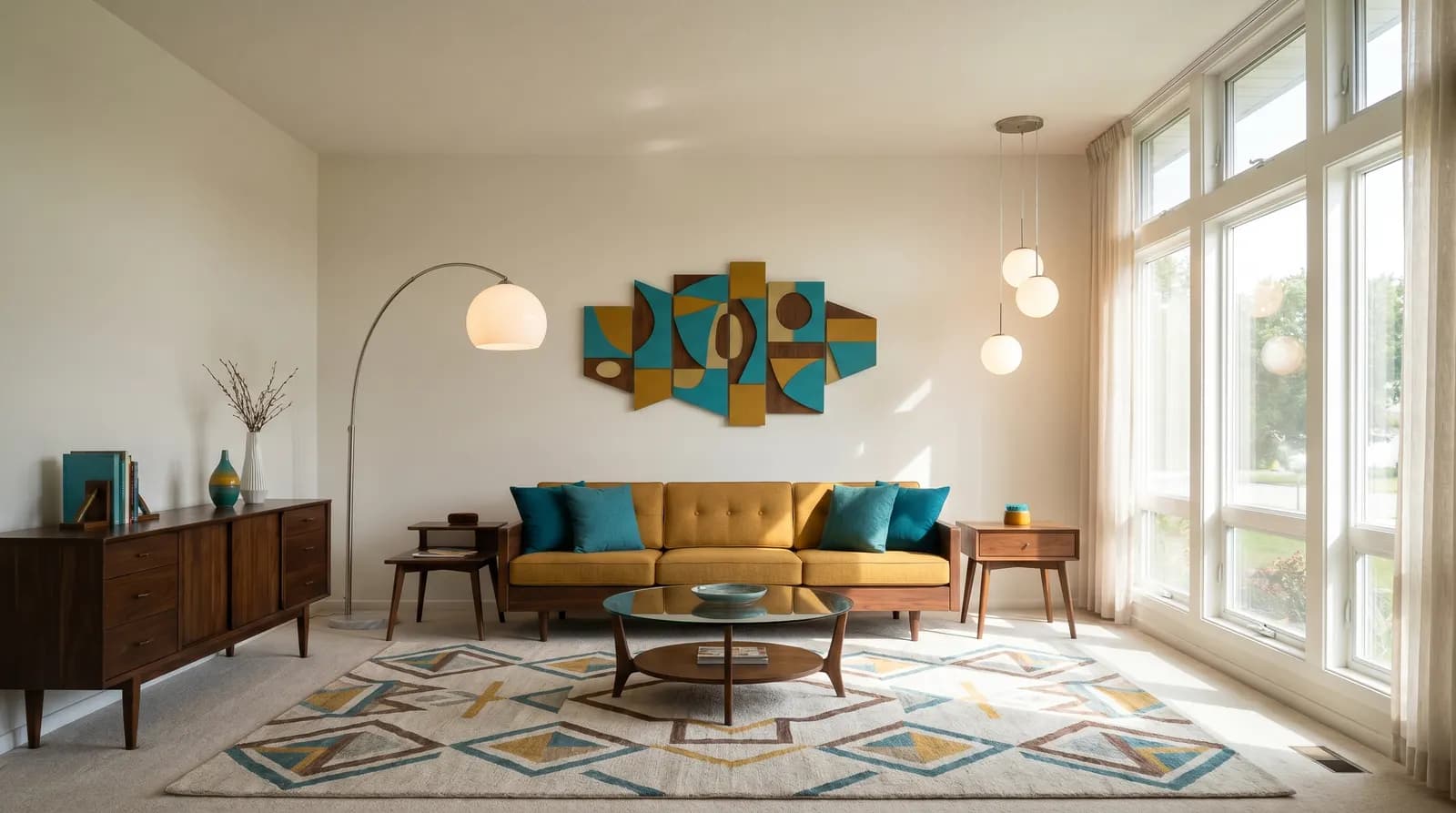
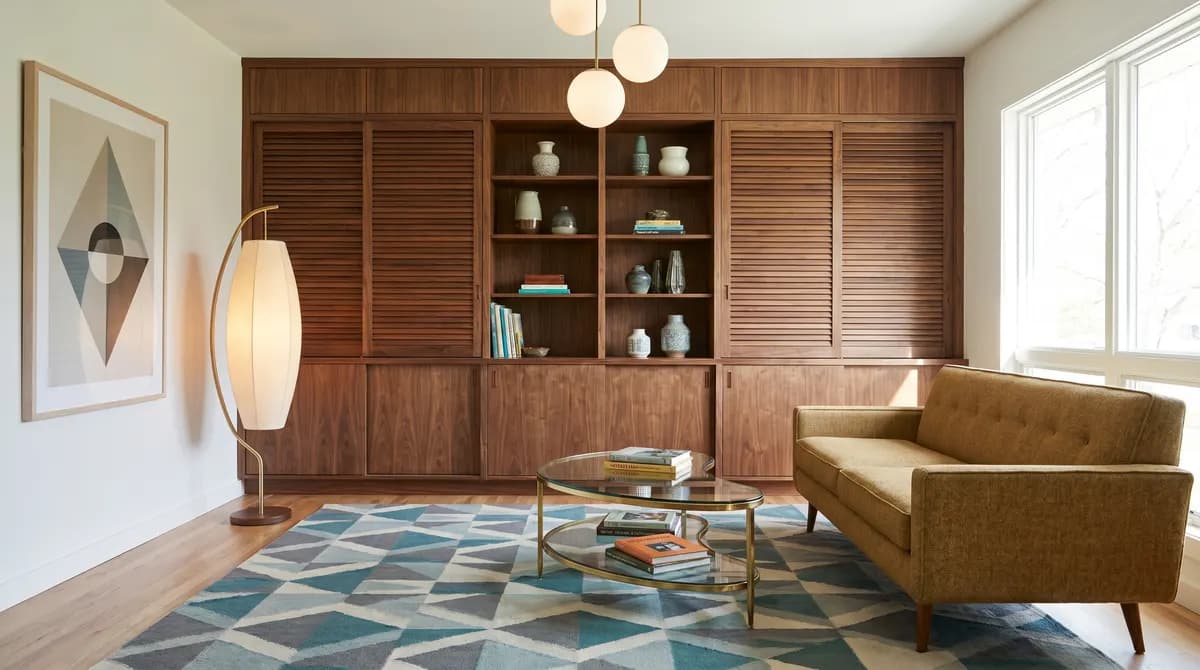
Mid-century modern is the design language that defined post-war American interiors between 1945 and 1965, shaped by European Bauhaus refugees and California optimism. In the living room, it shows up as low-slung walnut furniture on tapered legs, an honest expression of materials, large geometric forms and a confident use of saturated accent colours. Nothing is decorative for its own sake — every leg, joint and finish is visible and intentional.
Three principles run through every authentic mid-century modern living room. First, organic-meets-geometric: rounded walnut credenzas sit beside rectilinear sofas with steel-rod legs. Second, honest materials: real walnut, teak or rosewood with the grain on display; no faux finishes, no fussy carving. Third, one or two saturated accents — mustard, burnt orange, olive or teal — used confidently against a calm cream or off-white envelope.
In 2026 the look has had a sustained 15-year revival, fuelled by Mad Men, the resale market for vintage Eames and the rise of brands like Article and West Elm. The current iteration is slightly more restrained than the 1950s original — less starburst clock, more single walnut credenza — and pairs naturally with Japandi and Scandinavian. It is the canonical starting point for anyone who wants a living room that reads as designed without committing to either traditional or full minimalism.
12 Real Mid-Century Modern Living Room Examples
Each example below is a complete look — not a mood board. Click any image to see it full-size, then hit the generate button to try the same combination on your own room photo.
 1Example
 2Example
 3Example
 4Example
 5Example
 6Example
 7Example
 8Example
 9Example
 10Example
 11Example
 12Example
Key Design Elements
Colors
- Warm cream and oat white walls
- Mustard yellow accent
- Burnt orange or rust
- Olive or forest green
- Walnut and teak wood tones
Materials
- Walnut — the dominant wood
- Teak and rosewood for vintage pieces
- Velvet, boucle and tweed upholstery
- Travertine, marble or terrazzo on coffee tables
- Polished or aged brass on hardware and lighting
Furniture
- Low tufted sofa on tapered wooden legs
- Eames lounge chair with ottoman in walnut and leather
- Long walnut credenza with sliding doors
- Round travertine or walnut coffee table
- Floating walnut wall unit with open shelves
Lighting
- Arc floor lamp with brass base and marble foot
- Sputnik chandelier with brass spokes
- Globe pendant lights in glass or paper
- Tripod floor lamp with linen shade
- Small table lamps with ceramic mid-century bases
Textiles
- Geometric area rug in cream and rust
- Velvet or boucle throw pillows in saturated tones
- Wool or mohair throw over the sofa arm
- Linen or wool curtains in cream or olive
- Patterned cushions with abstract or atomic motifs
Mid-Century Modern Living Room Color Palette
Six pigments do most of the work — start here, then add one accent of your own.
The base wall colour. Warmer than pure white, it lets walnut look honey-coloured and mustard upholstery sing rather than scream.
The hero accent — usually the sofa or a single armchair. Saturated, slightly golden, distinctly mid-century rather than highlighter yellow.
Secondary accent — a velvet pillow, ceramic vase or single armchair. The rust-toned cousin of mustard; use one or the other as dominant, not both.
Optional third accent — a single chair, curtain, or ceramic. The grown-up alternative to the brighter mustard moments.
The dominant wood tone for sofa legs, credenza, coffee table and shelves. Repeat the same walnut finish across every wood surface.
Hardware, sputnik chandelier spokes, table lamp bases. Used sparingly — three to five brass moments in the whole room.
Must-Have Furniture & Fixtures
If you only buy these seven, you will read as authentically mid-century modern.
Low tufted sofa on tapered legs
Three-seat sofa, 200-220 cm long, 75-80 cm high, in mustard velvet or olive boucle. Tapered walnut legs splayed slightly outward. No chunky modern silhouettes.
Eames lounge chair + ottoman
The icon. Original Herman Miller if budget allows, otherwise a high-quality reproduction in walnut shells and cognac leather. Skip cheap pleather copies — they age badly.
Long walnut credenza
180-220 cm wide, on tapered or hairpin legs, with sliding doors and brass spindle pulls. Sits under the TV or against the longest wall as the main storage piece.
Round coffee table
90-110 cm diameter, in travertine, walnut burl or solid walnut. Three-leg base in walnut or brass. The single most photographed object in any mid-century room.
Arc floor lamp
Brass arm, marble or travertine base, white spun-aluminium shade. Curves over the sofa to provide reading light without a side table.
Sputnik or globe chandelier
Brass spokes with bulb-end finishes, or a cluster of glass globes. Hung over the coffee table or in the entry, the room's atomic-age moment.
Geometric area rug
A 230 x 320 cm rug in cream with rust, olive and walnut geometric pattern, or a flat-weave wool in a single muted tone. Anchors the seating zone.
Common Mistakes to Avoid
Buying too many vintage pieces at once — five 1950s pieces in one room reads as a museum, not a home. Mix one or two real vintage items with high-quality contemporary mid-century reproductions.
Using every accent colour at once — mustard sofa, orange chair, teal pillow, olive curtain is too much. Pick one dominant accent and one supporting; everything else stays neutral.
Pairing mid-century with the wrong rug — Persian and shag rugs both fight the silhouette. Stick to geometric flat-weaves, hand-knotted wool in muted tones or a single graphic pattern.
Choosing the wrong wood tones — orange-stained pine or red mahogany break the spell. Walnut and teak are the only safe defaults; ash and oak need very careful styling.
Overcrowding the room — mid-century is a low, horizontal style; it needs negative space to breathe. If you cannot walk easily around the coffee table, you have too much furniture.
Try Mid-Century Modern Living Room in Your Own Room
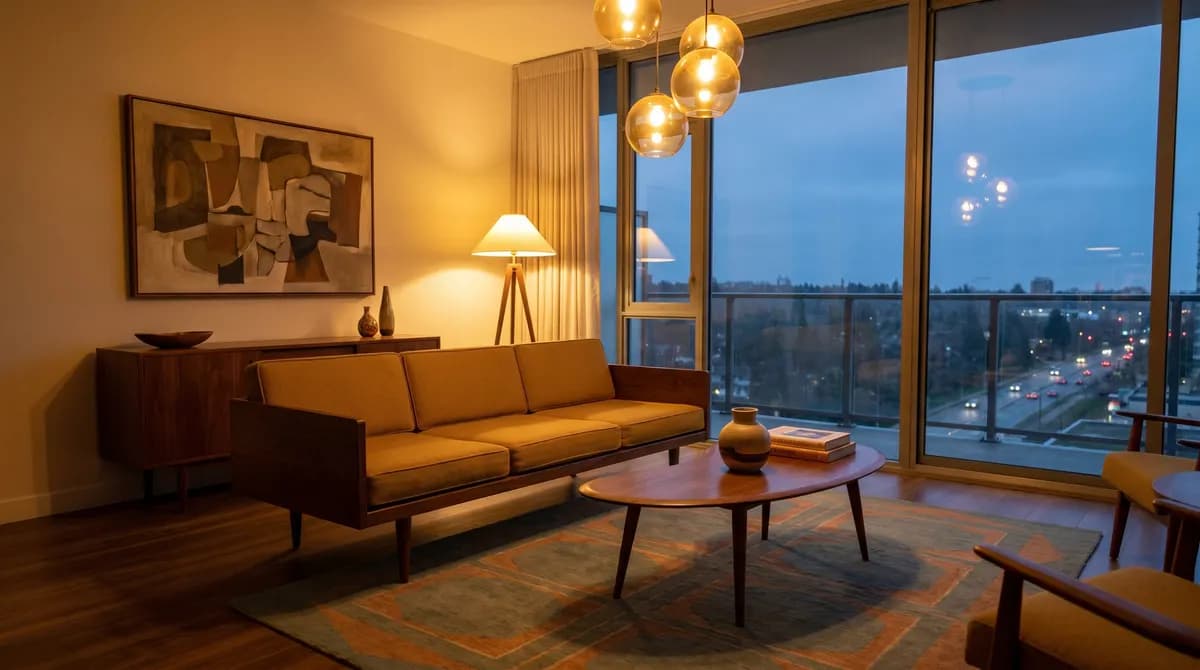
Upload a photo of your real living room. Get a photorealistic mid-century modern redesign in about 30 seconds. 4 free credits, no card.
Generate Your Mid-Century Modern Living Room FreeOther Mid-Century Modern Rooms
Apply the same palette and principles to the rest of the home.


Other Living Room Styles
Same room, different aesthetic — explore the rest of the living room style library.


Mid-Century Modern Living Room — Frequently Asked Questions
What colors define a mid-century modern living room?
Is mid-century modern still relevant in 2026?
How do I mix vintage and new mid-century pieces?
What flooring works for a mid-century modern living room?
How is mid-century modern different from contemporary modern?
Can mid-century modern work in a small living room?
How to Design a Mid-Century Modern Living Room
Five decisions, in this order. Skip any of them and the look will not land.
- 1
Choose your wood tone
Walnut or teak — pick one and commit. Walnut is darker, warmer, slightly chocolate. Teak is golden and showcases grain more aggressively. Repeat the same wood across credenza, coffee table, sofa legs and any shelving. Two competing wood tones is the fastest way to break the spell.
- 2
Pick a base + 1-2 saturated accents
Warm cream or oat on walls, walnut on woods, plus one dominant accent (mustard, burnt orange or olive) and one supporting. The accents go on the sofa, one chair, a single rug and pillows. Resist the urge to introduce a third accent colour — that's where rooms start to look like a 1959 catalogue parody.
- 3
Source the credenza + sofa as the hero pair
These are the two pieces that define the room. The credenza is the longest horizontal mass; the sofa is the comfort anchor. Buy them with matching wood tones and complementary scale — the credenza should be at least as long as the sofa.
- 4
Add iconic supporting cast
An Eames lounge chair (or quality reproduction), a round travertine or walnut coffee table, an arc floor lamp and a sputnik or globe chandelier. These four pieces are the supporting actors; together with the credenza-plus-sofa hero pair they carry 90 percent of the look.
- 5
Edit and add one personal piece
Mid-century is confident but disciplined — three to five styled objects on the credenza, one large piece of geometric art on the wall, one houseplant. Then add a single personal object: a vintage record player, a hand-thrown ceramic from your travels, an heirloom clock. This is what separates a styled showroom from a real mid-century home.
Keep Exploring
Tools and guides that pair with this style.