Mid-Century Modern Dining Room Design Ideas: 12 Real Examples (2026 Guide)
Walnut oval table, Eames chairs and a sputnik chandelier — a confident, sociable dining room that feels both retro and current. We unpack the look and show 12 photorealistic examples.
- 12
- Real examples
- ~30s
- AI render time
- 4 free
- Credits, no card
What is Mid-Century Modern Dining Room Design?
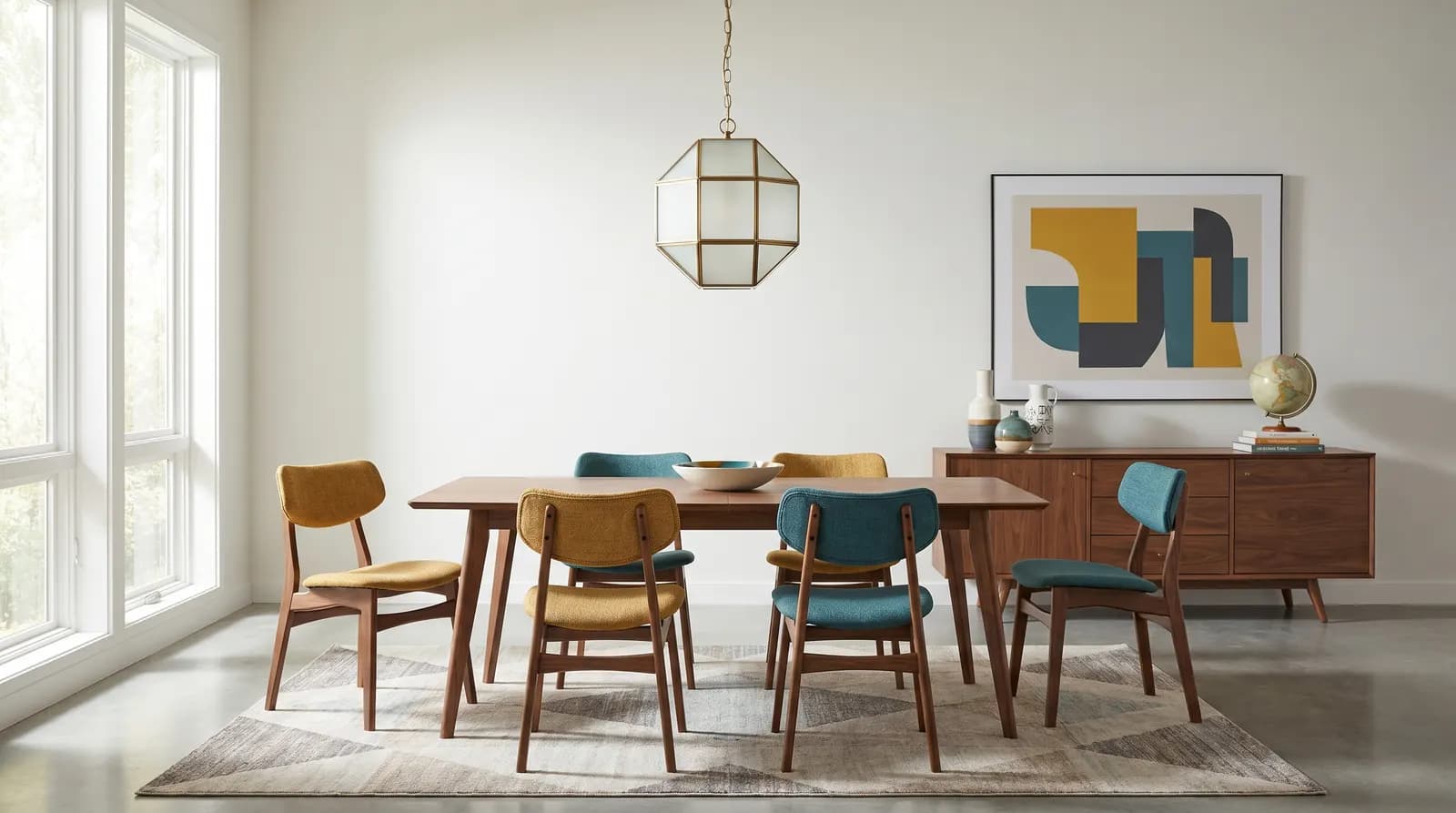
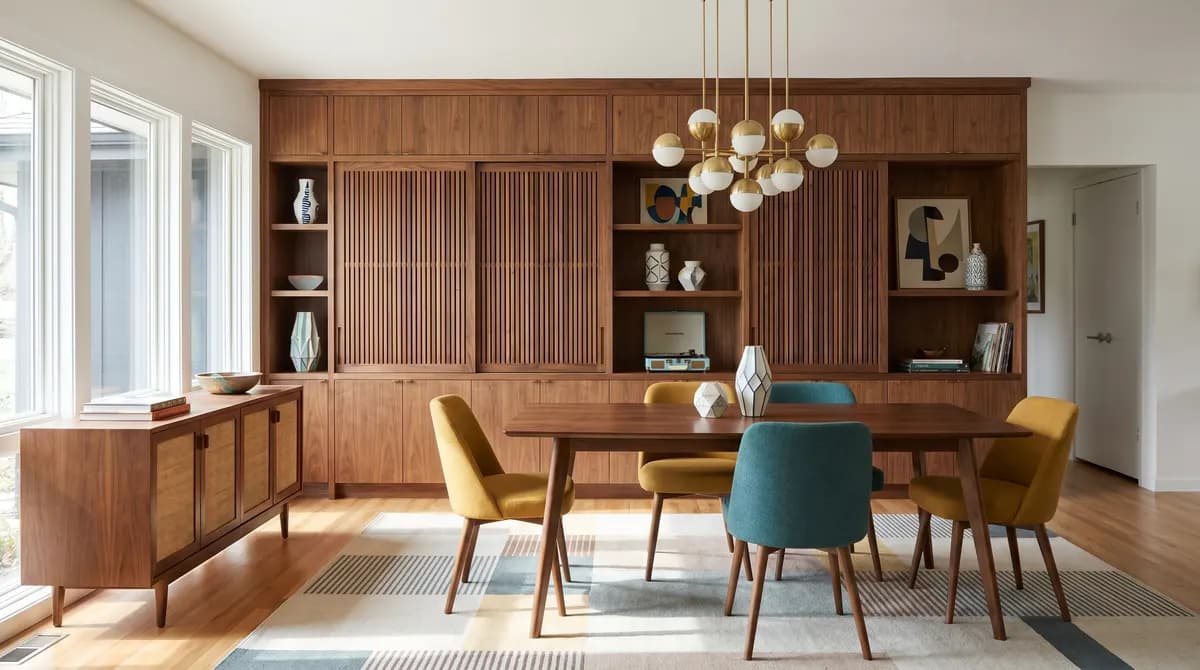
Mid-century modern dining is the room that defined post-war American hospitality — and it is the easiest mid-century room to assemble correctly. The vocabulary is small and ruthless: one oval or rectangular walnut table on tapered or pedestal legs, four to eight chairs that match each other, one statement light overhead, one credenza or sideboard for serving, and a calm cream envelope on the walls. Done right, the room reads as both retro and timeless; done wrong, it slides into a Mad Men diorama.
Three principles run through every authentic mid-century modern dining room. First, the table is the hero — usually walnut or teak, oval or rectangular, on tapered or pedestal base, seating four to eight. Second, the chairs are a matched set — six identical mid-century chairs are infinitely better than a 'mixed' Pinterest collection of three different styles. Third, the chandelier is the room's atomic-age moment — a brass sputnik, a cluster of glass globes, or a single dramatic Italian pendant.
In 2026 the look has had a sustained revival, helped by IKEA, West Elm and Article all running near-identical mid-century dining sets at three different price points. The current iteration is slightly quieter than the 1950s original — fewer starburst clocks, more single walnut credenza — and pairs naturally with Japandi and Scandinavian. It is also the most beginner-friendly dining style because the formula is fixed: walnut table, six matching chairs, sputnik above. Nail those three pieces and the room works.
12 Real Mid-Century Modern Dining Room Examples
Each example below is a complete look — not a mood board. Click any image to see it full-size, then hit the generate button to try the same combination on your own room photo.
 1Example
 2Example
 3Example
 4Example
 5Example
 6Example
 7Example
 8Example
 9Example
 10Example
 11Example
 12Example
Key Design Elements
Colors
- Warm cream and oat-white walls
- Mustard or burnt-orange accent
- Olive or forest-green secondary accent
- Travertine or warm grey on hard surfaces
- Walnut and teak wood tones
Materials
- Walnut — the dominant table wood
- Teak and rosewood for vintage credenzas
- Velvet, leather and boucle on chair seats
- Travertine, marble or terrazzo on credenza tops
- Aged brass on lighting and hardware
Furniture
- Oval or rectangular walnut dining table
- Six matching chairs in walnut with upholstered seats
- Long walnut credenza or sideboard
- Bar cart in brass and walnut
- Wall-mounted open shelving for ceramics and books
Lighting
- Sputnik chandelier with brass spokes over the table
- Cluster of glass-globe pendants as alternative
- Brass swing-arm sconces flanking the credenza
- Small table lamp on the bar cart for evening glow
- Beeswax candles in brass holders on the table
Textiles
- Geometric area rug in cream, rust and walnut
- Linen runner in oat or cream on the table
- Mustard or olive velvet chair upholstery
- Linen or wool curtains in cream
- Cotton placemats with woven texture
Mid-Century Modern Dining Room Color Palette
Six pigments do most of the work — start here, then add one accent of your own.
The base wall colour. Warmer than pure white, it lets walnut look honey-coloured and chair velvets sing rather than scream against the room.
Used on credenza tops, a single bar cart shelf or a small accent slab. Adds a quiet stone counterpoint to all the wood.
The hero accent — chair upholstery, one velvet runner, ceramic vase. Saturated and slightly golden, distinctly mid-century rather than highlighter.
Alternative dominant accent — single feature wall, chair upholstery or a hand-thrown vase. Pick mustard or burnt orange as dominant, not both.
The dominant wood tone for table, chairs, credenza and shelves. Repeat the same walnut finish across every wood surface in the room.
Sputnik chandelier, sconces, candlesticks, drawer pulls. Used consistently — a single brass finish across every metal element in the room.
Must-Have Furniture & Fixtures
If you only buy these seven, you will read as authentically mid-century modern.
Oval walnut dining table
180-220 cm long, oval or boat shape, on single pedestal or four tapered legs. Solid walnut top, matte oil finish. Skip glossy lacquered tops — they read as 1990s.
Six matching chairs
Six identical Eames-style shells in walnut, or six wishbone-style chairs, or six tapered-leg dining chairs with mustard velvet seats. The match matters more than the model.
Long walnut credenza or sideboard
180-220 cm wide, on tapered or hairpin legs, with sliding doors and brass spindle pulls. Sits against the longest wall as the room's main storage piece.
Sputnik or globe chandelier
Brass spokes with bulb-end finishes, 80-120 cm diameter, or a cluster of 5-9 glass globes. Hung 80-90 cm above the tabletop, centred over the table.
Bar cart in brass and walnut
Two-tier, 60-80 cm wide, brass frame with walnut shelves. Loaded with two crystal decanters, six glasses and one small ceramic vase. The unofficial hero of any mid-century dining room.
Geometric area rug
A 240 x 320 cm rug in cream, rust and walnut geometric pattern, or a flat-weave wool in a single muted tone. Sized to extend at least 60 cm past the chair when pulled out.
Open wall shelving
One or two runs of solid walnut shelving on a single wall, styled with ceramics, crystal decanters and one stack of hardback books.
Common Mistakes to Avoid
Mismatched chairs — a Pinterest 'eclectic' mix of three different chair styles fights the discipline of mid-century. Six matching chairs, always. The match is the look.
Choosing the wrong rug — Persian and shag rugs fight mid-century silhouettes. Stick to geometric flat-weaves, hand-knotted wool in muted tones or a single graphic pattern.
Hanging the chandelier too high — sputnik and globe pendants should sit 80-90 cm above the tabletop, not against the ceiling. Too high and the room loses its centre.
Using a glossy lacquered table top — high-gloss reads as 1990s contemporary, not mid-century. Matte oil finish so the walnut grain stays visible.
Over-styling the table — one linen runner, two brass candlesticks and one ceramic vase is plenty. Anything more reads as a wedding rehearsal, not a real family dinner.
Try Mid-Century Modern Dining Room in Your Own Room
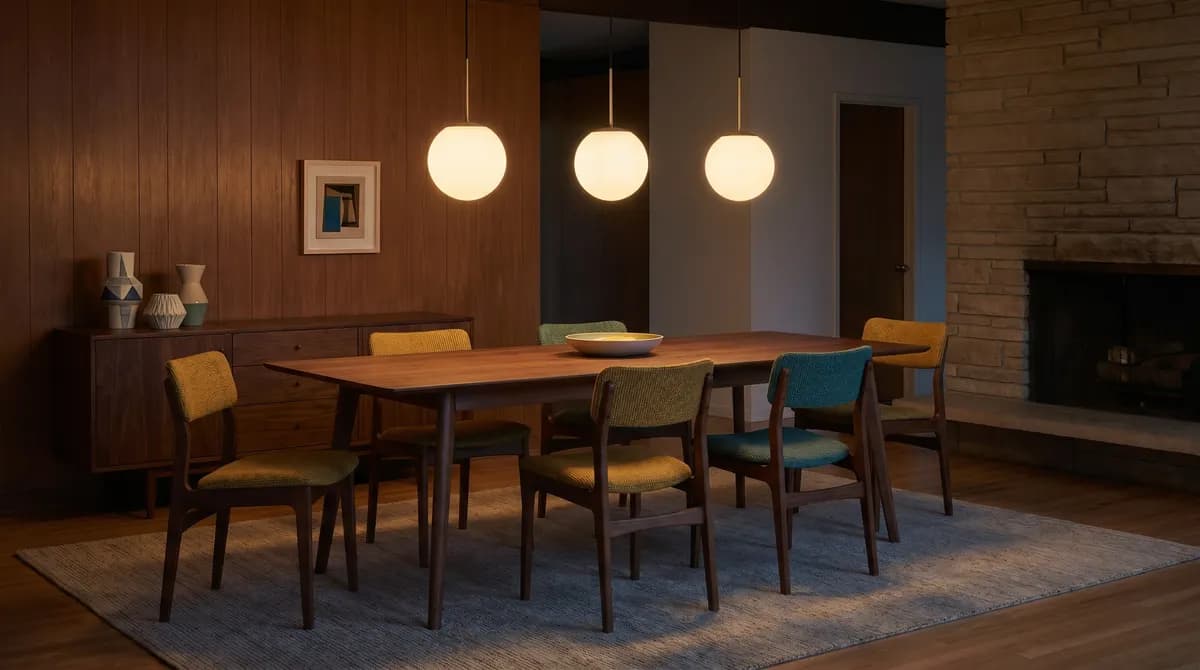
Upload a photo of your real dining room. Get a photorealistic mid-century modern redesign in about 30 seconds. 4 free credits, no card.
Generate Your Mid-Century Modern Dining Room FreeOther Mid-Century Modern Rooms
Apply the same palette and principles to the rest of the home.


Other Dining Room Styles
Same room, different aesthetic — explore the rest of the dining room style library.


Mid-Century Modern Dining Room — Frequently Asked Questions
What colors define a mid-century modern dining room?
Oval, round or rectangular — which dining table shape is most mid-century?
Do I have to use Eames chairs?
What flooring works for a mid-century modern dining room?
How is mid-century modern dining different from Scandinavian dining?
Can mid-century modern work in a small dining room?
How to Design a Mid-Century Modern Dining Room
Five decisions, in this order. Skip any of them and the look will not land.
- 1
Choose your hero table
Oval walnut, rectangular walnut or round pedestal — pick one based on room size. This is the most consequential decision in the room. Spend 35-40 percent of your budget here; everything else is supporting cast.
- 2
Source six (or four, or eight) matching chairs
All chairs must match each other. Eames, wishbone, Tulip, Cherner — pick one model and buy the full set. A matched set of six budget reproductions reads more correct than three mismatched vintage originals.
- 3
Pick your statement chandelier
Sputnik, globe cluster, or a single dramatic Italian pendant. 80-120 cm diameter, brass or mixed brass-and-glass, hung 80-90 cm above the tabletop. This is the room's atomic-age moment and the second most photographed object after the table.
- 4
Add a credenza or sideboard
Long walnut credenza, 180-220 cm, with brass spindle pulls. Skip if the room is under 12 sqm — use a bar cart instead. The credenza is the unofficial fourth hero of any mid-century dining room.
- 5
Layer one rug + one accent colour
A 240 x 320 cm geometric or flat-weave wool rug under the table. One saturated accent (mustard, olive or rust) repeated on chair upholstery, one ceramic vase and one linen runner. Resist adding a second accent — the discipline is what separates a mid-century room from a 1959 catalogue parody.
Keep Exploring
Tools and guides that pair with this style.