Minimalist Living Room Design Ideas: 12 Real Examples (2026 Guide)
One low sofa, one armchair, one coffee table, empty walls, a single wood tone, almost nothing on display — the minimalist living room is the architecture of subtraction. We unpack what makes it work, then show 12 photorealistic examples you can replicate.
- 12
- Real examples
- ~30s
- AI render time
- 4 free
- Credits, no card
What is Minimalist Living Room Design?
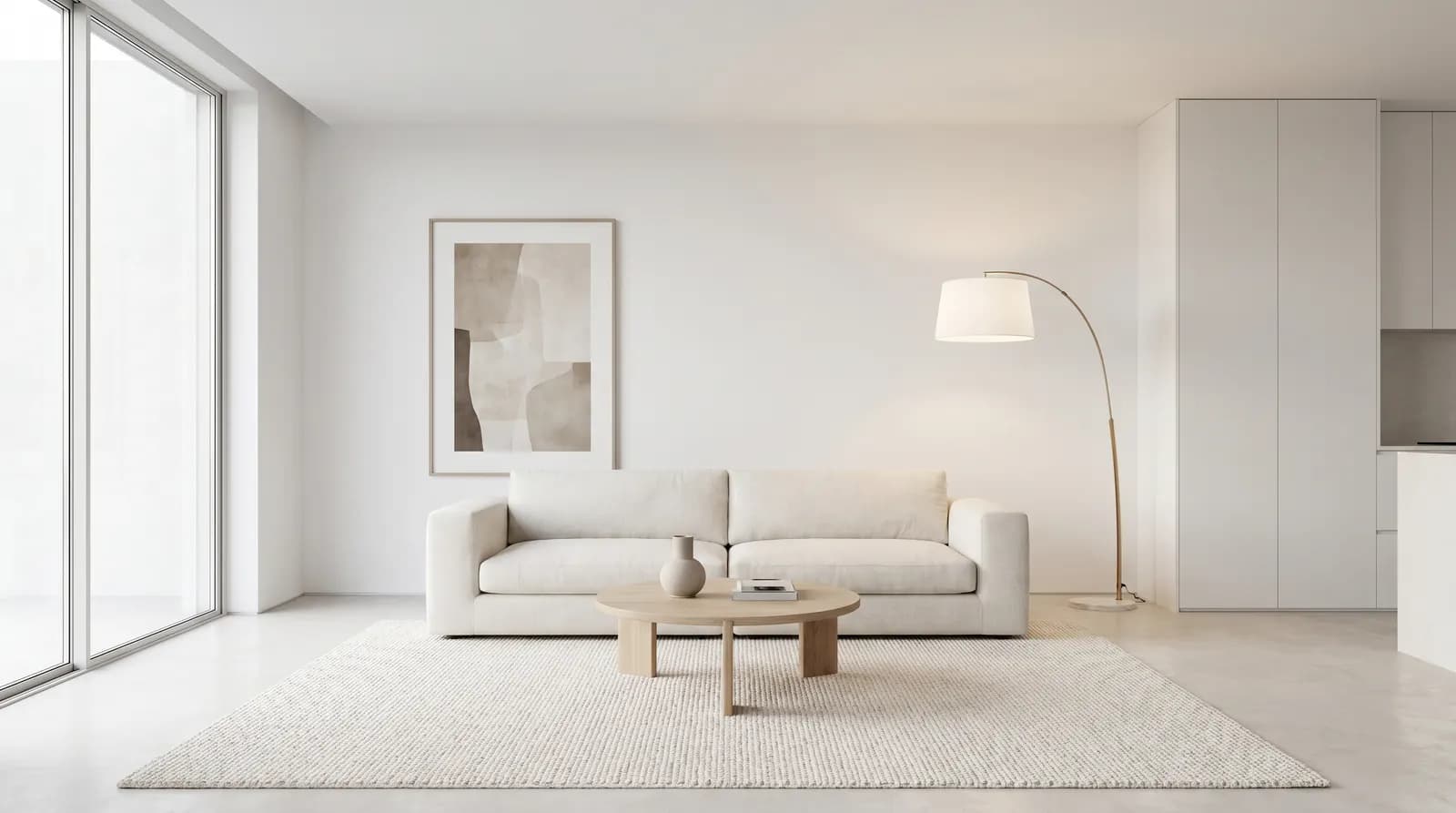
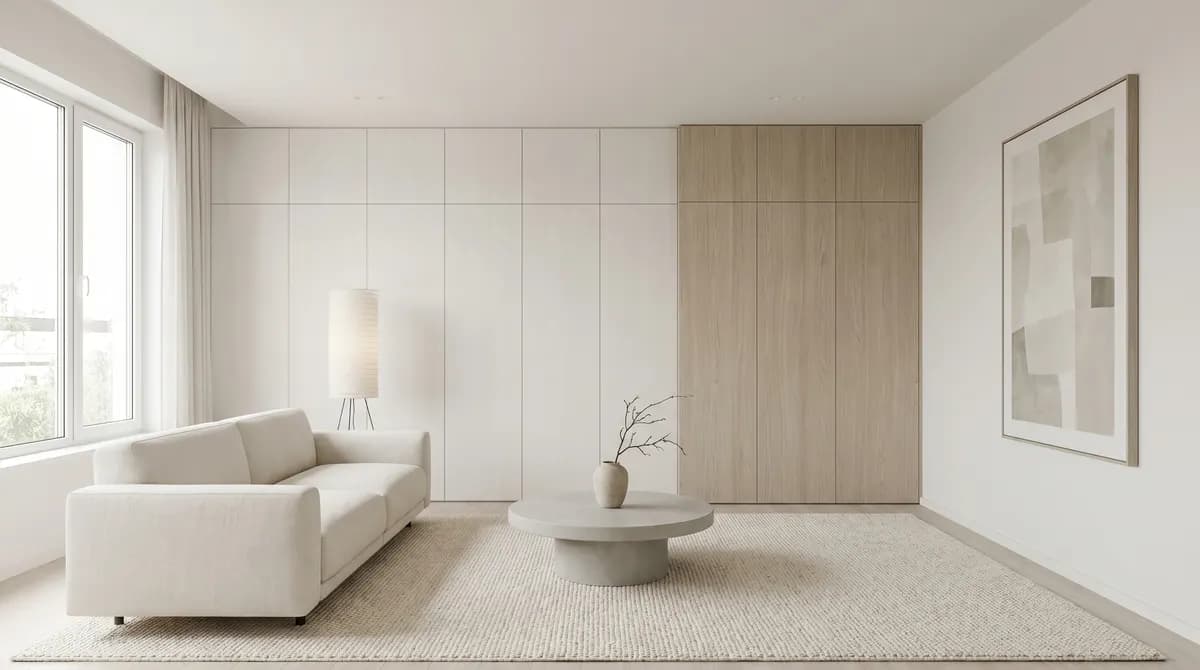
Minimalist living room design is not a style — it is a discipline. It treats every object in the room as a tax: it must justify its presence, or it does not stay. The result is a space defined less by what is in it than by what is conspicuously absent: no decorative cushions, no gallery walls, no console tables piled with curated objects, no rug pattern, no curtains beyond a single sheer linen panel. The architecture of the room — the proportions, the plaster, the light — does the visual work.
Three principles run through every authentic minimalist living room. First, restraint: the lowest possible object count, ideally under twelve visible items in the entire room. Second, monochrome: a single closely related palette of warm whites, light greiges and one wood tone, with no decorative colour. Third, scale of negative space: at least 60 percent of the floor and 80 percent of the wall surface must be empty. The room reads as architecture first and furniture second.
In 2026 the minimalist living room is the dominant aesthetic in premium new-build apartments, slow-living renovations and well-curated urban homes. It pairs naturally with Japandi (more wood and ceramic), Modern (more material depth) and Scandinavian (more hygge), and is the single best style for small spaces because empty surfaces always feel larger than full ones. We treat it as the canonical reference point for the living-room Style × Room series.
12 Real Minimalist Living Room Examples
Each example below is a complete look — not a mood board. Click any image to see it full-size, then hit the generate button to try the same combination on your own room photo.
 1Example
 2Example
 3Example
 4Example
 5Example
 6Example
 7Example
 8Example
 9Example
 10Example
 11Example
 12Example
Key Design Elements
Colors
- Warm white lime plaster walls
- Oat for upholstery and rugs
- Light greige for textiles
- Matte black or oxidised brass on hardware
- One mid-honey wood tone across the room
Materials
- Smooth lime plaster on every wall
- Pale honey oak — the dominant wood
- Wool boucle on the sofa and armchair
- Heavy linen on drapes and cushions
- Stoneware ceramic as the only display object
Furniture
- Low boucle or linen sofa, 70 cm seat depth, no tufting
- Single accent armchair in oat boucle
- Low oak coffee table, no shelf, no drawer
- Floor-to-ceiling handleless wall storage
- One floor lamp, no side tables, no console
Lighting
- One slim floor lamp in matte black or paper
- Cove LED uplighting at the ceiling perimeter
- Single wall sconce flanking the seating
- No overhead pendant in the main seating zone
- Every fixture dimmable, 2700 K only
Textiles
- Sheer linen panel on the window, no blackout
- Wool boucle throw folded once on the sofa arm
- Single low-pile wool rug under the seating
- Two linen cushions maximum on the sofa
- Stoneware ceramic as the only soft-adjacent object
Minimalist Living Room Color Palette
Six pigments do most of the work — start here, then add one accent of your own.
The base wall colour, ideally applied as smooth lime plaster so the eye reads texture as well as colour. Slightly warmer than pure white.
The dominant upholstery and drape colour. Carries the room visually and softens the hard plaster envelope.
Used on the rug and cushions. The neutral that links plaster, wood and textile without competing.
Concrete elements, ceramics and any tonal step beyond the dominant neutrals. The grounding mid-tone that keeps the palette from floating.
The strict accent — matte black hardware, the floor lamp, one piece of art if any. Used sparingly, almost as punctuation.
Pale honey oak — the only warm tone in the room, repeated across the coffee table, the shelf and any timber detail.
Must-Have Furniture & Fixtures
If you only buy these seven, you will read as authentically minimalist.
Low boucle or linen sofa
70 cm seat depth, no tufting, no piping, no decorative legs. Either floor-standing on a recessed plinth or wall-mounted. Oat, stone or warm white.
Single accent armchair
One low-back chair in oat boucle or warm-stone linen, set diagonally to the sofa. Hans Wegner CH07 or any honest knock-off in matching upholstery.
Low oak coffee table
Solid oak slab on a low metal or wood base, 35–40 cm tall. No shelf, no drawer. The negative space under the table is part of the design.
Floor-to-ceiling storage wall
Handleless plaster-finish doors or pale oak veneer running floor to ceiling on the long wall. Houses everything: books, electronics, toys, paperwork.
Single floor lamp
One slim matte black or paper-shade floor lamp beside the armchair, dimmable, 2700 K. Replaces the need for a side table.
Single low-pile wool rug
One flatweave wool or low-loop rug under the seating, sized so the front legs of every piece sit on it. Oat, stone or charcoal — no pattern.
Heavy linen drape or one sheer panel
Ceiling-track sheer linen panel on the window, pooling 2 cm on the floor. Adds softness and diffuses light without breaking the empty-wall rule.
Common Mistakes to Avoid
Decorative cushions — three or four cushions in mixed prints and colours is the fastest way to break minimalism. Two cushions maximum, both in the same fabric.
Gallery wall — a grid of framed prints, a curated arrangement above the sofa, a collection of objects on a console. Minimalism is one large piece of art per wall, or no art at all.
Pattern in the rug or curtains — a chevron rug, a printed curtain, anything geometric. The textiles in a minimalist living room are flat colour, no pattern, no fringe.
Open shelving overflow — one open shelf with three objects is minimalism; the same shelf with twelve books, a stack of magazines and a souvenir is not. Closed storage walls absorb everything that is not curated.
Mixed wood tones — pale oak coffee table next to a walnut shelf and a stained pine floor is the fastest way to look amateur. One wood tone, repeated.
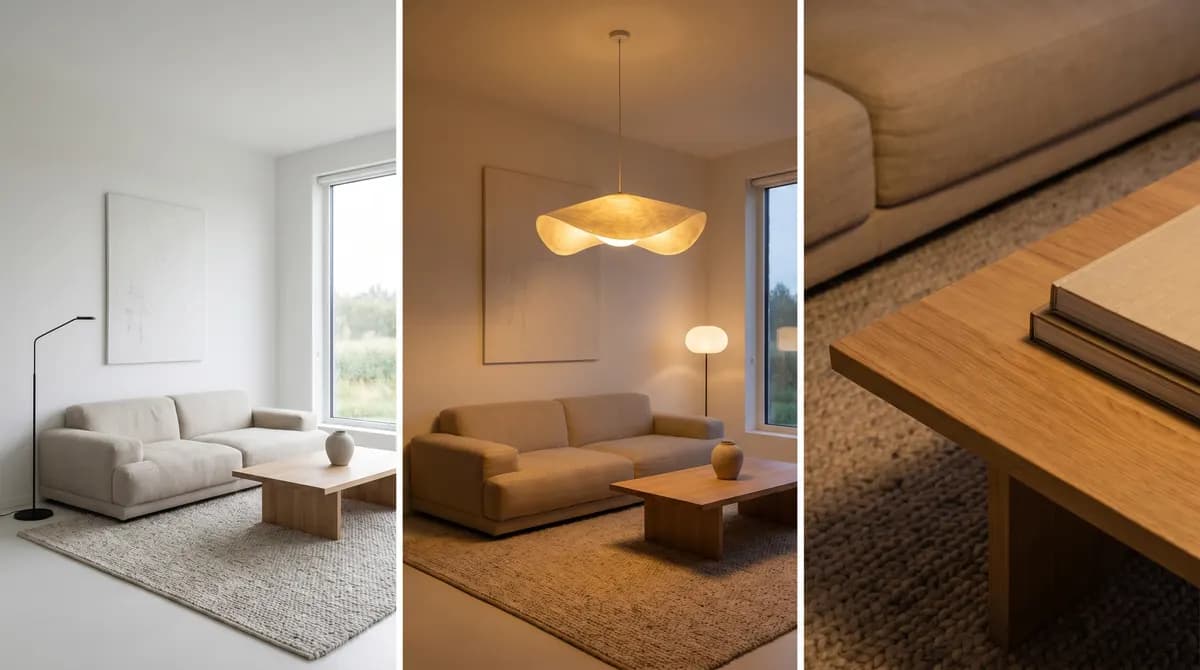
Try Minimalist Living Room in Your Own Room
Upload a photo of your real living room. Get a photorealistic minimalist redesign in about 30 seconds. 4 free credits, no card.
Generate Your Minimalist Living Room FreeOther Minimalist Rooms
Apply the same palette and principles to the rest of the home.


Other Living Room Styles
Same room, different aesthetic — explore the rest of the living-room style library.


Minimalist Living Room — Frequently Asked Questions
What colors define a minimalist living room?
Is minimalism the same as having no furniture?
How do I make a minimalist living room feel warm and not sterile?
What flooring works for a minimalist living room?
How is minimalism different from modern in a living room?
Is a minimalist living room good for family use with kids?
How to Design a Minimalist Living Room
Five decisions, in this order. Skip any of them and the look will not land.
- 1
Count your objects and cut the number in half
Before you buy anything, count every visible object in your current living room. Most rooms have between thirty and seventy. Minimalism aims for under twelve. Walk through the room and assign every object a job; if the answer is decorative redundancy, it does not stay. This single audit is the most consequential step.
- 2
Choose one wall finish and apply it everywhere
Smooth lime plaster, microcement or matte emulsion in a warm white — pick one and run it across every wall and ceiling. Resist the urge to introduce an accent wall in a contrasting colour; minimalism is a single envelope. The only acceptable break is a single fluted oak or plaster panel behind the sofa, used as architecture rather than as decoration.
- 3
Buy fewer, larger pieces
One generously sized boucle sofa, one low oak coffee table, one armchair, one floor lamp, one rug, one storage wall. Each piece must be the best quality you can afford — minimalism only works when individual objects withstand the scrutiny of being almost alone in the room. Cheap furniture in a minimalist setting reads as poverty, not discipline.
- 4
Light from low, plural, warm sources
Cove LED at the ceiling perimeter, one floor lamp, one wall sconce, one optional table lamp on the storage wall. Every fixture at 2700 K and on a dimmer. Never a single overhead pendant in the main seating zone — overhead light flattens the room and exposes every minor imperfection in the plaster.
- 5
Edit the display down to three objects
On the coffee table: one stone tray, one hardback book, one ceramic. On the open shelf: one ceramic, one book, one plant. On the storage wall front: nothing. Empty surfaces are the entire point of minimalism — the discipline is in choosing what gets to break that emptiness.
Keep Exploring
Tools and guides that pair with this style.