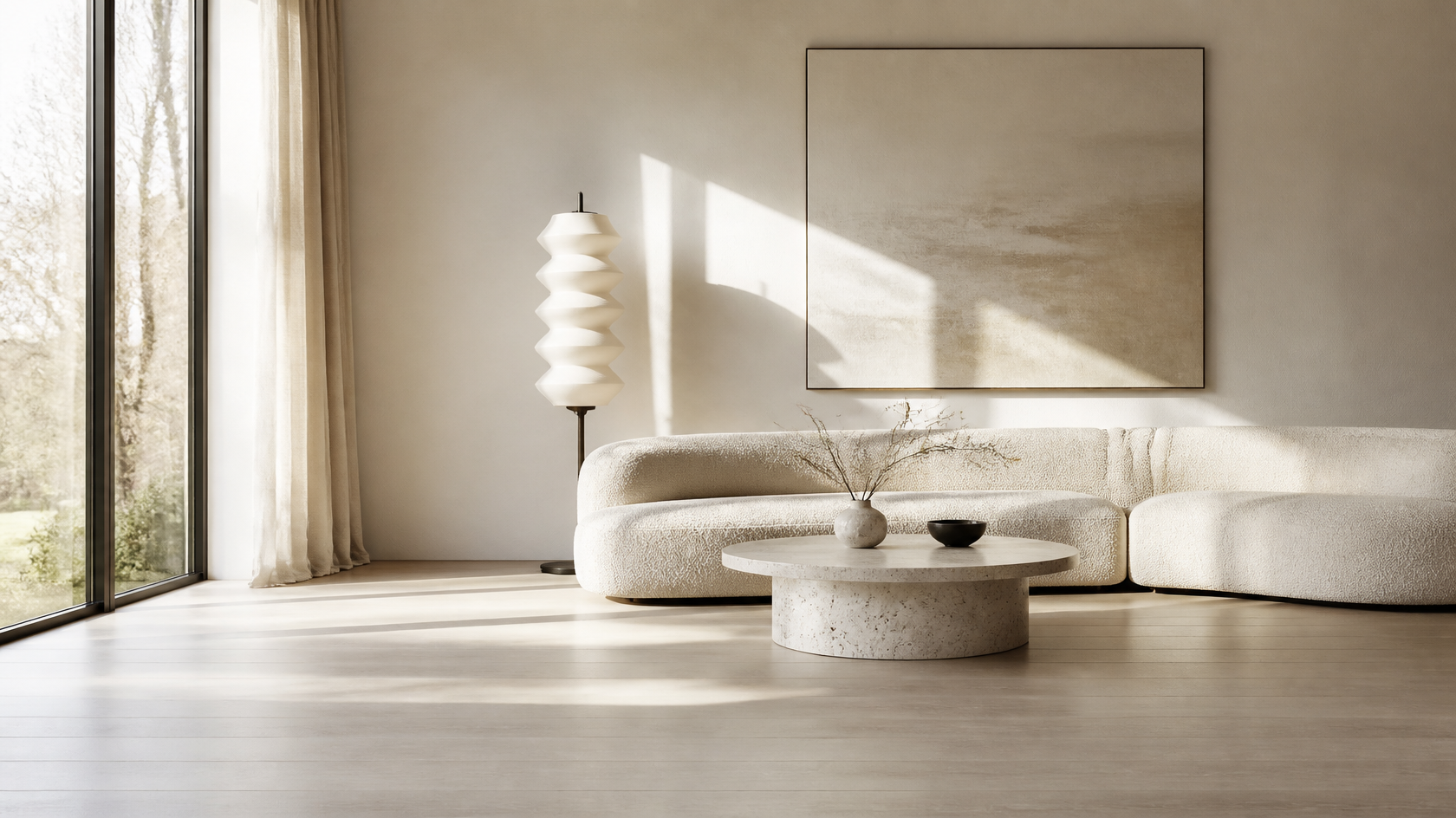
The remote-work era made the minimalist home office one of the most searched applications of the style, and it is genuinely easy to execute because the budget concentrates on three things: desk, chair, light.

A solid pale oak or walnut desk with no clutter — ideally with cable management hidden through a single grommet — paired with one clean-lined chair, one warm task lamp, and a single shelf above with two books and one object. That is the entire room. The wall behind the desk is the most important wall in the house if you appear on video calls: keep it a single warm plaster tone with one small piece of art, and treat it as your portrait background.
The mistake here is the gadget creep — the second monitor arm, the cable tangle, the standing-desk accessories, the sticky notes. Minimalism in a workspace is functional, not decorative: hide every cable, store every device you are not using, and keep the desk surface clear enough that the only thing competing for attention is the work.
You cannot create minimalist interior design without decluttering first — and decluttering is a system, not a weekend impulse. The fastest route is to go room by room and run every object through one test.
The Minimalist Test: Does this serve a clear purpose, or does it bring genuine joy? If the honest answer to both is no, it leaves the room. This single question does more work than any storage product, because the goal of minimalism is to own less, not to store more cleverly.
A practical four-step framework keeps the process moving:
- Empty the surface completely. Clear the entire shelf, counter or table, then put back only what passes the test. Starting from empty is psychologically easier than removing one item at a time.
- Apply the 90/90 rule. If you have not used something in the last 90 days and will not in the next 90, donate it. This cuts through sentimental hoarding fast.
- Eliminate duplicates. Keep the best one or two of anything you own in multiples. The rest goes.
- Find a home for everything that stays. An object without a designated place becomes future clutter. If it has no home, it does not stay.
The hardest part is psychological, not logistical: the fear that removing things makes a room feel unfinished. In practice the opposite happens — every object you remove makes the remaining ones read as more deliberate. The room becomes more minimalist as you subtract, not as you buy.
Most "minimalist" rooms fail in predictable ways, and the fix is almost always subtraction or a temperature change rather than a purchase.

| Mistake | Why It Reads Wrong | The Fix |
|---|
| All-white scheme with no warmth | Pure white reads cold and clinical, especially in low light | Switch to warm neutrals — bone, oat, mushroom |
| Cool LED lighting (4000K+) | Cool light makes every natural material look synthetic | Replace bulbs with 2700K warm LED on dimmers |
| Reduced to impersonality | A room that looks photographed for a showroom, not lived in | Keep fewer objects, but objects with real meaning or use |
| Empty mistaken for negative space | A bare, lifeless room is not the same as deliberate emptiness | Give the space one anchor — a chair, a plant, an artwork |
| Visible clutter on surfaces | Even a few stray objects break the calm in a sparse room | Hide it in seamless storage; keep surfaces clear |
| Glossy or synthetic materials | Reflect light wrong and feel cheap against the simple palette | Swap for matte natural materials — oak, linen, stone |
| Too many small objects | Five small things read as clutter; one large thing reads as intentional | Replace many small items with one significant piece |
| Trend-chasing accessories | Fast décor dates fast and adds visual noise | Buy slowly; choose durable, neutral, timeless pieces |
| Wall-to-wall pattern or gallery walls | Pattern and busy walls fight the calm | One large artwork or a clear wall |
The most overlooked fix is lighting temperature. People spend years wondering why their minimalist room feels cold when the room they admired in a magazine was simply lit at 2700K and theirs is at 4000K. That one difference does a surprising share of the visual work.
The traditional way to test a minimalist conversion is to spend weekends taping paint swatches to walls, ordering samples, and arguing about whether the white is "too cold." The faster way is to upload a photo of the actual room to an AI interior design tool and generate a photorealistic preview in about thirty seconds.
GenRoom is built for exactly this. The workflow:
- Take a photo of the room in daylight, from a corner, with as much of the floor and one full wall visible as possible.
- Upload it to GenRoom, open the generator, choose Interior Design, and pick the Minimalist style.
- Generate. You get a photorealistic render in about 30 seconds that preserves the room's architecture — windows, doors, ceiling height — while restyling the furniture, materials and palette.
- Iterate. Try standard minimalist, warm minimalist, and a darker earthy variant to see which suits your light. Each render is fast, so testing five directions takes minutes, not weekends.
- Refine with prompts. Add specific notes — "warm bone walls," "low oak platform bed," "clear the counters" — and regenerate until the room matches your intent.
- Shop to the render. Once you have a version you like, treat it as the brief: match the sofa silhouette, the wall tone, the lamp shape, one piece at a time.
The advantage over a Pinterest moodboard is that the render is your room — your ceiling height, your window light, your awkward radiator. A generic reference cannot tell you whether warm minimalism will actually work in your north-facing living room; a render of your own space can.
GenRoom gives every new account 6 free credits to try with no card required, and paid credit packs start at $9.99 for 36 credits (about 18 renders) — a one-time purchase, not a subscription, with credits valid for 180 days. For room-specific inspiration, the bedroom design guide and living room design guide show the same workflow applied to single rooms.

Minimalism overlaps with several neighbouring styles, and the confusion is the main reason people end up with a muddled room. Each has a clear distinguishing axis.
| Style | Defining Move | Palette Direction | Material DNA | Vibe |
|---|
| Minimalist (warm) | Reduction with warmth | Bone, oat, mushroom | Oak, stone, linen, bouclé | Calm, clear, intentional |
| Scandinavian | Functional brightness | Cool whites, light grey, soft blue | Pine, birch, wool, white-painted wood | Bright, airy, cosy |
| Japandi | Warm minimalism with imperfection | Oat, charcoal anchor, earth | Oak, walnut, linen, paper, ceramic | Quiet, grounded, lived-in |
| Modern / Contemporary | Clean lines with statement pieces | White, black, one bold accent | Steel, glass, leather, lacquer | Crisp, polished, gallery-like |
| Mid-Century Modern | Retro warmth and organic shapes | Walnut, mustard, teal, olive | Teak, walnut, leather, brass | Warm, characterful, curated |
The shorthand: if it is reduced + warm + clear, it is minimalist. If it is bright + soft + cosy, it is Scandinavian. If it is minimal + imperfect + Japanese-Nordic, it is Japandi. If it is clean + bold + polished, it is modern. Minimalism is the parent style; Scandinavian and Japandi are its two warmest, most popular children.
Minimalism is arguably the single best style for small spaces and rentals, because reduction is the solution to a small footprint. The fewer objects in a small room, the larger it reads — so the style and the constraint pull in the same direction.

The small-space and renter playbook:
- Choose multi-functional furniture. A storage bed, a console that divides a studio, a nesting table — each piece earning two jobs means fewer pieces overall.
- Keep furniture low. Low silhouettes leave more wall visible above them, which makes ceilings feel taller and rooms feel larger.
- Maximise natural light. Sheer linen instead of heavy curtains, a mirror opposite a window, clear sightlines to the glass.
- Swap the bulbs. Warm 2700K LEDs transform the feel of a rental in an afternoon and cost almost nothing.
- Replace one rug. A single neutral wool or jute rug grounds the room and carries more weight than any wall change you are not allowed to make.
- Edit, do not add. In a rental you cannot repaint or retile, but you can remove — every plastic object, every cool bulb, every glossy frame. The room becomes more minimalist as you take things out.
For studios, the highest-impact single move is a slim oak or cane room divider that separates the sleeping zone from the living zone. It defines two areas without losing light and reads as one clean architectural gesture. Our small room design guide goes deeper on the AI workflow for tight spaces.
If there is one thing to take from this guide, it is that minimalism in 2026 is warm. The cold, white, empty version is over; the version that is winning is built on soft neutrals, layered natural texture, warm light, and one or two pieces with genuine soul.

Warm minimalism keeps every rule of classic minimalism — reduction, restraint, negative space, hidden clutter — and changes only the temperature. Walls move from white to bone and mushroom. Textiles move from flat cotton to slubby linen and bouclé. Lighting moves from 4000K to 2700K. And the room is allowed exactly one personal object — a piece of art that means something, a ceramic from a trip, a single plant — so that it reads as a home rather than a showroom.
This is also the version that adapts best across climates. In warm regions, lean into pale wood, cane and lighter textiles for an airy feel. In cold or low-light regions, lean into deeper earthy neutrals, heavier wool and warmer light. The grammar stays identical; only the dial moves.
Minimalist interior design keeps only the furniture, objects and colours that are genuinely useful or genuinely loved, and removes everything else. It is built on four ideas: simple shapes, a restrained palette of two or three tones, every item having one clear function, and deliberate empty space. The 2026 version is warm — soft neutrals and natural texture rather than cold all-white rooms.
Warm neutrals: bone, oat, mushroom and warm sand, using a 60-30-10 split (60% dominant neutral, 30% secondary material, 10% accent). Add depth with one quiet anchor — charcoal, deep navy or forest green — used on a single element. Keep accents to one muted earth tone such as ochre, terracotta or sage, and use it on just one object. Stick to two or three colours per room.
Go room by room and run every object through one test: does it serve a clear purpose, or bring genuine joy? If neither, it leaves. Clear each surface completely and put back only what passes. Apply the 90/90 rule — if you have not used something in 90 days and will not in the next 90, donate it. Eliminate duplicates, and give everything that stays a designated home.
It does not have to be — that is the old, sterile version. Warm minimalism, the 2026 standard, stays inviting through warm neutral colours, natural materials like oak and linen, 2700K lighting, and one or two personal objects with real meaning. A minimalist room feels cold only when it is reduced to impersonality or lit with cool white light; both are easily fixed.
Minimalism is one of the best styles for small spaces, because reducing the number of objects makes a room feel larger. Most moves are renter-friendly and reversible: warm bulbs, sheer linen curtains, one neutral rug, low multi-functional furniture, and removing clutter. You can achieve most of the look without painting, drilling or replacing anything permanent.
An AI interior design tool like GenRoom lets you upload a photo of your actual room and generate a photorealistic minimalist render in about 30 seconds, keeping your real architecture while restyling the furniture, palette and materials. You can test warm, cool and darker variations in minutes, refine with prompts, and use the result as a shopping brief — far faster than ordering paint samples. New accounts get 6 free credits.
Both are reduced and clean, but Scandinavian leans brighter and cosier — cool whites, soft blues, pine and birch, layered wool for warmth — while minimalism is more disciplined, with a tighter palette, fewer objects and more deliberate negative space. Scandinavian is essentially minimalism made warmer and cosier for long northern winters; minimalism is the stricter parent style.
Confusing empty with intentional. A bare, lifeless room is not minimalism — it is just unfinished. True minimalism is curated reduction: fewer objects, but each one deliberate and meaningful, anchored by one or two focal pieces and warmed by natural texture and warm light. The second-biggest mistake is using cold 4000K+ lighting, which makes every material look synthetic.
Minimalism is what a home becomes when you stop asking "what can I add?" and start asking "what can I remove?" Strip a room back until only the useful and the loved remain, warm it with neutral colour and natural texture, light it at 2700K, and leave the negative space alone. The calm is the result. The editing is the work.
The fastest way to commit is to test the look on a room you already own. Upload a photo to GenRoom, generate a minimalist render — warm, cool and earthy variations — and you will know within the first result whether your room wants the pale palette or the deeper one, and whether your light supports white walls or warm sand. From there, the project becomes a matter of subtraction and sourcing: remove what does not earn its place, match the render one piece at a time, and let the empty space do the rest.