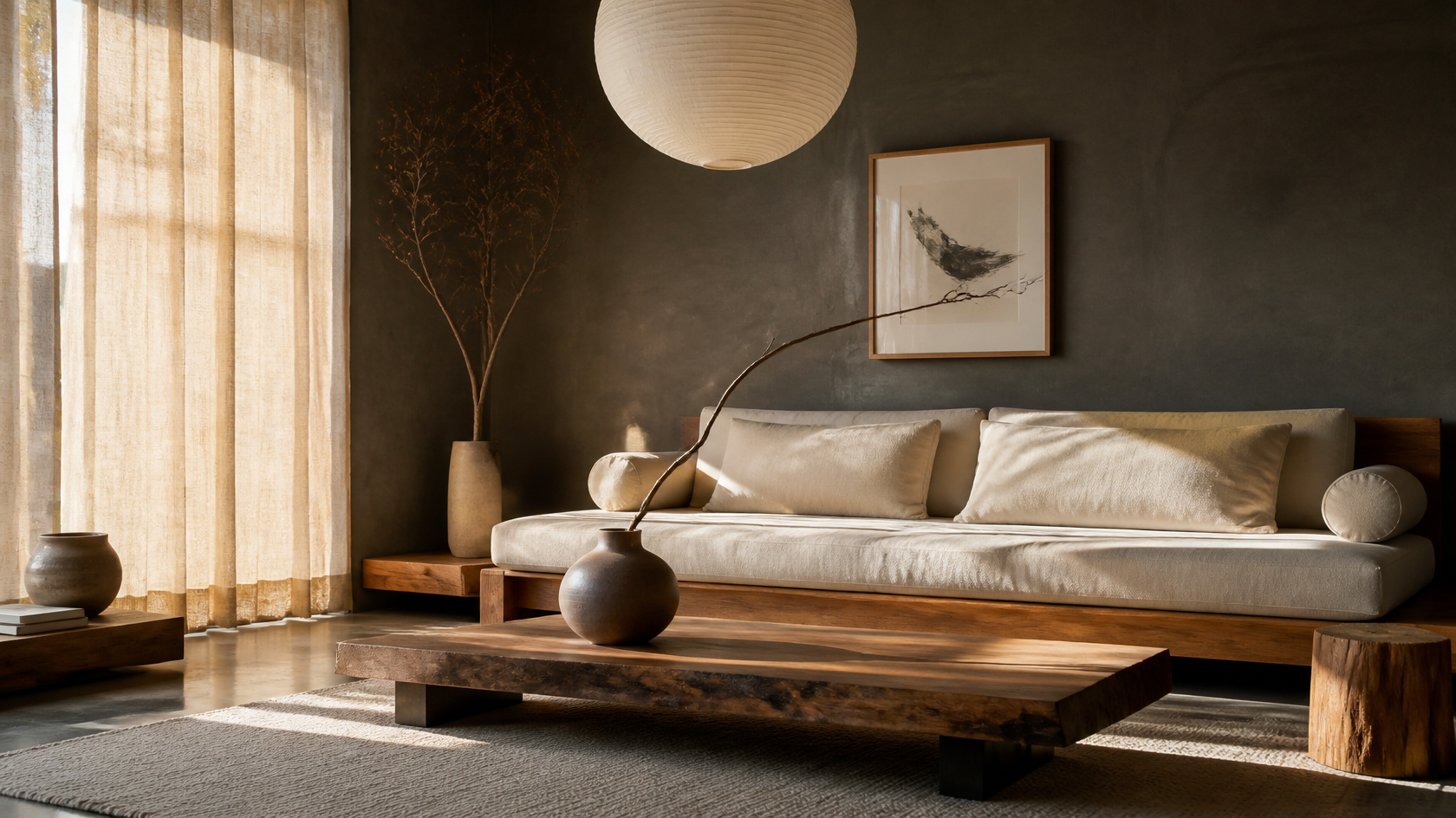
Most of the Japandi conversation is dominated by the same three or four iconic pieces. Knowing them helps you find equivalents at every price point.

- Hans Wegner CH24 Wishbone Chair (1949) — the single most-photographed Japandi chair. Steamed-bent oak, woven paper-cord seat. The platonic Japandi object. Authentic from Carl Hansen ~€800; respected near-equivalents from Stolab and Carl Hansen's lower lines from €350.
- Noguchi Akari Light Sculpture (1951) — Isamu Noguchi's paper-and-bamboo pendant series, originally hand-made in Gifu, Japan. Single most iconic Japandi light. Authentic from Vitra €250-€700.
- Tatami floor cushion (zabuton) — square heavy-cotton or linen floor cushion, 60x60cm. Anchors a corner of any room as a Japanese seating element. €50-€150.
- Platform bed in white oak — the silhouette is more important than the brand. Avocado, Floyd, Thuma and most Japanese-influenced Etsy makers all do versions from €600.
- Low coffee table in raw-edge wood — handmade from a single board with the natural live edge intact. Etsy and small workshops €400-€1200. Avoid mass-market "rustic" tables with stained MDF cores.
- Floor lamp with paper shade — Hay, Menu and Muji all make accessible versions at €100-€300. Vintage Akari finds at flea markets are a good investment.
- Hand-thrown ceramic vessel — buy directly from local potters. The cheapest piece in a Japandi room can also be the most authentic.
The trap in furniture sourcing is the IKEA Japandi rabbit hole. IKEA has done excellent Japandi-adjacent ranges (KIVIK, MALM, BERGSHULT shelves), but mixing IKEA with everything-else-IKEA results in a flat-pack atmosphere. The fix: combine one or two IKEA primary pieces (sofa, bed frame) with hand-made textiles, ceramics and a single statement light from elsewhere. The combination is what makes the room read as curated.
Japandi might be the single most rental-friendly major style. The reason is structural: most of the moves are object placements, not built-ins. You do not need to repaint, retile or replace cabinetry to get 80% of the way to a Japandi room.

The renter's Japandi playbook:
- Replace one rug with a heavy oat wool rug or jute. This single change carries more weight than any wall colour.
- Replace the curtains with sheer linen panels on a single black iron rod. Cost: under €150 even from IKEA's heavyweight linen options.
- Replace the overhead bulbs with 2700K warm LED. Replace cool-white kitchen lighting with under-cabinet warm strips.
- Add one paper pendant even if the existing fixture stays — clip a Noguchi-style shade over the bulb.
- Replace storage furniture with low oak alternatives. A €200 oak shoe bench at the entrance carries the entire Japandi mood forward.
- Add a single floor cushion in heavy linen as an extra seat.
- Edit, do not add. Half the work is removing — every plastic object, every cool-white bulb, every glossy frame. The room becomes more Japandi as you remove things, not as you buy them.
For studios and under-40m² apartments, the most impactful single move is a half-height walnut or shoji-inspired room divider that separates the bed from the living area. It defines two zones without losing daylight and reads as a Japanese architectural gesture in one piece of furniture.
Most "Japandi" projects fail in predictable ways. The fix is usually subtraction, not addition.

| Mistake | Why It Reads Wrong | The Fix |
|---|
| All-beige scheme with no anchor | Without one deep colour the room loses depth and reads "Pinterest landlord-special" | Add one charcoal door frame, one olive armchair, or one terracotta vessel |
| Cool LED lighting (4000K+) | Cool light makes every Japandi material look synthetic | Replace every bulb with 2700K warm LED on dimmers |
| Glossy lacquered furniture | Reflects light wrong, breaks the matte-and-natural rule | Refinish or swap for matte oil-finished wood |
| Too many objects on shelves | The negative space (ma) is what makes objects read | Remove 70% of shelf objects; leave the gaps |
| Wrong wood undertone | Yellow oak or orange-stained pine fights the cool linens | Use white oak (rift cut) or American walnut only |
| Decorative pillows in 4+ colours | Reads as Scandinavian-only without the Japanese restraint | Maximum two pillow colours, both in the natural neutral range |
| Wall-to-wall carpet | Hides the floor, which is half the room | Replace with hard floor + smaller wool or jute rug |
| Synthetic curtains | The polyester sheen kills wabi-sabi instantly | Heavyweight linen panels, even unhemmed at the bottom |
| Fake plants | The plastic vein on a fake fiddle-leaf reads from 5 metres away | One real plant — even a small Bonsai — beats five fake ones |
The hardest fix is the lighting. People underestimate it for years before they realise that the room they admired in a magazine was lit at 2700K and theirs is at 4000K, and that one difference is doing 60% of the visual work.
The traditional way to test a Japandi conversion is to spend three weekends taping fabric swatches to walls, ordering paint samples, lining them up against your existing furniture, and arguing with your partner about whether the oak in the cabinets is "too yellow." The new way is to upload a photo of the actual room to an AI interior design tool and generate a photorealistic preview in under sixty seconds.
GenRoom is built exactly for this use case. The workflow:
- Take a photo of the room in daylight, from the long-wall corner, with as much of the floor and one full wall visible as possible.
- Upload it to GenRoom, select Interior Design, then pick the Japandi style preset.
- Generate. You get a photorealistic render in 30-60 seconds that preserves your room's architecture, windows, doors and proportions, and re-styles the furniture, materials and palette.
- Iterate. Try the same room in standard Japandi, Dark Japandi and Warm Japandi to see which fits your light. Each generation costs one credit; the free tier includes 6 generations.
- Refine with custom prompts. Add specific notes — "swap to charcoal limewash walls," "add a paper pendant," "use a low platform bed in walnut" — and re-generate.
- Save the render and shop to it. Once you have a render you like, treat it as the brief for sourcing. Match the bench profile, the wall colour and the lamp shape one piece at a time.
The advantage over Pinterest moodboards is that the render is your room. The proportions match your ceiling height. The window light comes from the direction yours does. The render shows you whether your existing built-in radiator is a deal-breaker for the bench position you wanted. None of that is something a generic Pinterest reference can tell you.
Paid GenRoom plans start at $9.99 for 36 credits — about half the cost of a single quart of designer paint, for unlimited iteration of every room in the house.
The biggest source of confusion in Japandi search results is the four-way overlap with Scandinavian, modern minimalist and wabi-sabi-only interiors. Each has a clear distinguishing axis.
| Style | Defining Move | Palette Direction | Material DNA | Vibe |
|---|
| Japandi | Warm minimalism with imperfection | Oat, mushroom, charcoal anchor | Oak, walnut, linen, paper, ceramic | Quiet, grounded, lived-in |
| Scandinavian | Functional minimalism with brightness | Cool whites, light grey, hint of blue | Pine, birch, wool, white-painted wood | Bright, airy, IKEA-friendly |
| Modern Minimalist | Visual reduction for clean lines | Bright white, black, occasional accent | Steel, glass, lacquer, concrete | Crisp, gallery-like, cold |
| Wabi-Sabi-only | Imperfection without the warmth | Earthy mid-tones, raw clay | Hand-thrown ceramic, weathered wood | Rustic, philosophical, sometimes austere |
| Japanese Minimalist | Spatial discipline, ma-led | Pale wood, white, indigo accent | Tatami, hinoki, washi paper | Disciplined, contemplative |
The shorthand: if it is warm + minimal + imperfect, it is Japandi. If it is bright + minimal + tidy, it is Scandinavian. If it is sharp + minimal + dark, it is Modern Minimalist. If it is earthy + imperfect + handmade with no Scandinavian softening, it is pure Wabi-Sabi.
If you have a courtyard, balcony, deck or even a strip of patio, the Japandi extension outside is one of the highest-impact moves in the whole style. The Japanese garden tradition (karesansui, the dry rock garden) and the Scandinavian friluftsliv (open-air life) both prioritise quiet and natural materials.

The starter outdoor Japandi: cedar deck planks (or a small platform if you have no deck), a single sculpted boulder or oversized ceramic vessel, raked stone gravel around it, two or three potted bonsai or hardy small Japanese maples, one low cedar bench with a single oat linen cushion, and a paper or rattan outdoor lantern on a stand. No teak dining sets, no umbrella, no string lights.
The point is not to recreate a Japanese garden. The point is to extend the Japandi interior continuum to the outside — same materials, same warmth, same restraint — so that the door between inside and outside reads as a continuation rather than a switch.
Japandi can be implemented at any budget, but the allocation matters. The biggest budget mistakes are over-spending on the sofa and under-spending on the textiles and lighting — which is exactly the opposite of what works in practice.
| Room | Tight Budget | Mid Budget | Premium |
|---|
| Living Room | €600 (IKEA sofa + €120 linen throw + €80 paper pendant + €100 jute rug) | €2200 (mid-tier oak coffee table + heavy linen sofa cover + Hay floor lamp + wool rug) | €8000+ (custom oak built-ins + Wegner sofa + Akari pendant + Cultiver linen) |
| Bedroom | €450 (IKEA Malm + linen duvet + paper lamp) | €1500 (Avocado oak platform bed + heavy linen bedding) | €4500+ (handmade walnut platform + premium linen + Akari + walnut nightstands) |
| Kitchen | €300 (paint cabinets oat, add zellige peel-and-stick, change pulls to oak) | €4000 (replace cabinet fronts in oak veneer + soapstone counter + paper pendant) | €25000+ (full reno: rift-cut oak cabinets + honed stone counters + integrated appliances) |
| Bathroom | €250 (round walnut mirror + paper pendant + matte black hardware swap + linen towels) | €2000 (floating oak vanity + ceramic vessel sink + microcement wall section) | €15000+ (stone soaking tub + hinoki floor + full plaster walls + handmade ceramic sink) |
| Dining Room | €400 (IKEA Mörbylånga or oak table + 2 wishbone-style chairs + linen runner) | €1800 (mid-tier live-edge table + 4 Stolab-style chairs + bench + Akari pendant) | €6000+ (custom live-edge walnut + 6 authentic CH24 + woven paper pendant) |
| Entryway | €120 (oak bench + 3 iron hooks + sea-grass basket + ceramic vessel) | €600 (custom low oak bench + paper sconce + plaster wall section) | €2500+ (sunken travertine step + built-in oak millwork + Akari sconce) |
The single best-value swap at any budget is replacing one polyester rug with a heavy oat wool rug. €200-€400 transforms a room more than any single piece of furniture.
The original Japandi vocabulary comes from two cold-climate cultures (Japan's northern islands, Scandinavia). It needs minor adaptation for warm climates, but the core works everywhere.
Tropical and warm-humid (Southeast Asia, Mediterranean, Latin America): Lean further into the Japanese side of the formula. Use rattan instead of wool, woven cane instead of upholstered backs, paper and bamboo light filters, and a slightly cooler palette anchored in pale wood. Reduce textile weight. The result reads more like a Kyoto townhouse than a Copenhagen apartment, which is the correct local adaptation.
Cold and continental (Northern Europe, Canada, Northeast Asia): Lean into the hygge end. Heavyweight wool, layered linen throws, deeper anchor tones (Dark Japandi works particularly well here), and lighting at the warmer end of 2700K. This is the closest to the original blended Japandi recipe.
Desert and arid (Middle East, US Southwest, parts of Australia): Use limewash and clay plaster walls in the warm sand and terracotta range. The materials echo local building traditions while staying inside the Japandi grammar. Replace pale oak with darker walnut or smoked oak so the wood holds against bright direct light.
No. Minimalism is a visual rule — fewer objects, cleaner lines. Japandi is a philosophy that combines Japanese wabi-sabi (beauty of imperfection) with Scandinavian hygge (cosy warmth). A truly minimalist room can feel cold and impersonal; a true Japandi room is warm, lived-in and full of natural texture. The wood is a consequence of the philosophy, not the philosophy itself.
Yes — and Japandi is arguably the most budget-friendly major style, because the philosophy rewards subtraction. The most impactful moves are inexpensive: warm 2700K bulbs, heavy linen curtains, one wool rug, removing 70% of decorative objects. A full Japandi conversion of a living room can be done for €600-€900 starting from a generic IKEA-furnished baseline.
Japandi is one of the most rental-friendly styles. Most of the moves — bedding, rugs, lighting, curtains, decorative objects — are non-permanent. You can implement 80% of the look without painting, drilling more than four small holes, or touching the floors. The few items that benefit from permanent installation (limewash walls, kitchen cabinetry) can be deferred without losing the look.
Wabi-Sabi is one of the two philosophical sources of Japandi. A pure Wabi-Sabi interior leans further into the rustic, weathered and handmade — raw clay walls, visibly cracked ceramics, rough-hewn surfaces. Japandi softens this with the Scandinavian side (heavyweight linen, hygge lighting, low Wegner-style furniture) to produce something more habitable and Western-friendly. Wabi-Sabi alone can feel austere; Japandi is the warm, livable version.
The 2020 version was cooler, paler and more clinical — a lot of off-white walls and grey-toned oak. The 2026 version is warmer (mushroom, warm sand, terracotta accents), more textured (limewash and clay plaster instead of paint), and unafraid of depth (Dark Japandi is a fully mainstream variant). The other shift is more emphasis on the wabi-sabi side — hand-thrown ceramics, visible imperfections, less catalogue-perfect styling.
Partially. A modern sofa with a low silhouette and a neutral linen cover can fit a Japandi room with no changes. A modern dining table with sharp edges and a glossy finish will fight it. The test is: matte natural materials and low-to-medium height profile = fits. Glossy, chrome, sharp-edged, mid-century-bright = does not fit. You can usually keep 30-50% of existing modern furniture and convert the rest.
Japandi mixes well with classic Mid-Century Modern (the shared low silhouettes and warm wood help), with traditional Japanese (it is half-Japandi already), and with rustic farmhouse if you use the cleanest farmhouse pieces (oak, linen) and drop the country accessories. It mixes badly with industrial loft (too heavy), with maximalist eclectic (the opposite philosophy), and with traditional formal English (too ornate).
2700K everywhere. This is non-negotiable. Most factory-installed bulbs in the US, UK and Asia ship at 3000K-4000K, which kills the warmth of the materials. Every Japandi room benefits from a one-time bulb swap to 2700K dimmable LEDs across all fixtures — overhead, task and decorative. Outdoor Japandi lighting can go warmer still, to 2200K candle-equivalent.
One significant plant per room. Two is the absolute maximum, and only if one of them is small. The single-plant rule is what separates Japandi from the "biophilic minimalist" trend of the late 2010s, which loaded rooms with five fiddle-leafs and a monstera and then called it Japandi. A single Bonsai, a single Japanese maple in a pot, or a single dried branch in a hand-thrown vessel — that is the entire green budget for a room.
Yes: anything saturated. Bright red, royal blue, hot pink, electric green, primary yellow — none of these have a place in Japandi. The colour rule is that every shade in the room should look like it came from a natural source — wood, stone, earth, clay, plant pigment, undyed wool, charcoal. Bright synthetic colours read as artificial against the matte, natural materials and break the entire visual logic.
Japandi is what minimalism becomes when it grows up. Strip enough out of a room that the remaining objects can breathe; warm enough into it that the room still feels like a home; tolerate enough imperfection that the materials read as real. The visual is the result. The philosophy is the work.
The fastest way to commit is to test the look on a room you already own. Upload a photo to GenRoom and generate a photorealistic Japandi render — standard, dark and warm variations — in under three minutes. You will know within the first generation whether your room wants the pale palette or the dark one, and whether your light supports an oak floor or a smoked-oak floor. From there, the renovation becomes a sourcing exercise: match the bench, match the wall colour, match the lamp shape, and the room arrives.
The mistake people make with Japandi is treating it as a destination. It is closer to a discipline — a way of subtracting from a house until the few remaining objects feel inevitable.