Modern Interior Design: The Complete Guide (Principles, Room Ideas & 2026 Trends)

See it on your own room: Apply modern style to your room photo — free →. AI redesigns your real room in 30 seconds.
Modern interior design means clean lines, open floor plans, natural materials, and purposeful simplicity. It is not "cold." It is not "empty." It is a specific design philosophy rooted in early 20th-century modernism — Bauhaus, De Stijl, mid-century innovation — that strips a room down to its structural essentials and then rebuilds with intention. Every surface, every object, every light fixture earns its place through function and visual clarity.
This guide gives you everything: the history and exact definition (and why "modern" is not the same as "contemporary"), six foundational principles, color palettes with HEX codes and paint brand equivalents, room-by-room design breakdowns, iconic furniture with real pricing, a four-style comparison matrix, 2026-2027 trend forecasts, a step-by-step transformation process, and a three-tier budget guide. No vague inspiration boards. Specific numbers, specific products, specific decisions.
What Is Modern Interior Design?
Modern interior design refers to a specific aesthetic movement originating in the early-to-mid 20th century. It is not a synonym for "current" or "trendy" — that is contemporary design. Modern design has fixed characteristics: clean geometric lines, open space, a neutral-plus-accent color approach, natural materials (wood, leather, stone), and the principle that form follows function.
The Historical Roots
Three movements converge in what we now call modern interior design:
Bauhaus (1919-1933). Founded by Walter Gropius in Weimar, Germany, the Bauhaus school fused art, craft, and technology. Its interiors rejected ornament entirely. Marcel Breuer's Wassily Chair (1925) — tubular steel and leather — embodies the Bauhaus ethos: industrial materials, geometric purity, mass-producibility. When the Nazis closed the school in 1933, its faculty scattered globally, spreading modernist principles to the United States, Israel, and beyond.
De Stijl (1917-1931). The Dutch movement, led by Piet Mondrian and Gerrit Rietveld, reduced design to primary colors, straight lines, and right angles. Rietveld's Schroder House (1924) in Utrecht is essentially a three-dimensional Mondrian painting — open-plan, asymmetric, with movable walls. De Stijl contributed the idea that interiors should be spatial compositions, not just decorated rooms.
Mid-Century Modernism (1945-1969). Post-war America and Scandinavia pushed modernism into the mainstream. Charles and Ray Eames, Eero Saarinen, Florence Knoll, and Arne Jacobsen designed furniture for the middle class using new materials: molded plywood, fiberglass, bent metal. Their pieces — the Eames Lounge Chair (1956), the Saarinen Tulip Table (1956), the Jacobsen Egg Chair (1958) — remain the most recognizable icons of modern design.
Why It Endures
Modern design has survived for a century because its principles are structural, not decorative. Decorative trends cycle every 5-10 years. Structural principles — proportion, natural light, material honesty, spatial openness — do not date. A modern interior from 1960 looks different from one designed in 2026 in its materials and technology, but the spatial logic is identical.
Modern vs Contemporary: What Is the Actual Difference?
This is the single most confused distinction in interior design. Magazines, Pinterest boards, and even some designers use "modern" and "contemporary" interchangeably. They are not the same.
Modern design is a fixed historical style. It refers to the modernist movement (roughly 1920-1970) and its revival. Its characteristics are codified: clean lines, open plans, neutral palettes with bold accents, natural materials, geometric forms.
Contemporary design means "of the current moment." It is a moving target. In 2010, contemporary meant industrial lofts with exposed brick. In 2018, it meant Scandinavian hygge with pale woods and sheepskin throws. In 2026, it means warm organic modernism with curves and earth tones. Contemporary design borrows from multiple movements, including modernism.
| Dimension | Modern | Contemporary |
|---|---|---|
| Time period | 1920s-1970s (fixed) | Whatever is current (fluid) |
| Lines | Strictly geometric, straight | Mix of straight and curved |
| Color palette | Neutrals + bold primary accents | Varies by era; currently earth tones |
| Materials | Wood, leather, steel, glass, concrete | Anything trending; currently mixed metals, recycled materials |
| Ornamentation | None — form follows function | Minimal but some decorative elements allowed |
| Furniture legs | Exposed, often tapered | Varies; platform and legless pieces common |
| Mood | Confident, structured, airy | Warm, layered, evolving |
| Key designers | Mies van der Rohe, Le Corbusier, Eames | Varies by decade |
| Ceiling treatment | Clean, flat, often with recessed lighting | Statement ceilings, coffered, beamed |
| Predictability | High — you know what to expect | Low — changes every 5-7 years |
The practical takeaway: If you want a style that will look intentional in 20 years, choose modern. If you want to feel cutting-edge right now and are willing to update periodically, choose contemporary.
The 6 Core Principles of Modern Design
Every modern interior, from a 500-square-foot apartment to a 5,000-square-foot home, follows these six principles. They are not suggestions — they are structural requirements. Violate one and the room reads as "almost modern" rather than "modern."
1. Clean Lines and Geometric Forms
Modern design uses straight horizontal and vertical lines. Furniture has clear geometric silhouettes — rectangular sofas, cylindrical pendant lights, square-edged tables. There are no scrollwork, no carved details, no ornate moldings. The visual rhythm comes from proportion and repetition, not decoration.
How to apply: Replace any furniture with curved decorative elements (cabriole legs, tufted backs, ornate pulls) with flat-panel, straight-edge alternatives. Crown molding and chair rails should be removed or replaced with flat baseboards.
2. Open Space and Uncluttered Surfaces
Negative space is a design element in modern interiors, not wasted square footage. Surfaces — countertops, coffee tables, shelves — should be 70-80% clear. The eye needs room to move. Clutter breaks the visual calm that defines the style.
How to apply: Use the one-in-one-out rule. Every new visible object means one object goes into closed storage or leaves the house. Aim for no more than 3-5 decorative objects per surface.
3. Natural Light as a Material
Modern architects treated light as a building material, not an afterthought. Floor-to-ceiling windows, clerestory windows, skylights, and glass walls are hallmarks. If structural changes are not possible, modern interiors maximize existing light with minimal window treatments (sheer panels or roller blinds, never heavy drapes) and reflective surfaces.
How to apply: Remove heavy curtains. Install sheer linen panels or motorized roller blinds in white or light grey. Place mirrors opposite windows to bounce light deeper into the room.
4. Form Follows Function
Coined by architect Louis Sullivan and adopted by the Bauhaus, this principle means every design decision serves a functional purpose. A shelf exists to hold things, not to be decorative. A light fixture illuminates a task area, not just a blank wall. Furniture is sized for use, not for visual bulk.
How to apply: Question every object in the room. If it is purely decorative and does not serve a functional role, either find a functional version or remove it. A sculptural bowl is acceptable if it holds keys and mail.
5. Neutral Palette With Strategic Accents
Modern interiors use a base of whites, greys, blacks, and warm taupes. Color enters as deliberate accents — a single rust-colored cushion, a cobalt-blue vase, a mustard throw — not as wall-to-wall saturation. The 60-30-10 rule applies: 60% dominant neutral, 30% secondary neutral, 10% accent color.
How to apply: Paint walls in one of the neutrals listed in the color palette section below. Limit accent colors to two maximum. Distribute them across at least three locations in the room for visual balance.
6. Less Is More
Ludwig Mies van der Rohe's famous phrase is the philosophical backbone of modern design. It does not mean "have nothing." It means every element present has been considered and justified. A modern room with 15 carefully chosen objects feels richer than a maximalist room with 150 random items.
How to apply: Edit ruthlessly. After furnishing a room, step back and identify three things to remove. The room almost always improves.
Modern Color Palette: Exact Shades to Use

Modern design uses a restrained palette built on four tiers: base whites, grounding neutrals, warm accents, and bold accents. The specific shades matter — a yellow-tinted white reads traditional; a blue-tinted white reads modern.
Base Whites
| Color Name | HEX | Benjamin Moore | Farrow & Ball | Sherwin-Williams |
|---|---|---|---|---|
| Pure Modern White | #F5F5F0 | Simply White OC-117 | All White No.2005 | Extra White SW 7006 |
| Warm Linen White | #F0EDE5 | White Dove OC-17 | Pointing No.2003 | Alabaster SW 7008 |
| Cool Gallery White | #EEEEF0 | Decorator's White OC-149 | Wevet No.273 | Pure White SW 7005 |
Grounding Neutrals
| Color Name | HEX | Benjamin Moore | Farrow & Ball | Sherwin-Williams |
|---|---|---|---|---|
| Warm Grey | #B8B0A8 | Revere Pewter HC-172 | Elephant's Breath No.229 | Agreeable Gray SW 7029 |
| Charcoal Anchor | #3C3C3C | Wrought Iron 2124-10 | Railings No.31 | Iron Ore SW 7069 |
| Greige Foundation | #C5BDB0 | Edgecomb Gray HC-173 | Skimming Stone No.241 | Accessible Beige SW 7036 |
| Soft Taupe | #9E9189 | Pashmina AF-100 | London Stone No.6 | Balanced Beige SW 7037 |
Warm Accents
| Color Name | HEX | Best Use |
|---|---|---|
| Terracotta Clay | #C2693D | Throw pillows, ceramics, one accent wall |
| Olive Moss | #6B7C4E | Upholstered chairs, botanicals, textiles |
| Burnt Sienna | #A0522D | Leather furniture, accent objects |
| Ochre Gold | #CC9933 | Brass fixtures, statement lighting, textile trim |
Bold Accents (Use Sparingly)
| Color Name | HEX | Best Use |
|---|---|---|
| Cobalt Blue | #0047AB | Single statement piece — art, vase, cushion |
| True Black | #1A1A1A | Furniture frames, hardware, window mullions |
| Deep Burgundy | #722F37 | Velvet accent chair, art, small textile |
| Forest Green | #2D5A27 | Plants, one upholstered piece, kitchen cabinets |
Pro tip: Photograph your room in natural daylight and compare swatches on screen. Buy sample pots and paint 12x12-inch test patches on at least two walls (one with direct light, one without) before committing. Paint shifts dramatically between north-facing and south-facing rooms.
Essential Modern Materials and Textures

Modern design uses honest materials — you see what it is, not a simulation of something else. No faux-marble laminate, no vinyl pretending to be wood. Here are the seven essential materials and how to use them.
Concrete
Polished concrete floors, concrete countertops, and poured-concrete fireplace surrounds anchor modern interiors with industrial weight. Polished concrete flooring costs $3-8 per square foot (existing slab) or $8-18 per square foot (new pour with polish). Concrete countertops run $65-135 per square foot installed.
Budget alternative: Microcement (Beton Cire) overlay — $10-20 per square foot over existing surfaces. Looks identical, works on walls and floors.
Glass
Floor-to-ceiling windows, glass partitions, glass-topped tables, and glass balustrades define modern transparency. Structural glass walls cost $150-400 per square foot but transform a room more than any other single element.
Budget alternative: Oversized mirrors ($200-600 for 48x72-inch frameless mirror) create the same visual depth without structural changes.
Steel and Metal
Exposed steel beams, metal-frame windows, steel staircase railings, and chrome or brushed-nickel hardware. Black-frame steel windows are the single most requested modern upgrade — expect $800-1,500 per window for interior applications, $2,000-5,000 for exterior.
Budget alternative: Black aluminum-frame windows ($400-800 per window) deliver 90% of the look at 40% of the cost. For furniture, matte black metal legs from online retailers run $30-80 per set.
Natural Wood
Warm wood tones balance the coolness of glass and steel. White oak, walnut, and teak are the primary modern woods. Use them for flooring, furniture, and open shelving. White oak flooring costs $6-12 per square foot; walnut, $8-18 per square foot.
Key rule: Grain should be visible but subtle. Heavily knotted or distressed wood reads rustic, not modern. Choose quarter-sawn or rift-sawn cuts for tighter, more linear grain.
Leather
Leather in modern interiors is architectural: stretched over a chair frame, wrapped around a bench, used as cabinet pulls. The Mies van der Rohe Barcelona Chair (1929) is leather on a steel X-frame — no padding, no tufting, no buttons. Choose full-grain or top-grain in cognac, black, or saddle tan.
Marble and Natural Stone
Calacatta or Carrara marble on kitchen islands, bathroom vanities, and fireplace surrounds. Modern application means large, bookmatched slabs with minimal veining variation — not busy, heavily veined patterns. Budget $50-200 per square foot for Carrara, $180-400 for Calacatta.
Budget alternative: Sintered stone (Neolith, Dekton) costs $40-100 per square foot and replicates marble appearance with superior durability and zero porosity.
Brass and Brushed Gold
The warmth corrective. Brass hardware, brass-frame mirrors, brass-legged side tables, and brass pendant lights prevent modern rooms from feeling clinical. Aged or satin brass reads more sophisticated than polished brass — polished can skew traditional.
Room-by-Room Modern Design Guide
Living Room and Open Plan

The living room is the centerpiece of modern design because it showcases the style's greatest strengths: open space, natural light, and clean furniture arrangements.
Layout fundamentals:
- Float furniture away from walls. A sofa 18-24 inches from the back wall creates a more sophisticated spatial flow than pushing it against the wall.
- Define zones with area rugs, not walls. In an open plan, use a 9x12 or 10x14 rug to anchor the seating area, leaving 8-12 inches of bare floor visible on all sides.
- Limit seating to one major piece (sectional or sofa) plus 1-2 accent chairs. Modern rooms breathe; overcrowded seating arrangements collapse the open feel.
Essential pieces:
- Low-profile sectional or sofa in a neutral tone (grey, taupe, or white). Seat height 16-18 inches, arm height under 26 inches.
- Statement coffee table: walnut slab, glass-and-steel, or marble — one material, no mixed media.
- One floor lamp with a geometric shade or arc design, one pendant or chandelier above the dining area if open plan.
- Built-in or wall-mounted storage — no freestanding bookcases unless they are architectural (e.g., USM Haller system).

Open-plan specifics:
- Kitchen, dining, and living areas should share one material palette — same flooring, same wall color, coordinated metals. The visual continuity is what makes the space feel modern rather than just "big."
- Use a kitchen island as the transition element between cooking and living zones. A 10-foot island with waterfall edges (where the countertop material wraps down the sides) is the definitive modern kitchen centerpiece.
- Ceiling treatments should be consistent. Avoid coffered ceilings in one zone and flat in another — the inconsistency breaks the modern language.
Bedroom

Modern bedrooms are defined by what is not there. No headboard carvings, no ruffled bedskirts, no ornate nightstands. The bed is a low, clean platform. The textiles are layered neutrals. The lighting is sculptural.
Essential elements:
- Platform bed frame in walnut, oak, or upholstered in a neutral fabric. No footboard. Headboard is either a padded panel or absent entirely.
- Two identical nightstands — floating wall-mounted shelves or simple rectangular tables. Symmetry matters in modern bedrooms.
- One statement pendant or pair of wall-mounted reading sconces (Flos IC or Artemide Tolomeo style). No table lamps with fabric shades.
- Bedding: linen or high-thread-count cotton in white, sand, or light grey. One textured throw in a complementary tone. Maximum two pillow sizes.
- No visible closet clutter. Modern bedrooms require either built-in closets with flat-panel doors or a separate dressing room.
Color temperature: Bedrooms benefit from the warmer end of the modern palette. Use Warm Linen White (#F0EDE5) on walls instead of cooler whites. Add warmth through wood tones in the bed frame and nightstands.
Kitchen

The modern kitchen is the most technically demanding room to get right because it involves cabinetry, appliances, and functional requirements that can easily break the clean aesthetic.
Non-negotiable elements:
- Flat-panel (slab) cabinet doors. No raised panels, no shaker profiles, no glass inserts. The cabinet face should read as a continuous plane. Handle-less (push-to-open) or long bar handles in matte black or brushed nickel.
- Integrated appliances. Refrigerator and dishwasher behind cabinet-matched panels. Hood either fully integrated into the ceiling or a minimal stainless steel wall-mount.
- Waterfall-edge island in stone, concrete, or solid surface. The waterfall edge (where the countertop continues down to the floor) is the visual signature of a modern kitchen.
- Under-cabinet LED lighting and recessed ceiling downlights. No pendant lights over the island unless they are single geometric forms (e.g., a concrete dome or a spun-metal cone).
Countertop hierarchy:
- Calacatta marble — the luxury benchmark ($180-400/sq ft installed)
- Sintered stone (Dekton, Neolith) — comparable aesthetics, superior performance ($40-100/sq ft)
- White quartz (Caesarstone Calacatta Nuvo or Silestone Eternal Calacatta Gold) — $55-100/sq ft
- Polished concrete — the industrial-modern option ($65-135/sq ft)
- Butcher block walnut — warm modern variant, best for secondary surfaces ($40-80/sq ft)
Bathroom

Modern bathrooms succeed through seamless surfaces and invisible hardware. The goal is a space that looks like it was carved from a single material.
Key design moves:
- Floating vanity with vessel sink or undermount. Wall-mounted vanities create visual space below, making even small bathrooms feel larger.
- Frameless glass shower enclosure — no shower curtain, no framed glass. Walk-in (doorless) showers with a linear drain are the ultimate modern expression.
- Large-format tile: 24x48 or 32x32-inch tiles with razor-thin grout lines (1/16 inch) in a tone-on-tone color. Fewer grout lines = cleaner, more modern appearance.
- Matte black or brushed nickel fixtures throughout. Mix metals sparingly — one metal per bathroom is the rule.
- Wall-mounted toilet with concealed tank. This single change transforms a bathroom from standard to modern. Budget $800-1,500 for unit plus carrier frame installation.
Material pairings that work:
- Warm grey stone floor + white wall tile + walnut vanity + matte black fixtures
- Microcement walls + teak bench + brass fixtures + terrazzo floor
- Carrara marble walls + white floating vanity + polished chrome fixtures
Small Spaces

Modern design was made for small spaces. Its core principles — clean lines, light colors, uncluttered surfaces, and functional furniture — naturally maximize perceived square footage.
Strategies for apartments under 600 square feet:
- Wall-mounted everything. Floating vanities, wall-mounted desks, floating shelves, and wall-hung TV units. When the floor is fully visible, the room reads as 20-30% larger.
- Continuous flooring. One material from entry to living area to bedroom (if open plan). No transition strips, no carpet borders. This eliminates visual interruptions that make small spaces feel choppy.
- Full-height doors and cabinets. Standard 80-inch doors waste 16+ inches of wall height. Floor-to-ceiling doors (96-inch or taller) draw the eye up and make 8-foot ceilings feel taller.
- Mirror walls. A full-wall mirror behind a dining table or in a hallway genuinely doubles the perceived depth. Use frameless, edge-to-edge mirrors for maximum effect.
- Multifunctional furniture. A Murphy bed with integrated shelving. A dining table that expands from a console. An ottoman with internal storage. Modern design values objects that do double duty.
Create interior design with AI
Upload a photo of your room and get a professional design in 30 seconds. First generation is free.
Iconic Modern Furniture and Where to Find It

These ten pieces define the modern furniture canon. Each has been in continuous production for decades — they are not trends. The table includes the authentic manufacturer's price and a quality budget alternative.
| Piece | Designer (Year) | Manufacturer | Price | Budget Alternative | Alt. Price |
|---|---|---|---|---|---|
| Barcelona Chair | Mies van der Rohe (1929) | Knoll | $6,500-8,000 | Kardiel Pavilion Chair | $1,200-1,500 |
| Eames Lounge Chair & Ottoman | Charles & Ray Eames (1956) | Herman Miller | $7,500-9,500 | Imus Lounge Chair | $1,300-1,800 |
| Tulip Dining Table | Eero Saarinen (1956) | Knoll | $4,500-7,500 | Modway Lippa Table | $450-700 |
| Noguchi Coffee Table | Isamu Noguchi (1948) | Herman Miller | $2,500-3,200 | Poly & Bark Sculpture Table | $350-500 |
| Wassily Chair | Marcel Breuer (1925) | Knoll | $3,500-4,500 | Baxton Studio Chair | $300-500 |
| LC2 Petit Confort | Le Corbusier (1928) | Cassina | $5,000-7,000 | Kardiel Le Petit Chair | $1,000-1,400 |
| PH Artichoke Lamp | Poul Henningsen (1958) | Louis Poulsen | $8,500-12,000 | Leitmotiv Artichoke Pendant | $150-300 |
| Arco Floor Lamp | Castiglioni Bros. (1962) | Flos | $3,200-3,800 | West Elm Overarching Floor Lamp | $300-500 |
| USM Haller Shelving | Fritz Haller (1963) | USM | $2,000-6,000 | IKEA Eket System | $150-400 |
| Diamond Lounge Chair | Harry Bertoia (1952) | Knoll | $3,000-4,500 | Poly & Bark Morph Chair | $250-400 |
Buying strategy: Invest in one authentic piece for the room's visual anchor (the sofa or lounge chair). Use quality reproductions for supporting pieces. The visual impact of one genuine Eames chair paired with well-chosen alternatives is far greater than a room of mediocre reproductions.
Modern vs Scandinavian vs Minimalist vs Mid-Century Modern
These four styles overlap enough to cause confusion. They share DNA — clean lines, functional design, uncluttered spaces — but differ in warmth, material emphasis, cultural origin, and visual mood.
| Dimension | Modern | Scandinavian | Minimalist | Mid-Century Modern |
|---|---|---|---|---|
| Origin | Bauhaus / International Style (1920s-1960s) | Denmark, Sweden, Finland (1950s) | Japanese Zen + 1960s art movement | American + Scandinavian post-war (1945-1970) |
| Color palette | Neutrals + bold accents | Whites + pale naturals | White, black, grey — ultra-restrained | Mustard, teal, olive, burnt orange + wood |
| Primary materials | Concrete, steel, glass, leather, wood | Light wood (birch, pine), wool, linen | Whatever is essential — no specific palette | Walnut, teak, molded plywood, fiberglass |
| Warmth level | Medium — wood and leather add warmth | High — textiles, candles, hygge | Low — intentionally spare | High — organic curves, warm wood tones |
| Ornamentation | None | Minimal — handmade ceramics, textiles | None whatsoever | Moderate — graphic prints, statement art |
| Furniture legs | Exposed, often metal | Exposed, always wood (tapered) | Absent or hidden | Exposed, tapered wood or hairpin |
| Pattern use | Rarely — solid tones dominate | Subtle — geometric or botanical | Never | Bold — atomic, geometric, abstract |
| Typical lighting | Recessed, architectural, geometric pendants | Warm ambient, candles, paper lanterns | Minimal, concealed | Sputnik chandeliers, globe pendants |
| Space feel | Open, confident, structural | Cozy, bright, inviting | Serene, almost empty | Playful, warm, eclectic |
| Ideal room size | Medium to large | Any size | Any size | Medium to large |
| Budget entry point | $5,000/room | $3,000/room | $2,000/room | $4,000/room |
| Maintenance | Medium — materials need care | Low — durable natural fabrics | Low — less to maintain | Medium — vintage pieces need upkeep |
The simplest test: If the room feels like a gallery, it is minimalist. If it feels like a warm cabin, it is Scandinavian. If it feels like a 1960s designer's home, it is mid-century modern. If it feels like an architect's office — clean, functional, material-driven — it is modern.
Want to see how these styles look applied to your actual room? You can try GenRoom's AI room designer to visualize modern, Scandinavian, minimalist, or mid-century modern transformations using a photo of your space.
Modern Design Trends for 2026-2027

Modern design is evolving. The cold, all-white interiors of the 2010s are gone. The 2026-2027 direction keeps modernism's structural clarity but adds warmth, organic forms, and sustainability.
1. Warm Modernism
The dominant trend. Warm whites replace cool whites. Terracotta, camel, and olive replace grey as secondary tones. Limewash and plaster finishes add texture to walls that were previously flat-painted. This is not a rejection of modernism — it is its maturation.
What to buy: Limewash paint (Portola Paints or Bauwerk Colour, $80-120 per gallon) for a feature wall. The chalky, depth-rich finish is the fastest way to update a modern room without structural changes.
2. Curved and Sculptural Furniture
Straight lines remain the skeleton, but sofas, chairs, and tables are introducing gentle curves. The Roche Bobois Bubble sofa, the Ligne Roset Togo chair (now experiencing a massive resurgence), and custom curved banquettes in restaurants and homes reflect a desire for comfort within modern frameworks.
Key distinction: Modern curves are sculptural, not ornate. A kidney-shaped coffee table is modern. A cabriole-legged table is not.
3. Sustainable Luxury Materials
Recycled concrete, reclaimed timber, bamboo, terrazzo made with recycled glass, and low-VOC finishes. Clients increasingly demand material provenance. Sustainable sourcing is no longer a premium add-on — it is a baseline expectation in modern design.
Market data: The global sustainable furniture market reached $49.5 billion in 2024 and is projected to hit $71.2 billion by 2030, according to Grand View Research.
4. Biophilic Integration
Living walls, integrated planters, indoor trees (olive, fiddle-leaf fig, bird of paradise), and natural ventilation systems. The trend is moving beyond "add a potted plant" toward architecturally integrated greenery — planters built into kitchen islands, living moss walls in hallways, herb gardens in window sills.
Budget version: Three large-scale plants ($30-80 each) in modern ceramic planters ($50-150 each) placed strategically — one tall floor plant, one medium shelf plant, one trailing plant on a high surface.
5. Smart Home Integration
Motorized blinds, concealed speakers, voice-controlled lighting scenes, smart thermostats with minimalist interfaces (Nest, Ecobee), and wireless charging built into furniture surfaces. The modern principle of hiding functional elements has never had better tools.
Starter investment: Lutron Caseta smart dimmer kit ($250) + motorized roller blinds for the largest window ($300-800) + a smart speaker concealed behind acoustic fabric. Total: under $1,500 for a room.
6. Japandi Fusion
Japandi — the crossover of Japanese and Scandinavian minimalism — continues to influence modern interiors. The emphasis on wabi-sabi (beauty in imperfection), low furniture, and craft objects brings humanity to modern spaces. Expect to see more handmade ceramics, irregular stone objects, and aged-brass accents in otherwise clean modern rooms.
How to Transform Your Room to Modern Style
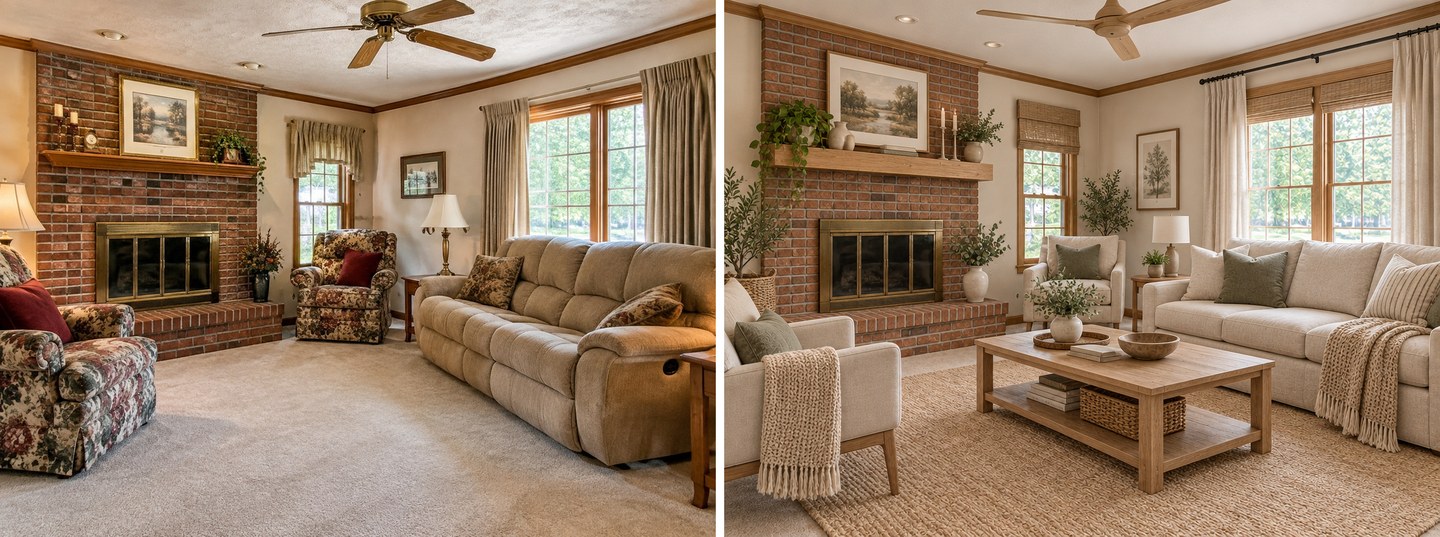
This is a practical step-by-step process. You can stop at any step and still see improvement — each one moves the room closer to modern.
Step 1: Declutter and Edit (Weekend 1)
Remove everything that is not structural or essential. Clear all surfaces. Take everything off the walls. Store it in another room — do not throw it away yet. Live with the empty room for 3-5 days. You will notice what you actually miss (put it back) and what you do not (donate or sell it).
Step 2: Neutralize the Walls (Weekend 2)
Paint walls in one of the base whites or grounding neutrals from the color palette above. One color for the entire room — no accent walls yet. If you have textured walls (orange peel, knockdown), consider skimming with joint compound to create flat surfaces — $1.50-3.00 per square foot from a drywall contractor.
Step 3: Address the Floor (Weekend 3-4)
If you have carpet, remove it. Modern design almost never uses wall-to-wall carpet. Budget options ranked by cost:
- Expose and refinish existing hardwood ($3-6/sq ft)
- Luxury vinyl plank in wide oak pattern ($2-5/sq ft installed)
- Polished concrete (if on slab, $3-8/sq ft)
- Engineered white oak hardwood ($6-12/sq ft installed)
Step 4: Replace Lighting (Weekend 5)
Swap boob lights (the standard flush-mount dome) with recessed LED downlights ($150-250 per light installed) or minimal flush fixtures. Add one statement pendant or floor lamp. Install dimmer switches on every circuit — $15-30 per switch, DIY installation.
Step 5: Upgrade Key Furniture (Weeks 6-10)
You do not need to replace everything. Focus on the three most visible pieces:
- The sofa. A clean-lined, low-profile sofa in grey, taupe, or ivory. Budget $1,200-3,000 for a quality modern sofa (Article, Interior Define, West Elm).
- The dining table. A rectangular or oval table in walnut, glass, or marble. Minimal base. Budget $500-2,000.
- The bed frame. A low platform bed in wood or upholstered fabric. No footboard. Budget $400-1,500.
Step 6: Add Modern Details (Week 11-12)
- Hardware: Replace all cabinet pulls and door handles with flat-bar or round-bar pulls in matte black or brushed nickel ($3-8 per pull).
- Textiles: One area rug in a solid neutral or subtle geometric. One throw blanket. Minimal pillows.
- Art: One or two large-scale pieces — abstract, photographic, or architectural. No gallery walls of 15 small frames.
- Plants: Two to three large plants in simple pots.
Step 7: Visualize Before Committing
Before purchasing major furniture or making structural changes, upload a photo of your room to GenRoom's AI room designer. You can preview multiple modern configurations — different furniture layouts, color schemes, and material combinations — without spending a dollar. This is particularly useful for open-plan spaces where the relationships between zones are difficult to imagine without visualization.
Budget Guide: Modern Design at Every Price Point
Tier 1: Essentials Only — $2,000-5,000 per room
Focus on paint, decluttering, lighting, and small hardware changes. Keep existing furniture but remove anything that actively clashes (ornate, heavily decorated, or visually heavy pieces).
| Item | Budget |
|---|---|
| Paint (walls + ceiling) | $200-400 |
| Lighting swap (3-5 fixtures) | $300-600 |
| Hardware replacement (pulls, knobs) | $100-200 |
| One statement rug (8x10) | $300-800 |
| Declutter + reorganize supplies | $50-100 |
| Two plants + modern pots | $100-250 |
| Minimal art (1-2 prints, framed) | $200-500 |
| Textiles (throw, pillows, linens) | $150-400 |
| Window treatment update | $200-500 |
| Total | $1,600-3,750 |
Tier 2: Significant Update — $8,000-20,000 per room
Replace key furniture, add built-in storage, and make moderate structural changes (removing a non-load-bearing wall, adding recessed lighting).
| Item | Budget |
|---|---|
| Everything in Tier 1 | $2,000-4,000 |
| New sofa or sectional | $1,500-4,000 |
| New dining table + chairs | $1,000-3,000 |
| New bed frame + nightstands | $800-2,500 |
| Built-in or wall-mounted shelving | $500-2,000 |
| Recessed lighting installation (8-12 lights) | $1,200-2,500 |
| One structural change (wall removal, opening) | $1,500-5,000 |
| Total | $8,500-23,000 |
Tier 3: Complete Renovation — $30,000-80,000+ per room
Full gut renovation including flooring, kitchen or bathroom remodel, custom cabinetry, structural modifications, and premium materials.
| Item | Budget |
|---|---|
| Everything in Tier 2 | $10,000-20,000 |
| New flooring throughout | $3,000-12,000 |
| Kitchen remodel (modern cabinets, island, appliances) | $15,000-50,000 |
| Bathroom remodel (floating vanity, frameless shower, stone) | $8,000-25,000 |
| Custom built-ins and millwork | $3,000-10,000 |
| Steel-frame windows or doors | $2,000-10,000 |
| Total | $41,000-127,000 |
Frequently Asked Questions
What makes a room look modern?
Clean lines, uncluttered surfaces, a neutral color palette with restrained accents, natural materials (wood, stone, glass, steel), open space, and abundant natural light. Remove ornate details, heavy window treatments, and excessive decorative objects. A room looks modern when every element present is intentional and functional.
Is modern interior design expensive?
Not inherently. The style is defined by simplicity, which means fewer objects — often making it less expensive than heavily decorated styles. A Tier 1 modern refresh (paint, lighting, hardware, textiles, decluttering) costs $2,000-5,000 per room. The most expensive element is typically flooring replacement, which is optional if you already have hardwood, polished concrete, or quality tile.
What is the difference between modern and contemporary interior design?
Modern refers to a specific historical movement (1920s-1970s modernism) with fixed characteristics: clean geometric lines, form follows function, neutral palette with bold accents, exposed structural materials. Contemporary means "of the current time" and is a moving target — it borrows from multiple movements and changes every 5-10 years. A 1960 modern room looks different from a 2025 contemporary room, even though the terms are used interchangeably in casual conversation.
Can modern design feel warm and cozy?
Yes. The perception of modern design as cold is a misconception based on 1990s-2000s all-white interiors. Modern design uses wood, leather, textured textiles, and warm-toned metals (brass, copper) to create warmth within a clean framework. The 2025 trend of "warm modernism" explicitly prioritizes earthy tones, limewash textures, and soft curves alongside clean lines.
What colors go with modern interior design?
A base of whites (both warm and cool), greys, and blacks. Grounding neutrals like greige, taupe, and warm grey. Accent colors are used sparingly: terracotta, olive, cobalt blue, ochre gold, deep burgundy, and forest green. Apply the 60-30-10 rule — 60% dominant neutral, 30% secondary neutral, 10% accent. See the full color palette table with HEX codes and paint brand equivalents above.
How do I make a small room look modern?
Wall-mount everything (vanity, shelves, TV unit, desk) to reveal maximum floor area. Use one continuous flooring material with no transitions. Paint walls and ceiling the same light neutral. Install full-height doors. Use frameless mirrors to double perceived depth. Choose multifunctional furniture (Murphy bed, extendable console-dining table, storage ottoman). Modern design's emphasis on simplicity and openness naturally benefits small rooms.
What furniture style is considered modern?
Furniture with clean geometric silhouettes, exposed legs (tapered wood or metal), flat-panel surfaces, and honest materials (solid wood, leather, steel, glass). Iconic examples include the Barcelona Chair (Mies van der Rohe, 1929), the Eames Lounge Chair (1956), and the Tulip Table (Saarinen, 1956). Modern furniture avoids carved details, ornate hardware, tufting, skirts, and decorative molding.
How do I transition from traditional to modern design?
Gradually. Start by removing ornate elements: heavy curtains, decorative moldings, carved furniture, patterned wallpaper. Paint walls neutral. Replace lighting fixtures with clean geometric forms. Swap hardware for simple bar pulls. Then replace the most visually dominant furniture pieces (sofa, dining table, bed frame) with modern alternatives. Keep pieces that already have clean lines regardless of their original style — good bones transcend categories.
What is the best flooring for modern interior design?
White oak hardwood (engineered or solid) is the most versatile modern flooring — warm, durable, and timeless. Polished concrete suits industrial-modern spaces. Large-format porcelain tile (24x48 inches or larger, minimal grout lines) works in kitchens and bathrooms. Luxury vinyl plank in wide-plank oak patterns offers the modern look at a fraction of the cost. Avoid small tiles, heavy patterns, and carpet.
Can I mix modern with other design styles?
Yes, but with discipline. Modern serves as an excellent base style. Layer in Scandinavian textiles (sheepskin, wool throws) for warmth. Add mid-century accent pieces (an Eames chair, a Sputnik chandelier) for character. Introduce Japandi elements (wabi-sabi ceramics, low furniture) for tranquility. The rule: keep the modern bones (clean lines, open space, neutral palette) and add no more than 20% elements from one other style.
Start Your Modern Transformation
Modern interior design works because it respects fundamentals — proportion, light, space, and material honesty. These principles do not go out of style. Whether you invest $2,000 in paint and lighting or $80,000 in a full renovation, the result is a space that feels intentional, calm, and built to last.
If you want to see what modern design would look like in your actual space before committing to purchases, try GenRoom's free room design tool. Upload a photo, select the modern style, and get an AI-generated visualization in seconds. It is the fastest way to test ideas without risk — and it is free for your first designs.