Japandi Interior Design: The Complete Guide (Wabi-Sabi Meets Hygge)

See it on your own room: Apply Japandi style to your room photo — free →. AI redesigns your real room in 30 seconds.
Japandi is a design hybrid that merges Japanese minimalism with Scandinavian functionality. It takes the wabi-sabi acceptance of imperfection from Japan, pairs it with the hygge-driven warmth of Nordic interiors, and produces rooms that feel calm, crafted, and deeply livable. Google Trends data shows "japandi interior design" searches grew 340% between 2020 and 2025, making it the fastest-rising style category in the home design space.
This is not another mood board article. Below you will find exact HEX color codes with paint brand equivalents, a room-by-room implementation guide, a furniture table with real designers and price ranges, a four-style comparison matrix, three budget tiers with specific costs, and a step-by-step transformation plan. If you want to see how Japandi would look in your own room before committing, try GenRoom's AI room designer — upload a photo and get a visualization in under 30 seconds.
What Is Japandi Design?
Japandi is the intersection of two design traditions separated by 5,000 miles but united by core beliefs: less is more, nature is the best designer, and a home should serve the people who live in it.
The term gained traction around 2017 when Western design media began recognizing the visual overlap between Danish mid-century furniture and Japanese woodworking traditions. But the philosophical connection runs deeper. Both cultures developed their aesthetic responses to harsh environments — Scandinavians to dark, cold winters that demanded cozy, light-filled interiors; Japanese to small living spaces that required discipline, order, and multi-functional design.
The five pillars of Japandi design:
- Intentional simplicity. Every object in the room earns its place. Decoration for decoration's sake is rejected by both traditions.
- Natural materials. Wood, stone, linen, cotton, wool, ceramic, and bamboo dominate. Synthetics are minimized.
- Muted color palettes. Earth tones, warm neutrals, and desaturated accents. No bright primaries, no high-contrast feature walls.
- Craftsmanship over mass production. Handmade ceramics, joinery furniture, woven textiles — objects with visible maker's marks and slight irregularities.
- Functional beauty. If it is beautiful but useless, it does not belong. If it is useful but ugly, it does not belong either. Japandi demands both.
The result is a style that photographs as minimal but lives as warm. Rooms feel spacious without feeling empty, ordered without feeling sterile, and sophisticated without feeling cold.
Wabi-Sabi and Hygge: The Two Philosophies Behind Japandi
Japandi is not just a visual style — it is the product of two philosophies that, despite originating in different hemispheres, arrived at remarkably similar conclusions about what makes a space feel right.
Wabi-Sabi: Finding Beauty in Imperfection
Wabi-sabi is a Japanese aesthetic worldview rooted in three Buddhist principles: nothing lasts, nothing is finished, nothing is perfect. In interior design, this translates to:
- Aged materials over new ones. A reclaimed wood table with visible grain, knots, and weathering is more desirable than a flawless lacquered surface.
- Handmade over factory-made. A ceramic bowl with an uneven rim, made on a potter's wheel, carries more value than a geometrically perfect mass-produced piece.
- Patina over polish. Brass that has oxidized to a green-brown tone. Leather that has softened and darkened with use. Linen that has become softer with every wash.
- Asymmetry over symmetry. An odd number of objects on a shelf. A branch arrangement that leans left. Space that breathes unevenly.
In practical terms, wabi-sabi gives you permission to stop chasing perfection. The crack in the plaster becomes a feature. The chip in the teacup tells a story.

Hygge: The Art of Cozy Comfort
Hygge (pronounced "hoo-gah") is a Danish concept with no direct English translation. It describes a feeling — the warmth of a candlelit dinner with friends, the comfort of a wool blanket on a rainy afternoon, the satisfaction of a well-organized shelf of books.
In interior design, hygge manifests as:
- Soft, layered lighting. Multiple warm light sources (2700K-3000K) instead of a single overhead fixture. Candles are central, not decorative.
- Tactile textiles. Chunky knit throws, linen cushion covers, sheepskin rugs — surfaces that invite touch.
- Warm wood tones. Light oak, ash, and birch in their natural state, never painted or veneered over particle board.
- Gathering spaces. Furniture arranged for conversation, not television viewing. Round tables over rectangular ones. Benches that encourage closeness.
Where wabi-sabi is philosophical, hygge is emotional. It does not ask "Is this perfect?" but rather "Does this feel good?"
How They Merge in Japandi
The fusion works because the two philosophies fill each other's gaps:
| Aspect | Wabi-Sabi Alone | Hygge Alone | Japandi Fusion |
|---|---|---|---|
| Temperature | Can feel austere | Can feel cluttered | Warm but edited |
| Color | Very muted, almost monochrome | Whites with warm accents | Earthy neutrals with depth |
| Texture | Raw, rough | Soft, plush | Both — rough wood meets soft linen |
| Objects | Sparse | Abundant (candles, books, throws) | Curated — fewer pieces, each with purpose |
| Mood | Contemplative | Social | Quietly comfortable |
Japandi takes wabi-sabi's restraint and adds hygge's warmth. It takes hygge's comfort and applies wabi-sabi's editing. The result is a room that a Japanese architect and a Danish furniture designer would both feel at home in.
Japandi Color Palette: Exact Shades to Use

The Japandi palette is rooted in nature: stone, sand, clay, moss, bark, charcoal. Colors are desaturated, never bright. The mood is quiet. Walls recede. Furniture and objects carry the visual weight.
Base Colors (Walls and Large Surfaces)
| Color Name | HEX Code | Benjamin Moore | Farrow & Ball | Use |
|---|---|---|---|---|
| Warm White | #F5F0EB | White Dove OC-17 | Pointing No.2003 | Primary wall color, ceilings |
| Parchment | #E8DFD1 | Muslin OC-12 | Joa's White No.226 | Feature walls, larger rooms |
| Warm Sand | #D4C8B8 | Shaker Beige HC-45 | Oxford Stone No.264 | Accent walls, built-ins |
| Soft Greige | #C4B9A8 | Pashmina AF-100 | Elephant's Breath No.229 | Kitchen cabinetry, millwork |
| Pale Clay | #BFA98F | Cabot Trail CC-424 | Dead Salmon No.28 | Earthy accent, powder rooms |
Accent Colors (Furniture, Textiles, Ceramics)
| Color Name | HEX Code | Sherwin-Williams | Use |
|---|---|---|---|
| Soot Black | #2C2C2C | Tricorn Black SW 6258 | Metal frames, light fixtures, accent furniture |
| Charcoal | #4A4A48 | Iron Ore SW 7069 | Upholstery, cabinet hardware |
| Forest Moss | #6B7E5E | Dried Thyme SW 6186 | Throw pillows, ceramic glazes, plants |
| Rust Ochre | #B07942 | Antiquarian Brown SW 0045 | Leather accents, terracotta pots |
| Slate Blue | #7A8B97 | Serious Gray SW 6256 | Linen bedding, stoneware |
| Deep Indigo | #3A4556 | Naval SW 6244 | Small accents only — a single vase, a book spine |
Color Rules for Japandi
The 60-30-10 rule adapted for Japandi:
- 60% warm whites and parchment — walls, ceilings, large rugs
- 30% mid-tones (sand, greige, clay) — furniture frames, cabinetry, curtains
- 10% dark and accent tones — soot black hardware, a moss green throw, a rust ochre ceramic
What to avoid:
- Pure white (#FFFFFF) — too clinical, breaks the warmth
- Cool grays with blue undertones — shifts the mood from Japanese-Scandinavian to industrial
- Saturated colors in large quantities — a bright yellow cushion fights the serenity
- More than two accent colors in one room — edit ruthlessly
Essential Japandi Materials and Textures

Materials are not just surfaces in Japandi design — they are the design. The philosophy values honest materials that show their nature: visible wood grain, the weave of a linen cloth, the irregular glaze of a hand-thrown bowl.
Wood: The Defining Material
Wood is the backbone of both Japanese and Scandinavian interiors, but each tradition favors different species and finishes. Japandi combines them:
Light woods (Scandinavian influence):
- White oak — honey-toned, tight grain, extremely durable. The default Japandi flooring and furniture wood.
- Ash — lighter than oak with a more pronounced grain. Ideal for dining tables and shelving.
- Birch — pale with a subtle golden warmth. Used in plywood forms (Aalto-style) and smaller objects.
Dark woods (Japanese influence):
- Walnut — rich chocolate brown with swirling grain. Used for statement furniture — a credenza, a bed frame, a low coffee table.
- Teak — warm amber with an oily feel. Common in mid-century pieces that cross-pollinate with Japandi.
- Shou sugi ban (charred cedar) — wood burned black on the surface for preservation and texture. Used on feature walls, exterior cladding, or a single accent piece.
The contrast principle: Japandi rooms almost always pair a light wood with a dark one. A white oak floor grounds a walnut dining table. An ash bookshelf displays objects on a shou sugi ban accent wall. This light-dark interplay prevents the room from reading as either too airy (pure Scandi) or too heavy (pure Japanese).
Fabrics and Textiles
- Linen — the primary Japandi textile. Used for curtains, bedding, cushion covers, and table runners. Always in natural or garment-dyed colors (oat, stone, sage).
- Cotton canvas — heavier weight for upholstery. Japanese-woven cotton (kofu) or Scandinavian heavy-grade cotton.
- Wool — boucle and chunky knits for throws and rugs. Merino or lambswool in undyed or muted tones.
- Hemp and jute — for area rugs, baskets, and woven wall hangings. Adds texture without pattern.
What Japandi avoids in textiles: velvet (too luxurious), silk (too formal), synthetic microfiber (too artificial), busy prints (too distracting).
Ceramics and Stone
- Stoneware in matte or semi-matte glazes — speckled, reactive glazes with visible kiln marks. Think Hasami Porcelain or Studio Arhoj.
- Terracotta — unglazed pots, planters, and decorative objects. The warm orange-brown adds earthiness.
- Natural stone — limestone, travertine, and slate for countertops, bathroom floors, and decorative trays. Honed finish (matte), never polished.
- Concrete — used sparingly for planters, side tables, or a bathroom vanity. Must be sealed and have a warm-toned aggregate.
Metals
Japandi uses metals minimally and purposefully:
- Matte black iron — light fixtures, shelf brackets, cabinet pulls. The dominant Japandi metal.
- Brushed brass — aged or unlacquered, so it develops patina. Used for faucets, small hardware, a single pendant light.
- Avoid: chrome, polished nickel, rose gold, or any high-shine finish. Japandi metals are quiet.
Room-by-Room Japandi Design Guide
Living Room
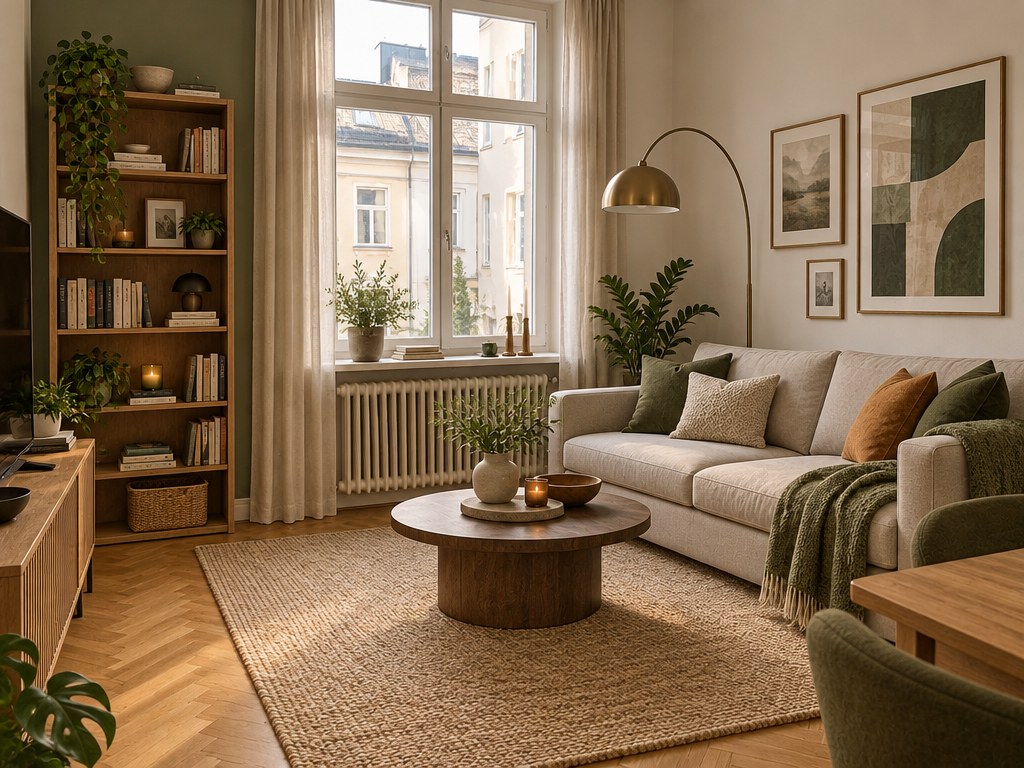
The Japandi living room is the most lived-in space and therefore needs to balance serenity with genuine comfort. It is not a showroom — it is where you read, talk, nap, and stare out the window.
Key elements:
- Low-profile sofa (seat height 35-40 cm / 14-16 inches). Japanese interiors sit low; Scandinavian sofas are already lower than American ones. Choose a clean-lined frame in white oak or walnut with linen or boucle upholstery in warm gray, oatmeal, or sage.
- Round coffee table. Soft shapes are central to Japandi — they echo the Japanese concept of "marumi" (roundness) and the Scandi preference for organic forms. Light oak or travertine, 80-100 cm diameter, low to the ground (30-35 cm).
- Floor-to-ceiling linen curtains in warm white or parchment. Never heavy drapes, never venetian blinds. The fabric should filter light diffusely, like a shoji screen.
- A single statement ceramics piece on the coffee table or shelf. Not a collection — one vase, one bowl, one sculptural object.
- Built-in or low-profile storage. Japanese tansu-style chests or Scandinavian sideboards keep clutter invisible.
- Plants — 2-3 maximum in a medium living room. A fiddle-leaf fig, a rubber plant, or a Japanese maple bonsai. No plant jungle — that is a different aesthetic.
Layout rule: Leave at least 30% of floor space visible. If the rug, furniture, and objects cover more than 70% of the floor, the room will feel cluttered regardless of style.
Bedroom

The Japandi bedroom is the simplest room in the house. It is designed for sleep, and everything that does not serve that purpose is removed.
Key elements:
- Platform bed with no visible legs or a very low frame (20-25 cm from floor to mattress top before bedding). Solid wood — walnut for drama, oak for calm. No headboard, or a minimal slatted headboard in the same wood.
- Linen bedding in oatmeal, warm white, or light stone. Layer with a single wool throw at the foot. Two to three pillows maximum — not the decorative pillow fortress of traditional Western bedrooms.
- Bedside tables — one on each side, different heights or styles for asymmetry (wabi-sabi principle). A simple wood stool on one side and a wall-mounted shelf on the other.
- Paper pendant lamps — Noguchi Akari or similar rice paper lanterns are the quintessential Japandi bedroom light. Soft, diffused, warm.
- No television. This is non-negotiable in a true Japandi bedroom. If you must, conceal it in a cabinet.
- Closet system hidden behind sliding panels or a linen curtain. Visible clothing storage disrupts the calm.
Color rule for bedrooms: Reduce the palette to three colors maximum. Walls in warm white, wood in one species, textiles in one muted tone. The brain registers fewer visual signals, and sleep quality improves.
Kitchen

The Japandi kitchen is the most functionally demanding room to design in this style, because kitchens require visible storage, hardware, and appliances. The goal is to make the functional beautiful.
Key elements:
- Flat-panel (slab) cabinets in light oak veneer or painted in soft greige (#C4B9A8). No shaker profiles, no glass fronts. Integrated handles (J-pull or push-to-open) or minimal matte black bar pulls.
- Open shelving on at least one wall — but only for curated items: matching stoneware bowls, a few glass jars, a wooden cutting board leaning against the wall. If your shelves become a dumping ground, close them behind doors.
- Countertops in honed natural stone (Caesarstone Primordia or Taj Mahal quartzite) or matte porcelain slab. No glossy granite, no busy veining.
- Matte black or brushed brass faucet. No chrome.
- Integrated or panel-ready appliances. The refrigerator should disappear behind a cabinet panel. The range hood should be minimal — a slim under-cabinet model or a hidden downdraft.
- A wood element — if cabinets are painted, add a thick oak countertop on the island. If cabinets are oak, add a contrasting walnut floating shelf.
Japandi kitchen mistake to avoid: the "Instagram kitchen" with zero objects on the countertop. Real kitchens have a kettle, a salt cellar, a fruit bowl. Japandi allows a few beautiful functional objects to live on surfaces — it just asks that they be chosen with care.
Bathroom

Water, stone, and wood — the Japanese bathing tradition (onsen culture) aligns almost perfectly with the Scandinavian love of spa-like wet rooms. This is the room where Japandi feels most natural.
Key elements:
- Freestanding soaking tub if space allows. Japanese ofuro-style (deeper, shorter) or a modern oval in matte white composite. If only a shower, use frameless glass with a teak or cedar shower bench.
- Natural stone floor tiles — limestone or travertine in large format (60x60 cm), honed matte. Heated floor underneath (both cultures value warmth underfoot).
- Wood vanity — floating, in teak or white oak with a live edge or waterfall detail. Sealed for moisture resistance.
- Matte black fixtures — wall-mounted faucet, rain showerhead, towel hooks. Minimal, geometric.
- Towels in warm white or oatmeal, waffle-weave cotton or linen. Rolled, not folded, stored on an open wood shelf.
- A single green plant — a fern, a pothos, or a Japanese peace lily. Bathrooms with plants feel like spas; bathrooms without plants feel clinical.
Avoid: patterned tiles, mirrored medicine cabinets with lighting strips, chrome fixtures, plastic accessories. Every surface should feel like something you would find in nature.
Small Spaces and Studios

Japandi is arguably the best interior style for small spaces. Japanese design was born in small spaces (the average Tokyo apartment is 65 sq m / 700 sq ft). Scandinavian design evolved in compact Nordic homes. Both traditions have centuries of practice in making limited square footage feel spacious.
Key strategies:
- Multi-functional furniture. A platform bed with built-in drawers. A dining table that folds against the wall (like a traditional Japanese chabudai). A bench that stores blankets.
- Sliding panels instead of swinging doors. Shoji-style screens or solid wood sliding doors save the arc space that hinged doors consume.
- Vertical storage. Floor-to-ceiling built-in shelving along one wall. Hooks on walls for bags and coats. Wall-mounted desks that fold up.
- Light colors on walls, dark accents on furniture. This creates depth without closing in the space.
- One statement piece per room zone. In a studio, designate zones (sleep, work, eat, relax) and allow one visually significant object per zone. Everything else fades to background.
- Mirrors — a single large mirror (frameless or in a simple light wood frame) to double perceived space. Position it opposite the largest window.
Studio layout tip: Place the bed area farthest from the entrance and separate it with a low bookshelf (120-140 cm height) that acts as both a room divider and storage. This creates the illusion of a one-bedroom layout without walls.
Create interior design with AI
Upload a photo of your room and get a professional design in 30 seconds. First generation is free.
Iconic Japandi Furniture and Where to Find It

Japandi furniture shares three qualities: low profiles, visible wood joinery, and restrained forms. Below are the iconic pieces and modern alternatives at different price points.
| Piece | Designer / Brand | Era | Price Range (USD) | Why It's Japandi |
|---|---|---|---|---|
| CH24 Wishbone Chair | Hans Wegner / Carl Hansen | 1949 | $700-$900 | Paper cord seat + steam-bent oak = Scandi craft meets Japanese materiality |
| Akari Light Sculptures | Isamu Noguchi / Vitra | 1951 | $250-$2,500 | Washi paper + bamboo. Literally Japanese-American-Scandinavian fusion |
| PP Mobler pp68 Chair | Hans Wegner | 1987 | $1,200-$1,500 | Exposed mortise-and-tenon joints echo Japanese joinery |
| Karimoku Case Study Shelf | Karimoku | 2020s | $800-$1,500 | Japanese oak, modular, minimal hardware |
| Platform Bed Frame | Floyd / Thuma | Modern | $800-$1,400 | Japanese-height platform, tool-free Scandinavian-inspired joinery |
| Low Round Coffee Table | Ethnicraft (Teak Circle) | Modern | $900-$1,200 | Solid teak, 30 cm height, organic round form |
| Tansu Step Chest | Traditional Japanese | Historical | $400-$3,000 | Multi-drawer staircase cabinet — functional sculpture |
| Muuto Outline Sofa | Anderssen & Voll | 2016 | $4,500-$7,000 | Clean Scandinavian lines, low seat, exposed aluminum base |
| Sori Yanagi Butterfly Stool | Sori Yanagi | 1954 | $400-$600 | Bent plywood + brass rods — Japan's answer to Eames |
| String Shelf System | Nisse Strinning | 1949 | $200-$800 | Wire-frame modular shelving, Swedish icon |
Budget Alternatives
You do not need $7,000 sofas to achieve Japandi. Here are brands that deliver the aesthetic at accessible prices:
- IKEA — Stockholm collection (solid walnut), Lisabo series (ash), Sinnerlig (cork and bamboo by Ilse Crawford). Budget: $50-$800.
- Article — Ceni, Burrard, and Seno lines. Clean shapes, warm wood, competent upholstery. Budget: $300-$2,000.
- Target (Threshold Studio McGee) — surprisingly good matte black hardware, stoneware, and wood accent furniture. Budget: $15-$500.
- Muji — the definitive Japanese everyday design brand. Storage boxes, shelving, bedding, tableware. Budget: $5-$400.
- H&M Home — linen bedding, stoneware, candles, wood trays. Budget: $10-$150.
Japandi vs Scandinavian vs Minimalist vs Wabi-Sabi
Understanding Japandi requires understanding what it is not. Here is a side-by-side comparison across eight dimensions:
| Dimension | Japandi | Scandinavian | Minimalist | Wabi-Sabi |
|---|---|---|---|---|
| Origin | Fusion (2010s) | Nordic countries (1950s) | International (1960s) | Japan (15th century) |
| Core Philosophy | Imperfect warmth | Democratic functionality | Less is more | Beauty in imperfection |
| Color Palette | Warm neutrals + earth tones | Cool whites + pastels | Monochrome (black/white/gray) | Earth tones + aged surfaces |
| Wood Tones | Light AND dark (contrast) | Light only (oak, birch, ash) | Any, often painted/lacquered | Dark, weathered, reclaimed |
| Typical Furniture Height | Low (30-40 cm tables) | Standard to low | Varies | Floor-level (zabuton, chabudai) |
| Clutter Tolerance | Very low | Low to moderate | Zero | Low (but asymmetric) |
| Decorative Objects | Few, handcrafted | Moderate (candles, throws) | Almost none | Few, imperfect, aged |
| Textiles | Linen, wool, cotton | Wool, sheepskin, cotton | Minimal | Hemp, cotton, raw silk |
| Lighting | Warm, layered, paper lanterns | Warm, candles dominant | Architectural, hidden | Natural light preferred |
| Nature Connection | High (materials + plants) | High (materials + light) | Low | Very high (materials + philosophy) |
| DIY Friendly | Moderate | High (IKEA culture) | Easy (remove things) | Difficult (requires patina/time) |
| Budget Entry Point | $2,000-$5,000 per room | $1,000-$3,000 per room | $500-$2,000 per room | $1,500-$4,000 per room |
Key takeaway: If you love Scandinavian design but find it too cool and light, Japandi adds warmth and depth. If you love minimalism but find it cold, Japandi adds soul. If you love wabi-sabi but find it too sparse, Japandi adds comfort.
For a deep dive into the Nordic side of this equation, see our Scandinavian design guide. For the pared-back end of the spectrum, explore minimalist design.
Japandi Design Trends for 2026-2027

Japandi is evolving. The 2020-era version was dominated by beige and black — handsome but predictable. The 2026-2027 iteration introduces more texture, more nature, and more technology hidden behind the simplicity.
1. Biophilic Integration Goes Beyond Potted Plants
Biophilic design — architecture that embeds nature into the built environment — is merging with Japandi in structural ways:
- Living walls in bathrooms and kitchens using preserved moss panels (no maintenance, no watering). Brands like Scandia Moss and Artisan Moss offer custom panels starting at $150/sq ft.
- Indoor water features — a recirculating stone basin in an entryway or a small bamboo shishi-odoshi (deer-scarer fountain) as a sound element. Starting at $200 for tabletop models.
- Natural light wells and skylights — renovation projects increasingly include tubular skylights (Solatube, $500-$1,500 installed) to bring daylight into interior rooms.
- Wood-ceiling beams — exposed structural or decorative beams in light oak or cedar across flat white ceilings. This adds warmth overhead, something previous Japandi iterations left blank.
2. Textured Walls Replace Flat Paint
The flat-painted wall is giving way to surfaces with depth:
- Limewash paint (Portola, Bauwerk, JH Wall Paints) creates a chalky, cloudy texture with natural color variation. A single coat looks like aged Italian plaster. Cost: $80-$120/gallon, covers ~400 sq ft.
- Microcement (Topciment, Ideal Work) on accent walls — seamless, tactile, available in Japandi-friendly colors. Cost: $15-$30/sq ft installed.
- Clay plaster (Clayworks, American Clay) — the most natural option. Absorbs humidity, creates an organic, slightly uneven surface. Cost: $12-$25/sq ft installed.
- Shou sugi ban accent panels — charred wood installed as a vertical feature wall behind a bed or fireplace. Cost: $15-$40/sq ft for panels.
3. Smart Technology Disappears Into the Design
Japandi and smart home technology are not opposites — the key is hiding the tech:
- Invisible speakers (Sonos In-Wall, Bowers & Wilkins CI) built into walls or ceilings, covered with plaster. Sound without visible hardware.
- Motorized linen roller shades (Lutron, IKEA Fyrtur) controlled by app or voice. The fabric looks analog; the mechanism is hidden.
- LED strip lighting behind floating shelves — indirect warm light (2700K) that mimics candlelight. No visible fixtures.
- Panel-integrated chargers — wireless charging pads built into nightstands and desk surfaces. No visible cables, no charging stations.
4. Curved and Organic Furniture Forms
The strict rectangles of early Japandi are softening:
- Arched doorways and niches — renovations are rounding off rectangular openings. A simple plaster arch over a bookshelf niche costs $200-$500 in drywall work.
- Curved sofas and chairs — the 2025 market favors kidney-shaped sofas, barrel chairs, and egg chairs. Brands like Ligne Roset, Gubi, and Ferm Living lead this shift.
- Oval and irregular dining tables — replacing the rectangular standard. Ethnicraft's Ellipse table and HAY's CPH30 in round format are current bestsellers.
- Soft-edge mirrors — asymmetric, organic-shaped mirrors (Ferm Living Pond series, $150-$400) replace sharp rectangles.
How to Transform Your Room to Japandi Style
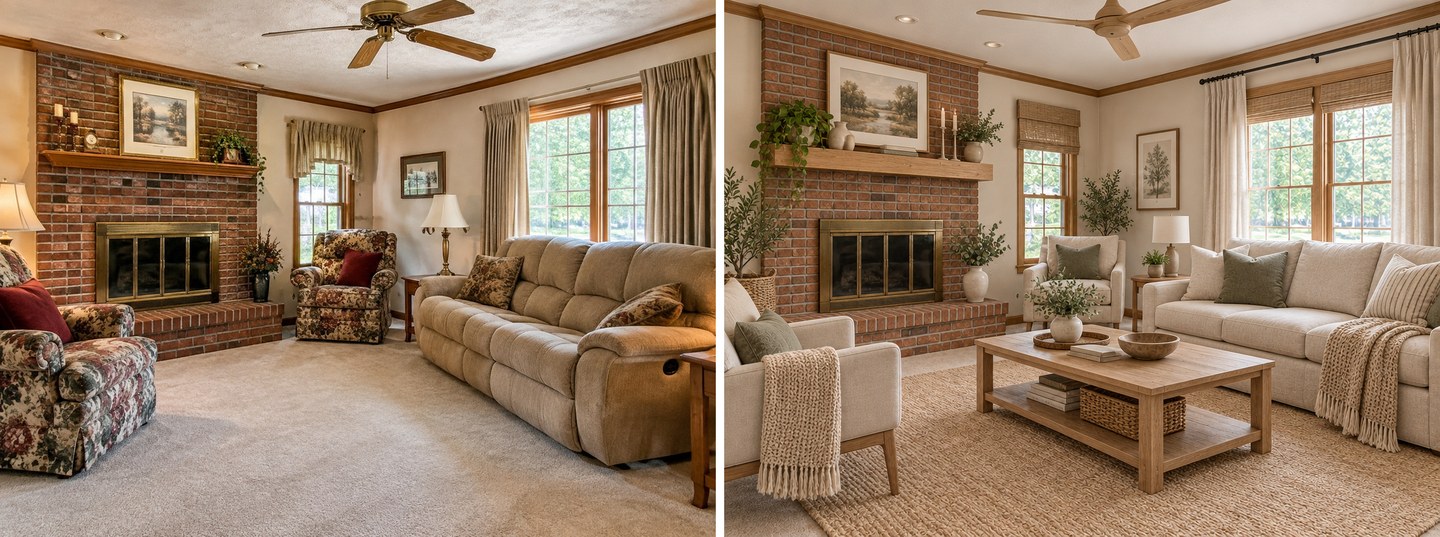
You do not need to gut-renovate. A Japandi transformation can happen in stages, starting with removal and ending with selective addition. Here is the process:
Step 1: Audit and Remove (Weekend 1)
Walk through the room with a box. Remove:
- Every decorative object that has no function or emotional significance
- Throw pillows beyond two per seating area
- Anything plastic, chrome, or high-gloss
- Patterned textiles with more than two colors
- Art in ornate or metallic frames
- Synthetic plants (real or nothing)
- Cable clutter — bundle and hide behind furniture
Target: remove 40-60% of visible objects. Japandi begins with subtraction.
Step 2: Repaint (Weekend 2)
Paint walls in warm white (#F5F0EB) or parchment (#E8DFD1). One coat of Benjamin Moore White Dove over most existing wall colors transforms the baseline. If you want texture, use limewash instead of standard latex.
Budget: $150-$300 for an average room (paint + supplies).
Step 3: Replace or Edit Lighting (Weekend 3)
Remove overhead fluorescent or cool-white LEDs. Replace with:
- One pendant light in paper, wood, or matte black metal
- One floor lamp with a linen shade or exposed filament bulb (2700K)
- Candles — at least three per room for evening ambiance
Budget: $100-$500 depending on pendant choice.
Step 4: Layer Natural Textiles (Weekend 4)
- Replace synthetic curtains with floor-to-ceiling linen panels
- Add a wool or jute area rug in a muted tone
- Swap polyester cushion covers for linen or cotton canvas
- Add one quality throw blanket in wool or waffle-knit cotton
Budget: $200-$600.
Step 5: Introduce One Statement Furniture Piece
This is where the transformation becomes visible. Choose one of:
- A low-profile oak or walnut coffee table
- A wood credenza or media console to replace a generic TV stand
- A set of dining chairs (Wishbone-style or similar)
- A platform bed frame
Budget: $300-$2,000 depending on the piece.
Step 6: Add Curated Objects
Now, and only now, add back three to five decorative objects:
- A handmade ceramic vase
- A wooden tray or bowl
- A single framed print (Japanese ink wash or Scandinavian line art) in a simple oak frame
- A green plant in a terracotta or stoneware pot
- A stack of two to three books on a topic you genuinely care about
Before you commit to buying furniture, you can visualize exactly how Japandi would look in your space. Upload a photo of your room to GenRoom's AI room designer and select the Japandi style — you will see a realistic transformation in seconds, which helps you decide on colors, furniture scale, and layout before spending anything.
Budget Guide: Japandi on Any Budget
Real numbers for transforming a standard 15-20 sq m (160-215 sq ft) living room. Prices are US market averages as of 2025.
Tier 1: Budget Japandi ($500-$1,500)
| Item | Source | Cost |
|---|---|---|
| Wall paint — warm white (1 gallon) | Benjamin Moore White Dove | $80 |
| Linen curtain panels (pair) | IKEA Dytag or H&M Home | $40-$80 |
| Jute area rug (160x230 cm) | IKEA Lohals | $80 |
| Linen cushion covers (x4) | H&M Home or Muji | $40-$60 |
| Waffle-knit throw blanket | Target Threshold | $30-$50 |
| Ceramic vase (handmade) | Etsy artisan or TJ Maxx | $25-$60 |
| Matte black shelf brackets + wood shelf | Home Depot + lumber | $40-$80 |
| Paper pendant lamp | IKEA Regolit or Noguchi knock-off | $10-$50 |
| Indoor plant + terracotta pot | Local nursery | $20-$40 |
| Total | $365-$580 |
This tier replaces textiles, lighting, and accessories while keeping existing furniture. The impact is substantial — a warm white repaint alone changes 80% of the visual field.
For more room-specific inspiration at this price point, Decoreixy's roundup of 15 Japandi living room ideas on a budget shows how to make each budget change read as intentional rather than cheap.
Tier 2: Mid-Range Japandi ($2,000-$5,000)
Everything in Tier 1 plus:
| Item | Source | Cost |
|---|---|---|
| Low-profile oak coffee table | Article Lenia or Floyd | $400-$800 |
| Wood credenza / media console | Article Nera or IKEA Stockholm | $300-$900 |
| Boucle or linen sofa (2-3 seat) | Article Ceni or IKEA Ektorp reupholstered | $800-$1,800 |
| Wool area rug (200x300 cm) | Ruggable or West Elm | $300-$600 |
| Quality pendant lamp | Muuto Rime or Menu Torso | $200-$500 |
| Additional Total | $2,000-$4,600 |
This tier introduces Japandi furniture while maintaining the textile and color updates. It delivers a cohesive room that reads as intentionally designed.
Tier 3: Premium Japandi ($8,000-$15,000+)
Everything in Tier 2, replacing key pieces with investment items:
| Item | Source | Cost |
|---|---|---|
| Designer sofa | Muuto Outline or Fredericia Calmo | $4,500-$7,000 |
| Wishbone dining chairs (x4) | Carl Hansen CH24 | $2,800-$3,600 |
| Noguchi Akari floor lamp | Vitra authorized | $500-$1,200 |
| Custom oak built-in shelving | Local carpenter | $1,500-$4,000 |
| Limewash wall finish | Professional application | $800-$2,000 |
| Handmade ceramics collection | Studio Arhoj, Hasami, or Jono Smart | $300-$800 |
| Additional Total | $10,400-$18,600 |
This tier is for lifers — people who want a room that will look better in ten years than it does today. Every piece is repairable, refinishable, and designed to develop patina.
Frequently Asked Questions
Is Japandi just a trend, or is it a lasting style?
Japandi is built on two of the most enduring design traditions in history — Japanese aesthetics (rooted in centuries of Zen philosophy) and Scandinavian modernism (70+ years strong). Trend cycles come and go, but the underlying principles — natural materials, functional simplicity, warm neutrals — have been relevant for decades and show no signs of fading. What may change is the name; the aesthetic will persist.
What is the difference between Japandi and Scandinavian design?
Scandinavian design is lighter, cooler, and more permissive with decorative objects (candles, throws, books on every surface). Japandi tightens the editing, adds Japanese elements like low-profile furniture, dark wood contrasts, and wabi-sabi imperfection. Think of Japandi as Scandinavian design that has studied in Kyoto. See our detailed Scandinavian design guide for the full comparison.
Can I mix Japandi with other styles?
Yes, but selectively. Japandi blends well with mid-century modern (shared era, similar wood tones), organic modern (overlapping material palette), and bohemian (both value handmade textiles). It clashes with industrial (too raw, too much metal), maximalist (opposing philosophy), and coastal (too bright, too many blues). When mixing, let Japandi be the base layer — 80% Japandi, 20% accent style.
Is Japandi good for families with children?
Absolutely. Both Japanese and Scandinavian design evolved in family homes, not bachelor lofts. The emphasis on durable natural materials (solid wood resists wear, linen gets softer with washing), low furniture (safe for small children), and clutter-free systems (everything has a storage place) makes Japandi one of the most practical family styles. The key adjustment: choose washable slipcovers over fixed upholstery, and add a designated toy storage zone with baskets that match the aesthetic.
What flooring works best for Japandi?
Wide-plank white oak is the gold standard — boards at least 18 cm (7 inches) wide, matte or satin finish, light to honey toned. Engineered hardwood works as well as solid for Japandi purposes and handles humidity better. Second choice: large-format natural stone tile (limestone, travertine) in kitchens and bathrooms. Avoid: laminate with a printed wood pattern, dark-stained hardwood, high-gloss finishes, small-format tiles in living areas.
How do I make Japandi work in a rental apartment?
Focus on what you can change without landlord permission: textiles (curtains, bedding, rugs, cushion covers), lighting (swap overhead fixtures if you keep the originals), removable wall treatments (peel-and-stick limewash-effect paper from brands like Tempaper), furniture, and decorative objects. Even without repainting, replacing textiles and adding two or three wood-and-linen pieces transforms the feel of a room. For instant visualization of what is possible, upload your rental room to our free room design tool.
What plants are best for Japandi interiors?
Choose structural, sculptural plants over trailing vines or colorful flowers. Top picks: fiddle-leaf fig (tall, architectural), snake plant (vertical, low-maintenance), rubber plant (glossy dark leaves), Japanese peace lily (flowering but minimal), bonsai (literally Japanese, high commitment). Avoid: trailing pothos cascading from shelves (too bohemian), bright flowering orchids (too formal), succulents in painted pots (too trendy). Pots should be terracotta, matte stoneware, or a simple concrete cylinder.
How is Japandi different from minimalism?
Minimalism strips a room to pure function and often results in cold, monochrome spaces with no warmth or personality. Japandi strips a room to intentional objects and then adds warmth through natural materials, soft textures, and handmade imperfections. A minimalist room might have a white couch on a white floor with a single chrome lamp. A Japandi room has an oatmeal linen sofa on an oak floor with a paper lantern, a ceramic vase, and a wool throw. Both are sparse, but Japandi is alive. See our modern interior design guide for more style comparisons.
Can I achieve Japandi style using AI design tools?
Yes — and it is one of the best ways to start. AI room visualization tools let you upload a photo of your current space and apply design styles instantly. This helps you test color palettes, furniture placement, and material combinations before purchasing anything. GenRoom's AI room designer includes a Japandi style option that generates photorealistic visualizations in seconds, so you can compare Japandi against other styles and share the results with family or a contractor before committing.
Japandi is a style that rewards patience and restraint. Start by removing rather than adding. Choose materials that will look better with age, not worse. Invest in fewer, better pieces rather than filling a room all at once. And when in doubt, ask the simplest Japandi question: does this object earn its place in the room? If the answer is not an immediate yes, the answer is no.
For more design inspiration, browse our AI-generated Japandi bedroom ideas and the full design ideas gallery, read the Scandinavian interior design guide, or jump straight to visualizing your own space with the free AI room designer.