Mid-Century Modern Home with AI: The Complete 2026 Design Guide
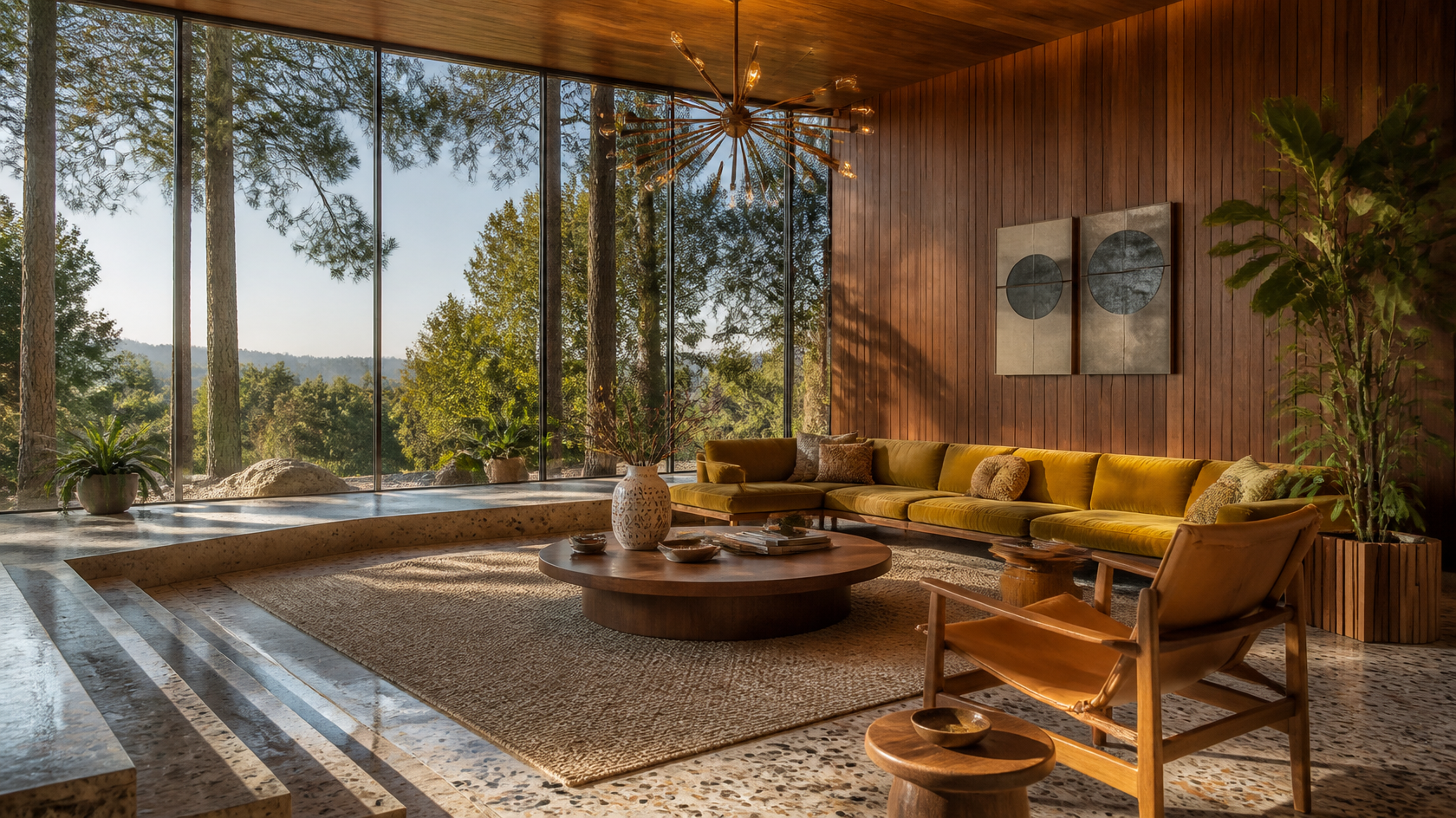
Mid-century modern is the rare design language that gets more relevant every decade. Born in the 1945-1965 post-war years and championed by architects like Joseph Eichler, Richard Neutra and Frank Lloyd Wright, it survived because it was right from the start: clean lines, organic curves, honest materials, and a deep belief that a beautiful home should also be a functional one. Today it dominates real-estate listings as a selling point, anchors the aesthetic of every cool restaurant in California, and continues to inspire furniture priced anywhere from $89 to $89,000.
But MCM is also the easiest style to do badly. Buy one Sputnik chandelier, one starburst clock, one teak credenza off the same retailer, and the result is not a home — it is a stage set. The line between authentic mid-century modern and themed mid-century modern is narrow, and most homeowners cross it the moment they hit "add all to cart." This guide is built to keep you on the right side of that line. We will work through the iconic pieces every MCM home is in conversation with, the signature elements that define the style, the exact walnut-teak-mustard-avocado palette, a room-by-room playbook for living rooms through bathrooms, the seven common mistakes that produce a costume rather than a home, and a step-by-step AI workflow using GenRoom to preview any of it on a photo of your real space — in under sixty seconds, before you spend a dollar.
What is Mid-Century Modern Design?
Mid-century modern is a 1945-1965 American design movement that combined post-war optimism, modernist principles imported by Bauhaus émigrés, and the new manufacturing techniques of the era (molded plywood, fiberglass shells, tubular steel, plastic laminates) into homes that felt at once disciplined and warm. It is sometimes called "warm minimalism" — it shares Bauhaus's hatred of ornament, but adds curves, human-scale proportions, and natural materials that the German school often left out.
The defining commitments are simple. Form follows function, but never to the point of coldness. Open floor plans connect kitchen, dining and living. Floor-to-ceiling windows blur the line between indoors and outdoors. Materials show their nature — walnut looks like walnut, leather looks like leather, brass develops a patina. And every room is curated, not decorated: a few significant pieces, generous negative space, and a single bold accent color carrying the room.
That last point is the one most people miss. Authentic MCM rooms are not full of mid-century furniture. They have one or two mid-century anchor pieces and a lot of breathing room around them.
The Iconic Pieces Every MCM Home Talks To
You do not need to own these to design a mid-century modern home. But you should know them, because every legitimate MCM room is in conversation with at least one — either by including a real example, a respectful reproduction, or a contemporary piece that quotes the same vocabulary.

Charles & Ray Eames
The husband-and-wife duo defined mid-century modern furniture more than any other designers. After eleven years experimenting with bent-plywood and fiberglass, they produced a catalog that is still in continuous production through Herman Miller. The pieces to know:
- Eames Lounge Chair and Ottoman (1956) — molded rosewood plywood and cognac leather, designed to be a "special refuge from the strains of modern living." Often called the single most important piece of furniture of the twentieth century.
- Eames Molded Shell Chair (1948-50) — the fiberglass shell on a wire, dowel or rocker base. Originally a Museum of Modern Art competition entry; now found in every museum café and design-conscious dining room in the world.
- Eames Aluminum Group (1958) — the slim leather-and-cast-aluminum desk chair you have seen in a thousand magazine offices.
Eero Saarinen
The Finnish-American architect (TWA Flight Center, Gateway Arch) treated furniture as architecture. He famously wrote that he wanted to "clear up the slum of legs" cluttering every interior, and his Tulip and Womb chairs answered the brief.
- Tulip Table and Chairs (1956) — single pedestal base in cast aluminum, white lacquer, marble or wood top. The clearest possible statement of mid-century's commitment to organic, sculptural form.
- Womb Chair (1948) — designed for a Florence Knoll request for "a chair I can curl up in." Foam over a fiberglass shell, four splayed steel legs.
Isamu Noguchi
Japanese-American sculptor who treated lighting and tables as sculptural objects first and functional ones second.
- Noguchi Coffee Table (1947) — the freeform glass triangle balanced on two interlocking wood pieces. Still produced by Herman Miller; still the platonic ideal of the mid-century coffee table.
- Akari Light Sculptures (1951-onward) — handmade washi paper over bamboo ribs. There are over 100 designs; even one in a corner shifts a room's character.
Hans Wegner
Danish master cabinetmaker who produced over 500 chair designs across his career, each treating the chair as a problem in wood joinery and human comfort.
- Wishbone Chair / CH24 (1949) — woven paper-cord seat, steam-bent oak top rail. Probably the most-copied dining chair in the world.
- Shell Chair / CH07 (1963) — three-legged sculpted plywood lounge chair, sometimes called "the smiling chair."
George Nelson
The Herman Miller design director who made everyday objects iconic.
- Nelson Bench (1946) — black-stained maple slats on hairpin legs. Equally at home as a coffee table, hallway bench, or media console.
- Marshmallow Sofa (1956) and the famous Ball Clock are still produced today.
If your room has at least one piece in dialogue with this canon — even a $200 reproduction Wishbone or a $400 Sputnik-style chandelier — it reads as authentic. If it has none, it reads as "modern" but not "mid-century modern."
Signature Elements That Define MCM
What turns a room with one mid-century chair into a mid-century modern room is a set of repeated visual cues — silhouettes, materials, architectural moves — that the style returns to again and again.
| Element | What it looks like | Where it lives |
|---|---|---|
| Tapered legs | Splayed at a slight angle, narrowing toward the floor, usually walnut or teak | Sofas, chairs, credenzas, dining tables, beds |
| Organic curves | No 90-degree corners on upholstery; gentle arcs on chair backs, table edges, headboards | Womb chair, kidney-shaped tables, curved sofas |
| Atomic / sputnik shapes | Radiating spokes, starbursts, spheres on slim arms | Chandeliers, wall clocks, decorative objects |
| Floor-to-ceiling glass | Single uninterrupted panes from floor to roofline | Living rooms, sometimes bedrooms (Eichler / Neutra archetypes) |
| Beam ceilings | Exposed structural beams, often Douglas fir or stained dark | Sunken living rooms, post-and-beam architecture |
| Sunken conversation pits | Recessed seating area 1-2 steps below main floor level | Living rooms (revived strongly in 2024-2026) |
| Fireplace as anchor | Stone or brick, often floor-to-ceiling, often freestanding | The visual centerpiece of the open-plan main room |
| Built-in storage | Slab-front, flush-mounted, no visible hardware or with brass pulls | Living-room walls, dining alcoves, bedrooms |
| Terrazzo floors | Cream base with chips of mustard, teal, brick-red, charcoal |
These elements are not optional decoration. They are the grammar of the style. A room that has the right furniture but lacks the right architectural language — no tapered legs in the dining set, no curve anywhere, no atomic shape, no horizontal lines — will not read as MCM no matter how expensive the chairs.
The Authentic MCM Color Palette
Mid-century modern is a saturated style pretending to be a neutral one. The walls are usually quiet — warm whites, soft creams, occasionally a single accent wall in saturated color — but the room is anchored by one high-saturation upholstery or accessory piece, and that piece is doing all the lifting.
Foundation neutrals (70% of the room)
- Warm white — Benjamin Moore Swiss Coffee, Sherwin-Williams Greek Villa, Farrow & Ball Pointing
- Cream / off-white — White Dove, Alabaster
- Warm gray — Revere Pewter, Worldly Gray
- Walnut wood tones — for cabinetry, paneling, furniture frames
- Teak wood tones — slightly warmer, redder than walnut, common in Danish modern
Accent colors (one per space, 10-15% of room)
- Mustard yellow — the most recognized MCM accent. A deep ochre, not bright yellow. Herman Miller used this extensively in upholstery across the Eames era. (Benjamin Moore Citrus Burst, SW Cocoon)
- Burnt orange — terracotta-leaning, never neon. (SW Spicy Hue, BM Audubon Russet)
- Avocado green — iconic for kitchens. Pair with ivory to avoid feeling dated. (SW Garden Gate, BM Avocado)
- Teal / aquamarine — sea blue-green, classic upholstery accent. (SW Tantalizing Teal, BM Mediterranean Sky)
- Brick / clay red — deep, earthy, never primary red. (SW Cavern Clay, BM Rosy Peach)
- Olive green — works as a secondary accent or for a velvet sofa
Metals (5% of room)
- Brass / antique brass — the dominant metal. Lamps, hardware, fireplace surrounds, table bases.
- Black powdercoat — for hairpin legs and modern reinterpretations.
- Chrome / brushed nickel — used sparingly, mostly on Saarinen pedestal bases.
Rule of thumb: one accent color per room. A mustard sofa, a burnt-orange ottoman, and an avocado armchair in the same space is not eclectic — it is a costume.
Mid-Century Modern Room by Room
The architectural moves and palette do not change much across rooms. What changes is which iconic furniture types live there, and what scale the saturated accent appears at. Here is the playbook.
Living Room
The hardest-working room in the MCM canon. Every visual cue we have discussed shows up here.

- Anchor piece: a low-profile sofa with tapered legs, often in burnt orange, mustard or teal velvet/tweed. The Marshmallow sofa, a curved sectional in tweed, or a clean three-seater on walnut legs.
- Conversation pair: an Eames lounge + ottoman, or two Womb chairs, set perpendicular to the sofa.
- Coffee table: Noguchi triangle, or a kidney-shaped walnut table on hairpin legs.
- Credenza: the single most identifying piece of an MCM living room — long, low, slab-front, sliding doors, brass or wood pulls. Houses media equipment and records.
- Lighting: Sputnik or starburst chandelier overhead, brass tripod or arc floor lamp in a corner, brass cone task lamp by the chair.
- Wall: one statement wall — wood paneling, stacked stone, or a single saturated accent paint — opposite a wall of glass.
- Floor: oak or walnut plank, with a single large geometric rug grounding the seating group.
Pro move: if your architecture allows it, the fireplace should be the visual axis the seating responds to, not the television. MCM was built before screens dominated rooms; it works best when you respect that.
Kitchen
Mid-century kitchens were the earliest "open plan" American kitchens, designed to be visible from the dining and living spaces rather than hidden away.

- Cabinets: flat-slab (no shaker frames, no raised panels) in walnut, teak, or white lacquer. Vertical grain matters — horizontal wood grain is more authentic than vertical.
- Hardware: long, thin brass pulls or recessed finger pulls. Never knobs.
- Countertops: white quartz, butcher block, or — for the brave — a polished cream terrazzo with mustard/teal chips.
- Backsplash: glossy ceramic tile in a single saturated color (turquoise, mustard, burnt orange, or olive), or a small mosaic in matching tones. White penny round is the safer option.
- Pendants: two or three brass globe pendants over the island, or a single oversized sphere.
- Appliances: stainless integrated where possible. If you want statement appliances, the SMEG FAB28 fridge in dusty teal or mustard is the closest contemporary version of the iconic 1960s GE colorful kitchens.
- Open shelving: one stretch of walnut open shelving with a few well-chosen ceramic pieces, never a museum of crockery.
Dining Room
The Tulip Table and Wishbone Chair combination is so dominant here that almost any other MCM dining setup will feel like a variation on it.

- Table: round Saarinen tulip in marble or white lacquer (seats 4-6), or a rectangular walnut table with tapered legs (seats 6-10).
- Chairs: Wishbone chairs in oak or walnut with paper-cord seats; or Eames molded shell chairs on wire bases; or upholstered low-back chairs in mustard/burnt-orange tweed.
- Lighting: an Akari paper lantern, a Nelson Bubble pendant, or a brass linear chandelier hung approximately 30-34 inches above the table.
- Sideboard: a long, low walnut credenza along one wall, housing dishware and linens.
- Art: one large abstract piece — atomic-era oil painting, geometric print, or a single sculptural object — never a gallery wall.
- Rug: optional, but if used, a wool flatweave in cream and burnt orange anchors the table nicely.
Bedroom
MCM bedrooms are quieter than the public rooms. The saturated accent appears in textiles only, and the room reads almost as a soft-focus version of the rest of the house.

- Bed: low-profile platform bed in teak or walnut, often with a tall headboard panel of the same wood — never tufted, never upholstered button-detailed.
- Nightstands: matching teak or walnut nightstands with two drawers and tapered legs.
- Lamps: matched pair of brass cone lamps or low-profile globe table lamps.
- Bedding: cream or oat linen sheets, burnt-orange or mustard throw at the foot, two euro shams in warm white, one small geometric accent pillow.
- Wall behind bed: walnut paneling, or a single saturated accent paint (forest green, deep teal, terracotta), or wallpaper in a small-scale atomic-era geometric.
- Storage: a long walnut dresser, slab-front, tapered legs, brass pulls — opposite the bed.
- Art: one large abstract piece above the dresser, paired with a single ceramic vessel.
Bathroom
Often the most expressive MCM room — the small footprint lets the saturated color and pattern carry without overwhelming.

- Vanity: floating walnut vanity with flat-slab doors, white quartz waterfall countertop, undermount or vessel sink.
- Faucet: brushed brass — single-handle, often the tall arched profile from Brizo or Kohler's mid-century collections.
- Mirror: circular brass-framed sunburst mirror, or a simple round brass mirror.
- Floor: terrazzo with cream base and mustard/teal/charcoal chips. If terrazzo is out of budget, a hex pattern in matte cream is the next best move.
- Shower tile: white penny-round, white 4x4 square, or a single accent wall in mustard or teal subway.
- Lighting: two brass sconces flanking the mirror; an Akari pendant if the ceiling allows.
- Greenery: one snake plant or pothos in a ceramic planter.
Home Office
The newest MCM room — Eichler-era houses rarely had a dedicated office, so this is where contemporary reinterpretations live.

- Desk: teak or walnut desk with tapered legs, ideally with a small drawer pedestal on one side rather than a full pedestal pair.
- Chair: Eames aluminum group in caramel leather, or a modern reinterpretation of the executive chair.
- Storage: built-in walnut bookshelves floor-to-ceiling along one wall — the single move that most transforms a generic office into an MCM office.
- Lighting: brass arc floor lamp, plus a brass cone desk task lamp.
- Art: one large abstract piece in burnt orange or mustard, or a vintage atomic-era poster.
- Rug: wool flatweave in a subtle geometric, cream and warm gray.
Create interior design with AI
Upload a photo of your room and get a professional design in 30 seconds. First generation is free.
The 7 Common Mistakes That Make MCM Look Like a Costume
These are the patterns that turn a thoughtful mid-century modern room into a themed restaurant. Avoid them all.
1. Buying matching sets
The fastest way to make a room look like a stage set is to buy the sofa, the loveseat, the armchair and the coffee table from the same MCM-themed retailer at the same time. Authentic MCM rooms are layered over years, with pieces from different decades, different woods, and different finishes coexisting. The look is curated, not delivered in one truck.
2. Using only dark wood
Walnut is iconic. So is teak. So is oak. Mix them. A room with three different wood tones (light oak floor, medium walnut credenza, dark stained teak chair) has visual depth. A room where every wood surface is the same medium-walnut stain looks like a furniture showroom.
3. Over-using the accent color
One mustard sofa is iconic. A mustard sofa, mustard pillows, mustard rug, mustard lamp and mustard wall art is theatre. The accent color should be the loudest thing in the room, but it should appear in one large place and one or two small ones — not everywhere.
4. Filling the negative space
Mid-century modern is a minimalist style. The empty space around each piece is part of the design. If you find yourself wanting to fill that corner with another chair, or that wall with another piece of art, stop. The breathing room is what lets the iconic pieces read.
5. Mixing in farmhouse / industrial / boho
Mid-century pairs well with: minimalism, Japandi, Scandinavian, Bauhaus, Memphis (carefully), early-1970s organic modern. It pairs terribly with: modern farmhouse (shaker cabinets, shiplap, mason jars), industrial (exposed bulbs, raw steel, brick), heavy boho (macramé, rattan everything, layered patterns). Pick a lane.