How to Choose Your Home's Exterior Style: A Visual Decision Guide

Your home's exterior is the first thing people see — and the last thing most homeowners think about when designing. We obsess over kitchen countertops and bathroom tile but leave the outside to whatever the builder chose in 1997. That is a missed opportunity.
Your exterior style affects curb appeal (and resale value), maintenance costs, energy efficiency, and how you feel every time you pull into the driveway. Whether you are building new, renovating, or just repainting, choosing the right exterior style is one of the most impactful design decisions you will make.
This guide compares the eight most popular home exterior styles, breaks down what each one costs, which climates they suit best, and gives you a decision framework to find your match. No architecture degree required.
The 8 Most Popular Exterior Styles
Modern

Modern architecture is defined by what it removes: ornament, clutter, and unnecessary detail. What remains is clean geometry, honest materials, and a strong connection between indoor and outdoor space.
Key features:
- Flat or low-pitched rooflines with deep overhangs
- Floor-to-ceiling windows and glass walls
- Asymmetric facades with geometric forms
- Open floor plans visible from the exterior
- Minimal exterior trim and decoration
Signature materials: Steel, concrete, glass, stucco, cedar or ipe wood cladding, metal panel siding (zinc, Corten steel)
Color palette: Monochromatic — white, charcoal, black, warm gray. Occasional natural wood accent for warmth.
Best climate: Mild climates (Pacific Northwest, Southern California, parts of the Southeast). Large glass areas can be costly to heat in extreme cold and to cool in extreme heat without high-performance glazing.
Cost range: $200–$400+ per square foot (new construction). Modern homes often cost 15–30% more than traditional due to custom engineering and premium materials.
Maintenance: Low to moderate. Metal and stucco exteriors are durable. Large windows require regular cleaning. Flat roofs need more attention than pitched roofs for drainage.
Traditional

Traditional style is the architectural comfort food of America — symmetrical, familiar, and universally appealing. It draws from Colonial, Georgian, and Federal influences and has been the default for suburban homes for over a century.
Key features:
- Symmetrical facade with a centered front door
- Gabled roof with moderate pitch
- Evenly spaced double-hung windows with shutters
- Covered front porch or portico with columns
- Decorative trim, crown molding, and dentil detailing
Signature materials: Brick, clapboard siding (wood or fiber cement), natural stone accents, wood trim, asphalt shingle roof
Color palette: Classic and restrained — cream, white, sage green, navy blue, colonial red, charcoal. Shutters typically contrast with siding.
Best climate: All climates. Traditional construction with pitched roofs, attics, and standard insulation works reliably everywhere. The style originated in the Northeast but has been adapted nationwide.
Cost range: $150–$280 per square foot (new construction). Among the most cost-effective to build because it uses standard materials and framing.
Maintenance: Moderate. Wood siding needs painting every 5–8 years. Fiber cement (James Hardie) extends that to 15–20 years. Brick is essentially maintenance-free for decades.
Craftsman

Craftsman style emerged in the early 1900s as a rejection of industrial mass production. It celebrates handmade detail, natural materials, and the idea that a home should feel built by a person, not a factory.
Key features:
- Low-pitched gabled roof with wide eaves and exposed rafters or decorative brackets
- Full or partial-width front porch with tapered columns (often on stone piers)
- Mixed materials on the facade (stone base, wood or shingle siding above)
- Double-hung windows with divided upper panes
- Built-in cabinetry and woodwork visible even from outside
Signature materials: Cedar or redwood shingle siding, natural stone, river rock, wood beams, slate or composition shingle roof
Color palette: Earthy and warm — forest green, deep brown, warm tan, olive, burgundy, russet. Inspired by natural surroundings.
Best climate: Moderate climates with all four seasons (Pacific Northwest, Midwest, Mid-Atlantic). The wide eaves protect from rain; the porch provides shade. Performs well in most regions.
Cost range: $180–$320 per square foot. The handcrafted detail (tapered columns, exposed woodwork, stone accents) adds cost versus standard construction.
Maintenance: Moderate to high. Wood shingle siding requires staining or painting every 4–6 years. Stone and brick elements are low maintenance. Exposed wood beams need periodic sealing.
Colonial

Colonial architecture is rooted in American history — the style dates to the 1600s and remains one of the most enduring and widely built home designs in the United States. It communicates permanence, formality, and timelessness.
Key features:
- Rectangular, box-shaped footprint (typically two stories)
- Perfectly symmetrical facade with centered front door (often with decorative pediment)
- Evenly spaced multi-pane windows (6-over-6 or 8-over-8 grids)
- Dormer windows on the upper floor
- Side-gabled roof with moderate pitch
- Minimal roof overhangs
Signature materials: Brick (most common), clapboard siding, wood trim and shutters, copper accents, slate or asphalt roof
Color palette: Formal and dignified — red brick with white trim, all-white with black shutters, pale yellow with green shutters, slate gray with cream trim.
Best climate: Northeast and Mid-Atlantic (where it originated), but adaptable to all US climates. The compact rectangular form is efficient to heat and cool.
Cost range: $160–$300 per square foot. Brick construction adds 10–15% over wood frame with siding, but the longevity and maintenance savings often offset the premium.
Maintenance: Low. Brick needs repointing every 20–30 years. Painted wood shutters and trim need refreshing every 5–8 years. Overall one of the lowest-maintenance exterior styles.
Contemporary

Contemporary and modern are often confused, but they are different. Modern refers to a specific historical movement (mid-20th century). Contemporary means "of the moment" — it evolves with current trends and borrows from multiple styles.
Key features:
- Asymmetrical, dynamic facades (no strict geometric rules like Modern)
- Mixed rooflines — combinations of flat, shed, and butterfly roofs
- Large windows but not necessarily full glass walls
- Bold material mixing (wood + metal + stone on one facade)
- Strong indoor-outdoor connection with covered outdoor living spaces
- Sustainability-forward: solar panels, green roofs, passive design strategies
Signature materials: Fiber cement panels, engineered wood cladding (Accoya, thermally modified), standing-seam metal roofing, stone veneer, stucco, large-format windows
Color palette: Current trends lean toward warm earth tones — charcoal, warm white, natural wood, matte black. Less stark than pure Modern; more warmth and texture.
Best climate: Highly adaptable. Contemporary design is defined by responding to its specific environment — a contemporary home in Arizona looks different from one in Vermont, and that is the point.
Cost range: $220–$400+ per square foot. Custom design and mixed materials drive costs higher than traditional, but the flexibility to choose materials means budget can be controlled.
Maintenance: Varies by material choices. Fiber cement and metal are low maintenance. Natural wood cladding requires periodic treatment.
Mediterranean

Mediterranean style transports you to the sun-drenched coasts of Spain, Italy, and Greece. It is designed for warm climates — thick stucco walls keep interiors cool, courtyards create shaded outdoor living, and tile roofs reflect heat.
Key features:
- Stucco exterior walls in warm earth tones
- Low-pitched or flat roof with clay barrel tiles (terracotta or red)
- Arched windows and doorways
- Wrought-iron details (balconies, railings, light fixtures)
- Courtyards and covered loggias (outdoor corridors)
- Decorative tile accents (Talavera, Moorish patterns)
Signature materials: Stucco, clay roof tiles, wrought iron, terracotta, natural stone (travertine, limestone), wood beams (exposed)
Color palette: Sun-warmed earth — terracotta, warm white, sand, ochre, Tuscan gold, cobalt blue accents, olive green.
Best climate: Hot, dry climates (Southwest US, Southern California, Florida, Texas). Stucco can crack in freeze-thaw cycles, and clay tiles are best where snow loads are low.
Cost range: $180–$350 per square foot. Clay tile roofing and custom stucco work add cost over standard construction, but the results are dramatic.
Maintenance: Low to moderate. Stucco needs recoating every 10–15 years. Clay tiles last 50–100 years but individual tiles can crack and need replacement. Wrought iron needs rust prevention in humid climates.
Modern Farmhouse

Modern farmhouse exploded in popularity in the 2010s (thanks largely to Chip and Joanna Gaines) and shows no signs of fading. It combines the warmth and simplicity of rural farmhouses with the clean lines and restrained palette of modern design.
Key features:
- Board-and-batten or lap siding (often white)
- Gabled roof with steep pitch and metal accent roofs
- Large front porch with simple square or round columns
- Black-framed windows (creating strong visual contrast on white siding)
- Sliding barn doors, exposed beams, and rustic-industrial details
- Mixed materials: siding + stone or brick on lower portions
Signature materials: Fiber cement siding (James Hardie in Arctic White is the default), standing-seam metal roofing, natural stone veneer, wood beams, black aluminum-clad windows
Color palette: High-contrast minimal — white siding with black windows and trim, natural wood accents, matte black hardware and lighting. Some variations use dark siding (charcoal, navy) with white trim for an inverted look.
Best climate: All climates. The steep gabled roof sheds snow and rain effectively. Fiber cement siding performs well in all weather conditions.
Cost range: $170–$300 per square foot. Relatively cost-effective because it uses standard framing and widely available materials. The aesthetic relies more on proportion and contrast than expensive finishes.
Maintenance: Low. Fiber cement siding lasts 30–50 years with minimal maintenance. Metal roofing lasts 40–70 years. Black window frames and hardware are factory-finished and do not need repainting.
Mid-Century Modern

Mid-century modern (roughly 1945–1970) is the architectural style most closely associated with optimism, experimentation, and the California dream. Homes by Eichler, Neutra, and Case Study architects set the template. Today, both original restorations and new builds in this style command premium prices.
Key features:
- Post-and-beam construction with open floor plans
- Low-pitched rooflines, often flat or with a single slope (shed roof)
- Floor-to-ceiling windows and glass walls connecting interior to landscape
- Integration with nature — homes sit in the landscape rather than dominate it
- Minimal ornamentation — structure itself is the decoration
- Carports instead of enclosed garages
Signature materials: Wood (cedar, redwood), glass, steel, concrete, natural stone, brick. Honest expression of materials — nothing is hidden or covered.
Color palette: Earth tones with accent colors — white, warm wood, charcoal, olive green, mustard yellow, burnt orange. Doors often painted a bold accent color (orange, turquoise).
Best climate: Originally designed for mild California climates. Can be adapted to other regions with modern insulation and window technology, but large glass areas need careful engineering in extreme temperatures.
Cost range: $250–$450+ per square foot. Restoration of originals can exceed new construction costs due to specialized materials and craftsmanship. New builds in this style require custom engineering.
Maintenance: Moderate. Original mid-century homes often need significant updates (single-pane glass, outdated insulation, flat roof maintenance). New builds with modern materials are lower maintenance.
Style Comparison Table
Here is a side-by-side comparison to help you narrow your choice:
| Dimension | Modern | Traditional | Craftsman | Colonial | Contemporary | Mediterranean | Farmhouse | Mid-Century |
|---|---|---|---|---|---|---|---|---|
| Build Cost (per sq ft) | $200–$400 | $150–$280 | $180–$320 | $160–$300 | $220–$400 | $180–$350 | $170–$300 | $250–$450 |
| Maintenance | Low-Med | Medium | Med-High | Low | Varies | Low-Med | Low | Medium |
| Best Climate | Mild | All | Moderate | All | Adaptable | Hot/Dry | All | Mild |
| Resale Appeal | Niche | Broad | Broad | Broad | Growing | Regional | Very broad | Niche/premium |
| Curb Appeal | Bold | Classic | Charming | Stately | Striking | Warm | Inviting | Iconic |
| Customization | High | Moderate | Moderate | Low | Very high | Moderate | Moderate | High |
| Energy Efficiency | High (if designed well) | Standard | Standard | Good | High | High (passive cooling) | Standard | Moderate |
| HOA Friendliness | Low | Very high | High | Very high | Medium | Medium | High | Low |
Key takeaway: If resale to the broadest audience matters most, Traditional, Colonial, and Modern Farmhouse are the safest choices. If personal expression matters more, Modern, Contemporary, and Mid-Century give you the most freedom.
How Climate Affects Your Choice

Your style preference matters, but your climate has veto power over certain choices. Here is what to consider:
Hot and dry (Southwest, Southern California, West Texas):
- Best: Mediterranean, Modern, Contemporary
- Stucco and masonry provide thermal mass (absorb heat during the day, release it at night)
- Light-colored roofs and walls reflect heat
- Covered outdoor spaces (courtyards, loggia) extend living area
- Avoid: Dark siding absorbs heat; wood siding dries and cracks
Hot and humid (Southeast, Gulf Coast, Florida):
- Best: Traditional, Colonial, Modern Farmhouse, Contemporary
- Elevated foundations protect from flooding
- Metal roofing resists moisture and algae growth
- Wide porches and deep eaves provide rain protection and shade
- Avoid: Flat roofs (drainage challenges); untreated wood (rot and termites)
Cold and snowy (Northeast, Midwest, Mountain West):
- Best: Traditional, Colonial, Craftsman, Modern Farmhouse
- Steep-pitched roofs shed snow (minimum 6:12 pitch recommended)
- Brick and stone resist freeze-thaw cycles
- Insulated wall systems and triple-pane windows are essential
- Avoid: Mediterranean clay tiles (cracking from frost); flat roofs (snow load)
Mild and wet (Pacific Northwest):
- Best: Craftsman, Contemporary, Modern, Mid-Century Modern
- Metal roofing and deep overhangs handle constant rain
- Cedar and fiber cement resist moisture
- Large windows capture the limited natural light
- Avoid: Stucco without proper drainage (moisture trapped behind walls)
Temperate (Mid-Atlantic, parts of the South):
- Best: Any style works. This is the climate zone with the most design freedom.
- Focus on materials appropriate for your specific micro-climate (coastal wind, urban heat island, etc.)
Material and Cost Considerations
The exterior material you choose affects appearance, durability, maintenance, and your annual budget for decades. Choose based on your climate, how long you plan to own the home, and how much maintenance you are willing to do.
Exterior Cladding Material Comparison:
| Material | Cost (per sq ft installed) | Lifespan | Maintenance | Pros | Cons |
|---|---|---|---|---|---|
| Vinyl Siding | $3 – $8 | 20–40 years | Very low | Cheapest, easy to install | Looks cheap, fades, cracks in cold, not paintable |
| Fiber Cement (Hardie) | $6 – $14 | 30–50 years | Low | Durable, paintable, fire-resistant, mimics wood | Heavy, requires skilled installation |
| Wood Clapboard | $8 – $16 | 20–40 years | High (paint/stain every 4–7 yrs) | Authentic, beautiful, traditional | Rot, insects, fire risk, expensive maintenance |
| Cedar Shingle | $10 – $18 | 30–50 years | Medium | Naturally rot-resistant, ages beautifully | Expensive, requires periodic treatment |
| Brick | $12 – $25 | 100+ years | Very low | Virtually maintenance-free, timeless | Expensive upfront, hard to change color |
| Natural Stone | $20 – $45 | 100+ years | Very low | Stunning, unique, extremely durable | Very expensive, heavy (structural requirements) |
| Stucco | $7 – $12 | 50–80 years | Low | Seamless, energy-efficient, paintable | Cracks in seismic and freeze-thaw zones |
| Metal Panel | $10 – $25 | 40–60 years | Very low | Modern look, fire-resistant, recyclable | Dents, requires professional installation |
| Engineered Wood | $7 – $12 | 20–30 years | Medium | Affordable wood look, consistent quality | Less durable than real wood, moisture-sensitive |
Roofing Material Comparison:
| Material | Cost (per sq ft installed) | Lifespan | Best Styles |
|---|---|---|---|
| Asphalt Shingle | $3 – $7 | 15–30 years | Traditional, Colonial, Farmhouse, Craftsman |
| Metal (standing seam) | $8 – $16 | 40–70 years | Modern, Farmhouse, Contemporary |
| Clay Tile | $12 – $25 | 50–100 years | Mediterranean, Spanish Colonial |
| Slate | $15 – $30 | 75–150 years | Colonial, Traditional, Craftsman |
| Composite/Synthetic | $8 – $14 | 30–50 years | Any (mimics slate, wood, tile) |
Create facade design with AI
Upload a photo of your home and get a new facade in the chosen style in 30 seconds. First generation is free.
Style Quiz: Which Exterior Is Right for You?

Answer these five questions and follow the path to your style match:
Question 1: How do you feel about maintenance?
- "I never want to think about my exterior." → Go to Q2a
- "I do not mind some upkeep for the right look." → Go to Q2b
Q2a: What is your aesthetic preference?
- "Clean and simple" → Modern Farmhouse (fiber cement + metal roof = decades of zero fuss)
- "Formal and timeless" → Colonial in brick (the ultimate set-it-and-forget-it exterior)
- "Warm and earthy" → Mediterranean (stucco + tile lasts generations)
Q2b: What matters most to you?
- "Character and craftsmanship" → Go to Q3a
- "Standing out from the neighborhood" → Go to Q3b
- "Blending in and broad appeal" → Go to Q3c
Q3a: Do you prefer warm wood tones or clean white?
- Warm wood → Craftsman (natural materials, handmade feel, porch-centric living)
- Clean white → Modern Farmhouse (board-and-batten, black accents, timeless simplicity)
Q3b: Geometric or organic?
- Geometric → Modern (flat roof, glass, concrete — architectural statement)
- Organic / mixed → Contemporary (borrow from any style, make it yours)
Q3c: Traditional or transitional?
- Traditional → Traditional (symmetrical, shuttered, universally liked)
- Transitional → Colonial with updated finishes (classic bones, modern palette)
Bonus path — Budget is the primary driver:
- Under $175/sq ft → Traditional with vinyl or fiber cement siding
- $175–$250/sq ft → Craftsman, Colonial, or Modern Farmhouse
- $250+/sq ft → Modern, Contemporary, or Mid-Century Modern
Still not sure? The fastest way to see which style actually suits your home is to test it visually. Upload a photo of your home's exterior to GenRoom's AI facade designer and see it rendered in multiple styles — Modern, Craftsman, Farmhouse, Mediterranean, and more — in under a minute.
How to Visualize Your New Exterior
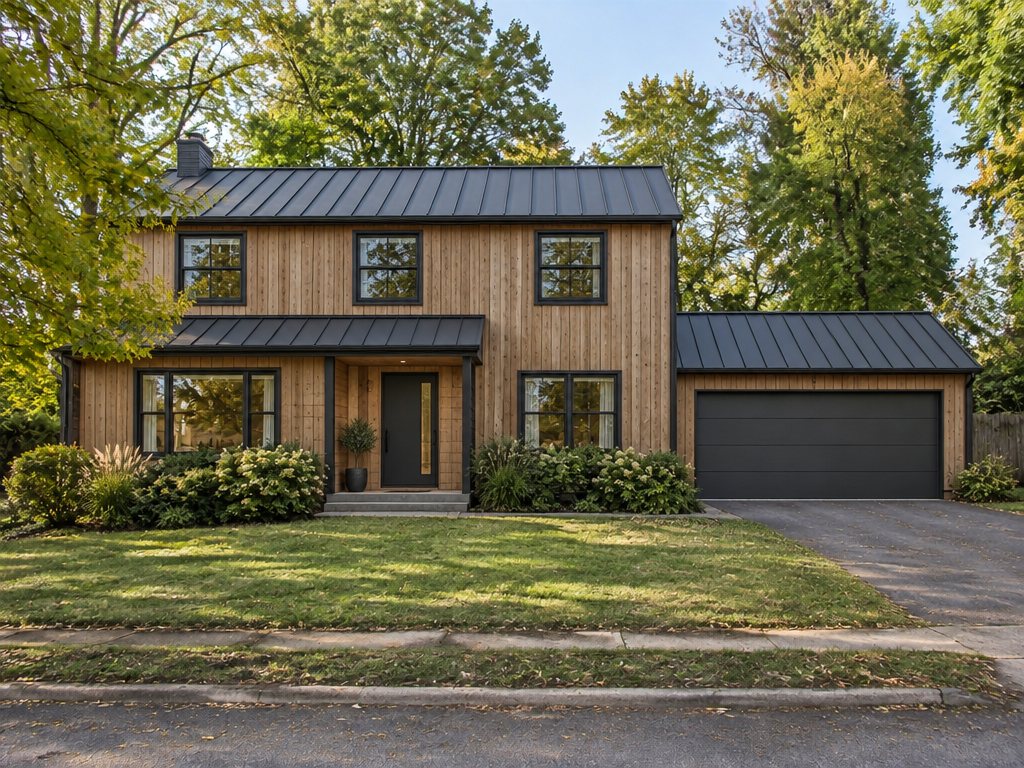
Choosing an exterior style from photos of other people's homes is helpful, but it does not answer the real question: what will this style look like on my house, with my proportions, my lot, and my surroundings?
This is where AI visualization changes the game. GenRoom lets you upload a photo of your current home exterior and generates realistic renderings of it redesigned in different architectural styles.
How to use it:
- Take a straight-on photo of your home's front facade in daylight
- Upload it to GenRoom's facade design tool
- Select a style — Modern, Craftsman, Farmhouse, Mediterranean, or others
- Receive an AI-generated visualization in seconds
Why this matters for real decisions:
- Compare 3–4 styles side by side on your actual home
- Share visualizations with your spouse, contractor, or HOA board before committing
- Discover styles you would not have considered — many homeowners are surprised by how well an unexpected style suits their home's proportions
- Save the cost of professional architectural renderings ($500–$2,000+)
Try it free — upload your home's photo and see it transformed →
Mixing Styles: When and How
Pure style adherence is for textbooks. Real homes blend influences all the time, and some of the most appealing exteriors are intentional hybrids. The key is knowing which styles mix well and which clash.
Combinations that work:
- Modern Farmhouse + Craftsman: Wide porches, natural materials, clean detailing. The natural evolution of both styles.
- Contemporary + Mid-Century Modern: Both share clean lines and a connection to nature. Easy to blend.
- Traditional + Colonial: These are already cousins — Colonial is a subset of Traditional. Mix freely.
- Mediterranean + Contemporary: Stucco walls, flat or low-pitch roofs, and indoor-outdoor flow are shared DNA.
- Craftsman + Traditional: Both are symmetrical and porch-forward. Swap some materials and you move between them seamlessly.
Combinations to avoid:
- Modern + Colonial: The symmetry of Colonial fights the asymmetry of Modern. The result often looks confused.
- Mediterranean + Farmhouse: Terracotta tiles and board-and-batten siding are from different worlds.
- Mid-Century Modern + Traditional: The structural honesty of Mid-Century clashes with the decorative layers of Traditional.
The one-third rule: If you are mixing styles, let one style dominate (about two-thirds of the visual impact) and the other accent (one-third). A Craftsman home with a contemporary front door and modern landscape lighting works beautifully. A home that is half Craftsman and half Contemporary looks indecisive.
FAQ
What is the most popular home exterior style in 2026? Modern Farmhouse remains the most-built new home exterior style in the US, followed by Traditional and Contemporary. However, regional preferences vary significantly — Mediterranean dominates in the Southwest, Colonial in the Northeast, and Craftsman in the Pacific Northwest.
Which exterior style has the best resale value? Traditional, Colonial, and Modern Farmhouse consistently appraise and sell well across the broadest markets. Modern and Mid-Century Modern command premiums in specific markets (coastal cities, design-forward neighborhoods) but may have narrower buyer pools in suburban or rural areas.
How much does it cost to change your home's exterior style? A full exterior restyle (new siding, trim, possibly roofing) typically costs $20,000–$80,000 depending on home size and materials. A focused update — new siding, paint, updated trim and shutters, new front door — can be done for $8,000–$25,000 and makes a dramatic difference.
Can I change my exterior style if I have an HOA? Most HOAs have architectural review committees that must approve exterior changes. Submit your plan (or better, an AI visualization of your proposed style) for pre-approval before hiring contractors. Many HOAs are flexible on style but strict on materials and colors.
What exterior style is most energy efficient? Modern and Contemporary styles lead in energy efficiency because they are typically designed with high-performance windows, continuous insulation, and passive solar orientation. Mediterranean homes perform well in hot climates due to thermal mass (stucco and tile). Any style can be energy-efficient with proper insulation, air sealing, and window selection.
Should I match my interior and exterior style? Ideally, they should share a common thread — a Craftsman exterior with a minimalist white interior can feel disconnected. You do not need an exact match, but the transition should feel intentional. A Craftsman exterior with warm-toned modern interiors, or a Modern exterior with Japandi interiors, creates natural harmony. Explore how interior styles complement your exterior with our modern interior design guide.
What is the cheapest exterior style to build? Traditional with vinyl or fiber cement siding and an asphalt shingle roof is the most cost-effective ($150–$200 per square foot). Modern Farmhouse is a close second because it uses standard framing and materials — the aesthetic is driven by proportion and color contrast, not expensive finishes.
How can I see what a different exterior style would look like on my home? Upload a current photo of your home to GenRoom's free AI facade design tool. It generates realistic visualizations of your home in different architectural styles — so you can compare Modern, Craftsman, Farmhouse, Colonial, and more before spending a dollar. It is faster and cheaper than architectural renderings, and you can share the results with contractors or your HOA for feedback.
Your Home, Your Statement
Your home's exterior is the one design decision the entire world sees. It shapes your neighborhood's character, affects your property value, and sets the tone before anyone walks through your front door.
The right exterior style is not about trends — it is about finding the intersection of what you love, what your climate demands, what your budget allows, and what will make you proud for decades.
Start by narrowing your favorites from the eight styles above. Consider your climate and materials. Run the style quiz. And when you are ready to see what a new style actually looks like on your house, upload a photo and let GenRoom show you →.
For more design inspiration, explore our facade design gallery or discover how your exterior and interior can work together with our free room design and room makeover tools.