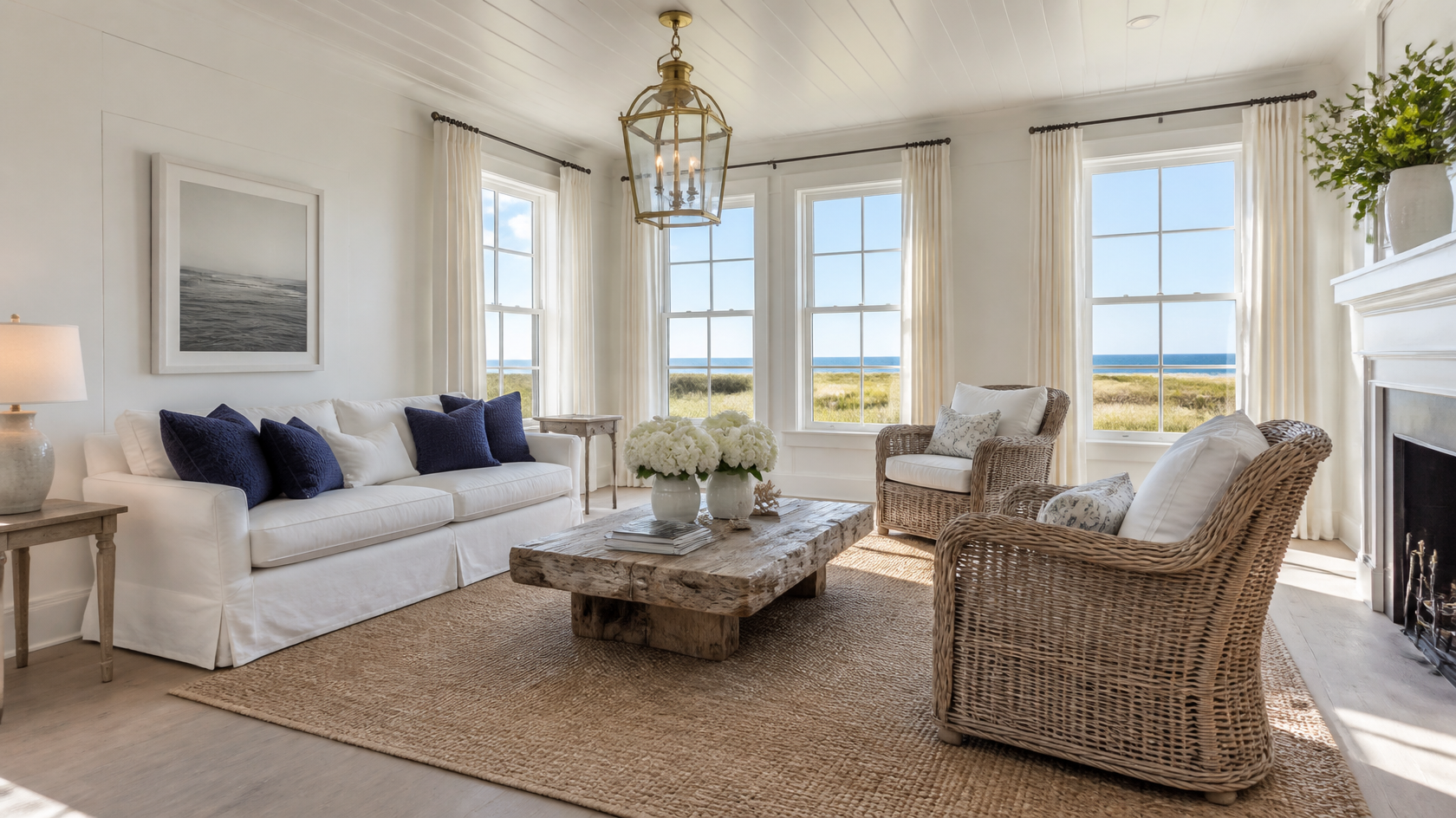
1. Treating coastal as a theme. Plastic seashells, ship-wheel mirrors, signs with arrows pointing to BEACH, decorative wooden oars, painted-driftwood letters spelling COASTAL across a mantle. Every single one of these reads as souvenir shop. Fix: allow yourself one literal coastal object per room — one real piece of driftwood, one real shell, one nautical chart in a clean wood frame — and exile the rest.
2. Using three shades of blue. Navy pillows, sky-blue walls, teal lamps, and a turquoise rug all in the same room. Each blue cancels the next out and the eye reads chaos. Fix: pick one blue. Use it on one element (lamps, or a single piece of upholstery, or a single painted door). Everything else stays in the white-and-natural-material register.
3. Skipping texture. A coastal room that is all hard surfaces (glossy paint, polished marble, glass coffee table) feels like a kitchen showroom, not a beach house. Fix: every coastal room needs at least four natural-fibre textures: a sisal rug, a linen sofa, a rattan armchair, a woven basket or pendant. Layer until the room feels touchable.
4. The wrong white. A cool blue-white (the kind that comes "free" with most contractor-grade paint) makes a coastal room look like a hospital corridor. Fix: use a warm-white with cream or buff undertones — Benjamin Moore "White Dove" OC-17, "Simply White" OC-117, or Farrow & Ball "School House White" 291. Sample on the wall, look at it at three times of day, then commit.
5. Heavy dark wood furniture. A coastal room with a mahogany dining table, a walnut bookcase, and a coffee table in dark oak fights the light. Fix: replace one dark piece with bleached or limed wood (Restoration Hardware "Salvaged Wood Trestle" in Weathered Grey is a workhorse). One dark wood piece is fine for grounding; three is too many.
6. Mixing the sub-styles. A Hamptons sofa next to a tropical rattan pendant in a Mediterranean room with a California floor is the most common Pinterest-induced mistake of the 2020s. Fix: pick one sub-style and stay in it for at least 80% of the visible material. One "wrong" piece is character; four "wrong" pieces is confusion.
The most expensive thing about a coastal renovation is committing to the wrong sub-style. A full Hamptons living room (slipcovered sofas, sisal rug, lanterns, sheer linen drapery, hardwood floor refinish) is a $15,000–$30,000 project. A Mediterranean kitchen with lime plaster, terracotta tile, and zellige backsplash is more. You do not want to find out at week six that you actually wanted California.
That is why we built GenRoom — to let you upload a single photo of your real room and see it transformed into any of the five coastal sub-styles in about thirty seconds. The workflow is:
- Photograph the room you want to redesign. One landscape photo, daylight, no people. Stand in a corner so the camera sees two walls. Switch on all lamps for an honest light reading.
- Upload to GenRoom and pick Coastal as the style. GenRoom currently offers Coastal as one of 63 styles, plus distinct presets for Hamptons, Mediterranean, Tropical, and Scandinavian Coastal.
- Generate four variations. Pick the strongest and refine it with the AI Editor — "make the floor lighter", "change the pendant to woven rattan", "add a navy throw on the sofa". Iteration is the entire point: thirty seconds per round, dozens of rounds.
- Lock the sub-style and ask GenRoom for a 4K render. This is the version you take to a contractor, a paint store, or a furniture buyer. Showing somebody a photo of your room redesigned beats describing the look in words by an order of magnitude.
In our own experience visualising coastal renovations on the platform, the most useful sequence is to generate all five sub-styles back-to-back on the same source photo. The differences between Hamptons, Mediterranean, Tropical, California, and Scandinavian on the same room are sharper than any guide article can describe — you see immediately which scheme your room's architecture wants. A low-ceilinged 1960s apartment almost always wants Scandinavian. A 1920s shingled colonial wants Hamptons. A new-build with glass walls wants California. The room tells you.
GenRoom plans start at $9.99 for 36 credits (about 18 generations) and go up to $39.99 for 300 credits with 4K output and the AI Editor enabled. Compared to a single hour with an interior designer ($150–$400 in 2026), it is a different category of cost. Compared to repainting a wrongly-chosen blue, it is free.
The single biggest practical mistake people make on a coastal renovation is buying in the wrong order. The correct order, from most permanent to most replaceable, is:
- Floor. Refinish to bleached oak, limed pine, or honed terracotta. Once chosen, you live with it for twenty years.
- Wall colour. Two coats of your chosen warm white. Sample first. Commit.
- Architectural fixed elements. Shiplap, beadboard, wainscoting, the kitchen island, the tub, the tile.
- Window treatments. Floor-to-ceiling linen sheers, mounted high and wide.
- Large upholstery. Slipcovered sofa, four-poster bed, slipcovered headboard.
- Rugs and pendants. Sisal underfoot, woven rattan overhead.
- Tables, chairs, casegoods. Bleached oak, weathered grey, or driftwood.
- Lamps and textiles. Cream linen, ticking stripe, oat boucle.
- One blue accent. Navy ginger jar lamp, sea-foam tub exterior, indigo throw.
- One literal coastal object per room. A real piece of driftwood, a real shell, a framed antique chart. Just one.
If you reverse this — start with the seashells, work down to the floor — you will spend twice as much money and produce half as good a result.
Coastal is a style — it uses behaviours (slipcovered fabric, natural fibres, warm white walls, one accent blue) to evoke proximity to the ocean. Nautical is a theme — it uses literal references (ship wheels, anchors, ropes, port-and-starboard light fittings) to look like a boat. Coastal can be sophisticated; nautical almost always reads as a souvenir shop. If you are in doubt, ask: would a person who has never been to the beach still think this room is calm and beautiful? If yes, it is coastal; if no, it is nautical.
Yes — Scandinavian Coastal is the sub-style designed for exactly this. It needs no view, no big windows, and no architectural drama. Whitewashed pine floor (or a sisal-bordered runner over your existing floor), warm white walls, one boucle sofa, one rattan pendant, one piece of driftwood, sheer linen at the window. Done in a 35-square-metre flat, it looks more authentic than a faux-Hamptons living room with no ocean nearby.
In descending order of impact for the dollar: (1) repaint the walls in a warm white (one weekend, $200); (2) add a large sisal or seagrass rug ($300–$600); (3) hang floor-to-ceiling sheer linen drapery, mounted high and wide ($200); (4) slipcover your existing sofa in cream linen via Bemz or Comfort Works ($400–$800). For under $1,500 and one weekend, you will completely change the feel of the room — without buying any furniture.
Tropical, obviously, but pay attention to material: teak, ironwood, and merbau tolerate humidity and salt; oak and pine do not. Avoid wool and heavy upholstery. Cotton and linen handle the humidity if they can air-dry. Polished concrete or terracotta floors beat hardwood. Ceiling fans are not optional — fit large-diameter (140 cm+) timber-bladed fans in every room.
Saturated navy walls are dated. Navy as an accent — a single piece of upholstery, a lamp base, a painted door — is still fine. The 2026 shift is toward chalkier, less saturated blues: sea-foam, smoky teal, faded indigo, "haint blue". If you are starting from scratch, pick one of those; if you already have navy and love it, keep it but limit it to one element per room.
Add one structurally warm element. The most reliable: a bleached but warm-toned oak floor (rather than a cool grey wash), an unlacquered brass lantern or sconce that has been allowed to patina, a single piece of warm-toned driftwood or olive wood, or one heavy oat-coloured linen throw layered over a cream sofa. Cold coastal rooms are almost always the result of pairing cool white walls with cool grey furniture and chrome metals — the fix is one warm material, not five.
Yes — that is exactly what Scandinavian Coastal is. The Nordic version of coastal is designed for cool light, short days, and long winters. It uses more white and less blue than American coastal, leans heavily on dried branches and driftwood for texture, and is the most achievable in a small house with limited natural light. In the UK, "coastal grandmother" with a warmer white and one navy accent works year-round.
Coastal design fails when it is theatrical and succeeds when it is functional. The five sub-styles — Hamptons, Mediterranean, Tropical, California, Scandinavian — are all built on the same four behaviours (light, salt, breeze, softness); they only differ in palette and architectural language. Pick one. Buy in the right order. Use one blue, not three. Allow yourself one literal coastal object per room.
And before you commit to a single tin of paint, test the scheme on a photo of your actual room with GenRoom — the version where you can see your living room in all five sub-styles, side by side, in under five minutes. The room will tell you which one it wants.