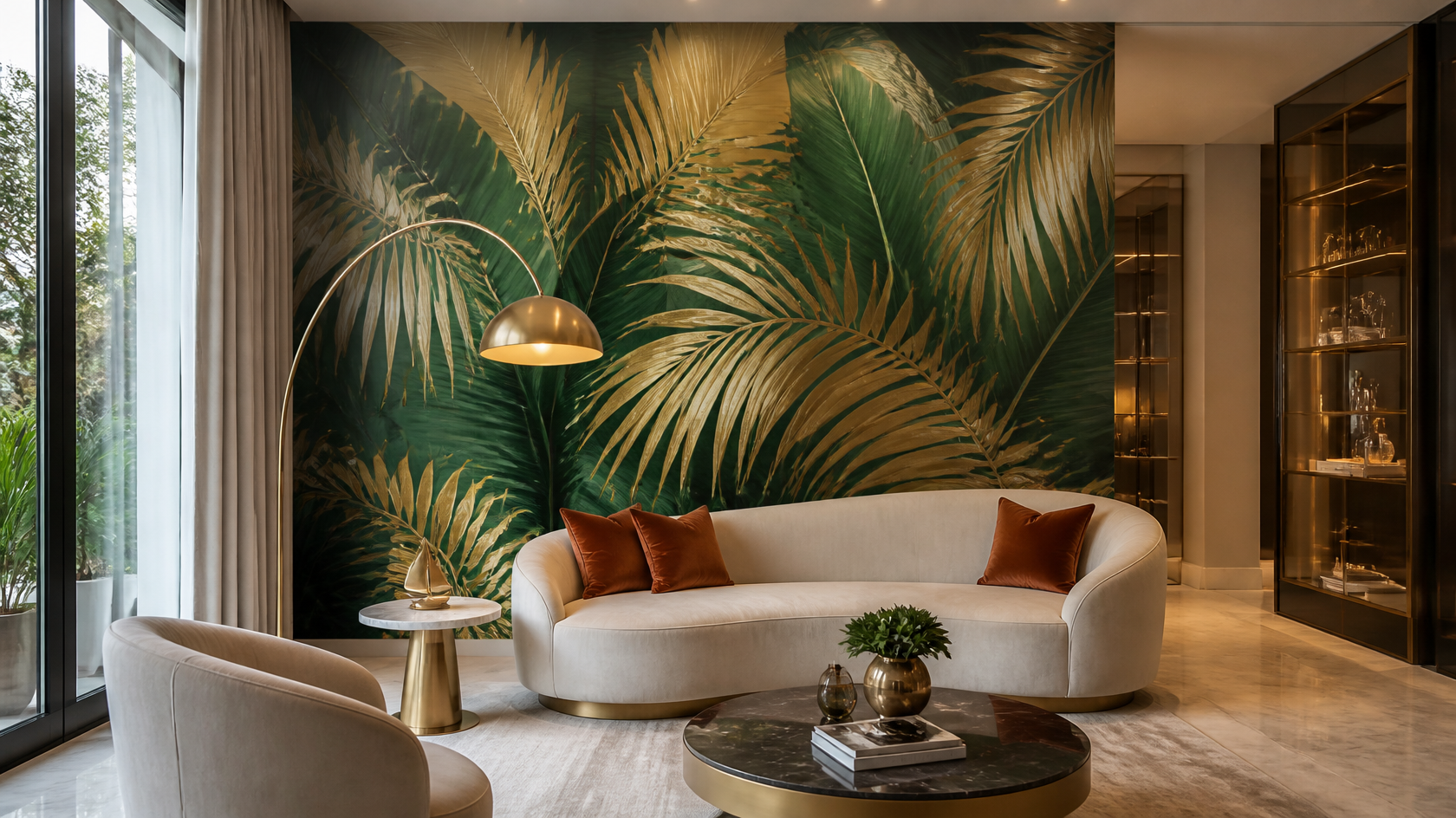
Wallpaper rarely lives alone. The three walls around your accent wall need to coexist with it. Some combinations that are almost foolproof:
- Large botanical wallpaper + warm white walls. Lets the pattern be the loudest thing in the room. Skip cool whites — they fight warm-toned paper.
- Grasscloth + soft clay or oat paint. Matches the natural fiber tone; the room reads layered rather than busy.
- Chinoiserie + deep sage or terracotta paint. Pulls the secondary color out of the pattern and amplifies it on the surrounding walls.
- Stripes + matching trim color. Painting trim in the darker stripe color makes the accent wall feel architectural, not decorative.
- Damask + matte black trim. Drama on drama. Powder rooms only.
What almost never works: large-scale wallpaper plus a strongly patterned rug, plus a patterned sofa. Two patterns is sophisticated. Three patterns is a thrift store. Pick one bold pattern per room and let the other surfaces play support.
The five mistakes we see most often, and how previewing in AI flags each of them before you hang anything:
1. Busy pattern in a busy room. A bedroom already has a printed duvet, a striped chair, and three pillows. Adding a 25 cm peony wallpaper breaks it. AI shows this immediately — the room reads chaotic in the render. Fix: switch to a small textured pattern, or strip back the textiles first.
2. Ignoring ceiling height. A large-scale pattern in a room with 2.4 m ceilings reads cropped — the eye sees half-blooms and assumes a mistake. AI shows you the proportions truthfully. Fix: drop to medium-scale, or commit to mural-as-art on one carefully chosen wall.
3. Wrong accent wall. Painting "an accent wall" on the wall that happens to be empty, instead of the one the architecture points to. AI lets you test all four walls in 3 minutes. The right answer is usually obvious by the second render.
4. Sample-vs-reality color shift. Wallpaper printed on roll often reads 10–20% darker than the sample swatch, because the swatch is lit from all sides. AI renders the paper in your actual room lighting, which tends to predict the real install accurately.
5. Picking a paper without thinking about pattern repeat. A wallpaper with a 50 cm vertical repeat needs more rolls to align than one with a 25 cm repeat. You can lose 10–15% of material to pattern matching. AI does not solve this directly, but it helps you commit to one pattern instead of changing your mind mid-project — which is when waste really happens.

Every room has its own physics. The pattern that works in a bedroom can fail in a living room, even if the wall sizes are identical, because the way you use the room changes what feels appropriate.
The room you spend the most waking time in. Choose patterns you will not get sick of in two years. Large-scale botanicals, grasscloth, subtle geometrics, or a single mural behind the sofa all wear well. Avoid extremely high-contrast patterns — they create visual noise during long evening sessions.
Patterns here should calm rather than activate. Sage, dusty rose, soft clay, muted blues. Behind the bed is the canonical placement. Skip the wall opposite the bed — you do not want a busy pattern as the last thing you see before sleep and the first thing you see on waking.
The boldest room in the house. You are there for an hour at a time, dressed up, eating well. Deep saturated colors, large florals, chinoiserie, even reflective foil prints — all fair game. Pair with low warm lighting.
The only room where "wallpaper everything" is the correct answer. Guests notice. You spend 30 seconds there at a time. Go dramatic — oversized florals, glossy lacquered prints, dark moody murals, anything you would never commit to in a bedroom.
Grasscloth and other textured naturals dominate here because they read professional on video calls without being distracting. A subtle vertical stripe behind your desk also videos well. Avoid anything moving — busy florals or large patterns pull the eye away from your face on a webcam.
Murals shine here because the entry is a brief, high-impact moment. A landscape mural — misty mountains, forest, cliffs, abstract clouds — sets the tone for the whole home in 5 seconds. Bonus: entryways are usually small enough that one mural panel covers the whole wall, simplifying installation.

A rough budget framework for a single accent wall, assuming a wall of 3 m wide x 2.5 m tall (7.5 sq m / about 80 sq ft):
| Tier | Wallpaper cost | Installation | Total |
|---|
| Budget peel-and-stick (DIY) | $60–$150 / €55–€140 | $0 | $60–$150 / €55–€140 |
| Mid-range traditional (DIY) | $120–$300 / €110–€275 | $0 | $120–$300 / €110–€275 |
| Mid-range traditional (pro install) | $120–$300 / €110–€275 | $320–$800 / €295–€735 | $440–$1,100 / €405–€1,010 |
| Premium designer paper (pro install) | $400–$1,200+ / €370–€1,100+ | $400–$1,000+ / €370–€920+ | $800–$2,200+ / €735–€2,020+ |
A mural typically costs $200–$600 ($185–€550) for a single-panel custom-printed scene up to roughly 3 x 2.5 m, plus the same installation cost as traditional paper if you do not hang it yourself.
Add 10–15% to material costs if your chosen paper has a large pattern repeat — that is the waste you will lose to pattern-matching. Add another $50–$300 per wall for prep if your walls are textured, damaged, or have old wallpaper to remove.
Yes, with caveats. Tools like GenRoom take your actual room photo and render wallpaper onto your specific wall, preserving the furniture, lighting, and proportions. The result is far more accurate than imagining a paper from a sample swatch. The two things AI cannot capture: texture under your hand and exact behavior under your evening lights. Order one physical sample before you commit.
Peel-and-stick if you rent, if it is your first wallpaper, or if you might want to change it in 2–5 years. Traditional if you own the home, if it is a high-traffic area, or if you are doing a whole room. Cost is roughly similar once you factor in pro installation for traditional — peel-and-stick wins on flexibility, traditional wins on lifespan and the high end of design choices.
Match scale to wall size and ceiling height. Walls under 2 m wide or rooms with 2.4 m ceilings: medium-scale (5–15 cm repeating elements). Walls 2–3 m wide with 2.5–2.7 m ceilings: medium to large (10–25 cm elements). Walls over 3 m wide or ceilings over 2.7 m: large or mural-scale. Small-scale ditsy patterns are usually a mistake on accent walls — they read as texture and lose the impact you were after.
No. Walls with doors, windows, or multiple outlets break up the pattern and undermine the focal-point effect. The accent wall should be a continuous surface that the eye naturally lands on when entering the room — usually behind the bed, sofa, dining table, or fireplace.
For a typical wall of 3 m x 2.5 m (7.5 sq m / about 80 sq ft), most rolls cover 5–5.5 sq m, so you need 2 rolls minimum. Add 10–15% extra for pattern matching, especially if the repeat is large. Always round up to whole rolls — buying one extra is much cheaper than re-ordering mid-project and risking a different dye lot.
Wallpaper is solidly in fashion in 2026. The accent wall trend specifically has shifted from the gray-painted accent walls of 2018 to bold textured wallpaper — grasscloth, oversized botanicals, painterly chinoiserie, panoramic murals. Warm palettes (clay, terracotta, sage, deep green) are leading; cool grays are fading.
Yes, but use wallpaper rated for high-humidity rooms — vinyl or vinyl-coated paper specifically labeled for bathrooms. Powder rooms (half-baths without showers) are easier and tolerate any standard wallpaper. Avoid wallpaper directly above stovetops, in shower zones, or anywhere with frequent splash exposure.
Peel-and-stick: peels off in 1–2 hours with no damage. Traditional: requires a steamer, scoring tool, and 4–8 hours per wall. This is the strongest argument for previewing in AI first — a 20-minute AI workflow prevents an 8-hour removal job.
The cost of getting wallpaper wrong is not the paper. It is the installation, the wall prep, the time, the regret. An AI wallpaper designer flips that equation: you spend 20 minutes previewing 20 options instead of one weekend agonizing over swatches taped to your wall. The right pattern at the right scale on the right wall takes a room from rental-generic to magazine-quality in a single project.
Pick the focal wall the architecture already points to. Match pattern scale to wall size and ceiling height. Test it in AI against your actual furniture, in your actual light. Order one physical sample to confirm. Then commit.
Ready to test wallpaper in your room? Upload a photo to GenRoom and preview accent wall options in 30 seconds.