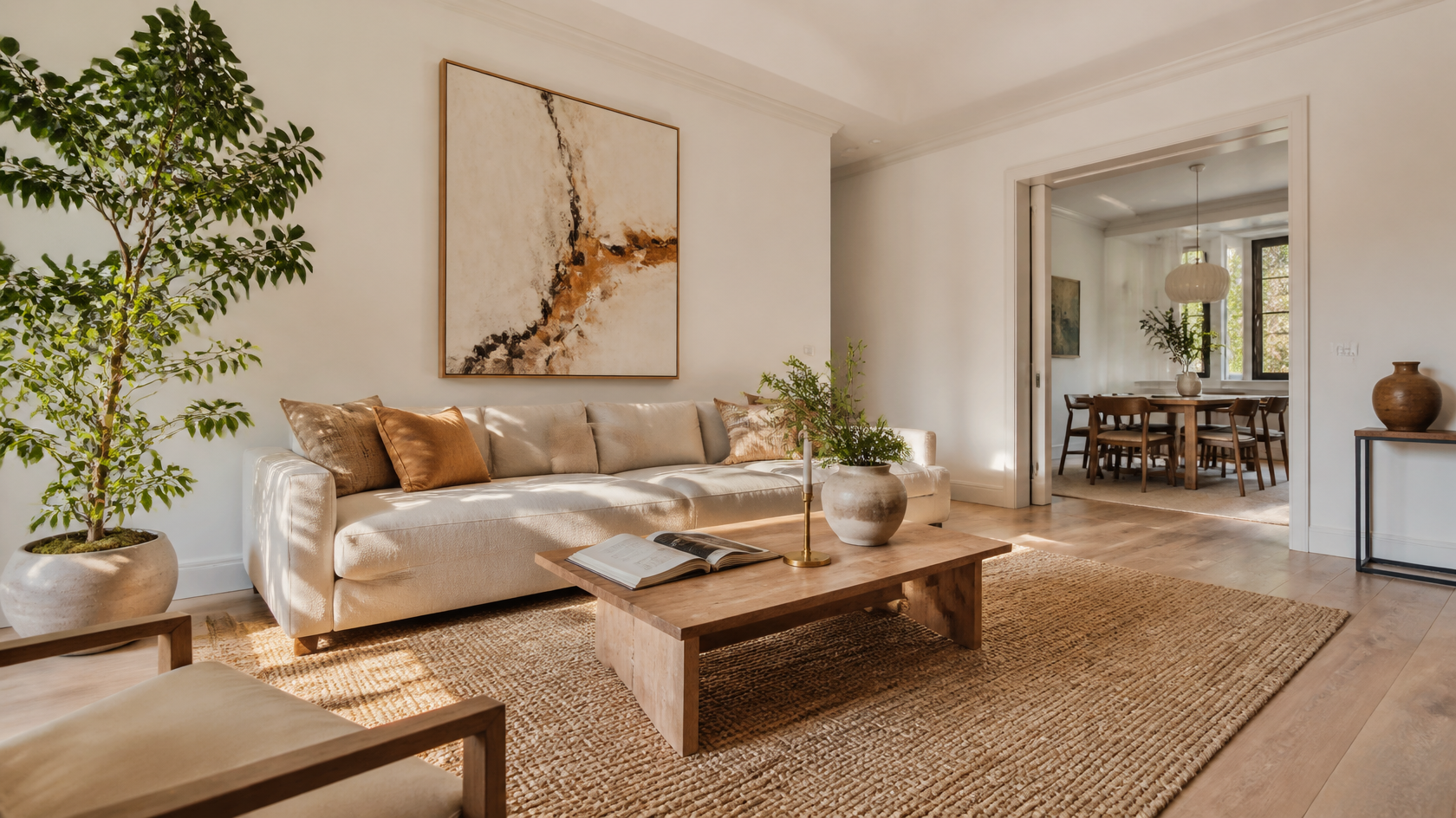
What works in a Brooklyn loft does not work in a Bodrum villa. Below is a market-specific cheat sheet based on top-performing Superhost listings in each region.
| Market | Top-Performing Style | Hero Photo Angle | Watch Out For |
|---|
| Mediterranean coast (Spain, Italy, Portugal, Turkey) | Modern coastal, whitewashed Mediterranean | Open terrace with sea view | Over-saturated blue water in photos triggers skepticism |
| Cappadocia, Bodrum, Marrakech | Warm earthy, stone-and-textile, Boho | Cave/stone interior with handmade textiles | Avoid generic Western styling — local materials convert |
| Northern Europe city apartments (Berlin, Warsaw, Vienna) | Scandinavian, mid-century modern, industrial loft | Bright living room near window with city view | Dark winter shots — always stage for golden-hour light |
| Paris, Provence, French Riviera | Parisian classic, Provence farmhouse, modern French | Window view (Haussmann balcony or lavender field) | Avoid clichés (Eiffel Tower posters) |
| Thailand, Bali, Indonesia coastal | Tropical modern, teak-and-linen, biophilic | Pool deck or villa exterior with pool reflection | Show shade and AC presence — heat is a booking objection |
| Tuscan and Italian countryside | Rustic Italian, Mediterranean farmhouse | Terrace with cypress or vineyard view | Keep stone and beam textures visible, don't over-modernize |
| German and Polish city apartments | Scandinavian, minimalist modern | Bright kitchen-living combo | Show storage and workspace — practical guests |
| Kazakhstan and Uzbekistan city stays | Modern minimalist with local accents | Living room with floor-to-ceiling windows | Show heating/AC infrastructure clearly |

Airbnb's content standards are clear: photos must accurately represent the property. Virtual staging that adds furniture or restyles existing furnishings is permitted if the room still accurately reflects what the guest will find on arrival. What is not permitted is fabricating amenities — a hot tub, a fireplace, a view, a balcony, square footage — that do not exist. Listings caught misrepresenting are removed, with Airbnb deleting more than 400,000 low-quality or non-compliant listings in 2024 alone.
The bigger 2026 development is California's AB 723, which requires conspicuous labels on any short-term rental image that has been digitally altered, including AI staging. The original image must be available immediately following the altered one in the gallery, or linked to an accessible original set. Hosts operating in California — or with guests who often originate from California — should treat this as the new floor. Even outside California, EU member states are tightening AI-disclosure rules in advertising, and Airbnb itself has signaled that it will tighten authenticity rules platform-wide in 2026-2027.
The pragmatic approach: never stage what is not there, disclose what was restyled, and keep an unaltered original of every photo on file. This protects your reviews, your Superhost status, and your account.
After reviewing hundreds of listings, the same handful of mistakes show up over and over. Avoid them and your listing will already outperform most competitors in your market.
1. Overstaging. Adding too much furniture, too many decorative objects, too many plants. The eye cannot find a focal point and the room reads as cluttered, not curated. Rule of thumb: every photo should have one clear hero element.
2. Style mismatch with property reality. Staging a 1970s Mallorca apartment as a glossy Manhattan penthouse. Guests will arrive expecting Manhattan and feel deceived. Stage toward the best version of what the property actually is, not against it.
3. Inconsistent style across photos. Living room is Scandinavian, bedroom is Boho, kitchen is industrial. The brain reads this as fake. Pick one design direction and apply it across all images.
4. Bad light direction. AI sometimes generates shadows that come from impossible angles or contradicts the window position. Inspect every image and reject any with implausible lighting.
5. Fabricated views. Adding ocean views, city skylines, or mountain ranges that do not exist. This is misrepresentation, plain and simple, and gets your account suspended.
6. Distorted scale. AI occasionally generates furniture that is too big or too small for the room. A sofa that appears to take up 80% of a 4-meter-wide living room is an instant red flag for guests.
7. Generic stock styling. The same beige sofa, the same olive tree in a basket, the same single Eames-style chair. Guests recognize the pattern across listings and discount your photos. Push your prompts toward specifics: a textile pattern that fits the region, an art piece, a unique lamp.
8. Skipping the human review. Treating AI as final and uploading directly. Always run one final human pass for proportions, lighting, realism, and brand consistency.
9. Not updating photos seasonally. Staging once and forgetting. Listings that refresh photos two to four times a year outperform static ones by 15-25%.
10. No disclosure. Even where not legally required, a brief sentence in the description ("photos professionally styled to show the home at its best") earns more trust than radio silence.
GenRoom is built for the workflow described above. Upload a photo of any room — empty or furnished — choose from over 50 design styles including Scandinavian, Mediterranean, Boho, Mid-Century, Coastal, and Japandi, and receive a photorealistic restaged image in roughly 30 seconds. The Pro Model produces magazine-quality output, the built-in AI Editor lets you refine specific elements with text prompts ("change the rug to a flat-weave kilim," "make the window light warmer"), and 4K output gives you the resolution you need for full-screen Airbnb display and for printing if you ever produce welcome packs.
For Airbnb-specific work, three GenRoom features matter most. First, multi-photo reference upload lets you anchor the style to your existing brand or to a specific aesthetic reference you have collected. Second, private generation keeps your test images off the public gallery while you experiment. Third, the 50+ style library covers every regional style described above — including local-feeling palettes for Mediterranean, Cappadocia-Boho, and Northern European urban properties.
Pricing starts at $9.99 for 36 credits (18 generations), which is enough to fully restage a one-bedroom listing's hero photos. The Basic plan at $19.99 covers a typical short-term rental refresh, and the Pro plan at $39.99 is right for property managers handling multiple listings or hosts running quarterly photo refreshes. See full pricing at genroom.io/pricing.
Yes, as long as the staged image accurately represents what guests will find on arrival. You may restyle existing furniture, change visible decor, or virtually furnish an empty room that you intend to actually furnish before booking. You may not fabricate amenities (hot tubs, fireplaces, balconies, views) that do not exist. Listings that misrepresent get delisted — Airbnb removed more than 400,000 in 2024 alone.
A complete photo refresh for a one-bedroom listing typically costs $5-$30 in AI generation credits across 6-12 hero images. A larger or multi-property refresh ranges from $50-$200. By comparison, a single professional photography session costs $300-$800 and physical staging rental runs $800-$2,900 per month.
In California, yes — under AB 723 (effective 2026), conspicuous disclosure plus access to the original image is mandatory. In most other markets it is currently optional but strongly recommended. A short line in your listing description ("photos professionally styled to reflect the property at its best") protects your reviews and signals integrity to guests.
No, if used honestly. Superhost criteria are based on cancellation rate, response time, ratings, and stay completion — not on photo origin. Hosts who use AI staging honestly tend to see ratings improve because guests find a property that meets or exceeds the visual promise. Hosts who use it dishonestly see ratings drop sharply on arrival, and that does kill Superhost status.
Aim for 24-30 photos. Listings in that range outperform listings with under 10 photos by approximately 33%. Beyond 30 photos, returns diminish — quality matters more than quantity past that threshold.
It depends on the market. Globally, Scandinavian and Modern Coastal are the most consistent top performers because they photograph well across screen sizes and signal "vacation energy" cleanly. Regional styles (Mediterranean for Mediterranean coast, Cappadocia-Boho for Anatolian properties, Alpine for ski markets) outperform generic Scandinavian in their local markets.
Two to four times per year for active listings. Refresh in advance of your peak season, swap in seasonal touches (warm textiles for autumn-winter, lighter linens and outdoor shots for spring-summer), and update any time you make a real change to the property. Listings that refresh photos quarterly maintain 80%+ occupancy in peak season versus 60% for static listings.
Only partially. AI can restyle a well-lit, well-composed photo dramatically. It cannot rescue a tilted, dark, midday-glare photo into a Superhost-quality image. If your source photos are weak, fix the source first: shoot in morning or late-afternoon natural light, hold the camera at chest height and level, declutter completely. Then apply AI staging on top.
For most hosts, the right answer is both. Hire a professional photographer every 18-24 months to capture exteriors, views, and verifiable amenities. Use AI virtual staging in between to refresh interiors, change seasonal moods, and produce alternative style variants. The combined approach typically costs less than two photo sessions a year while producing more visual variety than either approach alone.
Upload one good photo per room, generate three variants per room in your chosen style, pick the best, replace, and publish. Total time for a one-bedroom listing: about 90 minutes including review. Total cost: $5-$15.
AI virtual staging is no longer experimental — it is the default tool that competitive Airbnb hosts use to keep listings looking fresh, on-style, and photographed-for-the-scroll without spending $500 every six months on a photographer. The hosts who win in 2026 will treat it as a structured workflow: shoot good base photos, pick one regional style, generate multiple variants, review honestly, sequence for the funnel, and disclose when in doubt.
The cost of getting this right has collapsed by roughly 99% in the last three years. The booking advantage of doing it well — 24% more bookings, 40% more revenue, Superhost-level visual standards — has not. That is one of the rare arbitrages still open to independent hosts in 2026.
Try GenRoom on a single photo of your living room and see what your listing could look like by tonight: genroom.io/generate.