Three threats to balcony comfort: sun, rain, and wind.
Sun: Cantilever umbrellas (€80-300) work on most balconies. Retractable awnings (€200-1,500) require wall mounting and often HOA approval. Shade sails (€40-150) are the cheapest, most reversible option, but need three solid anchor points.
Rain: A solid roof or pergola with polycarbonate panels is the only true rain protection. Most apartment balconies cannot install one without major work. Plan for retreating indoors when it rains, and choose cushions and rugs that dry fast (acrylic, solution-dyed polyester, or all-weather wicker).
Wind: Above the fifth floor, wind is constant. Use weighted furniture, secure cushions with ties, and avoid lightweight folding chairs that blow off the railing. A windscreen of perforated metal or tempered glass dampens gusts and creates a microclimate.
Balcony makeover costs depend on size, materials, and how much you can DIY. These ranges reflect actual project budgets reported by interior designers and apartment dwellers in 2025-2026, across European, North American, and Asian markets.
| Budget Tier | Total Cost | What You Get |
|---|
| Minimal refresh | €100-300 | Two folding chairs, small table, 4-6 pots with plants, battery string lights, outdoor rug |
| Mid-range makeover | €400-900 | Compact sofa or quality bistro set, side table, 10-12 plants in larger pots, retractable shade sail, layered lighting (string + lantern), weatherproof storage box |
| Premium transformation | €1,000-2,000 | Modular L-sofa, premium teak or aluminum furniture, vertical garden system with drip irrigation, professional shade structure, integrated low-voltage lighting, composite decking tiles, custom planters |
| Designer / installed | €2,500-6,000+ | Custom built-ins, retractable awning, frosted glass panels, mature trees in oversized planters, designer fee, irrigation install |
For most apartment dwellers, the €400-900 tier delivers 80% of the visual impact at a fraction of the designer cost. AI design tools let you preview the premium look first, then strip back to a realistic budget without losing the core layout.
Pets change every balcony rule. Five adaptations to consider if you share the space with a dog or cat:
- Artificial turf (€20-50 per m²) gives a soft, drainable surface and feels like grass to the dog. Choose a permeable backing and rinse weekly.
- Plant safety: Many common balcony plants are toxic to dogs and cats. Avoid lilies, sago palm, oleander, hydrangea, azalea, and pothos (toxic to cats). Stick to herbs (basil, mint, parsley, rosemary, thyme), spider plants, Boston fern, areca palm, and bamboo.
- Railing safety: Cats can squeeze through gaps as narrow as 5 cm. Add a layer of plexiglass, fine wire mesh, or specialized "catio" netting if you have a cat.
- Climbing prevention: Never place furniture next to railings if you have a cat or small dog — they will use it as a launchpad.
- Water and shade: Pets cannot tell you when they are overheating. Always provide a shaded zone and a tipping-proof water bowl.
 Dog-friendly balcony: artificial turf with permeable backing, weighted furniture, pet-safe plants, gated entry
The AI workflow takes about 15-20 minutes and replaces hours of Pinterest scrolling and dozens of returned furniture pieces. Follow these eight steps in order.
1. Empty the balcony and clean. AI tools work best on a clean, empty space. Remove existing furniture, sweep the floor, take photos in natural daylight, not at night.
2. Take three photos. From inside looking out, from the door looking along the long axis, and from the balcony looking back at the door. These three angles give the AI enough spatial information to generate a coherent redesign.
3. Open GenRoom and upload one photo. Choose the "Exterior" or "Balcony" room type if available. Otherwise select "Patio" or "Outdoor."
4. Pick a style. Start with Mediterranean, Modern Minimalist, or Scandinavian. These three give the most usable balcony output. Avoid over-specific styles (e.g., "Japanese tea garden") on first generation — the AI may produce a beautiful render that ignores your real constraints.
5. Generate three to four variations. Use different styles or different prompts (e.g., "with vertical garden," "dining setup for two," "lounge zone with sofa") to test directions. Cost per generation: 1-2 credits.
6. Pick one winner. Compare your generated images side by side. Look for: realistic furniture sizing (does it actually fit your space?), correct sun exposure (does the AI version match your real sunlight pattern?), and material feasibility (are the plants and finishes available in your country?).
7. Build a shopping list from the winning render. Identify each piece: the chair style, the planter shape, the floor material. Search those terms on IKEA, Wayfair, Maisons du Monde, or local outdoor retailers.
8. Buy in stages. Start with the floor (rug or deck tiles) and one anchor piece (sofa, dining table, or bench). Live with it for two weeks before adding plants and accessories. This staged approach prevents the most common mistake: buying everything at once and discovering nothing fits.
After reviewing hundreds of balcony before-and-after projects, these seven mistakes appear in nearly every failed makeover. The AI workflow above prevents most of them, but knowing them helps you spot trouble early.
1. Oversized furniture. A sofa designed for a backyard patio (90 cm deep, 200 cm wide) will physically not fit on a 3 m² balcony. Always confirm furniture depth is 70 cm or less, and width is at least 30 cm narrower than the balcony.
2. Ignoring sun exposure. Many renters discover their plants die because the balcony gets only 2 hours of morning sun, not the 6 hours their tomatoes need. Track sun for a full day before buying plants.
3. No drainage plan. Watering 15 plants on a balcony with no drain means dirty water flowing onto the unit below. Use saucers, watering trays, or balcony rain mats. Some HOAs explicitly ban planters that drain off the balcony.
4. Buying lightweight furniture. Plastic chairs and aluminum tables blow off above the fourth floor. Choose weighted or wall-anchored furniture for high floors and windy locations.
5. Forgetting privacy. A beautifully designed balcony becomes unusable if neighbors can see directly into it. Plan privacy before furniture.
6. Skipping the ground rules check. Spending €600 on a charcoal grill that is illegal in your building is the most common expensive mistake. Check fire code, HOA bylaws, and weight limits first.
7. Trying to do too much in a tiny space. A 3 m² balcony with a sofa, dining table, BBQ, herb garden, and 20 plants reads as cluttered storage, not an oasis. Pick one program. Do it well. Add later if it works.
A traditional balcony designer or landscape architect charges €500-2,000 for a consultation plus design plan, depending on city. Timeline: 2-4 weeks. They produce CAD drawings, mood boards, and a shopping list. The output is high quality but slow and expensive for a 5 m² space.
AI tools produce a photorealistic visualization in 30-60 seconds for €0-2 per render. Timeline: same day. Output is less detailed than a designer's plan but enough to lock down the visual direction and answer the only question that matters: "Will this look good in my actual balcony?"
For balconies under 15 m², AI is almost always the right starting point. Use a designer only for: structural changes (built-ins, awnings, electrical), HOA submissions requiring drawings, or budget exceeding €5,000.
A balcony as small as 2 m² (about 22 sq ft) can function as a single-zone bistro nook. Below 2 m² the space becomes too narrow for any furniture and is best used as a plant-only display balcony with a wide railing for one mug of coffee.
Yes — AI is especially useful for renters because it lets you test reversible furniture and decor combinations before buying. Stick to the AI workflow above, then filter results for renter-safe items: no drilling, no permanent paint, no fixed lighting, weighted not wall-anchored screens. GenRoom's free tier covers this exploration without a credit card.
€100-150 covers a minimal but real makeover: two folding chairs (€40), a small folding table (€25), four small plants in pots (€30), a battery string light set (€15), and a budget outdoor rug (€30). Skip the planters initially and let the rug and string lights do the visual work.
Not if you size them right. A 40-50 plant vertical wall with a simple drip irrigation timer (€60-100 for the whole system) needs about 5 minutes per week of attention. Without drip irrigation, plan 15-20 minutes of hand-watering twice a week. Choose drought-tolerant plants (pothos, philodendron, ivy, snake plant) for low-effort walls.
In most condos and apartment complexes, decorative planters and reversible screens like bamboo roll-ups or tension-rod curtains do not require approval. Fixed screens, awnings, lattice mounted to the building, exterior-facing planter boxes hanging from the railing, and anything visible from the street usually do require written approval. Always check your CC&Rs or règlement de copropriété.
Usually no. The International Fire Code and most local fire codes ban charcoal and propane grills on multi-family balconies. Electric grills under 200 sq in (1,290 cm²) of cooking surface are typically allowed, but HOAs can ban even those. Check your local fire marshal and lease before assuming any grill is legal.
The full workflow — measure, photograph, upload, generate three variations, pick a winner, build a shopping list — takes about 20 minutes. The AI generation itself takes 30-60 seconds per render. Compare with 3-6 hours of Pinterest research or 2-4 weeks for a traditional designer.
AI tools generate generic photorealistic furniture, not specific catalog items. After generating a render you like, you reverse-search the furniture style (e.g., "rattan bistro chair," "L-shaped outdoor sofa beige") on local retailers — IKEA, Maisons du Monde, Westwing, John Lewis, Wayfair, AliExpress. The render gives you the visual target; local shopping fills in the actual products.
For style, layout, and proportions — yes. For exact furniture dimensions, plant species, or material specs — no. Use AI to lock the visual direction (style, color palette, layout zones), then verify each purchase against actual measurements and product photos before buying.
Modern Minimalist (black-and-wood) and Scandinavian Lounge consistently make small balconies feel larger. They use restrained palettes (2-3 colors), light or glass railings, and a single statement piece rather than a busy mix. Boho-Jungle works for plant lovers but only if you stick to a tight earth-tone palette — too many colors at small scale reads as cluttered.
Every balcony, no matter how small or how restricted by HOA rules, can become a real outdoor room. The decisive variable is not the size or the budget — it is whether you commit to one program (lounge OR dining OR garden), follow the layout templates that match your square footage, and confirm the ground rules before you spend a euro.
AI tools collapse the design-and-test loop from weeks to minutes. Upload a photo, generate four variations, pick the one that survives your sun, wind, weight, and HOA constraints, and build a shopping list. The two-hour AI workflow replaces both the Pinterest spiral and the expensive designer consultation.
Ready to test your balcony? Open GenRoom, upload a photo, and have four photorealistic options ready in five minutes. Free tier covers the exploration. No credit card. No design degree.
 The 2-4 m² bistro layout: round table 60 cm wide, two compact chairs, hanging plants on the railing — one zone, no clutter
 The 4-8 m² lounge layout: compact L-sofa, low table, single statement tree, and a layered rug to anchor the zone
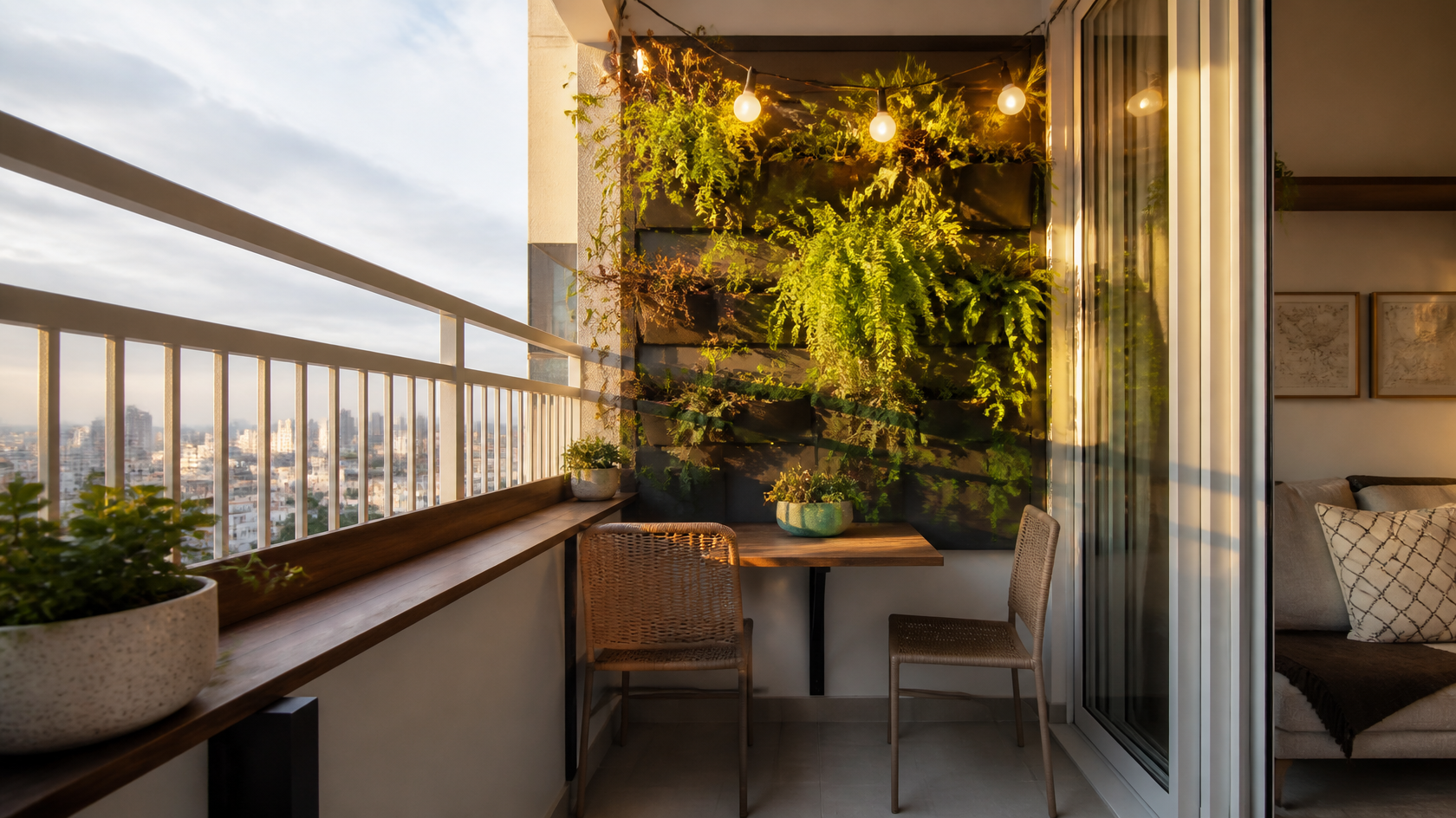
 Template D in practice: a folding table drops down for evening meals and disappears during the day
 Template E: a vertical garden wall can host 40-60 plants on just 2 m² of wall surface
 Mediterranean tiled style: patterned encaustic floor tiles do most of the design work — keep furniture simple
 Modern minimalist: matte black hardware, teak warmth, sculptural plants, zero clutter
 Boho-jungle: layer plants at multiple heights, mix textures freely, but keep the color palette to three earth tones
 Family-friendly: every piece is weighted, soft-edged, or unclimbable — safety drives the layout, then style