Teen Bedroom Ideas: Turn a Kid's Room Into a Teen Room With AI
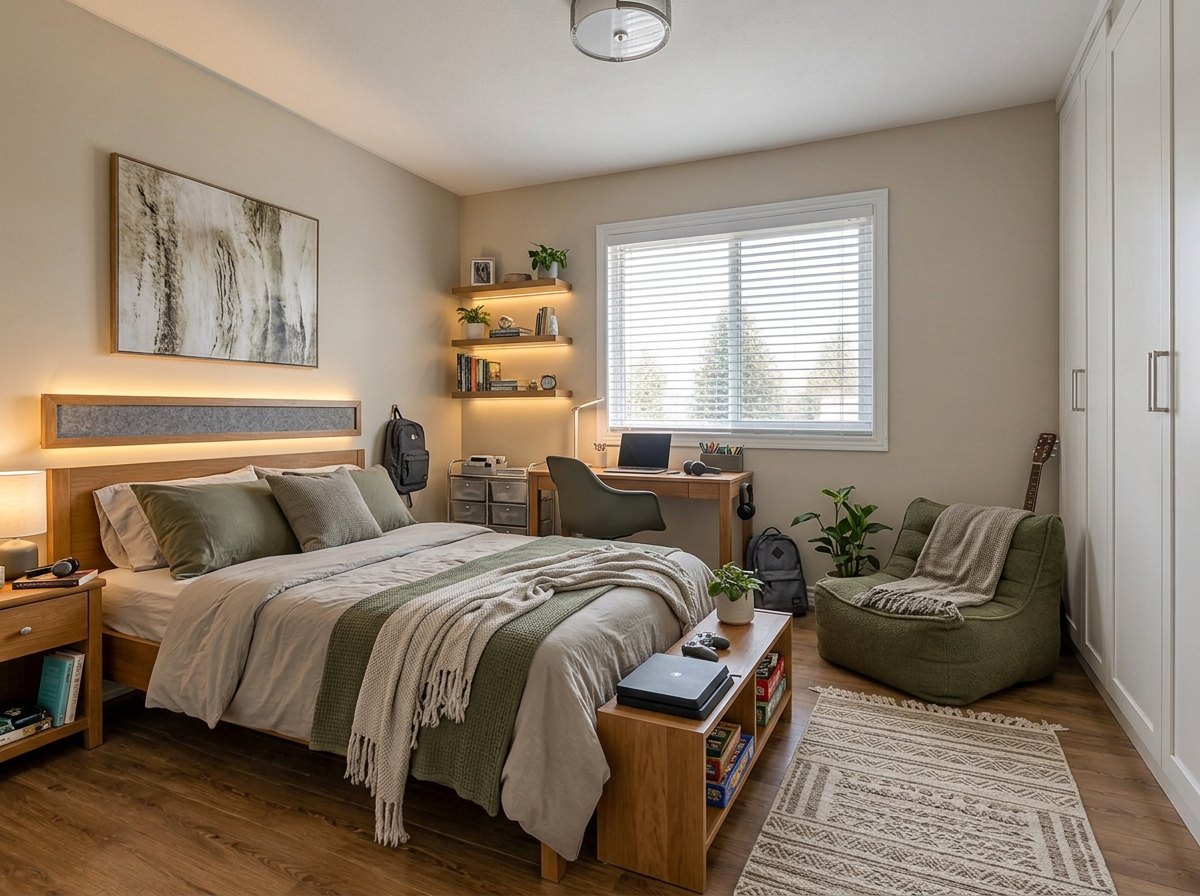
A real result from the GenRoom Studio: the ready task "Kids' room by age" set to "Teen" on a photo of a plain spare bedroom. The window, the wardrobe and the camera angle come from the original photo.
The quickest way to turn a kid's room into a teen room is to try the change on a photo of that exact room before you buy anything. Upload one photo, tell the AI the age and what the room has to hold — a study desk, a gaming setup, more storage, a lounge corner — and in under a minute you see the same room, same window, same camera, grown up. Then you can repaint it, change the light or swap the furniture with one more click.
That is exactly what people bring to GenRoom. Between March 2 and October 14, 2026, 283 people asked for a teenager's room in their own words. The requests are concrete. A loft bed "with a study and gaming area and a place to relax", in a room full of high cupboards. A bedroom for two teenagers, a girl and a boy, "with the existing furniture". A room for a 15-year-old girl that is only 2.4 meters wide, with a niche by the window. A navy, grey and black room with a clothing rack, a pegboard and a floor mirror. "Colors for two walls, modern, without cartoons."
Below: the exact Studio path, three real rooms (a pink room for an eight-year-old, a small shared room, a plain bedroom), how to get LED and ambient light, how to brief colors for a boy, a girl or neither, and where the AI got it wrong. For babies and younger children, see our nursery and kids room guide and the kids room design page.
What Do Parents and Teens Actually Ask For?
They rarely ask for "a teen room" and stop there. They name the activities the room has to hold and one or two constraints. We grouped the real requests (paraphrased, anonymised) by what they need the AI to do:
| What people write (paraphrased) | What it really means | Studio path |
|---|---|---|
| "Turn this into a teenager's room, everything a teen needs" | A full age change: sleep, study, hang out | Ready task "Kids' room by age" → Teen |
| "A 15-year-old who games: a gaming desk, LED lighting" | A setup plus a mood | "Kids' room by age" → Teen + a note |
| "Two teenagers, a girl and a boy, two beds, not bunk beds" | A shared room with two zones | "Kids' room by age" → Teen + a note about both |
| "Keep the bed and the white shelf, change the rest" | A budget makeover around what you own | Same task + "Keep the…" in the note |
| "A loft bed with a desk and gaming underneath" | More floor space in a small room | Same task + "a loft bed with…" in the note |
| "Calm colors, hidden lighting" | A finish and a light change on a result | Editor: Quick actions → Wall color, Lighting |
Two patterns stand out. First, people describe the teenager, not the furniture: the age, the hobby, sometimes a team or a band. Second, most rooms already have something worth keeping — a wardrobe, a platform, a mirror, a shelf. The Studio handles both, as long as you write it down.
How Do You Turn a Kid's Room Into a Teen Room in the Studio?
Upload a photo, set the space to Kids Room, pick the ready task "Kids' room by age", choose "Teen", add a one-line note, and press "Create design". Here is each step with what to watch for.
1. Upload one photo of the room. Stand in the doorway or a corner so two walls and the window are in the frame, at eye level, in daylight. The photo does not need to be tidy: toys on the floor are fine, the AI replaces them anyway.
2. Check "Your space". The Studio guesses the room type from the photo. Our pink room and our shared room were recognized as "Kids Room" straight away. A plain bedroom with a double bed was recognized as "Bedroom", which is fair — but the age task only appears for a kids room. Switch it in the "Your space" menu above the photo.
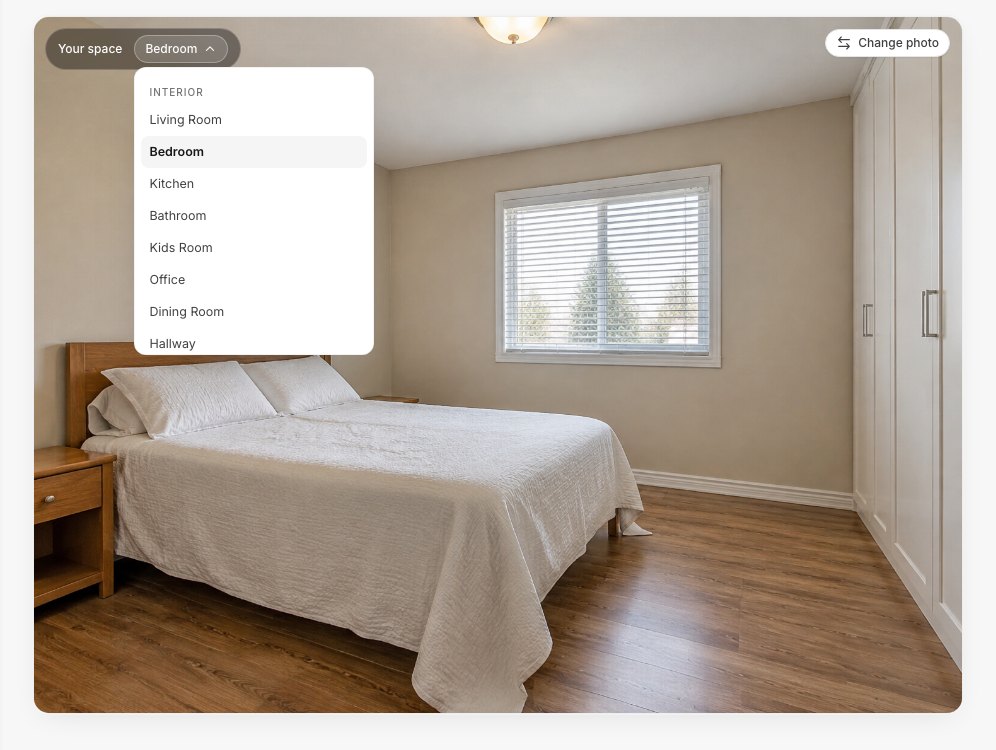 "Your space" above the photo: switch a plain bedroom to "Kids Room" to unlock the age task.
3. Open Ready tasks → Furniture & decor → "Kids' room by age". Click "Refine" next to it. You get four ages — Baby, 3–6 years, 7–10 years and Teen — and a field called "Anything to keep in mind?". Pick "Teen".
4. Write the note. This is where the real request goes: the age, what the teen does in the room, the colors, what to keep. One or two sentences are enough. Then "Save".
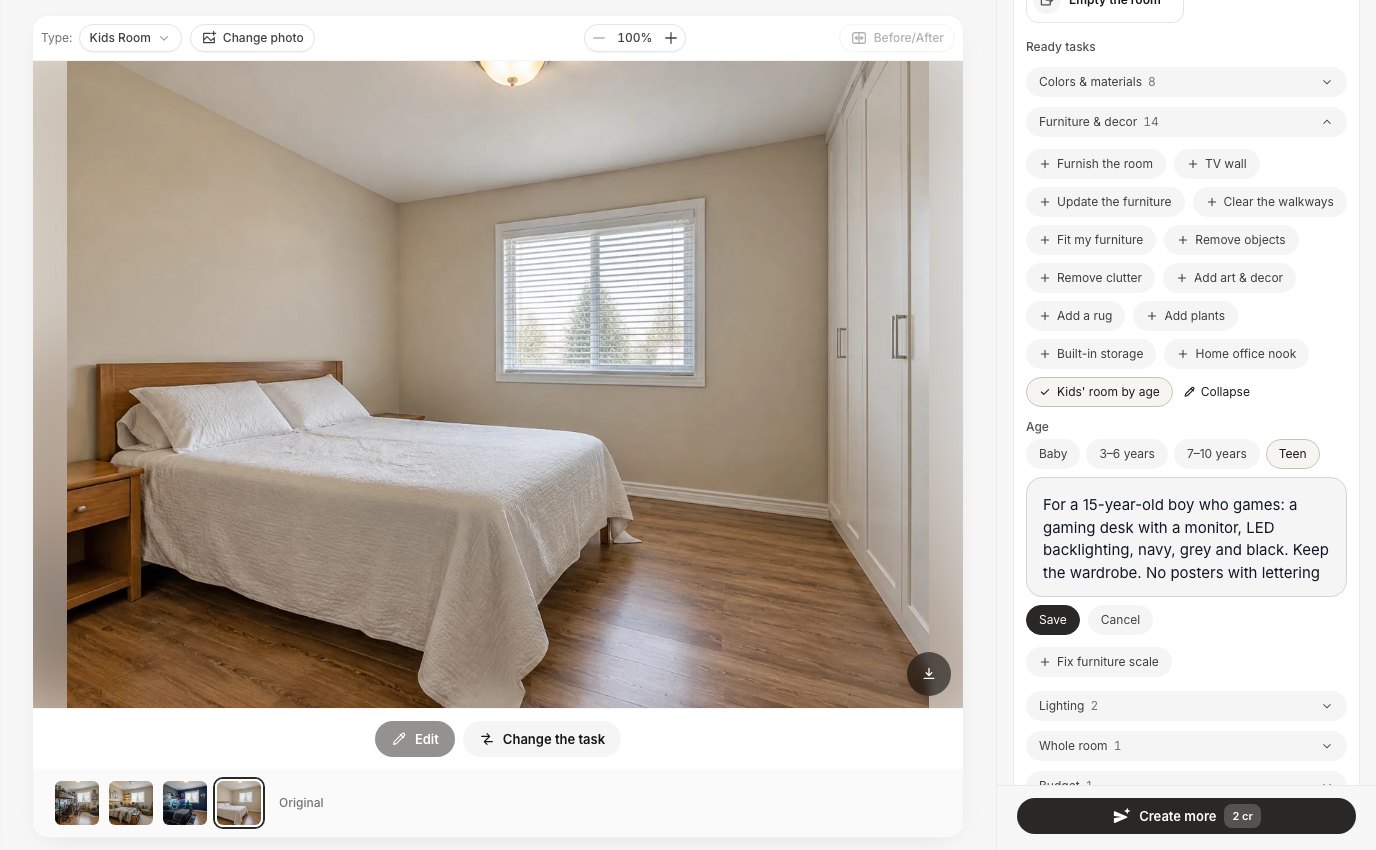 The ready task "Kids' room by age" with "Teen" selected and a note in "Anything to keep in mind?".
5. Press "Create design". A design costs 2 credits. In our tests each result took 24–49 seconds to generate (31–60 seconds from the click to the picture on screen). Every result stays in the work's history, so you can compare versions side by side.
One detail that saves confusion: modes and ready tasks are two routes, not one. If you click a mode such as "Full makeover" or "Designer look", the ready-task list steps aside (only "Keep to a budget" stays), and you describe the teen room in the brief instead. For a kid-to-teen change, the age task is the more direct route.
What Should a Teen Room Have?
A teen room has to work as five rooms in one: a bedroom, a study, a screen or gaming corner, a wardrobe and a place to hang out with friends. A kid's room is built around play on the floor; a teen room is built around a desk, a bigger bed and closed storage. This is what changed in every one of our results:
| In a kid's room | In a teen room | Why |
|---|---|---|
| Small bed or daybed with stuffed toys | Full-size bed or a daybed with grown-up bedding | Teens grow; the bed becomes a sofa by day |
| Play table and tiny chairs | A real desk and an adjustable chair by the window | Homework, laptop, daylight on the desk |
| Open toy bins on cube shelves | Closed boxes, a wardrobe, shelves for books | Less visual noise, more privacy |
| Play mat or a cartoon rug | One large plain or patterned rug | Grounds the room, softer look |
| Bright pastels, decals, cartoon prints | Sage, navy, greige, warm white, wood | Calmer colors that last for years |
| One ceiling light | Ceiling light + desk lamp + LED strips | Light for study, gaming and evenings |
| Floor space for play | A lounge corner: beanbag, armchair or floor cushions | Somewhere for friends that is not the bed |
If the room is small, the lounge corner is the first thing to cut, or it moves onto the bed. A loft bed frees the floor instead — we tried that too (Example 3).
Example 1: A Pink Room for an Eight-Year-Old, Grown Up
This is the most common starting point in the requests: a room decorated for a younger child, with butterfly decals, pink walls, a play kitchen and a table for tea parties. The teenager now wants a desk and a room that does not look like a nursery.
From play room to study room
We used the ready task "Kids' room by age" → Teen with the note: "For a 14-year-old girl: a proper study desk, more closed storage, sage green and warm white instead of pink, a reading corner. Framed art without any lettering."
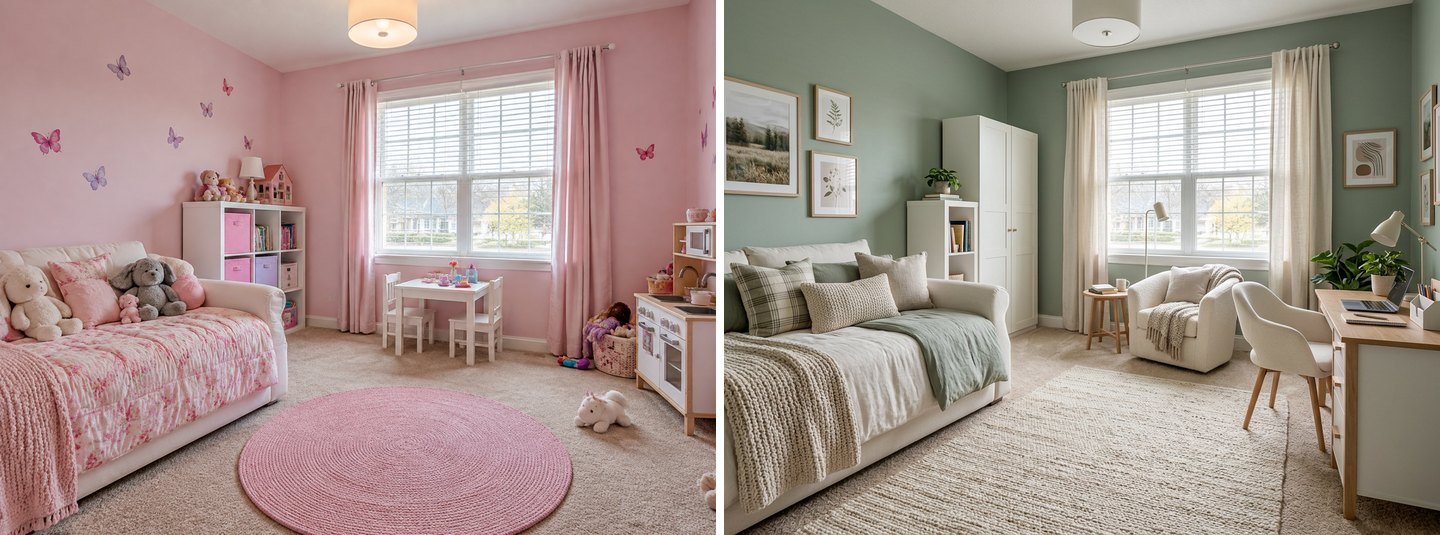 Before and after: the same window, ceiling light and camera. The toys, decals and play kitchen are gone; a desk, a reading chair and closed storage are in.
Every item on the list is there: a real desk by the window, a reading armchair, a tall wardrobe for closed storage, and sage green walls. The window, the curtain rod, the ceiling light and the camera point are exactly where they were in the photo, so you can judge the room, not a different room.
Same room, three teen versions
The note changes the result more than anything else. Here is the same photo with no note, with the note above, and with a budget note: "Keep the white daybed and the white cube shelf where they are. Add a desk, make the colors grown-up. No posters with lettering."
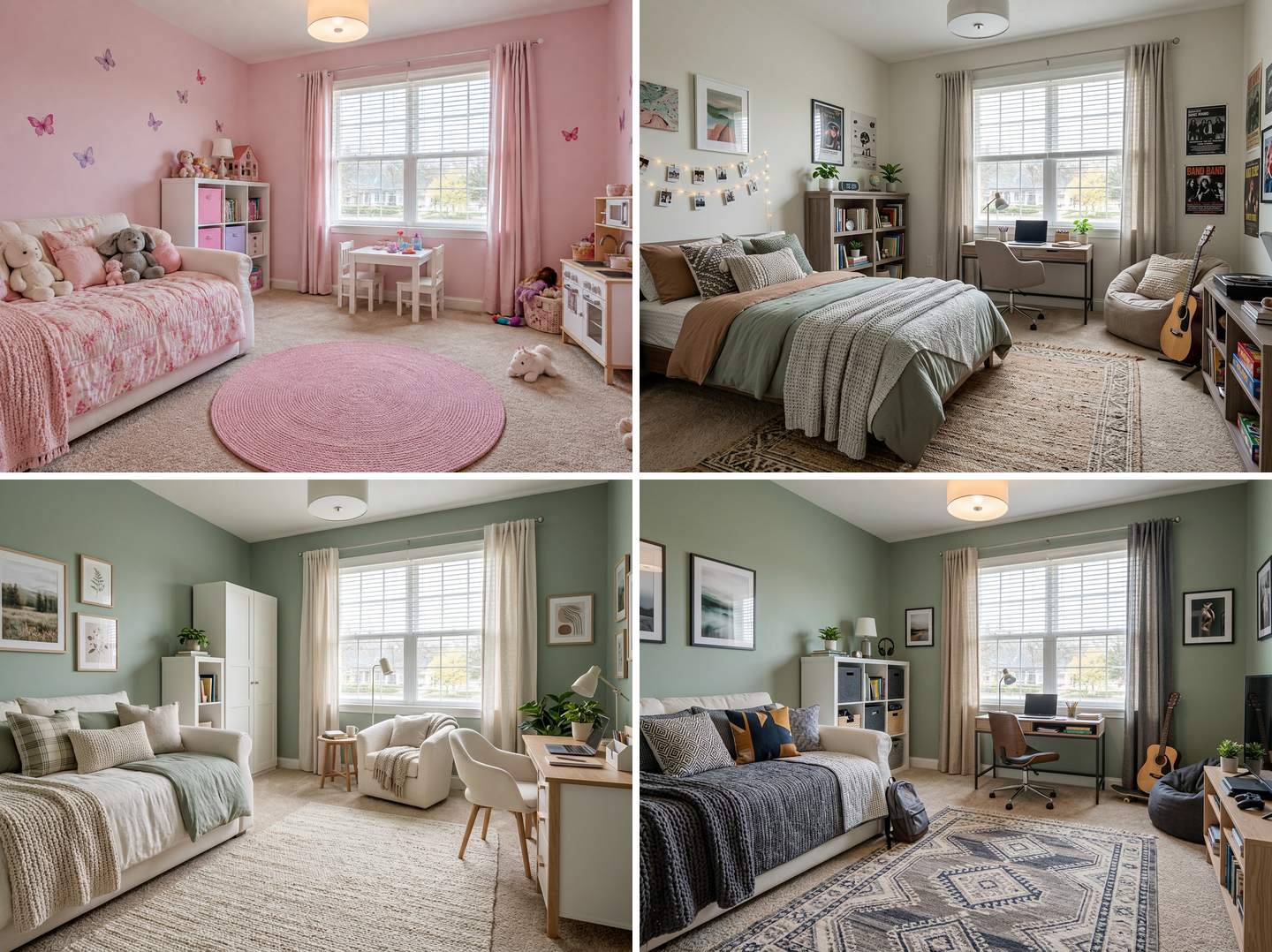 Top left: the original. Top right: "Teen" with no note. Bottom left: the 14-year-old girl note. Bottom right: "keep the daybed and the cube shelf".
The bottom-right version matters most for a real budget. The daybed and the cube shelf from the photo stayed in place; the pink bins became grey boxes, the walls went sage, and a desk and a TV unit were added. That is the cheapest kind of teen makeover — new paint, bedding, boxes and a desk — and the AI shows it honestly as a version of your own room.
Example 2: A Small Shared Room for Two Teens
A narrow room, about 2.6 meters wide, with two kids' sofa beds in blue and red, a cartoon road rug, cloud decals and a low toy shelf under the window. Shared rooms come up again and again in the requests: two teenagers, often a boy and a girl, "two beds, not bunk beds", and a desk for each.
Two beds, two desks, one window
Note: "For two teenagers, a girl and a boy: two separate beds, not bunk beds, and a desk for each. Calm colors, no posters with lettering."
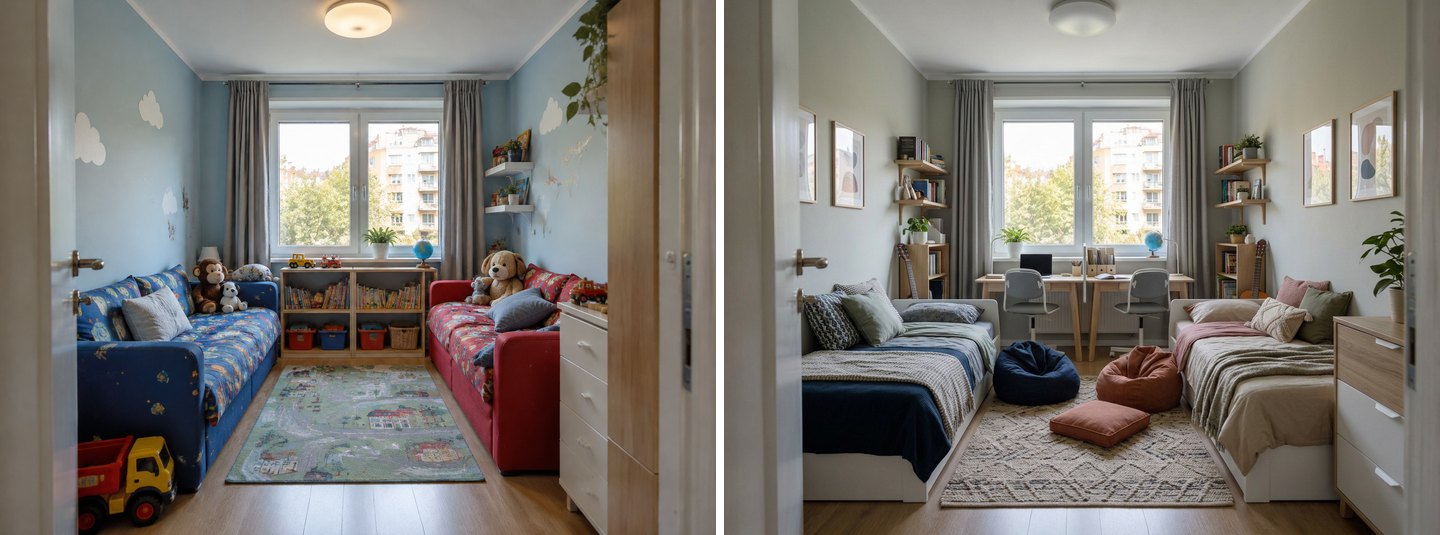 Before and after: the door, the window and the dresser on the right stay; the room gets two beds, a desk for two and calm grey-green walls.
The layout is the classic one for a narrow shared room: beds along the long walls, one long desk under the window with two chairs, shelves in the corners above each bed. Each side gets its own bedding color — navy on one bed, blush on the other — which is a simple way to give two teens their own zone without a divider. If the room is big enough for a real divider, see our room zoning ideas.
Try another wall color with one click
Shared rooms need a color both teens accept. Instead of a new design, open the result in the editor and use Quick actions → Wall color. We typed "soft sage green".
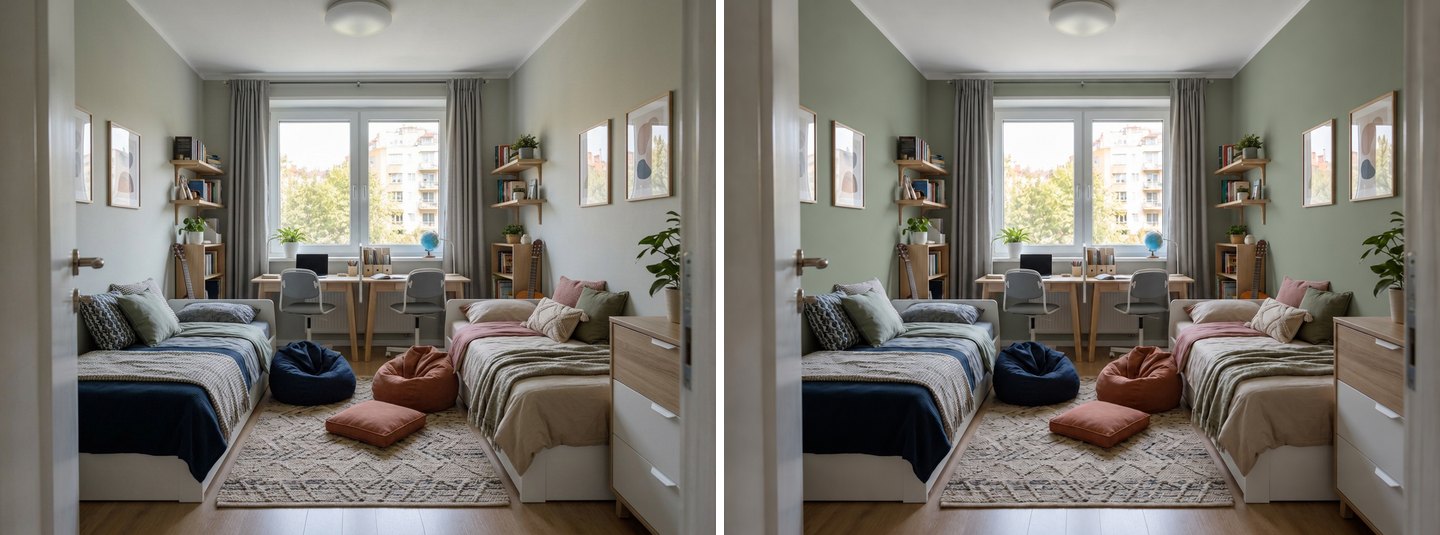 Editor → Quick actions → Wall color: "soft sage green". Only the walls changed; every object stayed.
Only the walls changed. The same quick action accepts a RAL code or a paint brand color, and the Colors library in the editor adds palette, NCS and HEX — useful once you have a short list. Our paint color guide covers that in detail.
Example 3: A Plain Bedroom Turned Into a Gaming Teen Room
The third room has nothing childish in it at all: beige walls, a double bed with a wooden headboard, a tall white built-in wardrobe on the right and an empty wall under the window. This is the "spare room becomes my son's room" case, and the one where people ask for a gaming setup most often.
A gaming desk, navy and LED backlight
We switched "Your space" to "Kids Room", picked "Kids' room by age" → Teen and wrote: "For a 15-year-old boy who games: a gaming desk with a monitor, LED backlighting, navy, grey and black. Keep the wardrobe. No posters with lettering."
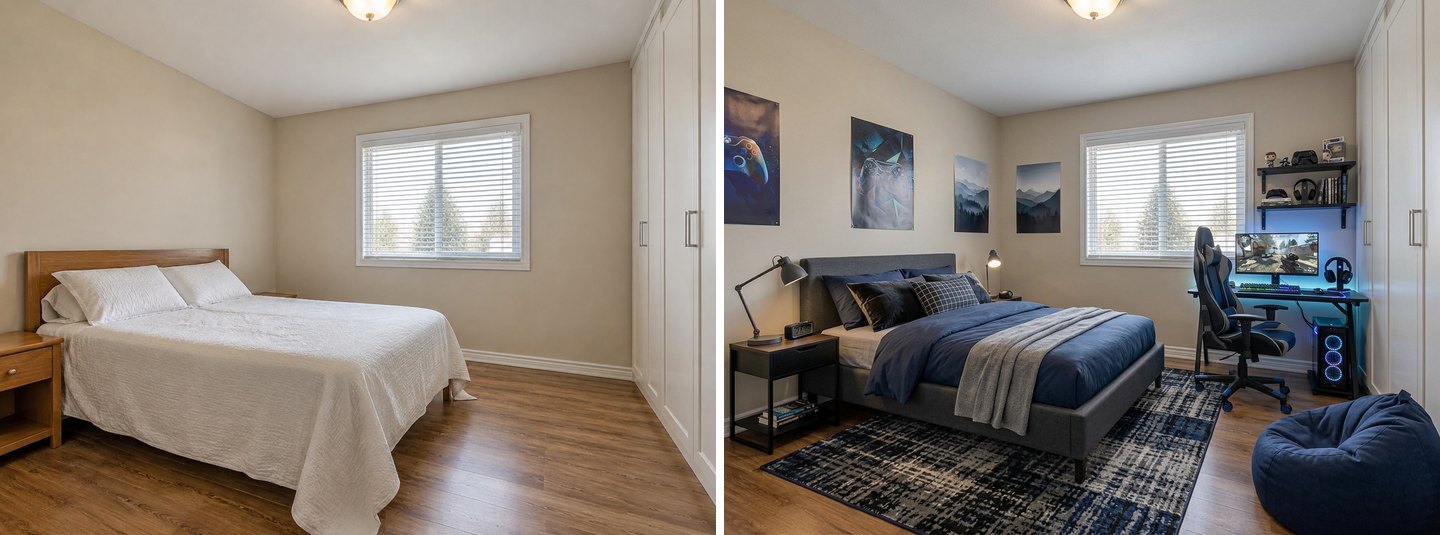 Before and after: the built-in wardrobe and the window stayed, as the note asked. The gaming desk went to the free wall by the window.
The wardrobe is untouched, the desk sits by the window rather than in front of it, and the blue LED glow sits behind the monitor and under the desk. Note that the bed moved: the task re-plans the room, so if the bed must stay where it is, say so in the note.
Gamer, gender-neutral or a loft bed
Same photo, two more notes. A gender-neutral version: "Gender-neutral room for a 16-year-old: warm wood, greige and olive, a desk by the window, a lounge chair, hidden LED lighting. Keep the wardrobe." And the loft request from the real data: "A loft bed with a study desk and a gaming setup underneath, a lounge corner to relax. Keep the wardrobe."
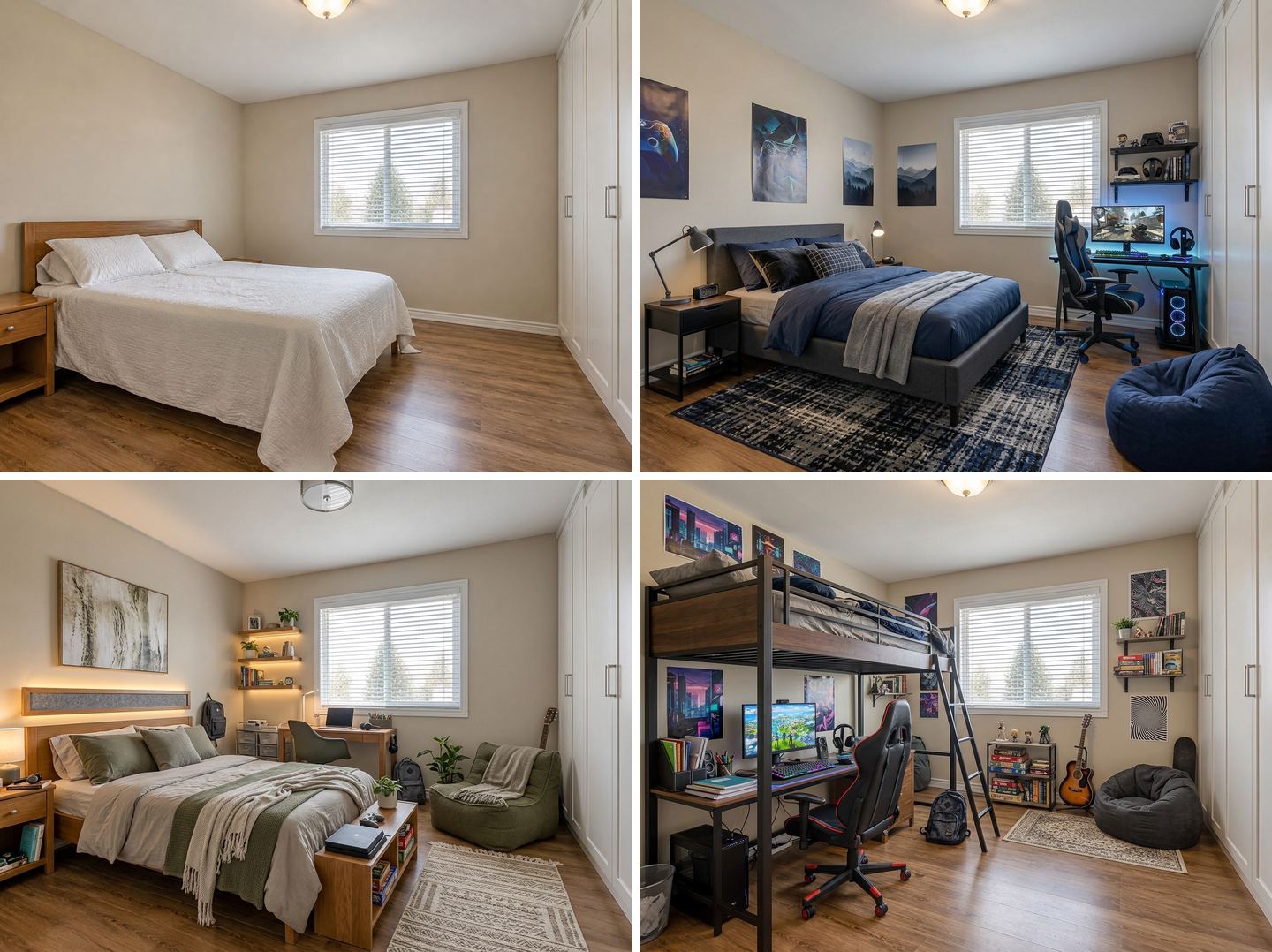 Top left: the original. Top right: the gaming note. Bottom left: gender-neutral, warm wood and olive. Bottom right: a loft bed with the desk underneath.
The loft version frees the whole floor: desk and chair under the bed, a reading corner with a beanbag by the wardrobe. It is the version that answers the "small room, but they want everything" requests best. Treat it as a layout idea, not a product: check the real loft bed's height against your ceiling and leave enough room to sit up in bed.
Create interior design with AI
Upload a photo of your room and get a professional design in 30 seconds. First generation is free.
How Do You Add LED and Ambient Lighting to a Teen Room?
Ask for it in the note, or add it afterwards with Quick actions → Lighting in the editor. The note is better when the light is part of the design (an LED strip behind a desk, a backlit headboard). The quick action is better when you like a result and only want to see it in the evening.
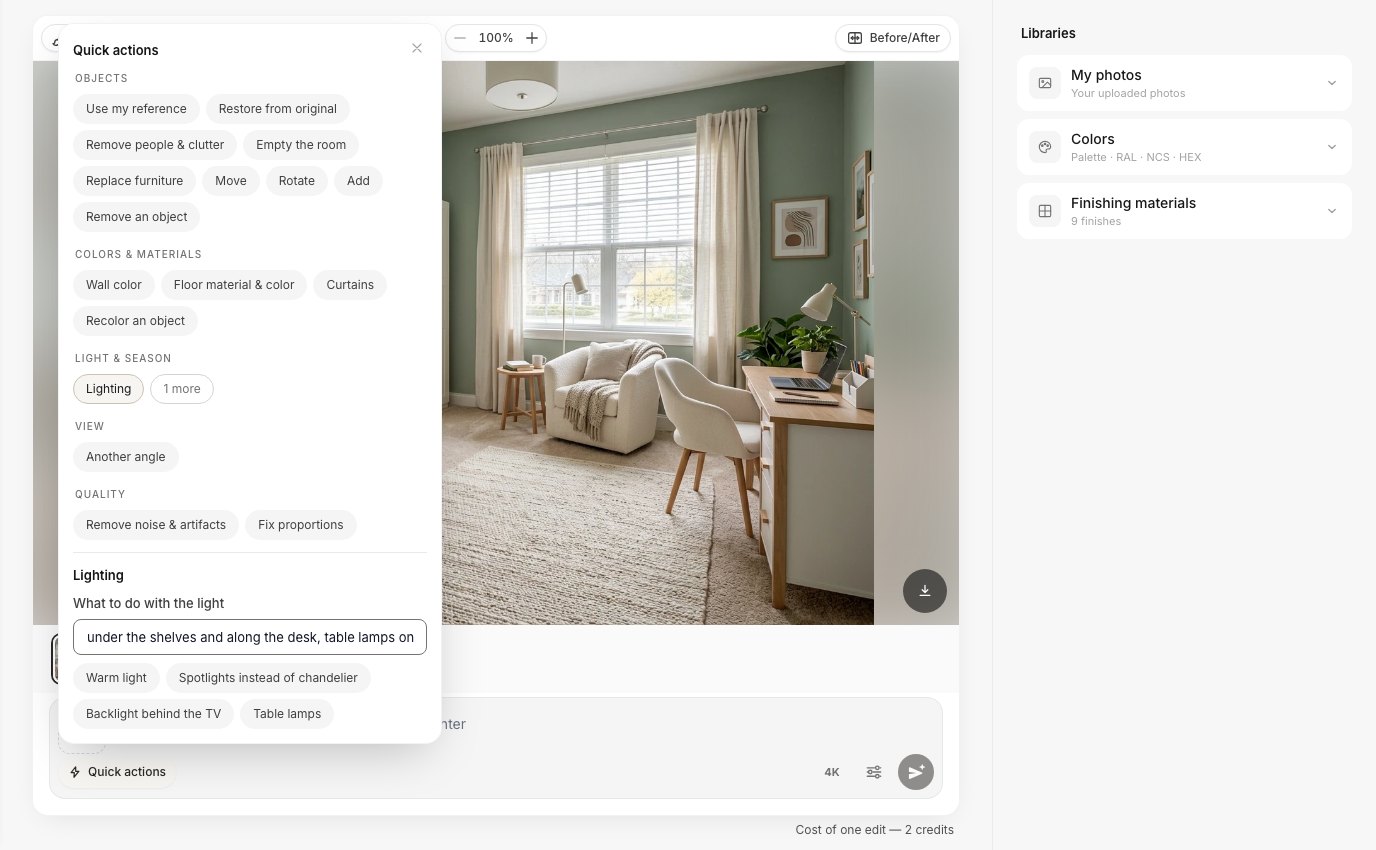 Editor → Quick actions → Lighting. Type what to do with the light or pick a chip.
On the sage room from Example 1 we typed: "evening: warm LED strip under the shelves and along the desk, table lamps on".
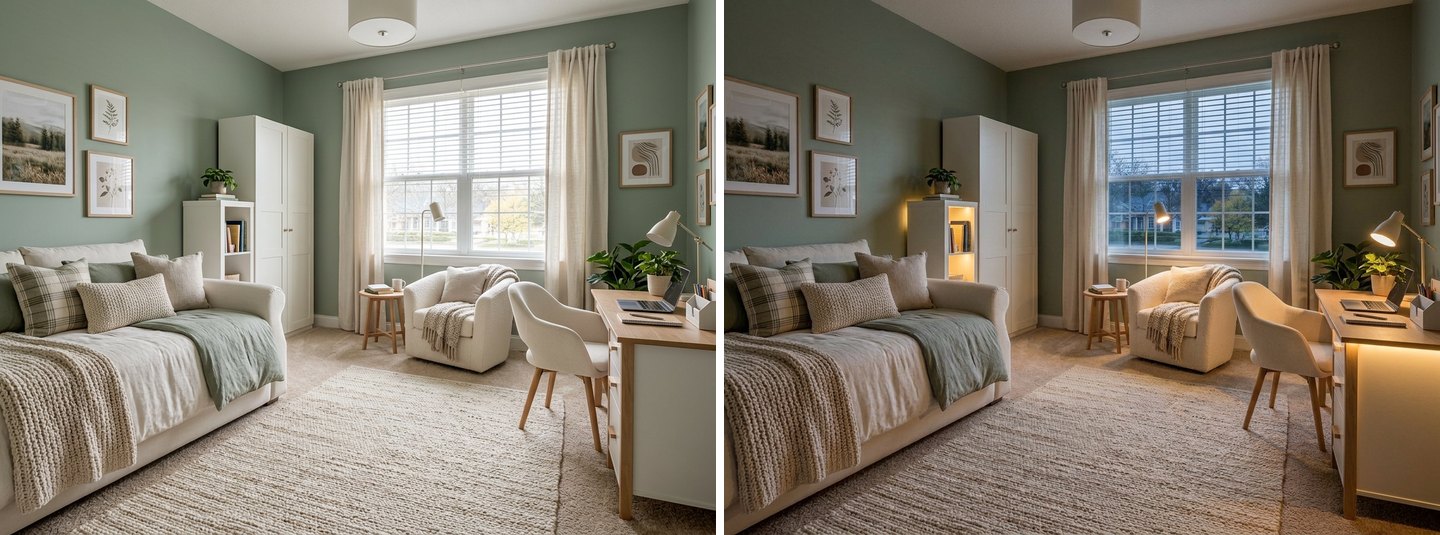 Quick actions → Lighting: the same room at dusk, with LED strips along the desk and in the shelf, and the desk lamp on.
The change is subtle, which is what a real LED strip does: a glow along the desk edge and inside the shelf, the desk lamp on, dusk outside. If you want the full "gamer" look — colored light behind the monitor and under the shelves — write the color in the note, as we did in Example 3. For a full guide to light layers, see our AI lighting design article.
Boy, Girl or Gender-Neutral: How Should You Brief the Colors?
Name the age, the hobby and two or three colors; leave the gender cues out unless they matter to the teen. The AI fills gaps with clichés (more on that below), so the more specific your note, the less it guesses. These palettes worked in our tests:
| Brief | What we wrote | What came back |
|---|---|---|
| Girl, calm and grown-up | "sage green and warm white instead of pink" | Sage walls, linen, light wood, cream armchair |
| Boy, gamer | "navy, grey and black, LED backlighting" | Grey bed, navy bedding, black desk, blue LED |
| Gender-neutral | "warm wood, greige and olive, hidden LED" | Oak bed, olive textiles, warm LED shelves |
| Two teens sharing | "calm colors" + one bed each | Grey-green walls, navy bed vs blush bed |
The real requests also include "2000s grunge with ambient lighting", "Stockholm aesthetic, very cozy" and "hockey decorations". Those work as notes too — they are just more of a gamble, so make two or three versions and pick. If one wall should carry the personality, try a feature wall instead of painting all four: our accent wall guide shows slats, panels and limewash on real photos.
Where Does the AI Get Teen Rooms Wrong?
Three things went wrong often enough that you should plan for them.
Posters with made-up lettering
The AI loves teen posters, and posters come with fake band names and nonsense words. In our three runs without a note about it, all three results had posters with made-up lettering — even though the Studio already tells the model not to add text. In the six runs where the note said "no posters with lettering" or "framed art without any lettering", none did. Add that line every time.
Teen clichés nobody asked for
A guitar appeared in six of our nine teen results, in rooms where nobody mentioned music. Skateboards turned up in four. They are easy to remove — Quick actions → Remove an object — but check what else goes with them.
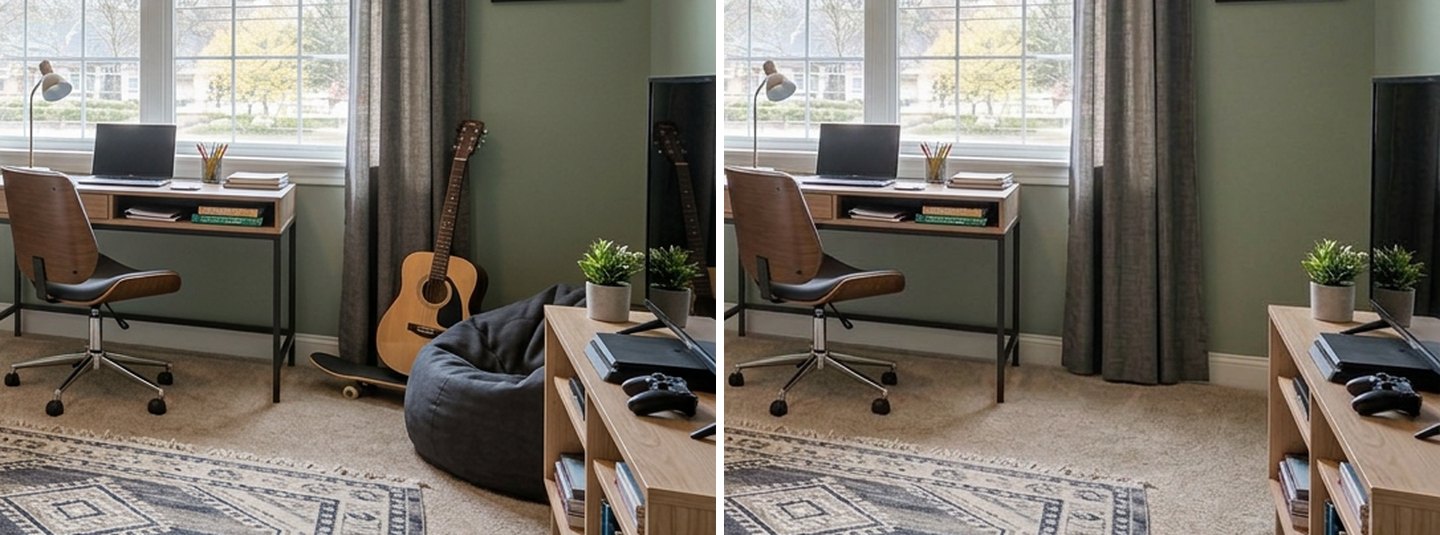 Remove an object: "the guitar and the skateboard". Both are gone — and so is the beanbag next to them, which we did not ask to remove.
We asked to remove the guitar and the skateboard; the beanbag beside them went too. The rest of the room was untouched. When objects overlap, name what must stay ("keep the beanbag"), or select the area with the brush first.
Sizes are not measured
People often write dimensions: "the room is 2.4 meters wide", "2.50 × 2.70 m", "a niche of 115 × 50 cm". The AI does not measure the room from a photo, so a desk, a bed or a loft bed in the result is a believable size, not a checked one. Use the result to choose a layout and a look, then measure before you buy. If a piece looks oversized, the ready task "Fix furniture scale" or the quick action "Fix proportions" brings it back to realistic proportions.
Safety: Anchor the Furniture Before the Room Is Done
A teen room usually adds tall, heavy pieces: a wardrobe, a bookcase, a TV, sometimes a loft bed. The U.S. Consumer Product Safety Commission (CPSC) estimates that emergency departments treated an average of 17,800 tip-over injuries a year in 2020–2022, and 44% of the victims were under 18. From 2013 to mid-2023, 217 tip-over deaths were reported; 71% of those killed were children aged one to three, and most deaths involved TVs and furniture (CPSC, 2026). A teen is not in the highest-risk group, but younger siblings and visiting children are.
The CPSC's advice, through its Anchor It campaign:
- Anchor TVs and furniture such as bookcases and dressers securely to the wall.
- If anchoring is not possible, put the TV on a sturdy, low base, push it back as far as possible and keep cables out of reach.
- Keep heavier items on lower shelves, and don't store tempting things (remotes, toys) up high where a child would climb.
The AI shows furniture, not fixings. Plan the anchors when you plan the layout — especially for the tall wardrobe and the wall-mounted TV a gaming room usually gets.
Tips for Better Teen Room Results
- Write the age and the activity. "A 15-year-old who games and does homework" beats "a cool room".
- Name what stays. "Keep the wardrobe", "keep the white shelf", "keep the bed where it is". The AI re-plans the room otherwise.
- Add "no posters with lettering" to every teen note.
- Ask for closed storage by name — "a wardrobe", "closed boxes", "built-in storage". Our storage ideas guide shows built-ins on real photos.
- Make three versions, then edit the best one. A new design re-plans the room; an edit (Wall color, Lighting, Remove an object) changes only one thing.
- Shoot from the doorway in daylight, with the window in the frame — it keeps the result readable.
- Show the teen the versions. It is their room; a side-by-side of three options ends most arguments faster than a mood board.
- Moving furniture only? If the teen likes the furniture and wants a new layout, try our furniture rearranging guide instead.
FAQ
How do I turn my child's room into a teenager's room?
Swap play for study and storage: a real desk and chair by the window, a bigger bed or a daybed, closed storage instead of toy bins, calmer colors and layered light. To see it first, upload a photo to the GenRoom Studio, set "Your space" to Kids Room, pick the ready task "Kids' room by age" → Teen, add a note with the age and what the teen does, and press "Create design".
What are some good ideas for a teenager's bedroom?
Plan five zones: sleep, study, screen or gaming, storage and a lounge corner. Then pick a grown-up palette (sage, navy, greige, wood), add a desk lamp and LED strips, and put one large rug down. In a small room, a loft bed with the desk underneath frees the floor.
How do I design a small bedroom for a teenage boy?
Keep the bed against a wall, put the desk under or beside the window, use the wall above the desk for shelves, and choose a loft bed if the floor is too small for both. For gaming, ask for "LED backlighting" and a color scheme such as navy, grey and black — and add "no posters with lettering" to the note.
Can AI design a shared room for a teenage boy and girl?
Yes. Write it in the note: "two teenagers, a girl and a boy, two separate beds, not bunk beds, a desk for each". In our test the AI put the beds along the long walls, one long desk for two under the window, and gave each side its own bedding color.
Can I keep the furniture we already have?
Yes, if you name it. With "Keep the white daybed and the white cube shelf where they are", both stayed in place and the AI changed only the walls, textiles, boxes and accessories, and added a desk. That is the cheapest version of a teen makeover.
Is there a free AI tool to design a teen bedroom?
GenRoom gives you 6 free credits when you create a free account, no credit card needed. A design or an edit costs 2 credits, so that is three tries; results on the free plan carry a watermark. After that, credit packs are one-time purchases, not a subscription — see pricing.
The Bottom Line
Teen bedroom ideas are easy to collect and hard to picture in your own room. The Studio closes that gap: set the space to Kids Room, choose "Kids' room by age" → Teen, write the age, the hobby, the colors and what to keep, and you get the same room grown up in under a minute. Then use the editor to try a wall color, an evening light or to remove what you don't want.
Expect posters with fake lettering and a guitar nobody asked for unless you say otherwise, and don't trust the sizes without a tape measure. Anchor the tall furniture before the room is finished. Try it on a photo of your child's room.