Vegetable Garden Layout Ideas: Plan Raised Beds on a Yard Photo
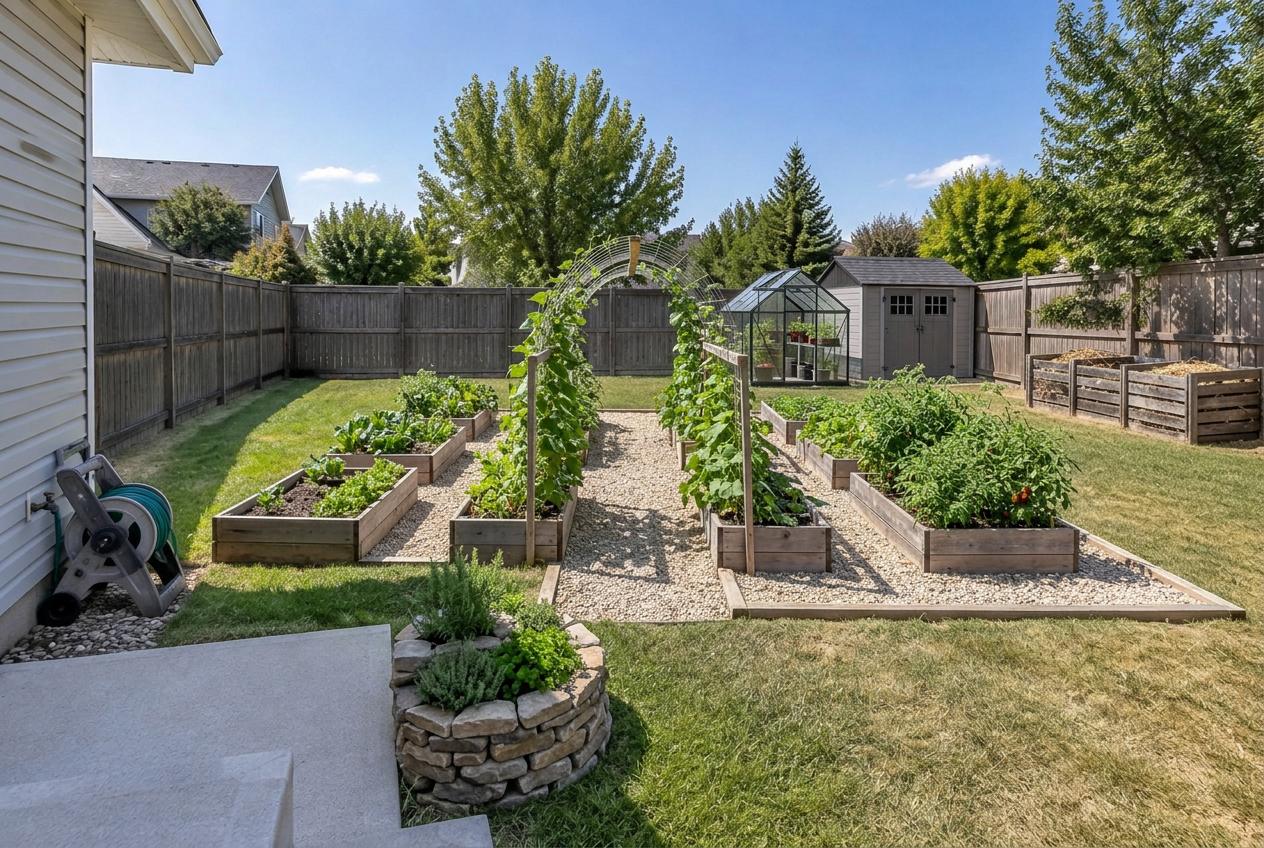
A real GenRoom result from one typed request: raised beds, gravel paths, a bean arch, a greenhouse by the shed, compost bins and a herb bed by the steps. The house, fence, shed and trees are from the original photo, which was a plain lawn. It took 38 seconds.
The quickest way to compare vegetable garden layout ideas is to draw them on a photo of your own yard. You upload one picture, ask for raised beds, paths, a greenhouse or a trellis, and about 30 seconds later you see the same view with the kitchen garden in place. Your fence, shed and trees stay where they are, so you can judge where the beds fit before you buy a single board.
People already use it this way. Between March and mid-October 2026, 111 people described a vegetable garden, raised beds or a greenhouse to the GenRoom Studio in their own words. Below we show the exact Studio path, nine real results from three ordinary yards (a sunny lawn, a small walled town yard and a slope), the sizes that university extension services and the RHS recommend, and the places where the AI got it wrong.
What Do People Actually Ask For in a Vegetable Garden?
Most requests combine beds with three or four practical extras: a path, something to climb on, a place for compost and sometimes a greenhouse. Here is how people put it, translated where needed, shortened and anonymised:
- "A vegetable garden with a trellis you can walk under, placed to get the most sun for tomatoes and cucumbers."
- "Raised beds for a senior, with compost bins and space to store the lawnmower."
- "Corten steel circles for raised beds, a trellis for climbing plants, no seating, and a path through the garden."
- "A kitchen garden with raised beds and paved paths over gravel."
- "Four beds, 2 m by 1 m and 60 cm high, in front of a pollinator strip along the fence."
- "An urban vegetable plot of 10 by 5 metres for vegetables and flowers."
- "A pallet vegetable garden in this corner. It measures 220 by 180 cm."
- "Move the pond behind the vegetable garden, make the beds a little wider and enlarge the chicken coop."
- "Put a greenhouse here for growing."
- "Incorporate a vegetable garden. Not on the driveway!"
Two things stand out. People think in sizes and places (2 m by 1 m, this corner, along the fence), and they want working parts, not decoration: compost, storage, a path wide enough to use. The last quote is a warning we come back to later. If you don't say where the garden goes, the AI picks a spot for you.
What Makes a Good Vegetable Garden Layout?
A good layout puts the beds in the sunniest part of the yard, keeps each bed narrow enough to reach the middle, and leaves paths wide enough to kneel or push a wheelbarrow. Everything else (greenhouse, compost, trellis) is placed around those three decisions. The numbers below come from university extension services and the RHS, not from us.
| Decision | Rule of thumb | Source |
|---|---|---|
| Sun | At least 6 hours of direct sun; 8 to 10 hours is ideal | Virginia Cooperative Extension |
| Fruiting crops | Tomatoes, peppers, cucumbers, beans and squash need about 8 hours of full sun | Virginia Cooperative Extension |
| Shade-tolerant crops | Lettuce, spinach, chard, kale, cabbage, beets, carrots, radish and parsley tolerate about 6 hours | Virginia Cooperative Extension |
| Bed width | 4 ft (about 1.2 m) for adults, 3 ft for children, so you reach the middle from either side | UGA Cooperative Extension |
| Soil depth | At least 10 inches (25 cm) of soil for most crops | UGA Cooperative Extension |
| Path between beds | 18 to 24 inches (45 to 60 cm) is comfortable; 12 inches is the tight minimum | UGA Cooperative Extension |
| Wheelbarrow or cart path | About 4 ft (1.2 m) between beds | UGA Cooperative Extension |
| Bed direction | Run beds north to south where possible, so tall crops don't shade lower ones | UGA Cooperative Extension, RHS |
Sources: Raised Garden Bed Dimensions, UGA Cooperative Extension (C 1027-4), Planning the Vegetable Garden, Virginia Cooperative Extension (426-312) and the RHS guide to making a raised bed.
The same Virginia Tech guide adds a few siting rules that matter when you look at your photo. Keep the garden away from trees and shrubs, which compete for water and cast shade. Put it close to the house and to a water supply. Avoid low spots and the foot of a slope against a solid fence, where cold air settles and frost lingers. On a slope, use terraces or raised beds to stop erosion.
The RHS makes the same point about light: most fruit and vegetables need full sun, so put beds in the south- or west-facing parts of the garden, away from tree shade, and run long beds north to south. It also suggests paths of at least 45 cm (18 in) for a wheelbarrow and at least 1 m if you need wheelchair access.
How Do You Plan a Vegetable Garden on a Photo of Your Yard?
Upload a photo, open Ready tasks → Planting → "Raised garden beds", pick a material and a place, and press "Create design". That's the shortest path. For a full kitchen garden with paths, a greenhouse and compost, type the whole plan into "Your request" instead, or add details later in the editor.
Step by step:
- Take the photo from where you will see the garden most: the back door, the patio steps or an upstairs window. Shoot in landscape, in daylight, with the whole area in the frame.
- Upload it in the Studio. The Studio detects that it's a yard. Check that "Your space" says Yard. If it says Facade, switch it, because yard tasks only appear for yards.
- Open Ready tasks → Planting → Raised garden beds. Choose the material (Wood, Corten steel or Stone) and where the beds go (In the sunny area, In the far corner or Near the house). There's a field for one more note, such as "four beds, paths of light gravel between them".
- Press "Create design". A design costs 2 credits. In our tests it took 28 to 39 seconds.
- Refine in the editor. Use "Select area" to circle the exact spot for a greenhouse or herb spiral and describe it, or pick a plant from the Plants library.
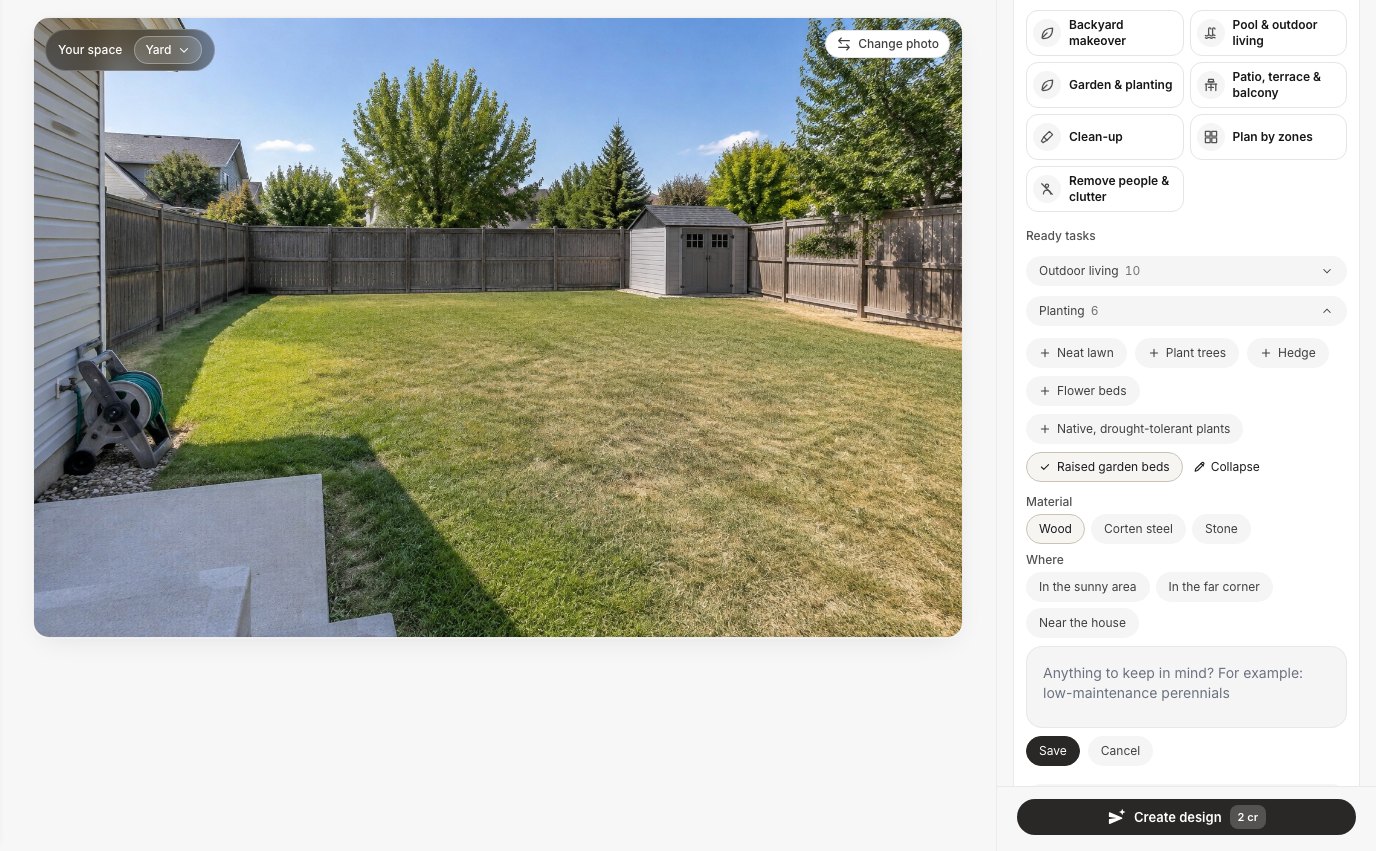 The "Raised garden beds" task in the Studio's Ready tasks. You choose the material and the place; the note field below takes anything else you want to keep in mind.
Other parts of the Studio help with a kitchen garden too:
- Paths & fences → Retaining wall with "Terrace the slope" or "Raised beds by the fence", for sloping yards.
- Plan by zones → With vegetable beds plans the whole yard by zones and includes a vegetable garden. More on what it does below.
- Time of day & season shows the same garden in summer, autumn or winter.
- The editor's Quick actions → Remove → "Flower beds and vegetable beds", if you want to see the yard without an old vegetable patch.
Example 1: What Does a Sunny Lawn Look Like With Raised Beds?
On an open lawn, the "Raised garden beds" task with its defaults (Wood, In the sunny area) placed four wooden beds in the sunlit right half of the yard and left the shaded strip by the house as lawn. That's the right instinct: the left side of the photo is in the house's shadow. Nothing else changed.
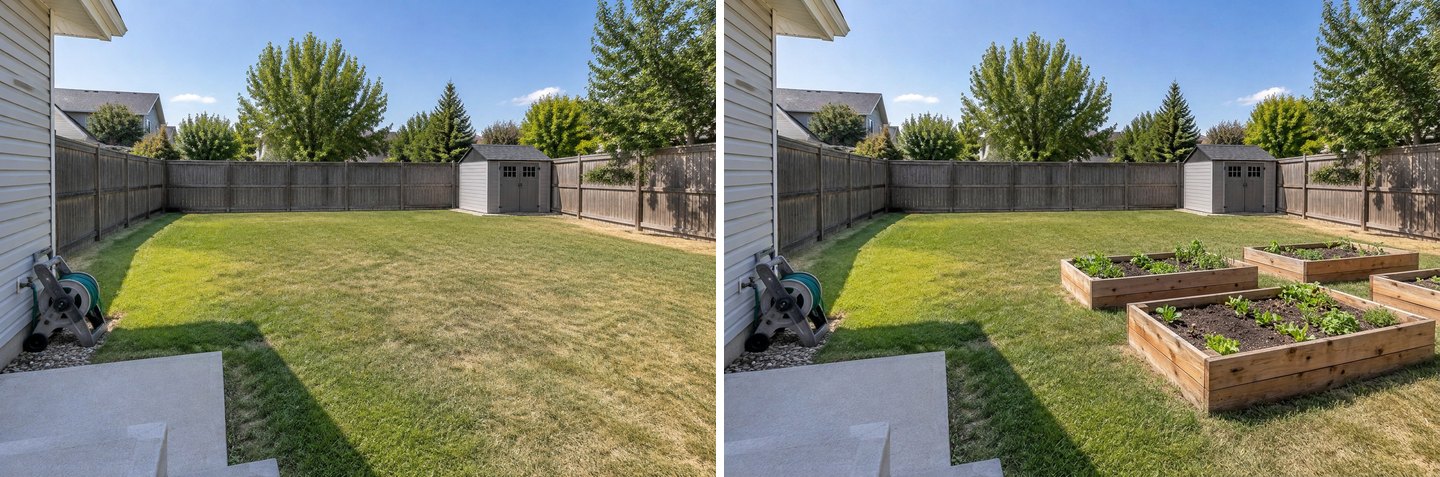 Before → "Raised garden beds" task with default options. 28 seconds. The fence, the shed, the hose reel and the shadow of the house are untouched.
Four boxes on a lawn is a start, not a kitchen garden. So on the same photo we typed one longer request in "Your request", built from the real requests above: six raised wooden beds about 1.2 m wide, gravel paths about 60 cm wide between them, a wider central path with an arched trellis for beans and cucumbers, a small glass greenhouse next to the shed, two wooden compost bins beside the shed and a stone herb spiral near the patio steps.
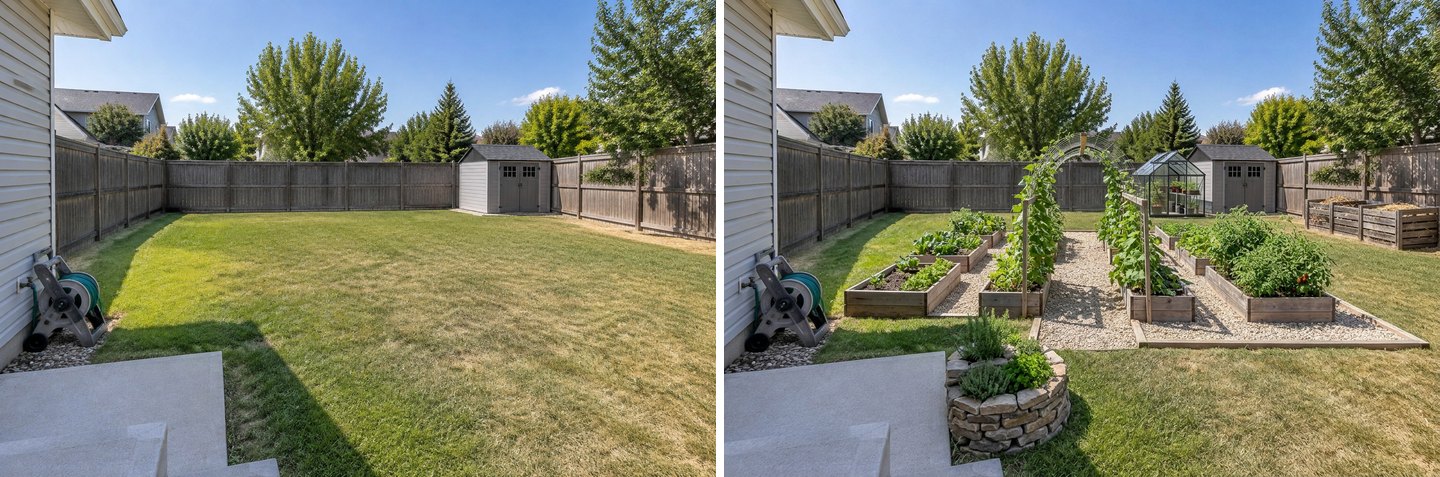 Before → one typed request. 38 seconds. Every item on the list is there, including the greenhouse beside the shed and the compost bins in the corner.
What worked: all six elements appeared, in roughly the right places, and the beds sit on gravel with real paths between them. What to check: the beds are not in two neat rows, the arch covers only part of the central path, and the "herb spiral" came out as a round stone planter rather than a true spiral. Treat the picture as a layout sketch you can react to, not as a drawing to build from.
How Do You Put One Element Exactly Where You Want It?
Use "Select area" in the editor: circle the spot, describe what goes there, and the AI changes only that patch. This is the best way to place things that need a specific position: a herb spiral by the kitchen door, a greenhouse on the sunniest corner, compost bins out of sight. It costs 2 credits per edit, like a design.
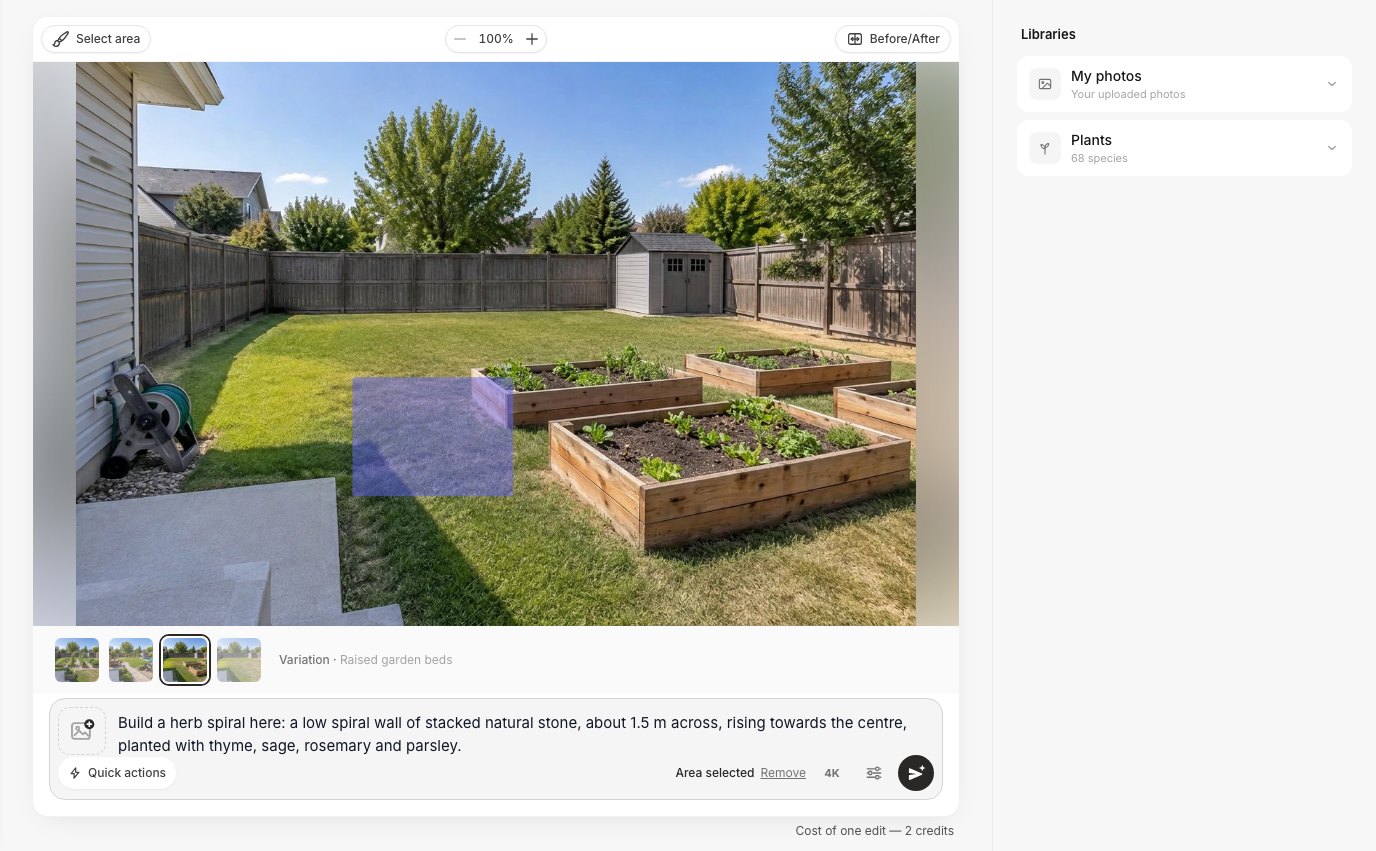 The editor: "Select area" (lasso) marks the patch next to the steps, and the request describes the herb spiral. "Area selected" confirms that the edit is limited to that patch.
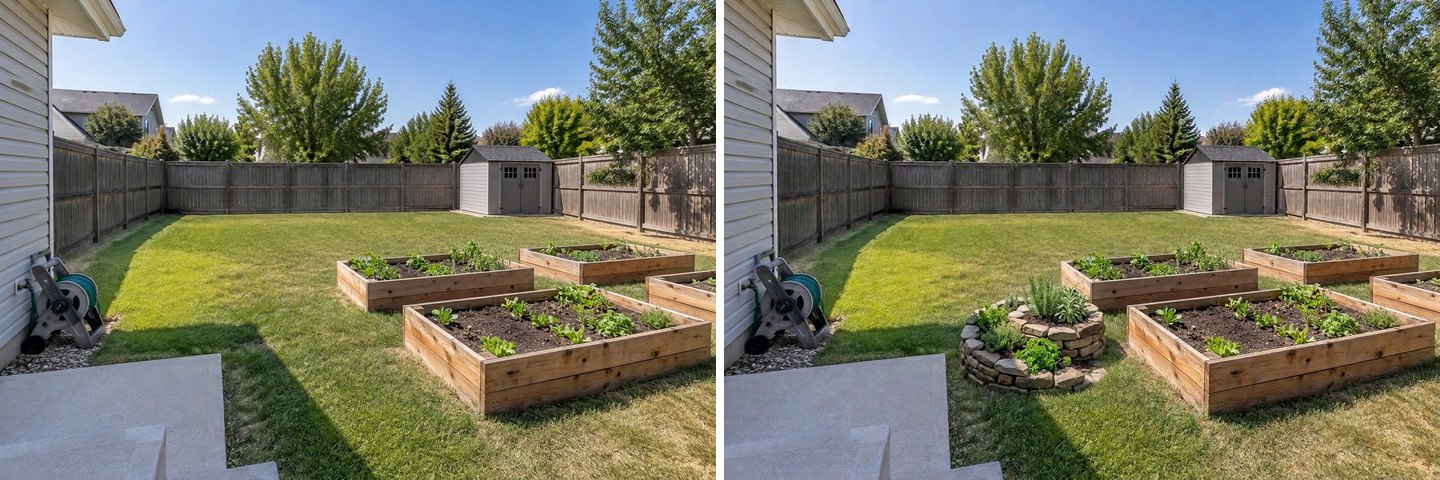 Raised beds → herb spiral in the selected area. 47 seconds. This time the stone wall really does rise in a spiral, and the beds, lawn and fence are unchanged.
Compare this with the herb bed in the typed request above. Given a precise area and a precise description, the spiral came out as a spiral. Given one line in a long list, it came out as a round planter. When one element matters to you, add it as a separate edit.
Can You Add Fruit Bushes From the Plant Library?
Yes for fruit, no for vegetables. The editor's Plants library has 68 species. Its Fruit filter shows nine: apple, currant, raspberry, cherry, plum, pear, blueberry, gooseberry and olive. Climbers include a grapevine. There are no vegetables or culinary herbs in the library (lavender is listed under Flowerbed), so you describe those in words.
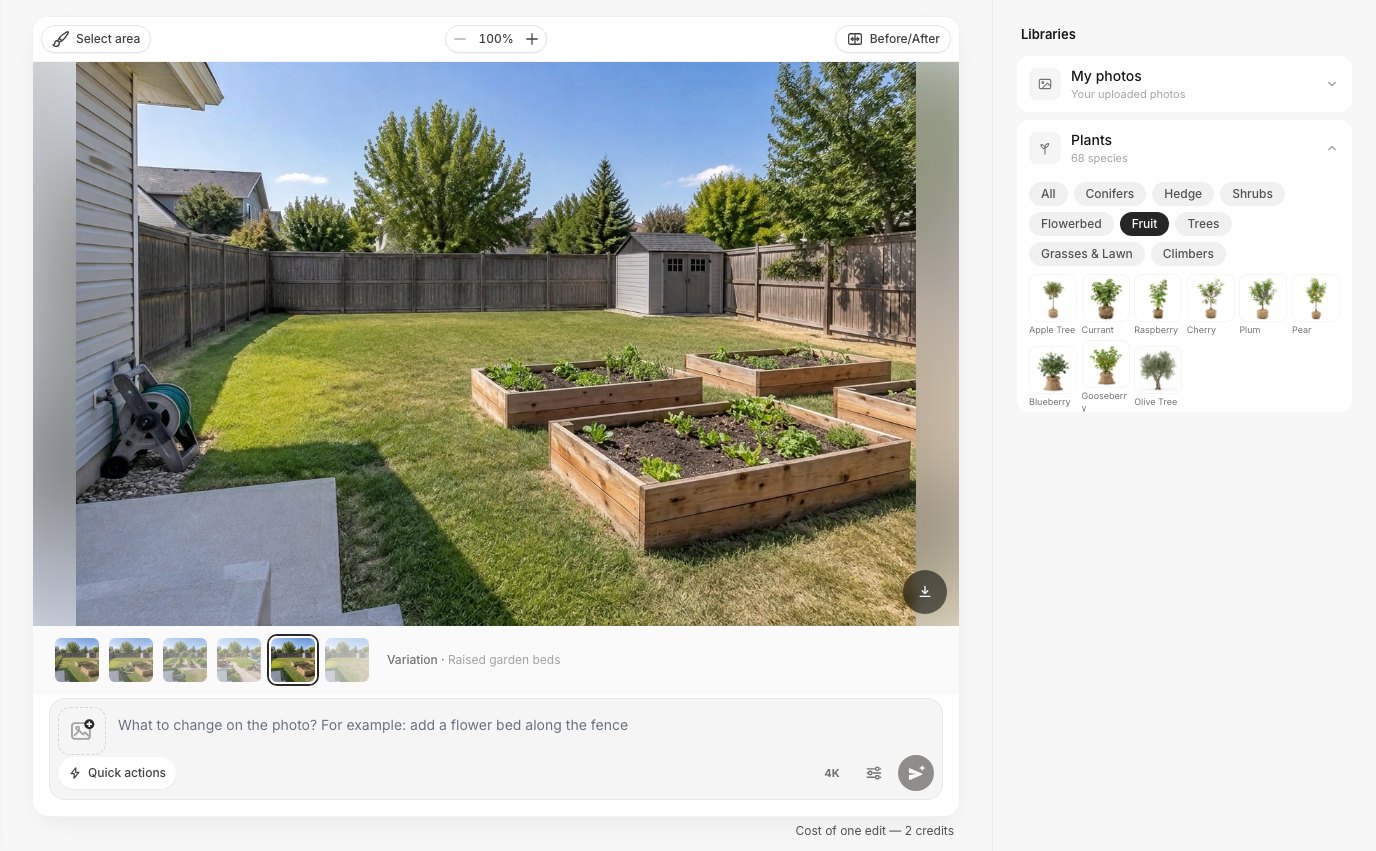 The Plants library with the Fruit filter. Tap a tile and choose "As a reference" to send that plant to the AI with your request.
We added Raspberry as a reference to the raised-beds result and asked for "a row of these raspberry canes on a simple wire support along the left fence, in a narrow mulched strip".
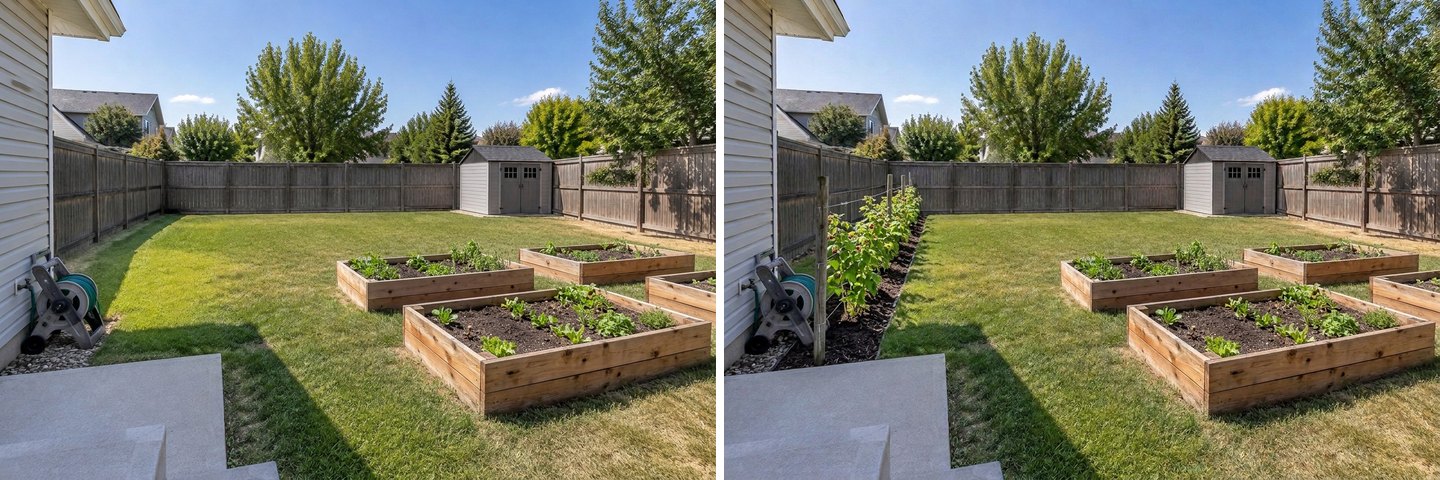 Raised beds → raspberry row from the Plants library. 44 seconds. The canes stand on posts and wire in a mulched strip; the beds did not move.
The AI followed the request literally and planted the row along the left fence, which in this photo is the shaded side by the house. That's a fair example of what it won't do for you: it doesn't decide whether a spot gets enough sun. You do.
Example 2: Can a Small Walled Yard Grow Vegetables?
It can hold beds, but a yard boxed in by tall walls gets less sun than a photo suggests, and the AI won't tell you that. Our second photo is a narrow town yard: brick walls on both sides, a strip of paving, a patchy lawn, a birch at the back and a wheelie bin. The photo was taken on an overcast autumn day.
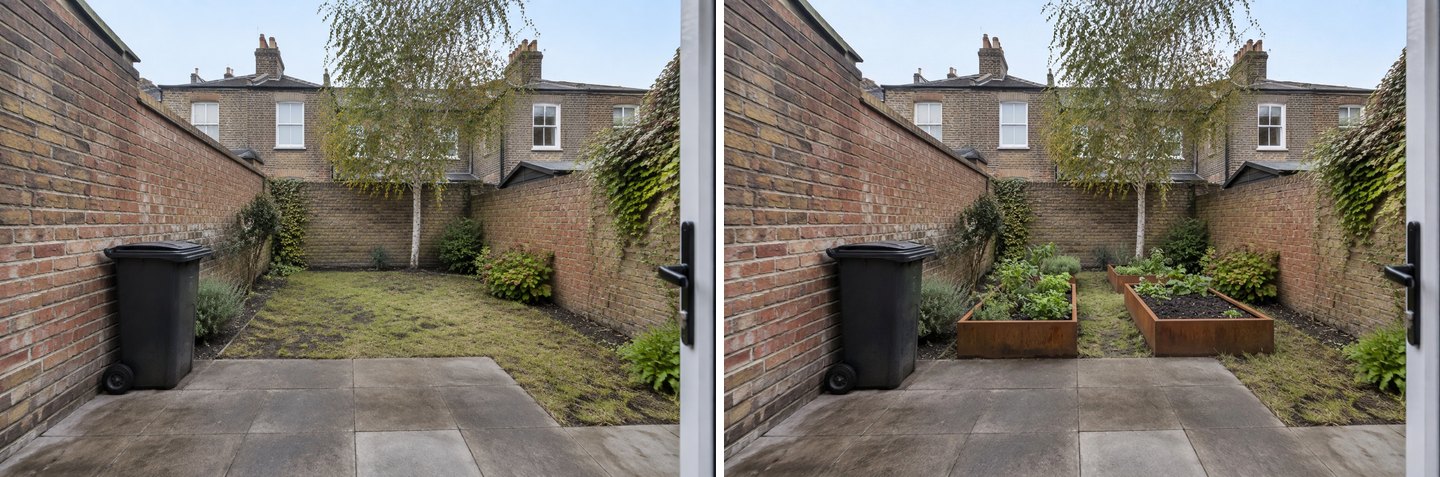 Before → "Raised garden beds" with Corten steel. 28 seconds. The walls, the bin, the birch and the paving stayed exactly as they were.
The default task put two corten beds in the middle of the lawn. That's fine as a first look, but a small yard usually needs every wall to work too. So we typed a request based on the real ones: two corten beds along the right-hand wall, a wooden trellis on that wall for climbing beans, herbs in pots on the paving, and a small wooden store to hide the bin.
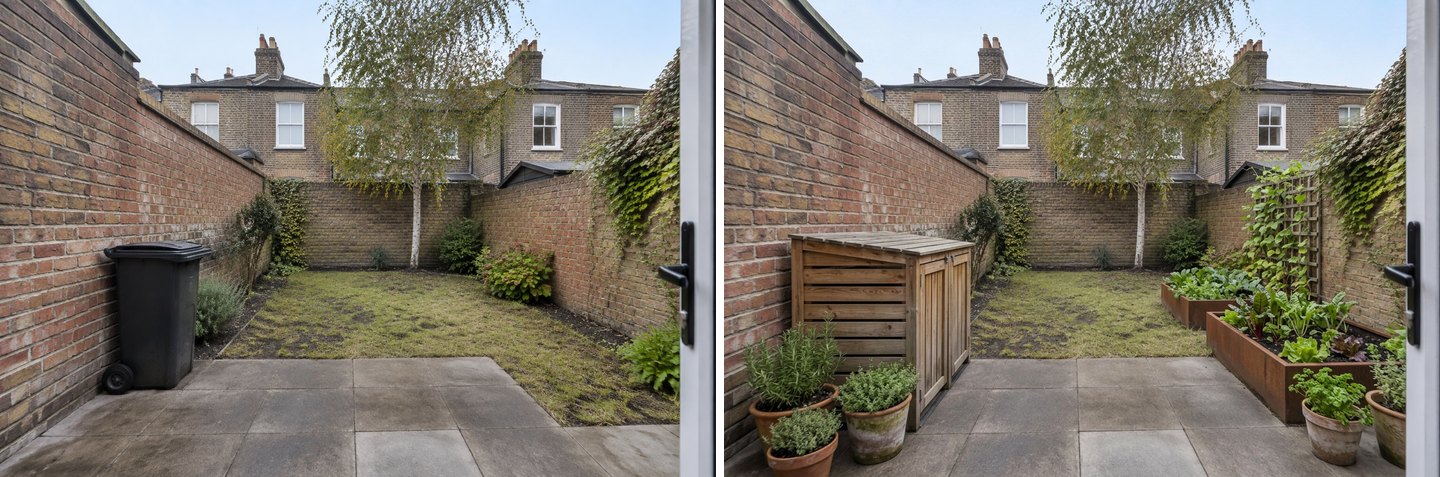 Before → one typed request. 39 seconds. The bin is hidden in a wooden store, the beans climb the wall, and the lawn path stays open.
This version uses the walls, keeps a path and hides the bin, which is what a small yard needs. Before you build it, though, count the hours of direct sun that actually reach those beds. If it's closer to 6 than to 8, the extension list above suggests leafy crops and roots (lettuce, chard, kale, beets, radish) rather than tomatoes. For more small-space ideas, see our guide to small backyard ideas.
Create facade design with AI
Upload a photo of your home and get a new facade in the chosen style in 30 seconds. First generation is free.
Example 3: How Do You Plan a Vegetable Garden on a Slope?
Terrace the slope first, then put the beds on the level ground you've made. In the Studio that's two ready tasks in one design: Paths & fences → Retaining wall (Natural stone, "Terrace the slope") and Planting → Raised garden beds. The extension guidance agrees: on sloped sites, use terraces or raised beds to avoid erosion.
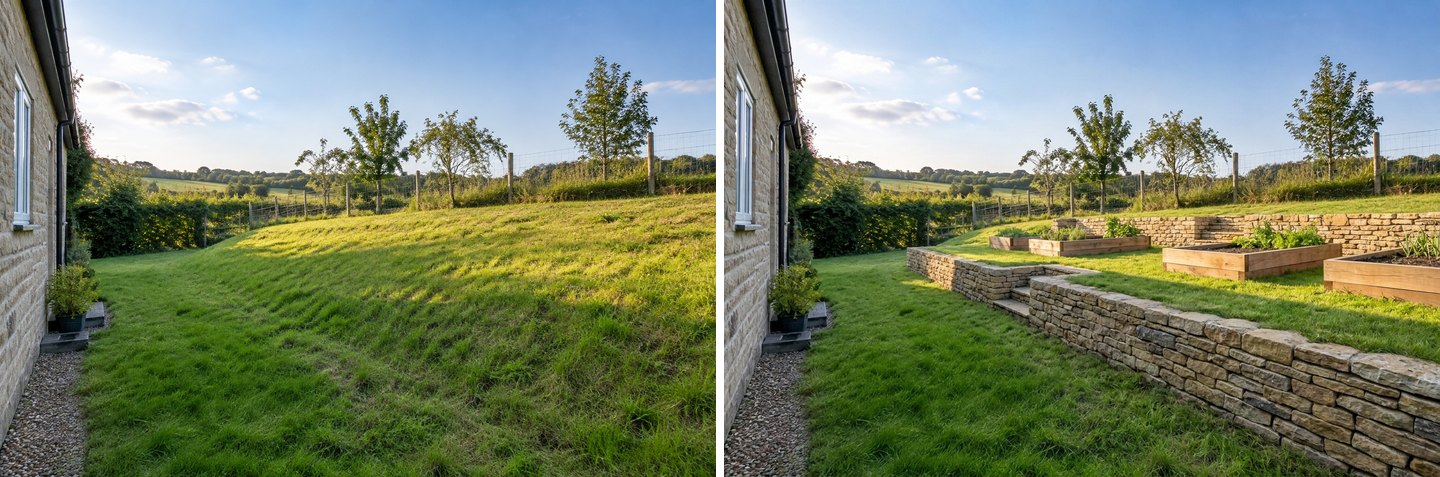 Before → "Retaining wall" + "Raised garden beds" in one design. 34 seconds. A dry-stone wall with steps creates a level terrace, and the beds sit on it. The house, the fence and the young trees are unchanged.
This is the most useful result in the set, because a slope is where people struggle to imagine the finished shape. You can see how high the wall would be from the house, where the steps land and how much flat ground the terrace gives you. The other wall options are split-face concrete blocks, gabions, timber sleepers and smooth concrete, if stone is beyond your budget.
Which Vegetable Garden Layout Fits Your Yard?
Match the layout to your space and your sun, then pick the Studio tool that shows it fastest.
| Your yard | Layout that usually works | How to see it in GenRoom |
|---|---|---|
| Open, sunny lawn | Rows of 1.2 m raised beds running north to south, gravel paths between | Ready tasks → Raised garden beds, then add paths in "Your request" |
| Full kitchen garden (potager) | Beds around a wider central path with an arch, greenhouse and compost at the edges | Type the whole plan in "Your request" |
| Small or walled yard | Beds along the sunniest wall, a trellis on the wall, herbs in pots | Raised garden beds with Corten steel, plus a typed request |
| Slope | Retaining wall to make terraces, beds on the level ground | Retaining wall ("Terrace the slope") + Raised garden beds |
| Whole yard with other zones | A vegetable corner linked by a path to dining and play areas | Plan by zones → With vegetable beds (check the result, see below) |
| Fruit along a fence | A row of canes or bushes in a narrow mulched strip | Editor → Plants → Fruit → "As a reference" |
If your plot is overgrown, tidy it first. Our guide to cleaning up an overgrown yard shows the same idea on a neglected plot: clear it, remove an old greenhouse and add three raised beds in its place. If you have children, you can combine the beds with a play area, as in our kid-friendly backyard guide.
What Does the AI Get Wrong?
The AI draws a convincing garden, but it doesn't measure sun, scale or seasons, and it guesses whenever your request leaves room. Here is what we saw in nine runs.
1. It doesn't know how much sun a spot gets. In the walled town yard, shot on a gray autumn day, both results show lush, healthy greens. The task places beds "in the sunny open part of the plot", but the AI judges that from one photo. It can't see the shadow the wall casts at 3 p.m. in July. Check sun hours yourself before you build.
2. It shows a summer harvest in any season. The town yard photo has a birch turning yellow, yet the beds are full of fresh leaves. The picture shows how the garden could look at its best, not what grows there in October.
3. Without a selected area, an edit decides where things go. On the terraced slope we asked, in words only, for a greenhouse at the right end of the upper terrace and compost bins at its left end. The greenhouse arrived, but it took the place of one raised bed, and the compost bins landed on the lower lawn instead of the terrace.
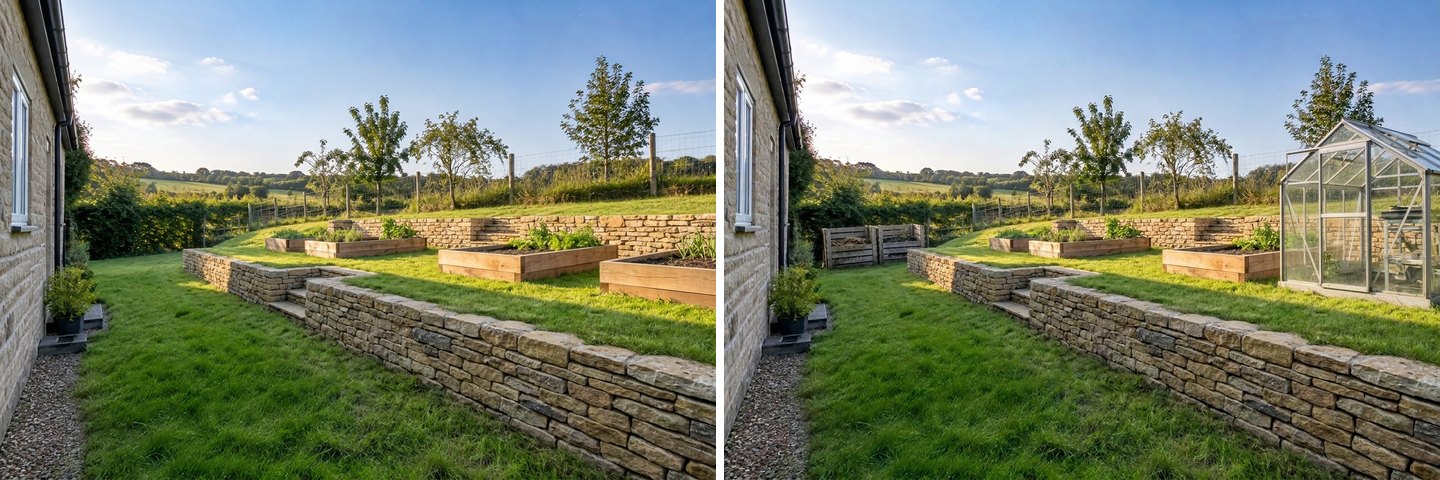 Terraced beds → an edit with words only. 33 seconds. The greenhouse replaced the front-right bed, and the compost bins ended up on the wrong level. With "Select area", the change stays inside the patch you mark.
4. "Plan by zones" treats the vegetable garden as a side dish. With "With vegetable beds" on, the mode planned a dining area with a grill, a play tower, a fire pit and a pool, and the vegetable garden became three small planters along the back fence. That follows the mode's description, which lists "a pool if there is room". If vegetables are the point, use the Raised garden beds task or type your own plan instead.
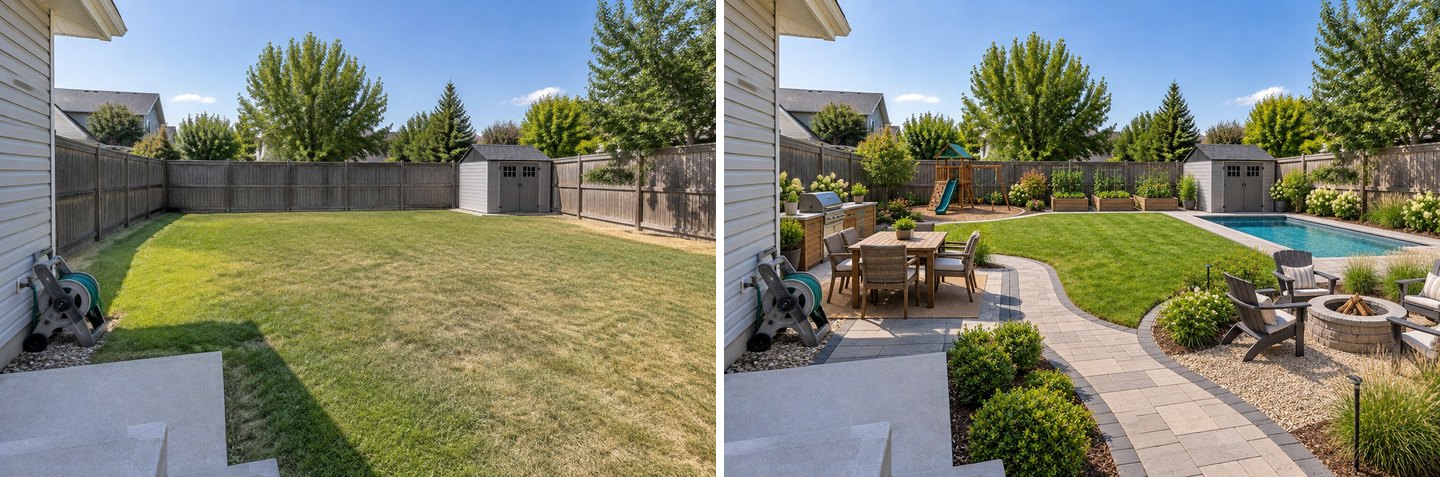 Before → "Plan by zones" with "With vegetable beds". 30 seconds. A complete family yard, but the vegetable garden is the smallest zone in it.
5. Counts and sizes are approximate. We asked for six beds 1.2 m wide in two rows. We got roughly six beds in a looser arrangement, and nothing in the picture is to scale. Plant spacing in the beds is decorative too. Use the picture to decide where the garden goes and how it should feel, then mark it out on the ground with string and stakes before you buy materials.
6. It doesn't plan crops. The AI won't give you planting dates, rotation or spacing. Virginia Tech recommends not growing the same plant family in the same spot more than once in three years. That planning happens on paper or in a garden planner, not in a picture. Our guide to choosing plants for your climate covers the planting side.
How Should You Write the Request?
Name the elements, their place and their material in one or two sentences, and say what must stay. These notes worked in our tests:
| What you want | What we typed or chose | Result |
|---|---|---|
| Simple beds on a lawn | Raised garden beds, Wood, In the sunny area | Four beds in the sunlit half |
| A full kitchen garden | "six raised wooden beds… gravel paths… an arched trellis… a small glass greenhouse next to the shed… compost bins… a herb spiral near the patio steps. Keep the house, the fence, the shed and the trees." | Every element appeared |
| Beds that use a wall | "two corten raised beds along the right-hand wall, a wooden trellis fixed to that wall for climbing beans" | Beds and trellis on the right wall |
| Hide the bin | "a small wooden store that hides the wheelie bin" | Slatted bin store in place of the bin |
| One element in an exact spot | Select area + "Build a herb spiral here…" | A true spiral in the marked patch |
| Fruit along a fence | Plants → Raspberry → As a reference + "a row of these raspberry canes on a simple wire support along the left fence" | Canes on posts and wire |
Three habits help most. Say where ("along the right-hand wall", "next to the shed", "not on the driveway"). Name the material (wood, corten, stone, gravel). And end with what to keep ("Keep the walls, the birch tree and the paving"). For more planted examples, see our AI garden design page.
How Much Does It Cost?
A free GenRoom account gives you 6 credits, enough for three designs or edits, and every design or edit costs 2 credits. Free results carry a watermark. Paid credit packs are one-time purchases, not a subscription: Start is $9.99 for 36 credits, Basic $19.99 for 100 and Pro $39.99 for 300. Purchased credits are valid for 180 days, and credits come back automatically if a generation fails. See pricing for details.
The nine results in this article cost 18 credits: six designs and three edits.
FAQ
Can AI design a vegetable garden layout from a photo of my yard?
Yes. Upload a photo to the GenRoom Studio, choose Ready tasks → Planting → Raised garden beds or type a plan in "Your request", and in about 30 seconds you get the same view with beds, paths, a greenhouse or a trellis added. Your house, fence and trees stay in place. The result is a visual layout, not a measured plan or a planting schedule.
How wide should raised vegetable beds be?
UGA Cooperative Extension recommends 4 feet (about 1.2 m) for adults and 3 feet for children, so you can reach the middle from either side without stepping on the soil. The RHS says widths under 1.5 m let you reach the centre. Leave 18 to 24 inches (45 to 60 cm) of path between beds, and about 4 feet where you push a wheelbarrow.
How much sun does a vegetable garden need?
At least 6 hours of direct sun a day, with 8 to 10 hours ideal, according to Virginia Cooperative Extension. Fruiting crops such as tomatoes, peppers, cucumbers and squash need about 8 hours. Lettuce, spinach, chard, kale, beets, carrots and radish tolerate around 6. The AI can't measure sun from a photo, so check it yourself over a day.
What is the best vegetable garden layout for a small yard?
Put a few narrow raised beds along the sunniest wall or fence, grow climbing crops on a trellis above them, and keep herbs in pots on the paving. In our walled town yard, one typed request in GenRoom produced exactly that, plus a store that hid the wheelie bin. Leave at least a 45 cm path to reach the beds.
Can I plan a vegetable garden on a slope?
Yes. Terrace the slope with a retaining wall and put the beds on the level ground. In the Studio, combine Paths & fences → Retaining wall ("Terrace the slope") with Planting → Raised garden beds in one design. Extension guidance recommends terraces or raised beds on slopes to prevent erosion, and warns against the frost-prone bottom of a slope.
Does GenRoom know which vegetables to plant?
No. It draws plausible vegetables in the beds, but it doesn't plan crops, spacing, sowing dates or rotation, and it shows a summer garden whatever the season. Its Plants library has fruit (raspberry, currant, gooseberry, blueberry, apple, pear, plum, cherry, olive) but no vegetables or culinary herbs. Plan the crops with your local extension service's guides.
The Bottom Line
The hard part of planning a vegetable garden is deciding where the beds go and how much of the yard to give up. A photo of your own yard answers that quickly. One task shows simple raised beds in about 30 seconds, one typed request shows a full kitchen garden with paths, a greenhouse, an arch and compost, and "Select area" puts a herb spiral or a greenhouse exactly where you want it.
The AI won't measure sun or plan your crops, so use the extension numbers above for bed width, paths and light, then try your layout in the Studio. Six free credits are enough for three versions.