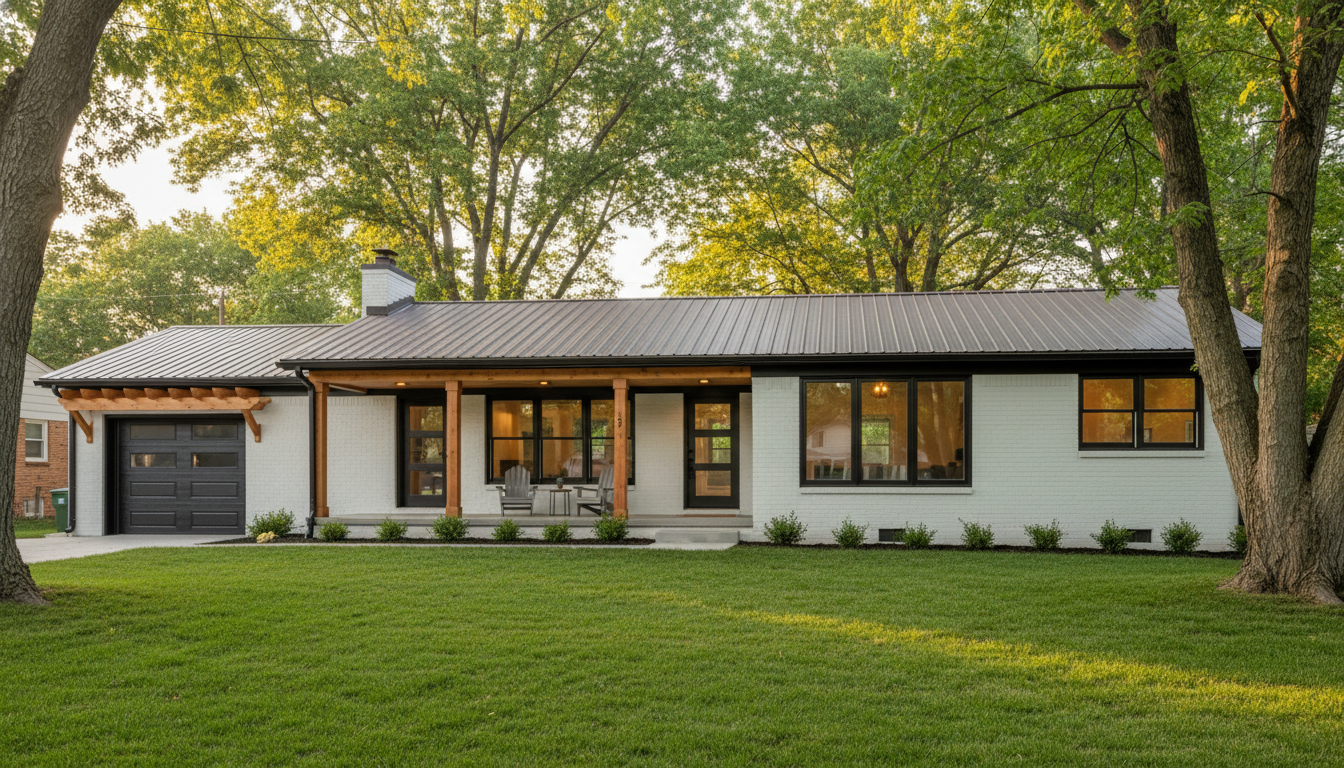
Roughly 40% of curb appeal is landscaping. Most ranch makeover budgets allocate 5%. This is the single most consistent error in residential renovation.

The 2026 baseline for ranch landscaping:
- Remove anything overgrown — junipers, yews, holly hedges installed in 1985 are invariably the wrong scale
- Plant in layers — short hedge at the foundation (boxwood), mid-height ornamental grasses, one or two specimen trees flanking the entry
- Stone or paver walkway wider than the original 36-inch concrete path (5 feet is a much better proportion for the porch)
- Foundation lighting — short bollards along the path, uplights on specimen trees
- Mulch in dark-pine or black (never red-dyed)
In AI renders, landscaping is the cheapest detail to swap. Generate the same house with three landscaping treatments and the impact will be obvious — and the cheapest line item in the project will often be doing the most visual work.
After running thousands of ranch transformations, four palettes consistently outperform the rest.
| Palette | Body | Trim | Roof | Door | Best For |
|---|
| Modern Farmhouse | White or warm cream | Black | Black metal | Sage / matte black | Suburban ranches in any region |
| Modern Bold | Charcoal or matte black | White | Dark gray asphalt | Cedar wood | Tighter lots, dramatic effect |
| Mid-Century Restored | Warm cedar / off-white | Black | Low-pitch gray asphalt | Saturated red / orange / teal | California, Arizona, Florida, modernist neighborhoods |
| Transitional Greige | Warm greige | White | Charcoal asphalt | Navy or sage | Universal — quietest, most resale-friendly |
Use AI to test all four on your specific house. The right palette will be the one that flatters your roofline, your existing windows, and your neighborhood context — not the one that looked best on Pinterest.
Mistake 1: Underestimating the porch. A 4-foot stoop with two columns is not a porch. Without proper depth (8 feet minimum) and proper width (10 feet minimum), the entry will still read as undersized regardless of what else you change.
Mistake 2: Painting the brick a trendy color. Sage green, navy, or any saturated color on brick reads as confident in 2026 — and dated by 2030. Stick with white, off-white, warm gray, or charcoal/black for resale-safe choices.
Mistake 3: Ignoring the garage door. On most ranches, the garage door is 30-40% of the front-facing visible surface. Replacing or refacing it (cedar plank, painted matte black, carriage-style barn doors) often produces more visual return per dollar than any other single upgrade.
Mistake 4: Keeping the dated roof. A re-side-and-paint job under an aged brown 3-tab asphalt roof looks unfinished. If the roof has 5+ years of life left, paint may not be enough to overcome it. Plan to re-roof within the same project or risk an incoherent final result.
Mistake 5: Window replacement done last. New windows reset the entire visual logic of the front facade — black frames, larger panes, cleaner trim. If new windows are in the budget, do them first; subsequent paint and material decisions will land more cleanly.
Mistake 6: Skipping the AI preview step. Plenty of homeowners commit to a ranch makeover and only see the final result when the painters are halfway through. AI removes that risk for the cost of a few hours of evening previewing. There's no reason to skip it.
A ranch house is the easiest residential renovation in America to transform — flexible silhouette, forgiving proportions, generous lots, and almost any modern style direction works. What used to require a $5,000-$15,000 architectural rendering package and three weeks of contractor consultations now takes 30 seconds and a phone photo.
Spend an evening on GenRoom's Facade tool, test the four or five direction-and-palette combinations that interest you on your actual home, and walk into contractor estimates with photoreal targets. The ranch you've been quietly underestimating is almost always one paint job and a real porch away from being the best-looking house on the block.
If your ranch has been waiting for an upgrade, this is the cheapest possible way to find out which version of the house has been hiding underneath the harvest-gold siding for forty years.
Modern farmhouse is the most popular target style for ranch transformations in 2026, because the long horizontal ranch silhouette suits farmhouse proportions naturally. Other strong directions include mid-century modern restoration (especially on warm-climate ranches), transitional greige palettes (resale-safe), and bold modern with charcoal or matte black bodies. AI tools like GenRoom let you test all directions on your specific house before committing.
Costs vary by scope. A paint-and-trim refresh with new front door and landscaping typically runs $8,000-$20,000. Adding an expanded covered porch raises the total to $25,000-$50,000. A full re-side, re-roof, new windows, and porch on a 1,500-2,000 sq ft ranch usually lands at $60,000-$140,000. AI previews don't change those numbers — they help direct the budget toward the changes that produce the most visual return.
Painting is significantly cheaper ($3,000-$8,000) and produces dramatic results. Replacement (or covering with siding) costs $15,000-$40,000 and is rarely necessary for cosmetic reasons. The exception is mortar or brick that's structurally compromised — that requires repair regardless of the cosmetic plan. AI previews of painted-brick options usually answer the question quickly.
Replacing the stoop with a real covered porch produces the highest visual return per dollar on most ranches. Second-highest: painting the brick or re-siding. Third: new front door, landscaping, and lighting as a packaged refresh. The garage door is also frequently underrated — it's 30-40% of the visible facade on most ranches.
Yes — significantly. A high-resolution photoreal render of your specific house in your target direction is dramatically more useful than a verbal description or a Pinterest collage. Contractors welcome them because they reduce rework. HOA boards approve them faster because they remove ambiguity from the design intent.
Yes — most modern AI exterior tools handle structural additions including second-story pop-tops, dormers, and roof reconfigurations. The render won't replace an architect's load calculations, but it will tell you within minutes whether the second-story version of your house is worth pursuing.
Saturated trend colors (deep teal, sage, mauve, terracotta) on the entire body have a short shelf life and tend to date in 5-7 years. Stick with white, warm cream, soft greige, charcoal, or matte black for the body, and put the saturated color on the front door instead. AI lets you test trend colors at body scale — the typical reaction is clarity that a deep navy ranch sounds great in theory and feels overwhelming in render.
About 30 seconds per render. A productive session — testing 5-10 direction options and refining the favorites — usually takes 30-45 minutes. That replaces what used to be a 2-4 week design consultation phase.