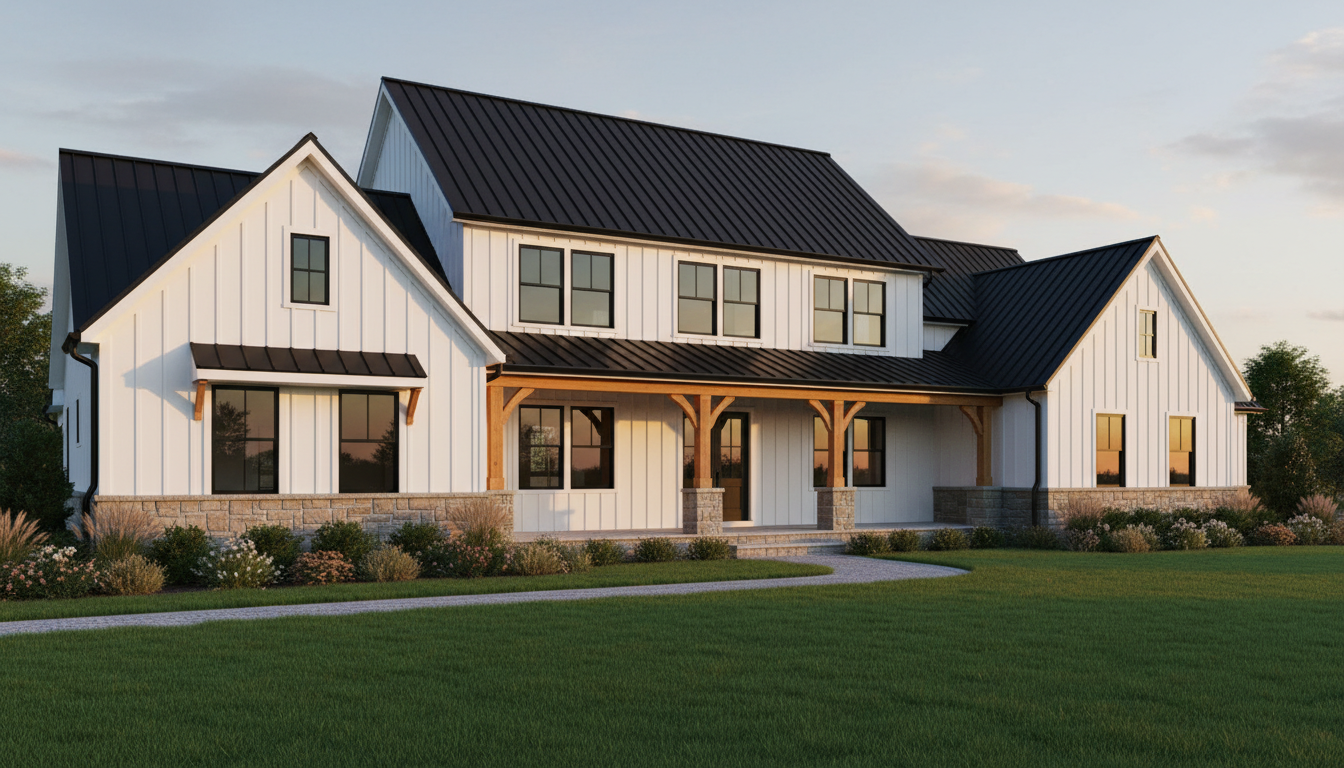
Color is where most homeowners get stuck. AI is excellent at letting you preview every reasonable option on your actual house before you commit. Five palettes are dominating the style this year.
The original. Warm white siding (Sherwin-Williams Alabaster or Benjamin Moore White Dove are reliable starting points), pure black window frames and roof, and cedar warmth in the porch ceiling. Risk: it can read as "every Pinterest house." Counter it with a non-black door — sage, navy, or oxblood.
The 2026 reverse-flip. Body in deep charcoal (Tricorn Black, Iron Ore, or Black Fox), windows trimmed in crisp white, roof in matte black metal. The look is dramatic and unusually flattering on smaller homes — the dark body recedes, making the architecture read taller and more refined.

The current "quiet luxury" version: a warm greige body (Accessible Beige, Agreeable Gray), cedar porch and column accents, soft black trim. No high-contrast moments. The whole exterior reads expensive without trying.
The dominant emerging palette of 2026. Body in soft sage (Evergreen Fog, Sage Green, Saybrook Sage), white trim, black roof, cedar warmth at the porch. Originally driven by sustainability messaging, now mainstream.
Crisp white siding, soft blue or stormy gray-blue shutters and door, weathered cedar accents, light gray standing-seam roof. Reads as Hamptons farmhouse rather than rural farmhouse — appropriate for waterfront and lake-house properties.
When previewing palettes in AI, render the same prompt three times before judging. Subtle shifts in lighting between generations matter more than they should — a charcoal house generated at noon will look completely different than the same prompt at golden hour.
Several AI exterior generators handle the modern farmhouse style competently. Here's an honest comparison of what each does well.
| Tool | Best For | Free Tier | Style Library | Custom Prompts |
|---|
| GenRoom | Photorealistic facade makeovers, dedicated Facade tab, 4K upscaling | Yes (starter credits) | 50+ exterior styles | Yes |
| HomeDesigns AI | All-in-one (interior + exterior + garden) | Limited free | Wide | Yes |
| Visualizee.ai | Real estate listing previews | Trial | Strong on contemporary | Yes |
| AI Two | Quick paint/curb appeal swaps | Free with watermark | Decent | Yes |
| RoomsGPT | Beginner-friendly, no signup | Yes | Modest | Limited |
The differentiator for modern farmhouse work specifically is whether the tool understands the architectural vocabulary. Generators that were trained primarily on interior design tend to muddle the roof pitch, the porch depth, and the proportion of the windows when generating exteriors — small errors that make the rendered house feel uncanny rather than aspirational.
GenRoom's Facade tab is purpose-built for this — it preserves the underlying architecture (roof angle, window placement, driveway perspective) while restyling materials and colors, which is exactly what you want when previewing a renovation rather than a fantasy.
Reviewing thousands of AI-generated and real-world farmhouse exteriors reveals the same recurring errors. Avoid these and your project will land in the top 20% of the style by default.
Mistake 1: Too much black. Black trim, black windows, black roof, black door, black sconces, black garage doors. The eye needs a break. Reserve at least one warm material — cedar, brass, stone — to anchor the palette.
Mistake 2: Skimping on porch depth. A 4-foot stoop with two columns is not a modern farmhouse porch. The porch needs to function as outdoor living space. If you can't fit two rocking chairs and a small table, expand it before painting anything.
Mistake 3: Wrong window proportions. Standard builder-grade windows on a modern farmhouse renovation read as "homeowner Photoshopped over their tract house." If the budget allows, replace with taller units. If it doesn't, frame the existing windows with thicker black trim to fake the visual mass.
Mistake 4: Generic landscaping. Boxwoods on either side of the door is fine. Boxwoods on either side of every window starts to feel like a model home. Layer in ornamental grasses, hydrangeas, or low boxwood hedging for variation.
Mistake 5: Forgetting the "fifth elevation." When approaching from the street, the roofline is half the visible house. A great body color with a beat-up shingle roof undermines the whole project. If the budget runs short anywhere, run short on landscaping, not on the roof.
Mistake 6: AI render purgatory. Generating endless versions and never committing. After your tenth iteration, save your top three and walk away for 24 hours. The right one will be obvious when you come back. Past 15 generations, you're optimizing noise.
A modern farmhouse exterior is one of the most forgiving styles to renovate into — almost any home with a gable roof and a buildable front-yard footprint can be coaxed there. What used to require a $5,000-$15,000 architectural rendering package now takes 30 seconds and a phone photo. The barrier to seeing your house transformed has effectively collapsed.
The honest path: spend an evening generating versions on GenRoom's Facade tool, pick a palette and a porch configuration you love, and walk into your contractor meetings with a photorealistic target instead of a Pinterest board. The conversation that follows will be dramatically more productive — and the final result, dramatically closer to what you actually wanted.
If your house has been waiting twenty years for an upgrade, this is the cheapest possible way to find out whether it's been waiting for modern farmhouse the whole time.
A modern farmhouse exterior combines traditional American farmhouse silhouettes — gabled roofs, vertical siding, deep covered porches — with clean contemporary detailing: black-framed oversized windows, standing-seam metal roofs, statement doors, and natural stone or cedar accents. The look is grounded and warm but unmistakably current, not period-correct.
Yes — and the results are far more accurate than most homeowners expect. Tools like GenRoom preserve your house's actual architecture (roofline, window placement, driveway, surroundings) while restyling materials, colors, and added features like porches. A photorealistic preview of your specific house typically takes 30 seconds and costs cents per generation.
Costs vary enormously by scope. A paint-and-trim refresh with a new front door can land at $5,000-$15,000. A full re-side, re-roof, new porch, and window replacement on a typical 2,500 sq ft home typically runs $80,000-$180,000 depending on materials and region. AI previews don't change those numbers — but they help you spend that budget on the right details rather than on regret.
The peak black-and-white version popularized in 2018-2022 has cooled, but the underlying style — gable rooflines, board-and-batten, deep porches — is settling into a long-term classic. The 2026 evolution leans warmer, softer, and more material-rich (cedar, stone, sage, greige). Homes built in this updated direction should age comfortably for decades.
A standing-seam metal roof in matte black or soft gray is the defining choice. Architectural asphalt shingles in dark charcoal can substitute when budget is tight, but the silhouette loses meaningful impact. Metal roofing also offers 40-70 year service life, which dramatically improves the project's long-term value.
Sage green, deep navy, charcoal black, dusty teal, and oxblood red all work beautifully. Avoid polished primary colors and pure white. Sage has emerged as the standout 2026 choice — it pairs with both white and gray bodies and reads as warm without being trend-locked.
About 30 seconds per render on most modern tools. A productive design session — generating 8-15 variations, comparing palettes, refining prompts — usually takes 30-45 minutes. That replaces what used to be a 2-4 week architectural rendering process.
Yes, and you should. A high-resolution AI render of your specific house in your specific target style is the most useful brief you can hand a contractor — far clearer than a Pinterest board or verbal description. Most builders welcome them because they reduce scope creep and rework.