Exterior Home Renovation on a Budget: What AI Can Show You
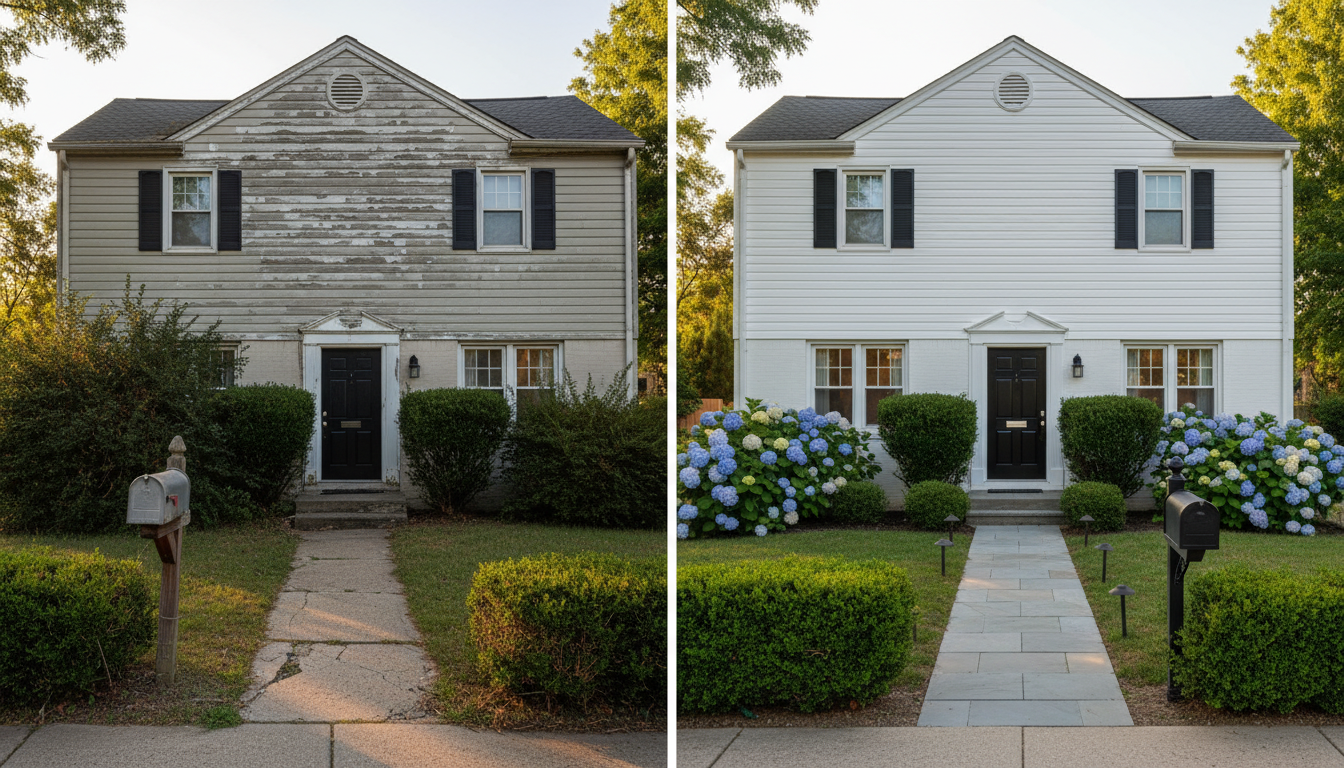
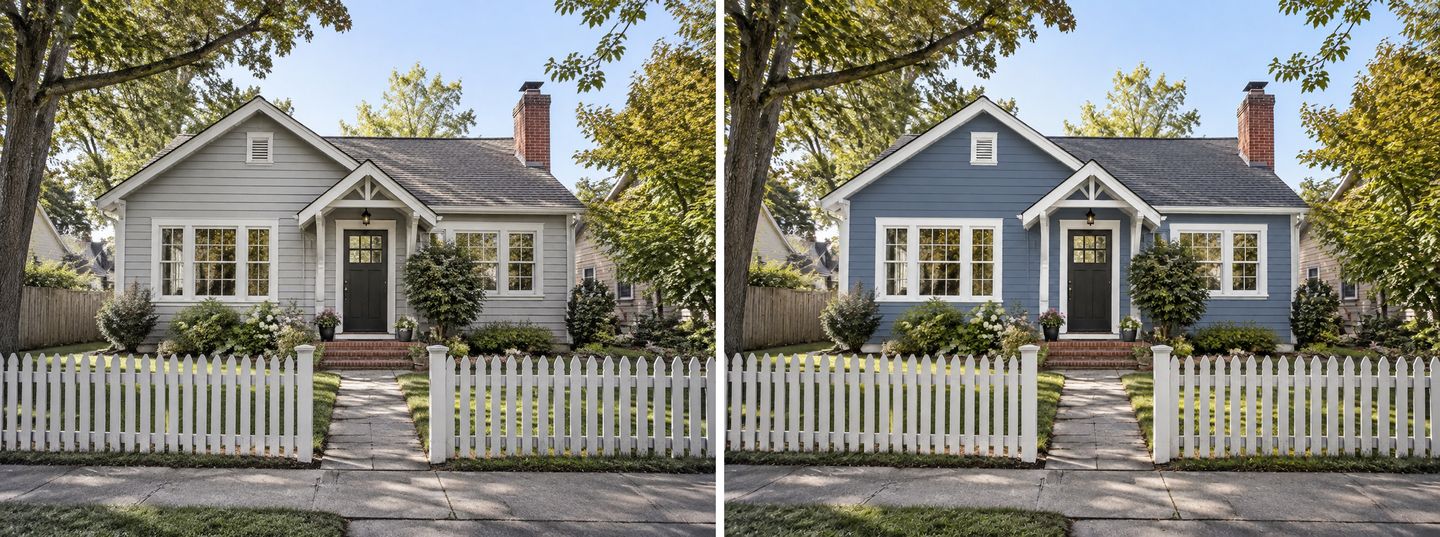
Most homeowners assume an exterior renovation requires $50,000+. It doesn't. A focused $2,500-$5,000 budget — spent on paint, lighting, hardware, landscaping, and one or two precision upgrades — can transform how a tired house reads from the street, often more than a full re-side or new windows would. AI exterior tools now let you preview every dollar of that budget on your specific house in 30 seconds, so you can direct the spend toward the highest-leverage changes before buying a single can of paint.
This guide covers the seven highest-ROI budget exterior projects under $5,000, what each actually costs in 2026, the order to execute them, and how to use AI to see the cumulative result on your own home before committing. GenRoom's facade design Studio is one of the best options for this — it lets you stack changes (paint + door + landscaping + lighting) in a single render so you see the combined effect, not just one upgrade in isolation.
If your house has been quietly disappointing you and the full renovation budget isn't in the cards, this is the lane that produces the most visible change for the least money.
Why Budget Exterior Renovations Punch Above Their Weight
The expensive exterior projects — re-siding, re-roofing, new windows, structural additions — produce real results but often don't dramatically outperform a focused budget refresh per dollar spent. The reason is concentrated visual leverage.
A $50,000 re-side replaces a surface most viewers don't actively notice (siding usually reads as background texture). A $3,000 paint, lighting, hardware, and landscaping refresh transforms the parts the eye lands on first — door, entry, foundation plantings, walkway approach. The eye prioritizes those areas, so improvements there register much harder than improvements anywhere else.
Real-estate research consistently confirms this:
- Garage door replacement: 94-103% ROI
- Front door replacement: 91% ROI
- Landscaping/curb appeal package: ~50% ROI but the strongest emotional response from buyers
- Re-siding: 65-75% ROI
- New windows: 65-72% ROI
- Re-roofing: 60-65% ROI
The numbers don't say expensive projects are bad — they say budget projects are dramatically efficient. For homeowners trying to maximize visible impact on a contained budget, the order is paint and door first, lighting and hardware second, landscaping third, larger projects fourth.
How AI Helps You Plan Spend Sequence
Without AI, a budget renovation is a sequence of small commitments where you can't see the cumulative effect until everything is done. AI exterior tools end that uncertainty entirely.
The workflow in GenRoom's Studio (it detects a facade automatically):
1. Photograph your house from across the street, golden hour or mid-morning, capturing the full front elevation including landscaping and walkway.
2. Upload to the Studio.
3. Generate one "fully refreshed" version of your house first. Layer all the changes — paint, door, hardware, landscaping, lighting — in a single ambitious render: pick the curb appeal mode, add your wishes, and click "Create design." For example: "Repainted in soft greige with white trim, matte black front door with brushed brass hardware, new path lighting, refreshed boxwood and hydrangea foundation plantings, dark pine mulch, slate stone walkway, larger terracotta planters flanking the door."
4. Then back off and isolate. Generate the same house with just the door changed, just the landscaping changed, just the paint changed — or brush over one area and describe a single change. The single-change versions tell you which line item is doing the most visual work — and where to direct the most budget.
5. Build a priority list from the renders. The change that visually transforms the most stays in. The change that barely registers can be deferred or cut.
6. Translate to a contractor brief. The "fully refreshed" render becomes the target image you hand to the painter, the landscaper, and the hardware installer. Communication between you and them collapses.
The whole exercise replaces what used to be a weeks-long sequence of trial-and-error with a 30-minute planning session.
The 7 Highest-ROI Budget Exterior Projects
In execution order, by dollar-per-visual-impact.
1. Paint the Front Door — $50-$200
The single highest-ROI change in residential exterior design. A quart of premium exterior paint, a brush, painter's tape, and a rainy Saturday. The total spend is typically $50-$200; the visual transformation is dramatic.

The 2026 colors that consistently produce the strongest result: matte black, charcoal, deep navy, sage green, walnut wood stain, and earth-tone terracotta. Avoid white-on-white (too quiet) and any saturated trend color that doesn't actively flatter your siding.
In AI previews, a fresh-painted front door is the most reliable single visual change you can test. Run six color options on your specific door in 5 minutes — the right one is usually obvious immediately.
2. New Hardware and House Numbers — $100-$400
The hardware your guests actually touch. Front door knob/lever, deadbolt, and house numbers in a coordinated finish. Brushed brass and matte black are the dominant 2026 finishes for a reason — they pair with virtually any door color and read as upgraded.

The undersized off-the-shelf hardware that came with the house is almost always too small for the door it's mounted on. Sizing up by 25-30% reads as professional. Generously-sized house numbers (8-10 inches tall, not the 4-inch supermarket version) is one of the most consistent quiet upgrades to a tired entry.
3. Lighting Refresh — $200-$800
Two new wall sconces flanking the front door, in a finish matching the new hardware. If the budget allows, low-voltage path lighting along the walkway. The transformation at dusk is dramatic.

A useful framework: a $400 lighting refresh on a tired suburban entry typically produces the same perceived value lift as a $2,500 hardscape change. Lighting is the most-skipped budget exterior upgrade — and one of the most consistently transformative.
In AI previews, generate the entry once at golden hour and once at twilight with the porch lights on. The night render is what tells you whether your lighting plan is working.
4. Pressure Wash Everything — $0-$300
The cheapest single transformation in exterior renovation. Pressure-washing the siding, the driveway, the walkway, and the porch removes 5-10 years of accumulated grime in an afternoon. Many tired suburban houses look 80% better after a single thorough wash.

If you don't own a pressure washer, rent one for $50-$80 a day. If you'd rather hire, $200-$400 covers a standard suburban single-story house and driveway. Always pressure-wash before deciding what else needs renovation — most homeowners discover the underlying surfaces are far better than they thought.
5. Landscaping and Foundation Plantings — $500-$2,500
The half of the project most homeowners underspend on. Roughly 40% of curb appeal is landscaping. Most budget renovations allocate 5-10% of the total spend.

The reliable 2026 budget landscaping kit:
- Remove anything overgrown (junipers, yews, holly hedges from 1985 are almost always wrong)
- Plant in layers — short hedge at foundation (boxwood), mid-height ornamental grasses, one or two specimen plants at the entry
- Fresh dark pine or black bark mulch (never red-dyed) — at $5-$8 per bag, this is the cheapest visual upgrade per dollar
- Two oversized planters flanking the door — boxwood, hydrangeas, or olive trees
- A wider walkway — 5 feet beats the standard 36-inch concrete path proportionally
Most of this is DIY-friendly. A productive weekend of work can produce a transformation that reads as a $5,000-$8,000 professional landscape job.
6. Painted Brick or Siding — $1,500-$5,000 DIY, $3,000-$8,000 Pro
The biggest budget upgrade in the under-$5,000 category. Painting existing brick or refreshing painted siding transforms the dominant visible surface.

DIY costs roughly $1,500-$3,000 for a single-story 1,500 sq ft home (paint, primer, supplies). Professional cost runs $3,000-$8,000 depending on prep work and access. The 2026 dominant directions: warm white limewash, soft greige, deep charcoal, or matte black for a dramatic statement.
Critical: paint is permanent on brick (it can't realistically be removed). Test colors thoroughly in AI before committing. The right color works; the wrong color is a $3,000 regret.
7. Mailbox, Walkway Edging, Driveway Refresh — $200-$1,500
The final-detail layer. New mailbox post in matching finish ($75-$300), defined walkway edging stone or steel ($200-$600), pressure-wash and seal the driveway ($150-$500). None of these alone are dramatic, but together they finish the project.
In AI previews, layer these in last — they're the difference between a "renovated" entry and a "designed" entry.
A Worked Example: $3,500 Suburban Ranch Refresh
Here's how to allocate $3,500 on a tired single-story ranch — the most common American suburban home — with priorities driven by AI previewing.
| Project | Cost | Impact |
|---|---|---|
| Paint front door (matte black) + brushed brass hardware kit | $180 | Highest single visual change |
| Two oversized matte black wall sconces | $280 | Transforms entry at night |
| Pressure wash entire facade and driveway (DIY rental) | $90 | Surfaces look 5 years younger |
| Repaint siding (DIY) — soft greige body, white trim | $850 | Dominant facade surface refreshed |
| Foundation plantings refresh (boxwood, hydrangeas, mulch) | $620 | 40% of curb appeal |
| Two oversized terracotta planters with boxwood topiaries | $240 | Anchors the entry |
| Path lighting kit (8 LED bollards) | $320 | Night transformation |
| New mailbox post in matte black | $180 | Finishing detail |
| New 8-inch matte black house numbers | $90 | Finishing detail |
| Landscape edging stone | $250 | Defines the work |
| Buffer for paint touch-ups, supplies | $400 | Realistic |
| Total | $3,500 |

This is what $3,500 actually buys when directed by AI previewing instead of trial-and-error. The same budget without planning typically lands closer to $4,500-$5,500 because of false starts and color-do-overs.
Create facade design with AI
Upload a photo of your home and get a new facade in the chosen style in 30 seconds. First generation is free.
Order of Operations: Why Sequence Matters
Most budget exterior renovations execute in the wrong order and end up over budget because of it. The right sequence:
1. Pressure wash everything first. It's free or near-free, and it tells you what genuinely needs replacement vs. cleaning. Most homeowners discover post-wash that 30-40% of what they planned to replace just needed cleaning.
2. AI-preview the full target. Generate a "fully renovated" render with all your planned changes layered. This becomes your decision-making frame for everything else.
3. Paint the door + hardware + lighting first. $300-$800 total, transforms the visible entry, and reveals whether you need bigger paint changes elsewhere.
4. Landscape and foundation plantings. Best done in spring or fall. The mulch alone makes a dramatic difference.
5. Body paint (siding or brick) last among the cosmetic projects. It's the largest commitment and the easiest to mess up. Once you've completed the smaller changes, you'll have a much clearer sense of which body color flatters the refreshed entry.
6. Hold a buffer. $300-$500 unallocated. Every renovation discovers a needed line item mid-project.
Common Budget Renovation Mistakes
Mistake 1: Spreading the budget too thin. $1,000 across ten different projects produces no visible change. $3,500 across four focused projects produces dramatic change. Concentrate spend.
Mistake 2: Skipping the AI preview. A budget renovation has zero margin for color do-overs. AI previewing on your specific house removes the most expensive guess in the project.
Mistake 3: Underspending on landscaping. 40% of curb appeal sits in the dirt around the foundation. If your landscaping budget is under $500, that's the line item to grow. Cut anywhere else first.
Mistake 4: Forgetting lighting. A $400 lighting refresh produces the same perceived value as a $2,000 hardscape change. The most-skipped category in budget renovations.
Mistake 5: Treating the entry as separate from the body. The door, the entry, the windows, the trim, the body, and the landscaping are a single visual system. Designing one piece without the others is why so many budget renovations end up looking incoherent.
Mistake 6: Not accounting for prep work. Painting brick requires careful prep, primer, and weather-cooperation. Planting requires soil testing if the existing landscape is dead. Budget 15-20% of the total project for prep, not just materials.
Final Thoughts
A focused $2,500-$5,000 budget, directed by AI previewing on your specific house, can produce more visible exterior transformation than a $30,000 unfocused renovation. The math works because budget renovations target the highest-leverage surfaces (door, entry, lighting, landscaping) that drive the eye's first impression of any house.
Spend an evening on GenRoom's facade design Studio, generate a "fully refreshed" version of your specific house, and use that render to direct the budget spend. The conversation that follows with your contractor — or your spouse — will be measurably more productive, and the renovation you end up with will be measurably closer to the photoreal target image you started with.
The cheapest paint and lighting upgrades are also the highest-ROI in residential renovation. AI just makes them confident instead of guessed.
FAQ
What's the best $5,000 exterior renovation?
The highest-ROI $5,000 exterior renovation focuses on five line items: front door paint and hardware ($300), entry lighting ($500), landscaping and foundation plantings ($1,500), siding or brick paint refresh ($2,000), and finishing details like mailbox and path edging ($700). GenRoom's facade design lets you preview the cumulative effect on your specific house before committing — most homeowners need 30 minutes to land on a confident plan.
Can I do an exterior renovation under $1,000?
Yes — and many of the highest-impact changes fall in this range. Front door paint ($50), new hardware kit ($150), two new sconces ($300), pressure washing ($90 DIY rental), refreshed mulch and basic foundation plantings ($300). The combined effect is visible from the street and meaningful. AI lets you preview the result before spending a dollar.
What's the highest-ROI single change?
Front door paint and hardware refresh at $200-$400 produces the most visual return per dollar of any residential exterior project. A close second is new exterior lighting (sconces and path lighting). Both are typically DIY-friendly weekend projects.
Should I paint my brick or replace it?
Painting is dramatically cheaper ($1,500-$3,000 DIY for a 1,500 sq ft home) than replacement ($15,000-$40,000) and produces more visible change. The trade-off: paint on brick is essentially permanent — it can't be easily removed. AI previews of multiple paint colors on your actual brick remove the commitment risk almost entirely.
How much does it cost to repaint a house exterior?
DIY paint costs $850-$2,500 for a typical 1,500-2,500 sq ft home (paint, primer, supplies). Professional cost runs $3,000-$8,000+ depending on prep work, access, and home size. AI previewing helps you commit to the right color the first time, which is the biggest single cost variable.
What should I do first in a budget exterior renovation?
Pressure-wash everything before any other work. It's free or near-free, removes 5-10 years of accumulated grime, and reveals which surfaces genuinely need replacement vs. just cleaning. Most homeowners discover post-wash that significant portions of what they planned to renovate just needed washing.
Can AI tell me which budget projects will work on my house?
Yes — that's the most useful application of AI exterior tools for budget renovations. Generate one render with all your planned changes layered together, then isolate single-change versions to see which line item is doing the most visual work. The combination tells you exactly where to direct the budget.
Will a budget renovation increase my home's resale value?
Yes — focused budget exterior renovations consistently produce strong returns. Garage door replacement, front door replacement, and landscaping upgrades return 90-100%+ of cost at resale on average. Combined with paint and lighting refreshes, a $3,500-$5,000 budget renovation typically produces $8,000-$15,000 in perceived market value gain.