Bohemian (Boho) Interior Design: The Complete 2026 AI Style Guide
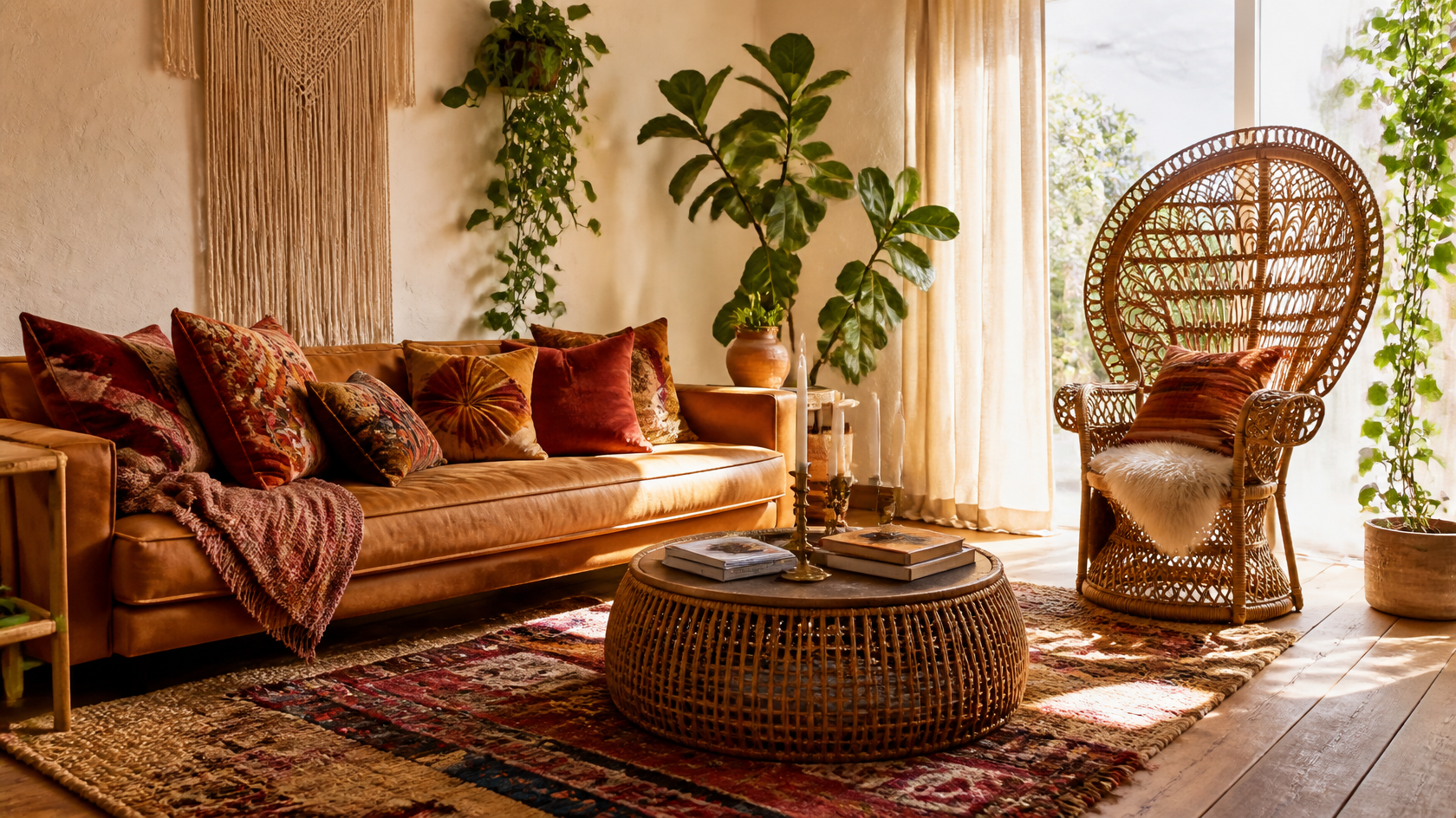
Bohemian design is the most personal style there is, and that is exactly why it is the hardest to get right. Born from the free-spirited, anti-establishment "bohème" of nineteenth-century Paris and reborn through 1960s counterculture, boho was always about collecting a life rather than decorating a room — vintage textiles from your travels, plants you have kept alive for years, the handmade ceramic you could not leave the market without. Done well, it is the warmest, most soulful interior on earth. Done badly, it is a pile of pampas grass, a mass-produced mandala tapestry, and a fiddle-leaf fig dying in the corner.
The difference between the two is not money. It is intention. And in 2026 the style has shifted hard toward the intentional end: the cluttered "dorm-room boho" of the late 2010s is out, and Refined Boho — curated, edited, artisan-led — is what every design publication is now championing. This guide is the version we wished existed when we started visualizing boho rooms for homeowners with GenRoom's AI interior design tool: the four substyles you can actually choose between, an honest earthy palette with real paint codes, the layering and pattern rules that separate "collected" from "chaotic," a room-by-room playbook for five spaces, the mistakes that make boho look like a flea market exploded, and an AI workflow that lets you test the whole thing on a photo of your real room in under sixty seconds — before you spend a dollar.
What is Bohemian Interior Design?
Bohemian interior design is an eclectic, layered, plant-filled style built on natural materials, warm earthy color, global textiles, and handmade objects collected over time rather than bought as a matching set. Its governing principle is the opposite of minimalism: more is more — but curated more, where every layer earns its place. A boho room feels like it has a story because, ideally, it does.
The four non-negotiable ingredients are texture, plants, pattern, and patina. Texture comes from rattan, jute, macramé, wool, leather and clay. Plants are not an accessory in boho — they are structural, the green that makes the warm palette breathe. Pattern arrives through vintage rugs, block-print throws and embroidered cushions, layered until the room reads as collected. And patina — visible age, handmade imperfection, the wabi-sabi acceptance that nothing should look factory-new — is what keeps boho from sliding into "themed."
What most people miss is the discipline hiding inside the abundance. Authentic boho is not random. It runs on a tight 3-4 color palette repeated across the room, a deliberate mix of old and new, and ruthless editing. The free-spirited look is engineered. That is the single insight this entire guide is built around.
The Four Boho Substyles (Pick One Before You Buy Anything)
The biggest mistake new boho decorators make is treating "boho" as one thing. It is four — and choosing your lane before you shop is what keeps a room coherent. Every great boho space leans clearly into one of these.
| Substyle | Palette | Mood | Best for |
|---|---|---|---|
| Classic / Maximalist Boho | Saturated jewel tones + earthy base — rust, mustard, indigo, emerald | Rich, layered, well-travelled | People who collect and want it all on display |
| Modern / Refined Boho | Neutral cream and oatmeal base + one or two earthy accents | Curated, calm, intentional | Renters and minimalists who want warmth without clutter |
| Desert / Earthy Boho | Sun-bleached terracotta, sand, clay, peach, off-white | Warm, dry, sculptural, tidy | Lovers of texture over color; warm-climate homes |
| Dark / Moody Boho | Deep teal, forest green, charcoal base + amber and rust | Dramatic, intimate, villa-like | North-facing rooms, evening spaces, bold decorators |

Classic Boho is the maximalist original — every layer turned up, jewel tones and global patterns piled high, plants everywhere. It is the hardest to execute without tipping into clutter, but the most rewarding when it works.
Modern Boho (the 2026 favorite) strips the palette back to neutrals and lets texture do the work instead of color. One large-scale woven fiber art piece, one statement rug, a few sculptural plants, and a lot of breathing room. This is the version that works in a rental and survives a move.
Desert Boho trades color for warmth — terracotta, sand, clay, off-white, and dry textures like jute, raw plaster and rough ceramic. It is the tidiest boho, ideal if you love the materials but find the maximalist pattern-mixing overwhelming.
Dark Boho is the dramatic newcomer: deep moody walls (forest green, teal, charcoal) as a base, then the full boho layering of velvet, wool, rugs and brass lighting on top. It feels like a private villa and photographs beautifully in evening light.
The Authentic Boho Color Palette (With Paint Codes)
Boho is an earthy palette with a saturated heart. The base is warm and grounding; the accents are where the personality lives. The discipline rule is simple and non-negotiable: pick 3-4 tones and repeat them across the room — terracotta in a cushion here, a plant pot there, artwork across the room. Repetition is what makes a boho space read as "collected" instead of "chaotic."
Foundation neutrals (60-70% of the room)
- Warm white / cream — the boho base coat. Benjamin Moore White Dove OC-17, Cloud White OC-130, Chantilly Lace OC-65
- Greige / warm taupe — for grounded, earthy walls. Richmond Gray HC-96, Venetian Portico AF-185
- Sand / jute tones — Jute AF-80, Concord Ivory HC-12
- Natural wood — light oak, reclaimed timber, cane and rattan throughout
Earthy accents (the boho signature, 20-30%)
- Terracotta / rust — the single most identifiable boho color. Earthy, warm, never neon. Desert Shadows 2114-30, Stone Brown 2112-30
- Mustard / ochre — golden, sun-faded yellow. Dorset Gold HC-8, Spice Gold 1040
- Warm browns — for leather, wood and grounding tones. Mississippi Mud 2114-20, Incense Stick 2115-20
- Dusty pink / clay — soft, romantic, common in desert boho textiles
Jewel-tone accents (classic & dark boho only, 10%)
- Emerald / forest green — beyond the plants themselves; for velvet and dark walls
- Indigo / teal — in rugs, ceramics, dyed textiles
- Burgundy / aubergine — New London Burgundy HC-61, Black Bean Soup 2130-10 for moody depth
Metals & finishes (5%)
- Brass / antique gold — the dominant boho metal, in Metallic Gold 2163-40 hardware, lighting and mirror frames
- Black matte — used sparingly for contrast on fixtures
Rule of thumb: neutrals carry the room, earthy tones carry the personality, and jewel tones are the spice — a little goes a long way. A room with five competing saturated colors is not eclectic; it is loud.

The Materials That Make a Room Read as Boho
If color is the personality of boho, material is its grammar. A room can have the right palette and still feel wrong if everything in it is smooth, new and synthetic. Boho lives in texture.
| Material | Where it shows up | Why it matters |
|---|---|---|
| Rattan & cane | Peacock chairs, pendant lights, headboards, side tables | The defining boho material — warm, woven, handmade |
| Jute & sisal | Layered base rugs under patterned rugs | Grounds the room and adds floor texture |
| Macramé | Wall hangings, plant hangers, cushion fringe | Handmade fiber craft, the boho signature on walls |
| Vintage textiles | Persian kilims, Moroccan rugs, Suzani, block-print, ikat | The pattern layer; ideally collected, not bought new |
| Leather | Caramel/cognac sofas, poufs, slings | Adds warmth and ages beautifully (patina) |
| Clay & terracotta | Pots, vessels, tile, plaster walls | The earthy, sun-warmed surface boho is built on |
| Handmade ceramic | Vases, bowls, lamp bases | Imperfect glaze = the anti-factory boho ethos |
| Wool & sheepskin | Throws, poufs, layered chair covers | Cozy weight, especially in dark and scandi boho |
| Dried botanicals | Pampas, eucalyptus, palm, grasses | The sculptural, low-maintenance plant layer |
The 2026 refinement is worth noting: cheap mass-produced macramé and dusty pampas in every corner are out; large-scale, high-end woven fiber art and authentic, artisanal pieces are in. The material list has not changed — the quality bar has risen. One beautiful handwoven wall piece beats five thin synthetic ones.
How to Layer Boho Without Looking Cluttered
This is the section competitors skip and the one that actually matters, because "more is more" is precisely the instruction that ruins most boho rooms. Layering is a skill with rules.
Rule 1 — Lock the palette first. Choose your 3-4 tones (e.g. cream, terracotta, mustard, oak) and refuse anything outside it. This single constraint does 80% of the work. A tightly limited palette can absorb an enormous amount of pattern and still feel intentional.
Rule 2 — Layer rugs, don't scatter them. The boho floor is a large neutral jute or Berber base with one patterned vintage rug layered on top, slightly off-center. Two patterned rugs of similar scale fight; a neutral base plus one hero pattern sings.
Rule 3 — Mix pattern scale, not pattern count. When you combine patterns, vary the scale — one large geometric, one medium floral, one fine stripe — and keep them all inside the palette. Three patterns at the same scale clash; three at different scales read as collected.
Rule 4 — Vary plant height. Don't line plants up at the same level. Use a tall fiddle-leaf or palm for structure, a trailing pothos or devil's ivy cascading from a shelf for drama, and sculptural succulents or snake plants for texture. Plant stands and ladders create the vertical layering boho depends on.
Rule 5 — Leave negative space. Even maximalist boho needs the eye to rest. Keep one wall quiet, one surface clear. The empty space is what lets the layered areas read as deliberate rather than desperate.
Rule 6 — Build over time, and edit. The fastest way to look like a themed store is to buy everything at once from one retailer. Real boho accrues. And every few months, remove what no longer fits the vibe. Editing is as much a part of boho as collecting.
Bohemian Design Room by Room
The palette and materials stay constant; what changes room to room is which pieces anchor the space and where the pattern intensity lands. Here is the playbook.
Living Room
The boho living room is the style's showpiece — the room where layering, plants and pattern all converge.
- Anchor piece: a low caramel or cognac leather sofa, or a deep-seated linen sofa, piled with mismatched cushions in your palette.
- Statement seat: a rattan peacock chair, a hanging chair, or a low sling chair — the single most recognizable boho furniture move.
- Floor: a large jute base rug with one vintage Persian kilim layered on top.
- Coffee table: low and woven (rattan drum) or a reclaimed-wood slab, stacked with art books, a tray and a handmade vessel.
- Walls: one macramé or large woven fiber art piece; a gallery wall of textiles and framed prints on another.
- Plants: a tall fiddle-leaf fig in the corner, trailing pothos from a shelf, and a cluster of smaller pots on the table.
- Lighting: a rattan or beaded pendant overhead, plus a brass floor lamp; warm 2700K bulbs only.
Bedroom
Boho bedrooms are the coziest version of the style — texture-heavy, plant-filled, and built around the bed as a layered centerpiece.

- Bed: a low wooden platform bed, or a cane/rattan headboard, dressed in layered natural linen in oatmeal, rust and mustard.
- Headboard wall: a large macramé hanging or a Moroccan wedding blanket pinned above the bed — the boho bedroom's signature.
- Bedding: layered, not matched — a block-print throw, a chunky knit blanket, mismatched euro shams, one patterned lumbar cushion.
- Lighting: rattan pendant lights flanking the bed instead of table lamps, or woven sconces.
- Plants: trailing greenery on a wooden ladder shelf, a tall palm in the corner.
- Floor: layered jute and Berber rugs, ideally with a sheepskin underfoot.
Kitchen
Boho kitchens lean warm and handmade, swapping sterile minimalism for terracotta, ceramic and open, lived-in display.

- Backsplash: warm terracotta, cream or patterned zellige / encaustic tile.
- Shelving: open wooden shelves displaying handmade ceramic bowls, earthenware and glassware — never a sterile cabinet wall.
- Island / counters: butcher-block or warm timber; a vintage kilim runner on the floor.
- Lighting: rattan or woven pendants over the island.
- Hardware & fixtures: brass or aged-bronze faucet and pulls.
- Life: hanging dried herbs, trailing plants on the windowsill, woven baskets for storage.
Bathroom
The small footprint makes the bathroom the most expressive boho room — pattern and texture carry hard without overwhelming.

- Floor: patterned encaustic cement tile in terracotta and cream, or warm hex in clay tones.
- Vanity: a wooden vanity with a vessel sink and brass faucet.
- Mirror: a round rattan-framed or brass sunburst mirror.
- Plants: trailing greenery and a tall potted palm thrive in bathroom humidity — a defining boho move.
- Textiles: layered textured towels in rust and oatmeal, a small vintage rug, a macramé wall accent.
Dining Room
The boho dining room is deliberately unmatched — the "collected over time" ethos at its most literal.

- Table: a round or live-edge wooden table.
- Chairs: deliberately mismatched — one rattan, one vintage wood, one with a sheepskin throw — unified by the wood tones and palette.
- Lighting: a low woven, rattan or beaded pendant centered over the table.
- Walls: a gallery wall mixing framed textile art, woven baskets and prints.
- Floor & plants: a vintage kilim underfoot, trailing greenery and a tall plant in the corner.
Create interior design with AI
Upload a photo of your room and get a professional design in 30 seconds. First generation is free.
The Dark Boho Option: Boho's Most Dramatic Form
Worth its own section because it is the fastest-growing boho direction of 2026 and the one most likely to read as "expensive."

Dark boho keeps every boho ingredient — rattan, plants, vintage rugs, layered textiles, brass — but swaps the bright plaster base for deep, moody walls: forest green, teal, charcoal or even near-black. The dark envelope makes the warm accents (rust, amber, mustard) glow, and the brass-and-amber-glass lighting does the rest. It is intimate, villa-like, and forgiving of north-facing rooms that bright boho can leave feeling cold. The trick almost nobody mentions: paint the ceiling and trim the same dark color as the walls. The room loses its edges, the plants and lamps float, and a small room reads as a cocoon rather than a box.
The 6 Mistakes That Make Boho Look Cluttered
These are the patterns that turn a soulful boho room into visual chaos. Avoid them all.
1. No palette discipline
The number-one boho failure. Five saturated colors with no repetition reads as random, not eclectic. Lock 3-4 tones and repeat them deliberately across cushions, pots, art and textiles. The palette is the leash on the chaos.
2. Buying a "boho set" from one store
Boho is the anti-matching-set style. A sofa, two chairs and a rug bought together from one boho retailer looks like a showroom display, not a collected home. Mix eras, sources and wood tones. Add pieces over months, not in one delivery.
3. Pampas and mandala overload
Dusty pampas in every corner and a mass-produced mandala tapestry are the two clichés that instantly date a room to 2018. In 2026, one sculptural dried arrangement and one high-quality woven fiber piece replace a dozen cheap ones.
4. Filling every surface
Layering is not the same as cluttering. Every shelf crammed, every wall covered, every surface stacked — and the eye has nowhere to rest. Leave one quiet wall and one clear surface. Negative space is what makes the busy areas look intentional.
5. Same-scale pattern collisions
Three bold patterns at the same scale fight each other. Vary the scale — large, medium, fine — and keep them inside the palette. Scale variation is the difference between "mixed" and "messy."
6. Cool, bright lighting
Boho is a warm, golden-hour style, and cool 4000K LEDs kill it instantly. Use 2700K bulbs everywhere, lean on warm rattan and brass fixtures that filter the light, and add candles. The right light does half the boho work.
The AI Workflow: Designing Your Boho Home with GenRoom
Boho is the most trial-and-error-heavy style there is, because the whole look depends on how layers interact — and you cannot know how a rug, a wall color and three plants will read together until you see them in the room. Buying your way to the answer is slow and expensive. AI visualization collapses it to seconds.
Upload a photo of your real room to GenRoom, pick a style, and within about thirty seconds you have a photorealistic preview of that exact room reimagined in boho — same walls, same windows, same proportions, just dressed in the right palette, materials and layering. Run it across four substyles and five rooms, and you have decided your entire direction in under ten minutes, for the price of a couple of coffees.
Step 1: Photograph each room
Stand in the corner with the widest view, open the curtains, turn on the lights, and shoot in landscape with your phone's standard 1x lens. One photo per room.
Step 2: Run the Boho preset
On the Generate page, upload the photo (the Studio detects the room automatically), pick the Bohemian style, and click Create design. In about thirty seconds you have a redesigned room. GenRoom's paid one-time packs start at $9.99 for 36 credits (about 18 designs and edits) — less than a single quart of designer paint, for plenty of iteration on every room.
Step 3: Test all four substyles
This is the move that makes AI uniquely valuable for boho. Generate the same room as classic, modern, desert and dark boho. Seeing your actual space in each substyle tells you instantly which one your light and architecture want — something no Pinterest board can answer.
Step 4: Refine with the AI Editor
If a result is 80% right, the AI Editor (included in every plan, even Free) lets you adjust one element at a time with words or a brush. Type "add a large macramé wall hanging above the sofa" or "swap the rug for a terracotta Persian kilim," and it reworks just that part of the image.
Step 5: Compare and commit
Generate three to five variations per room, place them side by side, and the one you keep returning to is your direction. For whole-house planning, the Pro pack ($39.99 / 300 credits, about 150 designs and edits) covers every room and substyle with room to iterate.
Prompts that produce the strongest boho results
If you add your own wishes in words rather than relying on the style alone, these phrasings work hardest:
- Living room: "Bohemian living room with low caramel leather sofa, layered terracotta and mustard cushions, vintage Persian kilim over jute rug, rattan peacock chair, macramé wall hanging, trailing pothos and a tall fiddle-leaf fig, rattan pendant, warm 2700K lighting."
- Bedroom: "Boho bedroom with low wooden platform bed, layered oatmeal and rust linen bedding, large macramé headboard, rattan pendant lights, trailing plants on a ladder shelf, jute and Berber layered rugs, warm morning light."
- Dark boho: "Dark moody bohemian living room, deep forest-green walls, teal velvet sofa, vintage jewel-tone rug, brass and amber-glass pendants, layered wool throws, abundant plants, warm low evening light."
Specificity matters. Words like "vintage kilim," "rattan," "macramé," "terracotta," "layered linen," "trailing plants" and "2700K" do far more than "boho" alone.
What a Real Boho Room Costs in 2026
Boho is one of the more budget-flexible styles, because thrift, vintage and handmade are baked into its ethos — but the quality bar of Refined Boho means a few hero pieces are worth investing in. Here is a realistic living-room breakdown.
| Element | Thrift / budget | Mid-range | Investment |
|---|---|---|---|
| Sofa | $400 (secondhand leather) | $1,200 (linen / leather) | $3,000+ (artisan leather) |
| Vintage rug | $80 (flea-market kilim) | $400 (quality vintage Persian) | $1,500+ (collectible antique) |
| Rattan accent chair | $120 (mass-market) | $350 (quality cane) | $900+ (vintage peacock) |
| Woven fiber wall art | $40 (small macramé) | $250 (large handwoven piece) | $800+ (artist fiber art) |
| Plants (set of 5-7) | $150 | $350 (mature specimens) | $700+ (large statement trees) |
| Lighting (pendant + lamp) | $120 | $400 (rattan + brass) | $1,200+ (vintage / designer) |
A complete, soulful boho living room runs roughly $900-$1,500 if you thrift and layer over time, or $5,000-$8,000 if you buy quality artisan pieces new. The beauty of boho is that the thrifted version often looks more authentic than the expensive one — patina and personal history are features, not flaws. AI lets you preview either end on your actual room before committing.
How AI Compares to Hiring a Designer
| Option | Cost | Time | Customization | Best for |
|---|---|---|---|---|
| GenRoom (Start) | $9.99 one-time / 36 credits | ~30 sec per image | High (styles, modes, AI Editor) | First-pass visualization, choosing a substyle |
| GenRoom (Pro) | $39.99 / 300 credits | ~30 sec per image | Very high (AI Editor, free 4K, reference photos) | Whole-house, multi-substyle planning |
| Online designer (Decorilla / Modsy) | $1,400-$2,800 / room | 2-4 weeks | High | Final shopping lists, source links |
| Local interior designer | $5,000-$15,000+ / room | 6-12 weeks | Highest | Full renovation, custom sourcing |
For most homeowners and renters, the right order is AI first to decide direction and substyle, then self-source (boho's natural mode) or a designer to execute. The AI step eliminates the expensive mistakes; the sourcing step is where boho actually comes alive, one collected piece at a time.
FAQ
Is bohemian style still in style in 2026?
Yes — but it has evolved. The cluttered, mass-produced "dorm-room boho" of the late 2010s is out; Refined Boho is in: curated, intentional, artisan-led, with restrained palettes and a few high-quality pieces instead of many cheap ones. Boho's core appeal — warmth, personality, connection to nature and craft — is timeless, and design publications consistently rank it among the most-searched interior styles. The style is not fading; it is maturing.
How do I make boho not look cluttered?
Six rules: (1) lock a 3-4 color palette and repeat it; (2) layer one patterned rug over a neutral base, not two patterns of equal scale; (3) vary pattern scale, not pattern count; (4) vary plant height for vertical layering; (5) leave one quiet wall and one clear surface; (6) build over time and edit regularly. The free-spirited look is engineered — clutter is what happens when the discipline is missing.
What colors are used in boho interior design?
A warm earthy base (cream, greige, sand, natural wood) carries 60-70% of the room; earthy accents (terracotta, rust, mustard, ochre, warm brown, dusty pink) carry the personality; and jewel tones (emerald, indigo, teal, burgundy) appear sparingly in classic and dark boho. Brass is the signature metal. The rule is 3-4 tones, repeated — not a rainbow.
What is the difference between boho and modern boho?
Classic boho is maximalist — saturated jewel tones, heavy pattern-mixing, layers everywhere. Modern (or Refined) boho keeps the natural materials, plants and global accents but strips the palette back to neutrals, edits the clutter, and lets texture rather than color do the work. Modern boho is the version that works in a rental and survives a move; classic boho is for dedicated collectors with the discipline to keep it coherent.
What plants are best for a boho room?
Variety and height matter more than any single species. Use a tall fiddle-leaf fig, palm or rubber plant for structure; trailing pothos, devil's ivy or string-of-pearls cascading from shelves for drama; and sculptural snake plants, succulents and cacti for low-maintenance texture. Plant stands and ladder shelves create the vertical layering boho depends on. For low-effort impact, add dried botanicals — pampas, eucalyptus, palm — alongside the live ones.
Can boho work in a small apartment or rental?
Yes — boho is one of the most rental-friendly styles, because it's built on textiles, plants, rattan and vintage finds rather than construction. Choose Modern or Desert boho for small spaces (they read calmer), use layered rugs and macramé instead of paint and tile, and lean on vertical plant layering to add life without floor space. Everything is removable when you move.
Does AI visualization actually look like the finished boho room?
In our testing, AI previews match the executed room with about 80-90% fidelity in palette, materials and overall feeling. The exact rug or chair in the image won't be the one you find at the flea market — but the layering, color and texture will be a close match. Treat AI previews as direction and substyle confirmations, not as a shopping list for specific pieces. For boho especially, where the look depends on how layers interact, that direction-setting is exactly the hard part AI solves.
The Bottom Line
Bohemian design is the warmest, most personal interior style there is — and the one most often ruined by good intentions, because "more is more" without discipline becomes clutter fast. The shortcut is to design the room twice: first in AI on a photo of your real space, where you can test all four substyles and every layer for free, and then in collected, thrifted, handmade objects once you know exactly which direction is yours. Upload your room to GenRoom, generate classic, modern, desert and dark boho versions side by side, and let the previews tell you which one your light and your life want — before you spend a dollar. The plants and textiles can be gathered over years. Spend an hour deciding the direction first. For more style playbooks, see our guides to Japandi and mid-century modern design.