AI Roof Design Visualizer: Compare Shingles, Colors & Styles
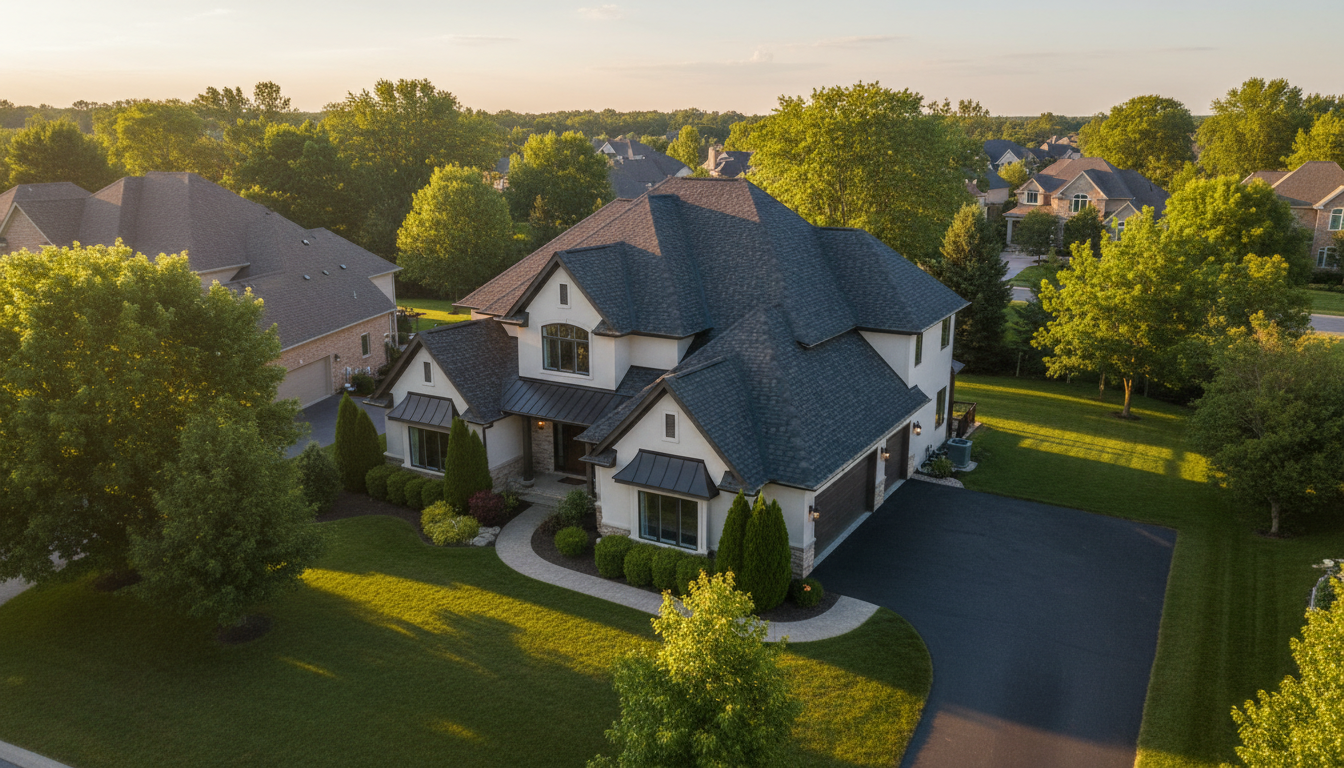
An AI roof design visualizer lets you upload a photo of your house and see it with different shingle types, materials, and colors — architectural asphalt, standing-seam metal, slate, cedar shake — in under a minute, on your roof, with your lighting and surroundings. It replaces the old workflow of holding cardboard samples up to your fascia and squinting.
The roof is roughly half of what passersby see when they look at a house. A bad color choice is a 25-year visual mistake — most asphalt shingle roofs aren't replaced until they wear out, which is why so many homeowners freeze mid-decision. AI visualization removes that paralysis: you can preview every reasonable combination on the actual silhouette of your home before a single bundle of shingles arrives at your driveway.
This guide walks through how AI roof visualizers actually work, the dominant shingle materials and colors for 2026, how to match a roof to your house style, and a comparison of the leading tools. We'll also flag the mistakes that quietly derail most re-roofing projects. GenRoom's facade design Studio is one of the most accurate options for this — preserving your house's architecture while restyling the roof material and color, which is exactly what you want when previewing a real renovation.
What Is an AI Roof Visualizer?
An AI roof visualizer is a tool that takes a photo of a house and digitally replaces the roof with a different material or color, producing a photorealistic render. Older "roof visualizers" from shingle manufacturers used 2D image overlays — they pasted a flat shingle texture onto a stock image of a generic house. Modern AI tools work fundamentally differently: they understand the geometry of your roof from the photo, then synthesize the new material in a way that respects perspective, lighting, and shadow.
The practical difference is enormous. A 2D overlay produces a render that looks roughly correct from one angle and breaks down on hips, valleys, and dormers. A modern AI render handles all of those naturally because the model reasons about the underlying surface, not just the pixels.
Three categories of AI roof tools dominate the market in 2026:
- General AI exterior design tools — built for whole-house restyling, with the roof as one of many editable surfaces. GenRoom, HomeDesigns AI, and Visualizee fall here.
- Manufacturer visualizers — Owens Corning's Design EyeQ, GAF's Virtual Remodeler, Atlas Select Your Roof. Free, branded, but locked to that manufacturer's catalog.
- Pro contractor tools — iRoofing, RenoWorks. Paid, used by roofing companies in sales meetings to close jobs.
For most homeowners, a general AI exterior tool gives the best balance: full creative range, photorealistic output, no vendor lock-in.
Why Visualize Before You Re-Roof
Asphalt shingle replacement runs $8,000-$25,000 on a typical American home. Metal, slate, or designer composite can run $25,000-$80,000+. Whatever you choose is sitting overhead for 20-50 years.

Three reasons AI previews are practically useful, not just nice-to-have:
1. Color samples are misleading at every step. The 6×6 inch sample at the home improvement store looks nothing like an entire roof in direct sunlight, and the 4K manufacturer render of a "model home" doesn't account for your trim, your siding, your trees, or your neighborhood context. Only a photorealistic preview on your actual house bridges that gap.
2. Pairing matters more than the shingle. A shingle that's stunning on a brick colonial reads as wrong on a stucco ranch. The interaction with siding, trim, and brick is where most amateur color choices fall apart. Visualizing on the real facade exposes the mismatch instantly.
3. Contractor and HOA buy-in. Showing your contractor or HOA board a high-resolution photoreal preview is dramatically more persuasive than a verbal description of "weathered wood with charcoal undertones." It also reduces miscommunication on installation day.
A useful pattern: before booking any roofing estimate, run 5-10 AI previews on your own home. Save the top 2-3. Hand them to every contractor who quotes. The bidding conversation that follows will be measurably more productive.
How AI Roof Visualization Works: Step-by-Step
The workflow on most modern AI exterior tools is similar. Here's how it goes in GenRoom's Studio, with facade modes such as siding & roof:
1. Take the right photo. Stand across the street, shoot straight-on, capture as much of the roof as possible. Avoid harsh midday glare. Mid-morning or late afternoon is ideal — even, raking light reveals roof texture without burning out shadows. Higher resolution always wins; phone cameras from 2020 onward are usually fine.
2. Upload to the visualizer. Drag the photo into the tool. Modern AI tools detect the roof geometry, siding, and surroundings automatically.
3. Choose a roof material and color. Most tools offer presets for architectural asphalt, standing-seam metal, slate, cedar shake, terracotta tile, and synthetic composite. Specify a color — charcoal, weathered wood, slate gray, evergreen, terracotta — or describe one in natural language.
4. Refine with prompts. This is where most users undersell themselves. Don't just accept the default. Add specifics: "matte black standing-seam metal roof with crisp ridge lines, two-inch seam spacing, low sheen finish." The more architectural vocabulary you use, the more accurate the render.
5. Generate, compare, iterate. Run the same house with three or four roof options side by side. Save your favorites. Most homeowners need 6-12 generations to land a final direction. Budget 20-30 minutes for a productive session.
6. Test in different lighting. Critical step most people skip. Re-render the same combination at midday, golden hour, and overcast. A roof that looks dramatic at sunset can read as muddy in flat winter light. Picking a color that holds up across all conditions is the difference between a good choice and a great one.
Top Roof Materials in 2026 (With AI-Rendered Examples)
Five materials dominate residential roofing in 2026, each with a distinct visual personality and price point.
Architectural Asphalt Shingles
Architectural shingles — also called dimensional or laminated shingles — are the default upgrade over basic 3-tab asphalt. They use multiple bonded layers to mimic the depth of slate, wood shake, or tile while staying affordable. They've been the standard for new-home construction since the early 2000s and now own roughly 75% of the residential market.
In AI renders, architectural shingles photograph well in any color. The layered shadow lines give the roof visual weight that flat 3-tab shingles can't match. If your budget allows architectural over basic 3-tab, the curb-appeal upgrade is significant.
Lifespan: 25-30 years Cost range: $4-7 per square foot installed Best for: Most residential roofs, especially modern, traditional, and farmhouse styles
Standing-Seam Metal
Standing-seam metal is the defining contemporary roof. Long vertical panels with raised seams create crisp, parallel lines that read as architectural rather than industrial. Once associated only with commercial buildings and barns, metal has become the premium choice for modern, modern farmhouse, and craftsman-revival homes.

Beyond aesthetics, metal lasts: a properly installed standing-seam roof routinely hits 50-70 years. It also performs in heavy snow, sheds wildfires better than asphalt, and qualifies for insurance premium reductions in many regions.
Lifespan: 50-70 years Cost range: $10-18 per square foot installed (2-3x asphalt) Best for: Modern, modern farmhouse, contemporary, mountain, and coastal homes
Slate (Natural and Synthetic)
Natural slate is the gold standard of roofing — and the most expensive. It's literal stone, fireproof, virtually indestructible, and capable of lasting a century or more. Synthetic slate (made from rubber-and-plastic composites) reproduces the look at roughly half the price and a fraction of the structural weight.

In AI renders, slate's irregular tones and slight color variation are difficult to fake — most generators handle it well, but some flatten the texture. Generate two or three versions and compare; the right render will have visible color variation rather than a uniform sheet.
Lifespan: 100+ years (natural), 50 years (synthetic) Cost range: $15-30+ per square foot natural, $10-15 synthetic Best for: Tudor, Victorian, French country, high-end traditional homes
Cedar Shake (Real and Composite)
Real cedar shake offers warmth and texture nothing else can match — a hand-split, naturally weathering wood roof that ages from honey-gold to silver-gray over a decade. It's also the highest-maintenance choice on this list, demanding cleaning, treatment, and occasional replacement of damaged shakes.

Composite cedar shake (synthetic) reproduces the look at lower maintenance and longer life. Both are protected or restricted in some wildfire-prone regions — check local code before committing.
Lifespan: 30 years (real), 50 years (composite) Cost range: $8-14 per square foot real, $10-13 composite Best for: Craftsman, traditional cottage, lake house, woodland-context homes
Designer Composite and Tile
Designer composite shingles (like CertainTeed Symphony, DaVinci Bellaforté, Brava) are engineered to mimic slate or cedar shake at lower weight and cost. Clay barrel tile defines Mediterranean and Spanish-style homes — almost impossible to substitute when authenticity matters.
Lifespan: 50 years (composite), 50-100 (clay tile) Cost range: $9-15 composite, $12-25 tile Best for: Mediterranean, Spanish revival, southwestern, and high-end traditional homes
Best Roof Shingle Colors for 2026
Color is where most homeowners freeze. Six colors dominate the 2026 residential roofing palette.
1. Charcoal Black
Pure black or near-black architectural asphalt is the most-installed shingle color in 2026. It pairs well with virtually every siding color, makes a house feel anchored and intentional, and reads as crisp without trying.

Best paired with: white, off-white, light gray, or any pale siding. Avoid against very dark or warm-saturated bodies — they fight rather than complement.
2. Slate Gray
A softer, cooler-toned middle gray. Less stark than charcoal, more sophisticated than mid-gray. The default safe choice for transitional and contemporary homes.
Pairs well with: cool greige, blue-gray siding, white trim, brick foundations.
3. Weathered Wood / Mocha
A multi-tonal brown shingle that mimics aged cedar shake. Warmer than gray, more forgiving than black. Best on traditional, farmhouse, and craftsman homes where warmth is part of the brief.
Pairs well with: warm beige, cream, sage, terracotta accents.
4. Evergreen Mist (Owens Corning's 2026 Color of the Year)
Owens Corning named Evergreen Mist — a sage-leaning forest green — the 2026 Shingle Color of the Year. Green roofs were once a niche choice for log cabins and craftsman cottages; in 2026 they're trending hard, often paired with warm cream or beige siding for a "quiet luxury" effect.

Pairs well with: cream, warm beige, cedar accents, stone foundations.
5. Slate Blue
A subtle navy-leaning gray-blue. Reads as elegant rather than stark. Works on coastal homes, traditional homes, and modern farmhouses with cool palettes.
Pairs well with: white, soft gray, navy shutters, light blue or gray siding.
6. Terracotta Tile
For Mediterranean and Spanish-style homes, the answer is rarely shingles at all — it's clay or composite barrel tile in burnt-orange terracotta.

Pairs well with: cream, warm beige, white stucco, wrought iron.
Create facade design with AI
Upload a photo of your home and get a new facade in the chosen style in 30 seconds. First generation is free.
How to Match Roof Color to House Style
The shortcut is simple: pick a roof that respects the era and architecture of your house, not just your favorite color. A few reliable rules.
| House Style | Recommended Roof |
|---|---|
| Modern Farmhouse | Matte black standing-seam metal OR pure black architectural |
| Modern / Contemporary | Standing-seam metal (any color) OR very dark architectural |
| Craftsman | Weathered wood architectural, cedar shake, or evergreen architectural |
| Traditional / Colonial | Charcoal, slate gray, or weathered wood architectural |
| Cape Cod | Pure black or charcoal architectural |
| Tudor / Victorian | Slate (natural or synthetic) |
| Mediterranean / Spanish | Terracotta or sand-toned barrel tile |
| Mid-Century Modern | Standing-seam metal in low-sheen black or gray |
| Lake House / Coastal | Cedar shake or weathered-wood architectural |
The other piece nobody mentions: roof color affects perceived house size. Dark roofs anchor a tall house and make it feel grounded. Light or mid-tone roofs visually shrink the roofline and let the body of the house dominate. If your roofline is your weakest architectural feature, go darker.
Top AI Roof Visualizer Tools Compared
Several tools handle roof visualization competently. Here's how the major options compare.
| Tool | Best For | Material Range | Photorealistic | Free Tier |
|---|---|---|---|---|
| GenRoom | Whole-house restyling with roof as part of the system | Architectural, metal, slate, cedar shake, tile | Yes (very) | Yes |
| Owens Corning Design EyeQ | Preview Owens Corning shingles only | Owens Corning catalog | 2D overlay | Yes |
| GAF Virtual Remodeler | Preview GAF shingles only | GAF catalog | 2D overlay | Yes |
| iRoofing | Pro/contractor sales tool | Wide | Yes | Paid |
| Renoworks Roof Designer | Multi-manufacturer | Wide manufacturer set | Mixed | Yes |
The split is fundamental. Manufacturer tools (Owens Corning, GAF, Atlas) are designed to sell their own products — limited to their catalog and visually dated. AI-first tools like GenRoom let you compare across materials and brands, generate photoreal output, and ignore vendor lock-in entirely.
For most homeowners doing serious decision-making, the right move is to use both: an AI exterior tool to nail down the material, color, and finish, then a manufacturer visualizer at the end to confirm the specific SKU you'll order.
Common Roof Visualization Mistakes to Avoid
Mistake 1: One photo, one lighting condition. A roof color always looks different at golden hour than at noon. Generate at multiple times of day before committing.
Mistake 2: Ignoring the trim. Roof color interacts with fascia, gutter, and trim color. A black roof on a black-trimmed house reads differently than the same roof on a white-trimmed house — the roof can disappear into the trim or fight it.
Mistake 3: Trend-chasing. Slate blue and evergreen are gorgeous on the right house and visually weird on the wrong one. The roof is overhead for 25-50 years; classic colors aged better than trend-driven ones every time the data has been examined.
Mistake 4: Not testing texture, just color. A "weathered wood" architectural shingle and a real cedar shake roof look very different at 30 feet. AI renders capture this well — make sure you're comparing materials, not just colors.
Mistake 5: Skipping the contractor preview. Once you've narrowed to two options, share both with three contractor estimates. Pros will flag installation issues — flashing color mismatches, ventilation incompatibilities — that visualizers miss.
Final Thoughts
The roof is the single largest visual surface on your house and one of the most expensive to redo. Twenty years ago, the only way to preview the decision was a 6×6 sample held at arm's length. Today, a 30-second AI render on your own house is the cheaper, faster, and dramatically more accurate path.
Spend an evening on GenRoom's facade design Studio, test the four or five materials and colors that interest you on your actual home, and walk into roofing estimates with a clear, photoreal target. The conversation with your contractor will be measurably more productive — and the roof you end up with will be much closer to the one you actually wanted.
Whichever direction you go, the cost of being wrong used to be 25 years. Now it's well under a dollar per render.
FAQ
What is an AI roof design visualizer?
An AI roof design visualizer is a tool that takes a photo of your house and renders it with a different roof material, style, or color in a photorealistic way. Modern AI tools understand the underlying geometry of your roof and synthesize new materials that respect perspective, lighting, and shadow — far more accurate than the 2D overlay roof visualizers from a decade ago.
How accurate are AI roof previews?
Modern AI roof renders from purpose-built tools like GenRoom are usually accurate enough to make confident purchase decisions. They reproduce material texture, color, and roof geometry faithfully. The one limitation is exact color matching: monitor calibration and AI color rendering may differ slightly from the physical product, so always confirm with a sample before final purchase.
Can I use an AI visualizer to plan a re-roof for my own house?
Yes — that's the most common use case. Take a clear, well-lit photo of your house from across the street, upload it to the tool, and generate previews with different shingle materials and colors. Most homeowners run 6-15 versions before settling on a direction. The whole process takes 20-30 minutes.
What's the most popular roof shingle color in 2026?
Charcoal black or near-black architectural asphalt shingles dominate residential roofing in 2026 — they pair with virtually every siding color and read as crisp and intentional. Other major 2026 colors include slate gray, weathered wood, and Owens Corning's color of the year, Evergreen Mist (a sage-leaning forest green).
How long do different roof types last?
Architectural asphalt shingles last 25-30 years, standing-seam metal 50-70 years, real cedar shake 30 years (composite cedar shake 50), synthetic slate 50 years, and natural slate or clay tile 100+ years. AI visualization helps you weigh aesthetic preference against lifespan and cost more confidently.
Are manufacturer roof visualizers (Owens Corning, GAF) better than AI tools?
Manufacturer tools are accurate within their own catalog but limited to that brand's products and usually use older 2D overlay technology. AI exterior tools like GenRoom let you compare across materials and brands and generate photoreal output. The best workflow uses an AI tool to choose the material, then a manufacturer tool to confirm the specific SKU.
Can AI roof visualization preview metal roofs and slate?
Yes. Modern AI tools handle metal (standing seam, metal shingle, corrugated), slate, cedar shake, designer composite, and clay tile competently. Standing-seam metal is one of the easier materials for AI to render accurately because of its strong geometric pattern.
Will my contractor accept AI renders as a project brief?
Yes — most contractors actively welcome them. A high-resolution photoreal render of your specific house in your specific target material is a clearer and more useful brief than verbal description or a Pinterest board. It reduces miscommunication on installation day and makes scope discussions faster.