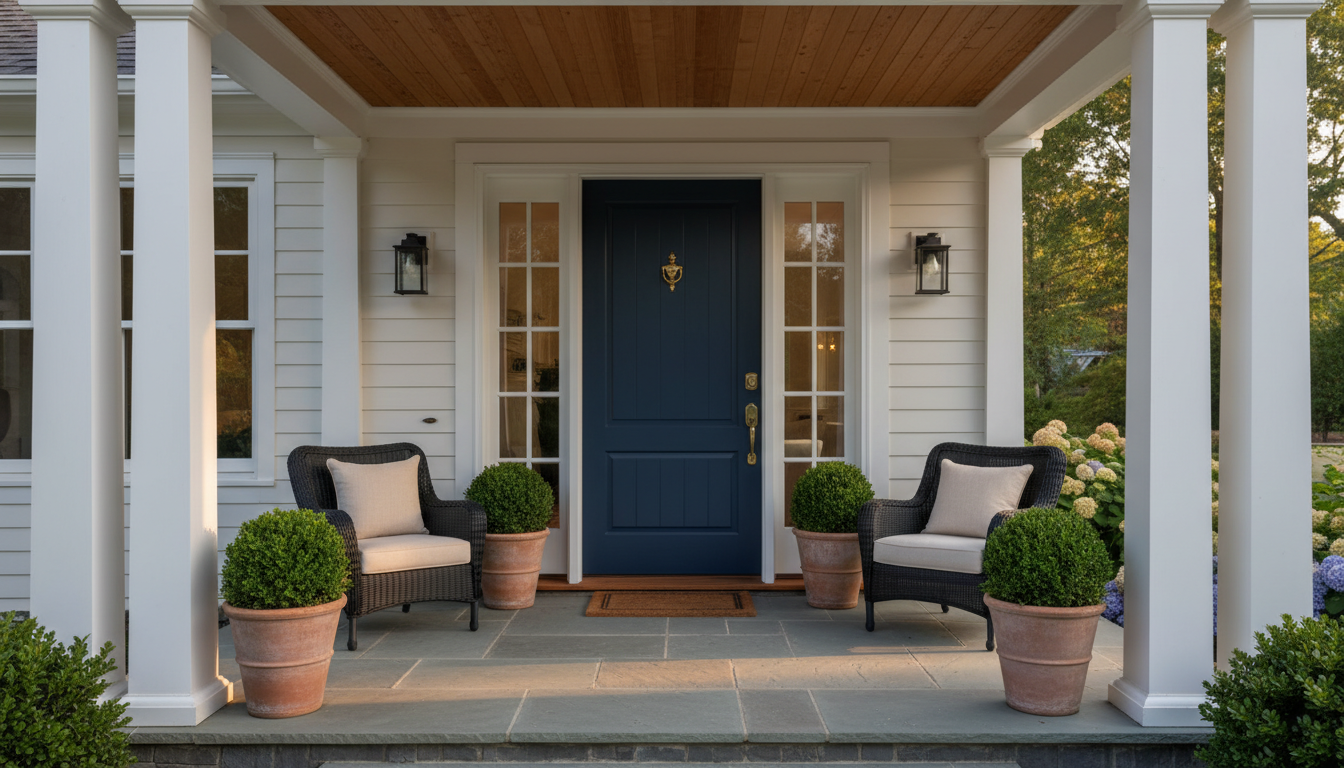
Lighting is what separates a pretty entry from one that photographs well at night and welcomes guests after sunset. Three categories matter.
The standard residential setup. Two matching sconces at roughly head height, sized larger than feels right (most homeowners install undersized fixtures).
A useful rule of thumb: the fixture's height should be roughly one-quarter the height of the door, the width roughly one-third the width of the door's exterior trim. Most off-the-shelf sconces are too small by this rule.
For porches with a covered ceiling, a hanging lantern adds dimension that wall sconces alone can't. Edison-bulb lanterns, gas-style brass lanterns, and modern globe pendants all work depending on style.
Often skipped, dramatically high-impact. Low-voltage path lights along the walkway and uplights on a specimen tree near the entry transform the house at night. Total cost: $300-$800 for a quality LED kit installed.
In AI previews, generate the entry once at golden hour and once at twilight with porch lights on. Most homeowners discover a finish or a color works at one time of day and not the other — the night render is the one that catches it.
The line between a styled porch and a "decorated" one is whether the styling reads as functional or ornamental. The functional version photographs well and welcomes you home; the decorated version feels like a model home.

The reliable porch styling kit:
- Two oversized planters flanking the door (boxwood, hydrangeas, or olive trees) — go larger than you think
- A bench, rocking chair pair, or small seating cluster sized to actually sit on
- A round side table that holds a drink
- A throw blanket casually placed (visual permission to use the porch)
- One natural element — a stone bowl, a copper watering can, a stack of seasoned wood
- A generously-scaled welcome mat in a natural fiber
Avoid: tiny terracotta pots (always look like leftovers), seasonal decorations as the primary styling, and anything plastic.
Mistake 1: Painting the door without testing it on the actual house. The same paint chip looks different against red brick, white siding, or charcoal stucco. AI previews close that gap in seconds.
Mistake 2: Skimping on hardware. The door hardware is the one piece of the entry guests physically touch. Spend more than feels right.
Mistake 3: Undersized lighting fixtures. Almost every off-the-shelf sconce is too small for the entry it's installed on. Buy bigger.
Mistake 4: Generic landscaping at the entry. Two boxwood pots is fine. Two boxwood pots flanked by red mulch and a single annual flower is the universal sign of a porch nobody actually uses. Layer in scale.
Mistake 5: Not coordinating finishes. Door hardware in matte black, sconces in brass, house numbers in chrome — three different finishes within ten feet — is the most common amateur entry mistake. Pick one finish and commit.
Mistake 6: Treating the door as separate from the porch. The door, hardware, lighting, planters, and walkway are a single visual system. Designing them piece by piece without an overall direction is why so many entries feel disjointed.
The front door and porch are the smallest area on your house with the biggest visual return. A few hundred dollars in paint, hardware, and styling can transform how the entire house reads from the street — and AI removes the guesswork that used to make those decisions stressful.
Spend an hour on GenRoom's Facade tool, test the seven dominant door colors of 2026 on your actual entry, decide which color wears best on your specific siding and lighting, and walk into the paint store with a clear photoreal target. The conversation that follows will be measurably more efficient — and the entry you end up with will be measurably closer to the one you actually wanted.
Twenty years ago this decision required samples, masking tape, and stomach acid. Now it takes thirty seconds per render.
The dominant 2026 colors are elevated charcoal black (the most universally flattering), muted greens like sage and eucalyptus, warm wood stains in walnut and cedar, and classic navy for the resale-safest non-neutral choice. The "right" color depends on your siding, the lighting at your house, and your architectural style — AI previewing on your actual house is the fastest way to choose between them.
Take a clear photo of your house entry, upload to a tool like GenRoom, and generate versions with different door colors. Most homeowners run six to ten variations in a 20-30 minute session and land on a confident choice. The AI preserves your siding, brick, lighting, and surroundings so you're seeing the actual color on your specific house.
A paint, hardware, and styling refresh on an existing door typically runs $300-$1,200 in materials and DIY labor. Full door replacement plus paint, hardware, and lighting lands at $2,000-$6,000. Adding or expanding a covered porch is the larger project at $15,000-$60,000 depending on scope. AI previews help direct the budget toward the changes that will produce the most visual impact.
Brushed brass and matte black are the dominant 2026 finishes for residential door hardware. Brushed brass leads on warm-palette homes (white, cream, sage, walnut wood doors) while matte black dominates on cool-palette and modern homes. Polished chrome and polished brass have largely fallen out of fashion for residential entries.
Yes — finish coordination across the door hardware, porch lighting fixtures, and house numbers is one of the strongest "designer" signals in entry design. Pick one finish (matte black, brushed brass, oil-rubbed bronze) and use it across all three. Mixing finishes within ten feet is the most common amateur mistake in entry design.
A compact craftsman-style porch (single bench, two oversized planters, hanging lantern, slate floor) works on most smaller homes without the wraparound footprint dominating the lot. AI lets you preview both wraparound and compact options on your specific house — the right scale becomes obvious immediately.
Yes — modern AI exterior tools handle structural additions including covered porches, expanded entries, second-story pop-tops, and re-rooflines. The render won't replace an architect's load calculations, but it will tell you within 30 seconds whether the porch-added version of your house is worth pursuing.
About 30 seconds per render. A full session — testing 6-10 color and hardware combinations — usually takes 20-30 minutes. That replaces what used to be multiple hardware-store trips and weeks of indecision.