Italian Villa Facade Design
Guide to facade design in Italian Villa Facade style: materials, colors, architectural solutions, and examples
Italian villa facade design covers the rural and suburban country house tradition of Italy from the Renaissance forward, particularly the Tuscan and Umbrian villas of the 16th century and the Italianate style that swept Britain and the United States from 1830 to 1880. The look is recognizable globally: warm stucco walls in cream, ochre or terracotta, low-pitched red tile roofs with deep overhanging eaves, round-arched windows, and a strong horizontal cornice line at the eave.
Materials and palette
Walls are smooth or lightly textured stucco in warm Mediterranean tones — buttery cream, warm yellow ochre, soft terracotta, pale rose or muted sienna. Roofs are clay barrel tile (coppi or canale) in warm red-brown to orange, laid at a low 4:12 to 6:12 pitch with deep 60-90 cm overhanging eaves. Cornices, window surrounds and quoins are sometimes painted in a slightly contrasting cream. Window frames are painted in soft green, white or terracotta.
Facade features
Look for round-arched windows on at least one elevation, tall rectangular casement windows with louvered shutters elsewhere, a low-pitched terracotta tile roof with deep overhanging eaves on decorative wooden brackets, a square or rectangular tower (campanile) projecting above the main roof on grander examples, a recessed arched entrance, and a strong horizontal stringcourse marking the floor levels. Stucco is occasionally rusticated at the ground floor.
Common mistakes
Don't use synthetic stucco (EIFS) in cold or humid climates — it traps moisture and ages poorly compared to traditional cement stucco. Don't pair Italian villa with steep roof pitches; the low pitch with deep eaves is fundamental. Don't paint the trim white against bright cream stucco — historical villas use tone-on-tone cream variants.
Budget tips
Traditional cement stucco runs $7-12 per sq ft installed; synthetic EIFS at $5-9 per sq ft is cheaper but problematic in some climates. Clay barrel tile costs $9-15 per sq ft installed versus $5-8 for concrete tile imitation. Custom wooden eave brackets cost $80-200 each. A complete Italian villa exterior is typically 15-30% over standard construction. Upload a photo of your house and our AI redraws it in Italian villa style in seconds — free to try.
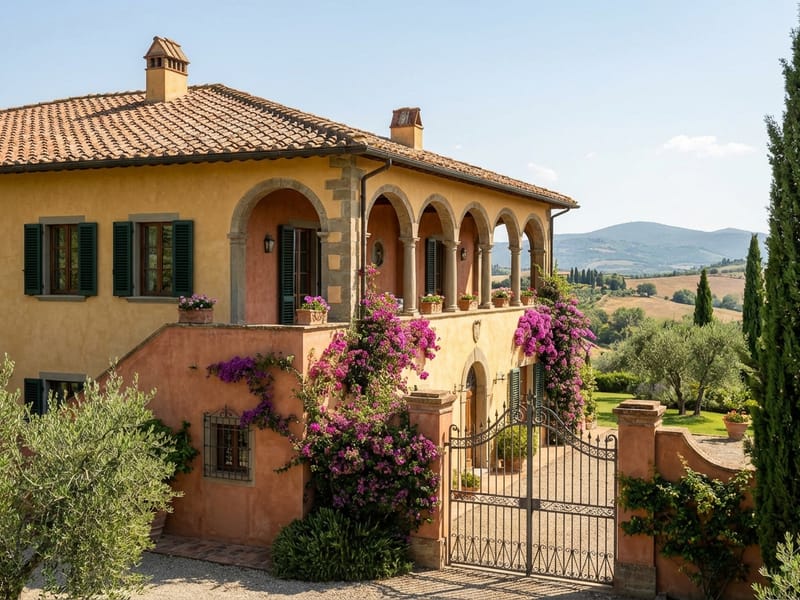
Key elements of Italian Villa Facade style
Warm Stucco Walls
Smooth or lightly textured stucco in warm cream, ochre, terracotta or pale rose — the dominant facade material of the Italian villa.
Low-Pitched Tile Roof
Clay barrel tile (coppi) roof at 4:12 to 6:12 pitch in warm red-brown, with characteristic deep overhanging eaves.
Round-Arched Windows
Round-arched windows on at least one elevation, often paired or arranged in groups, with rectangular casements elsewhere.
Decorative Eave Brackets
Carved wooden brackets supporting the deep eaves — a defining detail of both Renaissance villas and the Italianate revival.
Optional Campanile Tower
A square or rectangular tower projecting above the main roof on larger villas, evoking medieval Italian hill towns.
Louvered Shutters
Painted wooden louvered shutters on casement windows, in soft green, white or terracotta to complement the wall tone.
Try creating your own design
Upload a photo of your house and get a professional facade design in 30 seconds. First 2 designs are free.
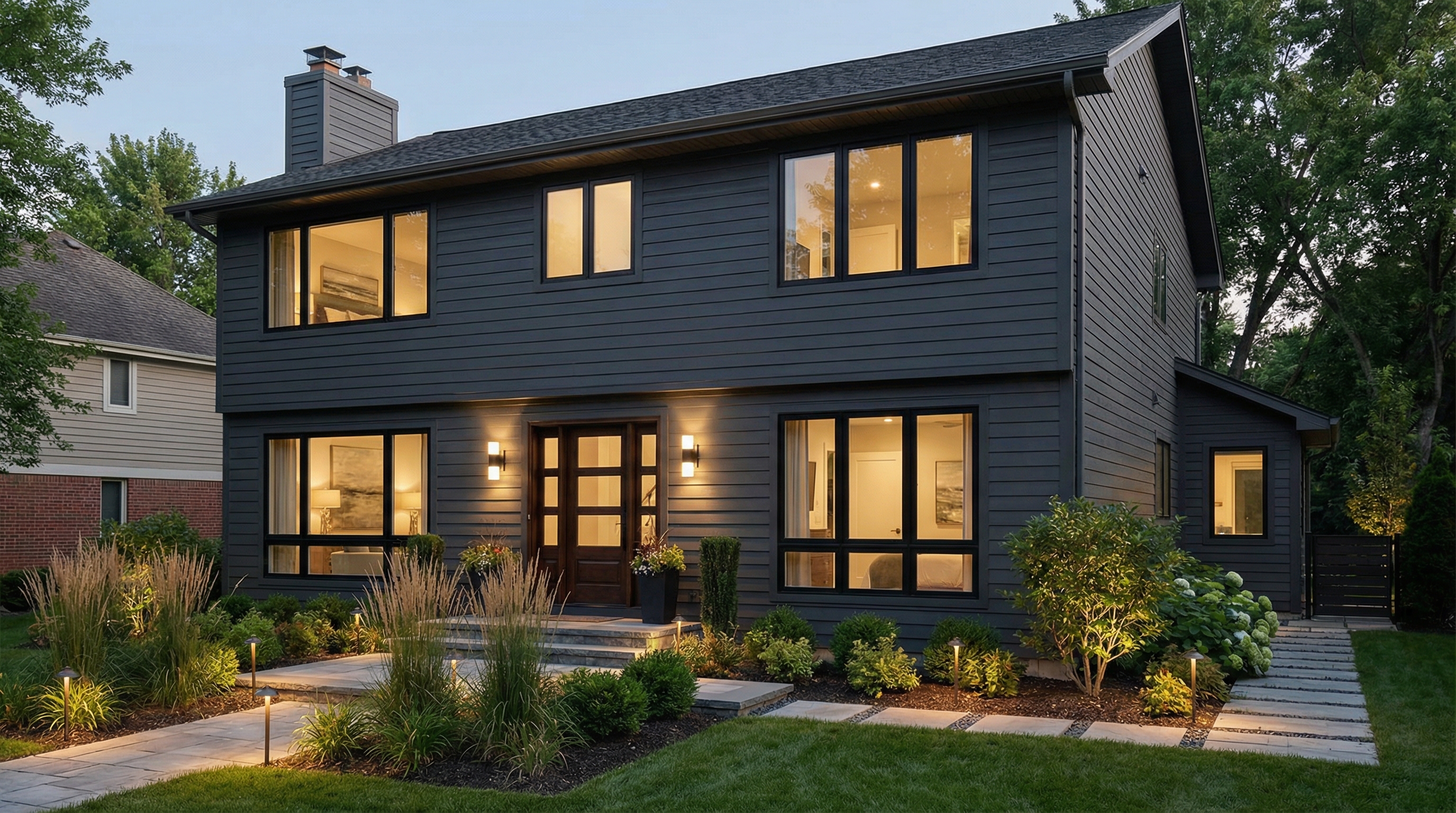
Italian Villa Facade: facade design
See more examples in the Italian Villa Facade style gallery or the full design gallery.
FAQ: facade design in Italian Villa Facade style
- Warm stucco walls, low-pitched terracotta tile roof, deep overhanging eaves on decorative brackets, round-arched windows and a strong horizontal cornice line.
- A revival of Italian villa architecture popular from 1830-1880 in Britain and the United States, characterized by stucco walls, low roofs, deep bracketed eaves and a square cupola or tower.
- Spanish Colonial is whiter, has more decorative tile and ironwork, and often features a courtyard. Italian villa is warmer in palette, more horizontal in massing and more classically proportioned.
- Clay barrel tile (coppi or canale style) in warm red-brown, laid at a low 4:12 to 6:12 pitch with deep eaves. Avoid steep pitches.
- EIFS is cheaper but ages poorly compared to traditional cement stucco and can trap moisture in cold or humid climates. Traditional cement stucco at $7-12 per sq ft is worth the upgrade.
- Tuscan earth tones — buttery cream, warm yellow ochre, soft terracotta, pale rose. Avoid bright white walls.
- Yes, but choose traditional cement stucco over EIFS, and ensure good roof overhang detailing to manage snow and rain. The deep eaves are functional as well as decorative.