Contemporary Garden Design
Guide to landscape design in Contemporary Yard style: features, plants, materials, and examples
Contemporary garden design refers to current landscape architecture (post-2000), drawing influences from modernist garden pioneers (Thomas Church, Roberto Burle Marx, Dan Kiley, mid-20th century) and post-2000 designers including Piet Oudolf's New Perennial Movement (which redefined planting with grasses and herbaceous perennials) and Tom Stuart-Smith's structured naturalism. The result is a landscape language that combines clean architectural lines, restrained palettes, and sophisticated plant compositions.
What makes a contemporary garden distinctive
Six hallmarks: strong rectilinear hardscape geometry, large-format paving in concrete or natural stone, ornamental grasses as primary planting, architectural specimen plants (Phormium, agave, fatsia, multistem trees), restrained planting palettes (typically 5-10 species used in mass), and integrated water features and lighting as design elements.
Plant palette
- Grasses: Stipa tenuissima, Calamagrostis 'Karl Foerster', Pennisetum 'Hameln', Miscanthus 'Gracillimus'
- Perennials: Echinacea, Echinops, Salvia 'Caradonna', Verbena bonariensis, Eryngium, Sedum 'Autumn Joy'
- Architectural plants: multistem birch, multistem Amelanchier, Trachycarpus fortunei, Phormium tenax, Yucca rostrata
- Shrubs: cloud-pruned boxwood, Pittosporum tobira, low Hebe, Carex
- Forbidden: bedding annuals, hanging baskets, gnomes, mixed-color flower borders
Hardscape elements
Paving: large-format concrete pavers (90x90 cm minimum), board-formed concrete, sawn limestone, porcelain pavers, raw steel weathering Corten edging. Walls: board-formed concrete, Corten steel screens, gabion stone walls, single-tone stuccoed walls. Water: minimal still-water rills or reflecting pools, often integrated into paving. Lighting: recessed in-ground uplights, linear LED strips at step risers and walls. Furniture: low concrete benches, linear teak seating, sculptural single chairs.
Common mistakes
- Mixing too many plant species. Contemporary planting uses 5-10 species in mass. Cottage-garden variety reads chaotic against architectural hardscape.
- Cluttered ornamentation. One sculptural element per zone; never garden gnomes, fairy lights, or themed accessories.
- Wrong paving scale. Small pavers (under 60 cm) look domestic. Contemporary requires large-format paving for the visual scale.
- Adding bedding flowers. Contemporary gardens use perennials and grasses, not seasonal annuals. Pansies and petunias break the style.
Budget approach
Cost-saving moves: large-format concrete pavers (cheaper than natural stone, achieves the same scale), ornamental grasses (under $15 per plant, mass plant in groups of 5-10), multistem trees from local nurseries, Corten steel edging fabricated locally, and minimal but well-positioned LED uplighting. A complete contemporary garden makeover for 100 square meters runs $4,000-8,000.
Upload a photo of your yard and our AI redraws it as a contemporary garden in seconds — free to try.
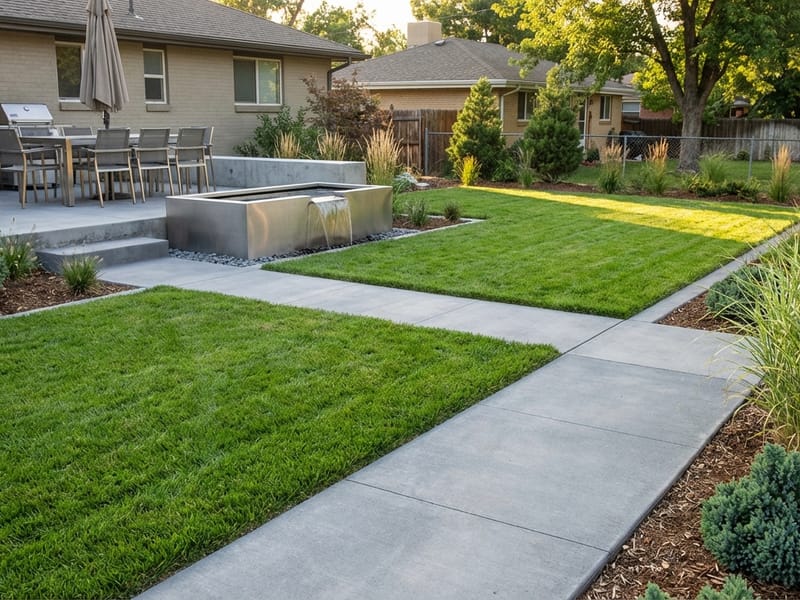
Key elements of Contemporary Yard style
Ornamental Grasses
Stipa, Calamagrostis, Miscanthus, and Pennisetum massed in large drifts provide movement, texture, and four-season interest.
Architectural Plants
Multistem birch, Trachycarpus palms, Phormium, and Yucca rostrata provide sculptural specimens that punctuate the planting.
Large-Format Paving
Concrete pavers, sawn limestone, or porcelain at 90x90 cm or larger create bold geometric paving patterns at architectural scale.
Corten Steel
Weathering Corten steel edging, planters, and screens provide the warm-orange rusted patina that softens contemporary hardscape.
Integrated Lighting
Recessed in-ground uplights and linear LED strips at step risers and walls dramatize the garden by night without visible fixtures.
Reflective Water
Minimalist still-water rills, reflecting pools, or single sheet-flow water walls integrate water as a calm sculptural element.
Try creating your own design
Upload a photo of your yard and get a professional landscape design in 30 seconds. First 2 designs are free.
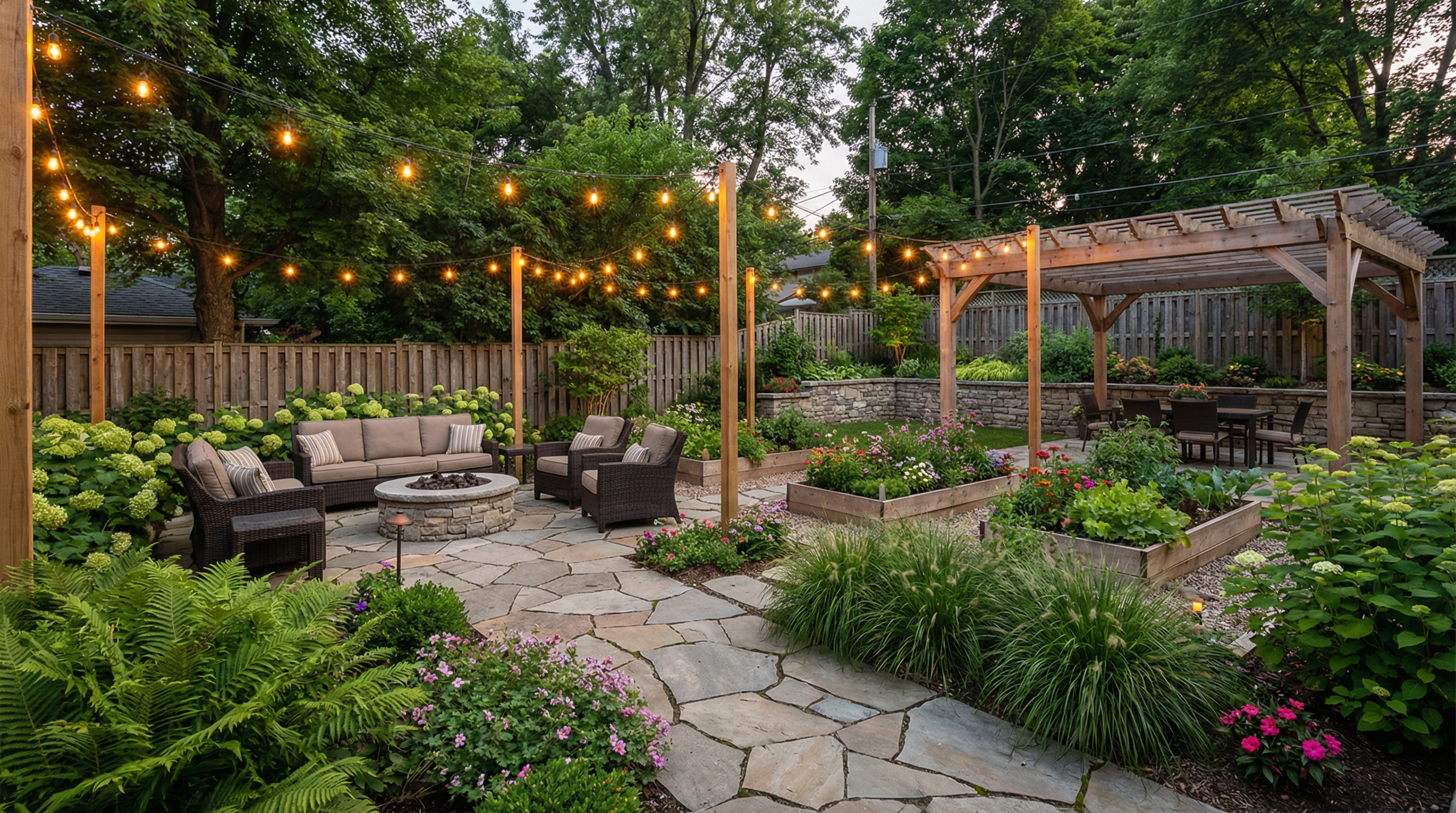
Contemporary Yard: landscape design
See more examples in the Contemporary Yard style gallery or the full design gallery.
FAQ: landscape design in Contemporary Yard style
- Contemporary garden design refers to current landscape architecture (post-2000) — clean rectilinear hardscape, large-format paving, ornamental grasses and perennials in mass, architectural specimen plants, and restrained planting palettes of 5-10 species.
- Ornamental grasses (Stipa, Calamagrostis, Miscanthus, Pennisetum), structural perennials (Echinacea, Salvia, Verbena, Eryngium), and architectural specimens (multistem birch, Phormium, Yucca, Trachycarpus). Mass plantings of 5-10 species typically anchor the design.
- The New Perennial Movement is a planting philosophy pioneered by Dutch designer Piet Oudolf starting in the 1990s. It uses large drifts of herbaceous perennials and ornamental grasses for naturalistic textural compositions, replacing traditional bedding annuals.
- Modernist gardens (mid-20th century — Church, Burle Marx, Kiley) emphasize bold geometric form, sculptural plants, and architectural clarity. Contemporary builds on that foundation but adds softer New Perennial planting, sustainable practices, and integrated water and lighting.
- Yes — many of the best contemporary gardens are small. Key moves at small scale: one large-format paved terrace, three to five grass varieties massed, one architectural specimen tree, Corten steel edging, and discreet LED uplighting.
- Large-format concrete pavers (90x90 cm or larger), board-formed in-situ concrete, sawn limestone or sandstone in large slabs, large-format porcelain pavers, and decomposed granite for informal paths. Avoid small-format brick, cobblestones, and standard 60x60 cm pavers.
- Moderate — significantly less than English cottage or formal gardens. Grasses need annual late-winter cutting back. Perennials need division every 3-4 years. Hardscape needs only occasional cleaning. Total maintenance is typically 1-2 hours per week on a 100-square-meter garden.