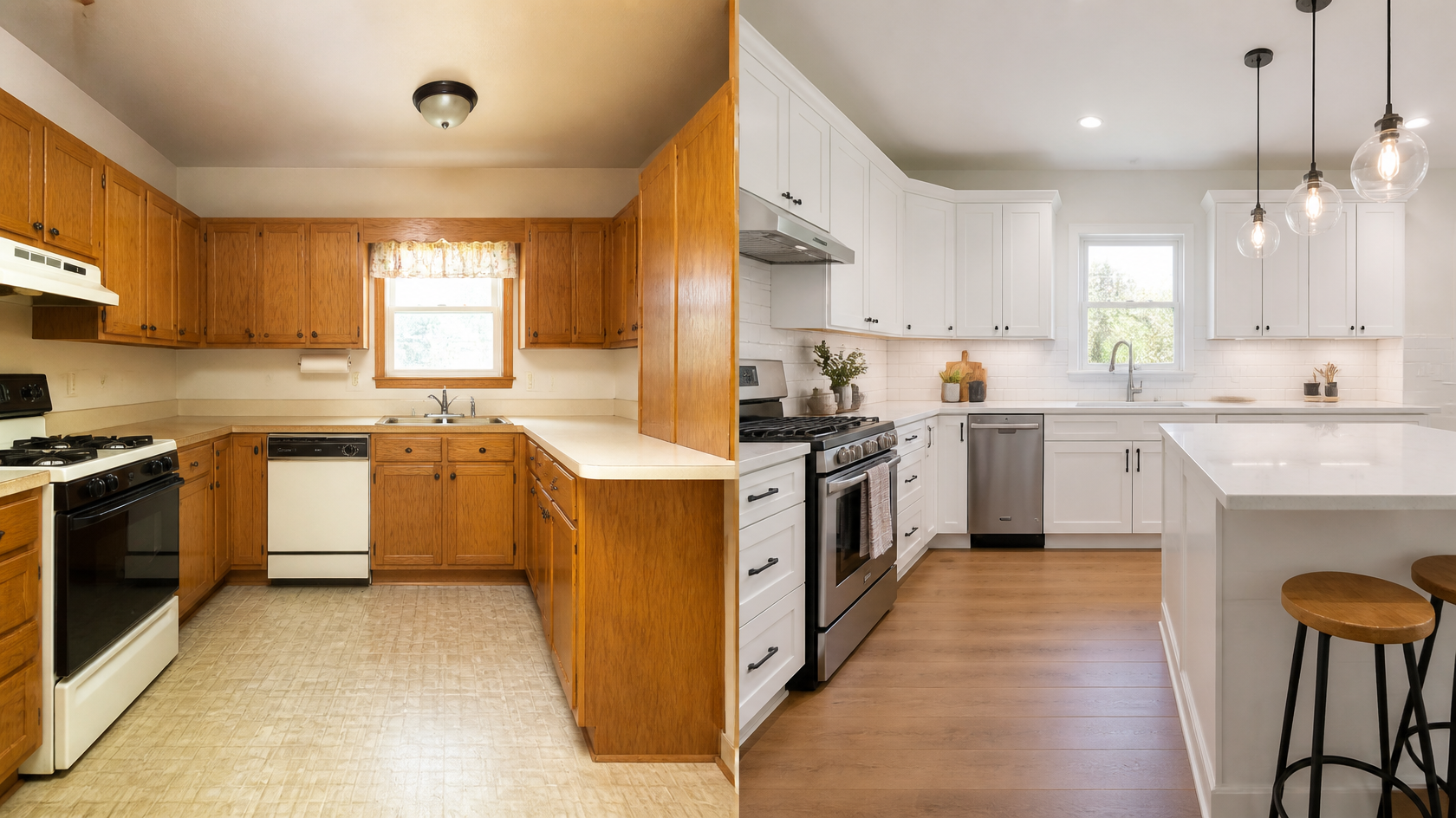
The single most common reason a flip loses money is over-improvement for the neighborhood. The flipper falls in love with the project, picks finishes they would put in their own house, and quietly inflates the budget by $20K-$40K. The buyer pool for that street caps their price at the local ceiling. The extra $30K becomes a gift to the next owner.
The fix is brutally simple:
- Comp first, design second. Pull five sold comps in the last 6 months within a half-mile. Look at the renovation level in the photos. That's your ceiling — not your starting point.
- Walk three open houses on the same street the week you close. See what's actively selling. Match the finish level, don't exceed it.
- AI-render against the comps. This is where AI tools earn their keep on the highest-stakes decisions. Generate a render that matches the comp ceiling. If you're tempted to go "just a little nicer," remember: the buyer pool doesn't pay for "just a little nicer."

A few less-obvious traps that show up in our reviews of underperforming flips:
- Skipping permits. A renovation done without required permits can be discovered at the buyer's inspection and either delay closing 30-60 days (holding cost disaster) or knock 5-10% off your sale price as a concession. Always pull the permits — even when "the inspector won't notice." They notice. Buyers' agents notice. Title companies notice.
- Ignoring the HVAC and roof. Buyers and their inspectors don't care about your new tile if the roof is 23 years old and the furnace is on borrowed time. A $400 roof inspection and a $150 HVAC inspection before purchase are the cheapest insurance in the flip business.
- Picking trendy paint colors. In 2024-2025 we saw flippers slap "earthy terracotta" or "moody navy" on entire homes following Pinterest trends. Six months later those palettes felt dated. Stick with classic warm whites, light greiges, and soft off-blacks for trim. Boring beats trendy in resale.
- Generic mass-market staging. The opposite trap of over-improvement. If every room reads as "Airbnb starter pack," the listing photos look like every other flip on the market. Use AI to subtly differentiate — a bit more personality without picking a strong style that excludes buyers.
Here's a stat every flipper should print on their office wall: staged homes sell 25% faster than unstaged ones, and according to the NAR profile of home staging, 23% of buyers' agents said staging increased the dollar value offered by 1-5%.
Physical staging costs $2,000-$5,000 per project, requires furniture rental for the duration of the listing, and only stages one look. AI virtual staging costs $15-$30 per room total, takes 60 seconds per render, and lets you stage the same room in three styles for buyers with different tastes.
For a flipper running 8-12 projects a year, that's $15,000-$50,000 in pure savings on staging alone — money that goes straight to the bottom line.

The mechanics are simpler than they sound. Using a tool like GenRoom:
- Upload one photo. Phone snapshot is fine — daytime, well-lit, wide enough to see the whole room. For exteriors, capture from the same angle you'd use for an MLS hero shot.
- Pick a style. GenRoom has 50+ interior styles plus 30+ exterior facade styles. For flip work, "Modern," "Modern Farmhouse," "Coastal" and "Transitional" cover 80% of mainstream buyer demand.
- Get the render in ~30 seconds. Photorealistic at 4K. Save the result alongside your scope notes.
- Refine with the AI editor. Don't love the cabinet color? Type "make the cabinets warmer white" and re-render. This is where pre-purchase scoping gets bulletproof.
- Repeat for every decision point. Kitchen → 4 renders. Bath → 3 renders. Facade → 3 renders. Living room → 2 renders. Total time: under an hour per property.
GenRoom's pricing starts at $9.99 for 36 credits (18 generations) — about the cost of one fancy coffee for an entire flip's worth of decision visuals. The Basic tier at $19.99 gives you 100 credits plus the AI Editor, which is the sweet spot for a flipper running one or two projects a month. Active flippers running 5+ projects use the Pro tier at $39.99 for 300 credits, 4K output, and multi-photo upload (useful for matching style across multiple rooms in the same property).
In a market where the median flip profit is $60,000 and the median ROI is 23.1%, the flippers who win in 2026 are the ones who stop guessing at scope and start visualizing every decision before they commit dollars. The Cost vs Value Report tells you which renovations make money. The 70% rule tells you what to pay. Holding costs tell you how fast to move. AI visualization tools tie all three together — and turn a five-day scope debate into a one-hour decision.
If you're flipping houses in 2026, the question isn't whether to use AI in your workflow. It's how soon. Start with one property. Render the kitchen, the primary bath, and the facade. Compare your old gut-feel scope to the visualized scope. The first $300 of margin you save will pay for an entire year of AI subscriptions — and the second flip will be cleaner, faster, and more profitable than any flip you've done without these tools. Try it free at genroom.io/generate.
Aim for 25-30% gross ROI at minimum on any deal you take down. The current market median per ATTOM is 23.1%, which means half of all flips return less than that. A 25-30% target gives you a buffer for the inevitable cost overruns and time slippage. If a deal pencils below 20% on your initial analysis, walk away — the margin will get eaten by holding costs.
The 70% rule is a starting point, not a ceiling. In thinner markets with limited inventory, experienced flippers run 72-78% MAOs, accepting tighter margins for deal flow. In softer markets or with newer flippers, 65-68% provides more cushion. Always model the actual deal: ARV minus repair minus holding minus closing minus your target profit equals MAO.
Garage door replacement at 268% ROI, per the 2025 Cost vs Value Report. Average cost $4,672, average resale value added $12,507. It's the single best dollar-for-dollar improvement a flipper can make, and it takes one day to install. Steel front door replacement at 216% ROI is a close second and pairs naturally with the garage door upgrade.
Yes, but mid-range scope only. The 2025 Cost vs Value Report shows minor kitchen remodels return 113% ($28K cost → $32K resale value added), while major upscale kitchens return just 36%. Mid-range bathroom remodels return 80%. Stick to refacing cabinets instead of replacing, quartz instead of marble, and subway tile instead of designer mosaics.
AI renders are scope tools, not construction documents. They communicate finish level, color, and layout intent — which eliminates the biggest source of bid uncertainty. Contractors still need actual measurements, materials specs and code requirements to give a binding price. Plan on the render reducing bid spread by 30-40%, not replacing the bid process.
Yes — virtual staging is now standard practice in many markets. The key is disclosing in the listing that photos are virtually staged, and using realistic AI-generated furniture (not obvious clip-art overlays). MLS rules vary by region but most allow virtual staging if disclosed. Cost: $15-$30 per room versus $2,000-$5,000 for physical staging, and you can stage the same room in multiple styles for different buyer profiles.
A common pro framework: renovation budget should not exceed 15-20% of ARV. On a $300K ARV property, that's $45K-$60K total renovation. Going above 25% of ARV pushes the project into "too much skin in the game" territory and exposes you to market risk. AI visualization lets you test scope against this budget before committing — render the property at $30K, $45K and $60K finish levels and see which one matches the local comps.
Plan on $2,500-$4,500 per month for a $250K project: hard-money interest, taxes, vacant-home insurance, utilities, lawn care. Current average days-to-flip per ATTOM is 161 days, so total holding costs typically land between $13,000-$24,000 per project. Every additional 30 days costs $2,500-$4,500 in pure friction. Speed is profit.
Only if you have a system, capital reserves, and a niche. The amateur "I watched HGTV and bought a property" flippers got washed out in 2023-2024 when rates spiked. The flippers still making money are running tight processes (often with AI tools), buying off-market, using their own crews, and specializing in specific price points and neighborhoods. If you can't do at least three of those four things, work with an experienced flipper before going solo.