Japandi Bathroom Design Ideas: 12 Real Examples (2026 Guide)
Hinoki wood, microcement walls, charred cedar and blackened steel — the bathroom of a Kyoto ryokan meets a Copenhagen flat. We unpack what makes it feel truly Japandi, then show 12 photorealistic examples you can copy.
- 12
- Real examples
- ~30s
- AI render time
- 4 free
- Credits, no card
What is Japandi Bathroom Design?
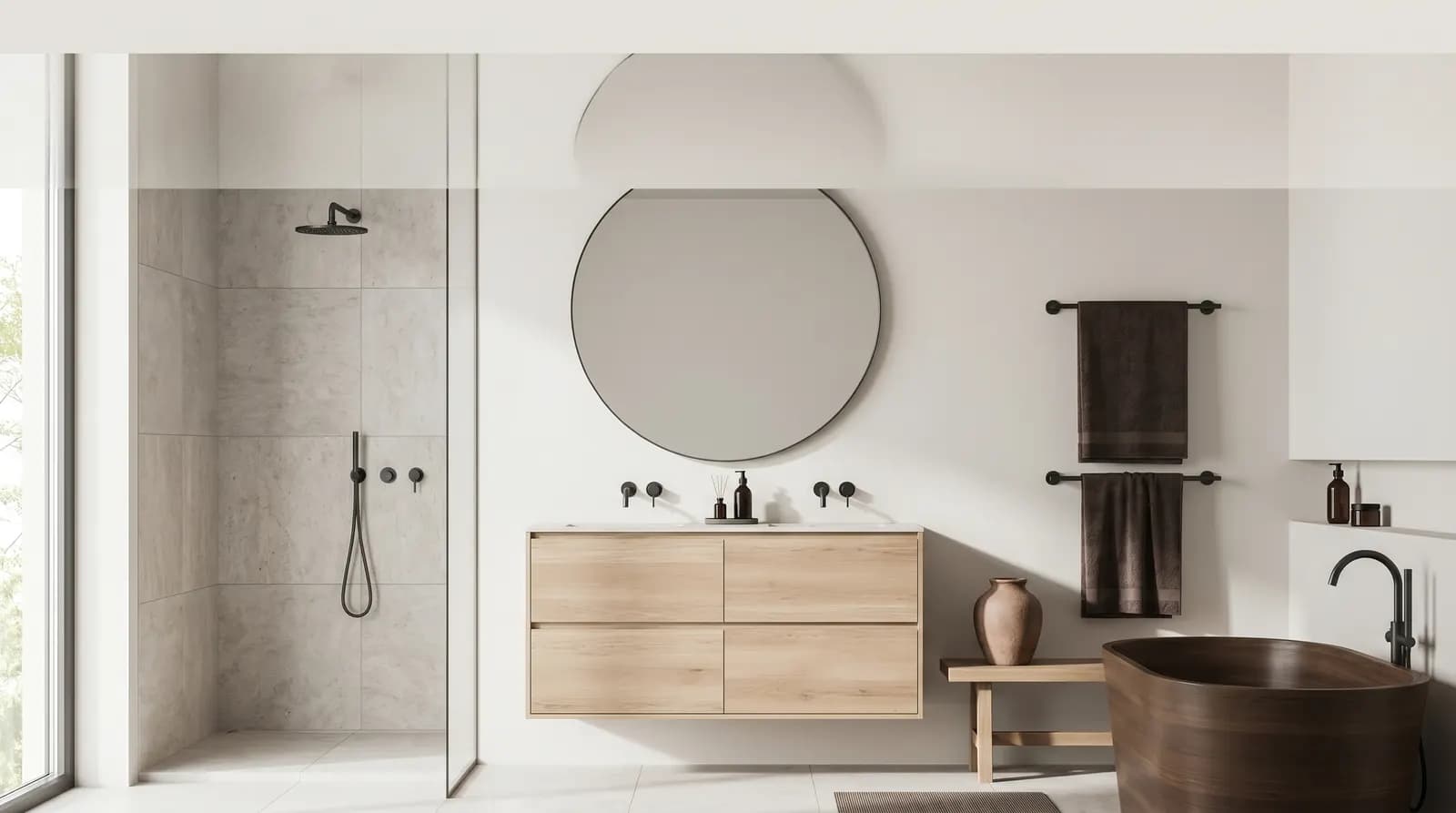
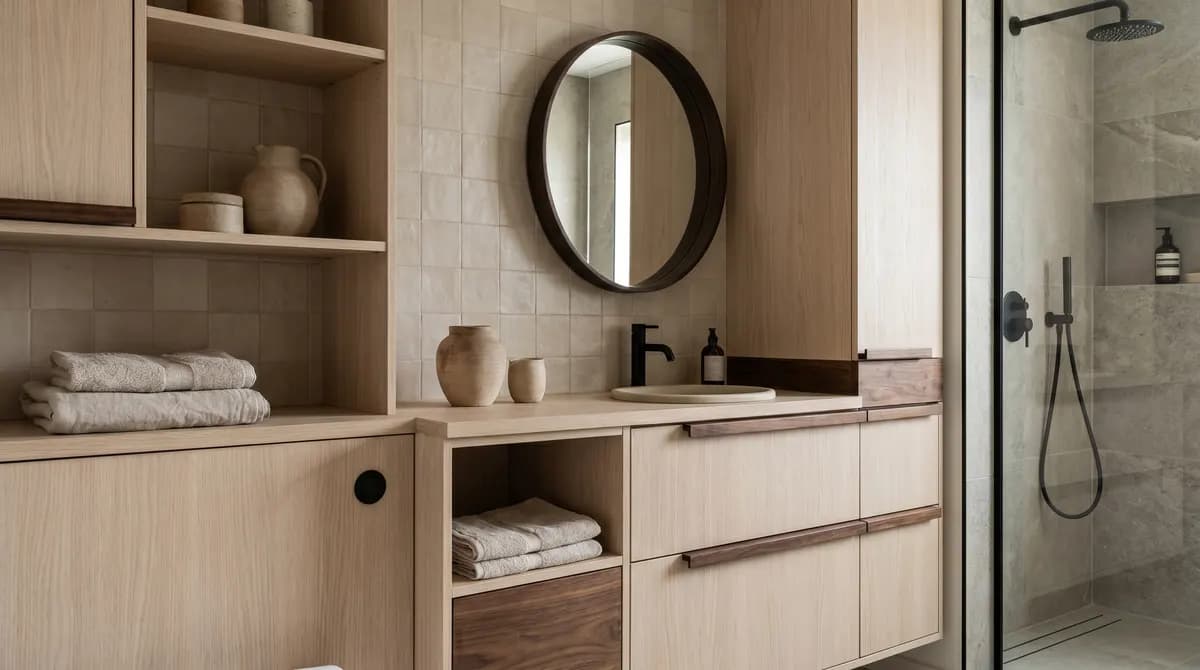
Japandi bathroom design takes the bathing rituals of Japan — the soaking tub, the wet-room shower, the wooden duckboard underfoot — and the surface palette of Scandinavia (pale plaster, oat linens, oak shelving) and folds them into a single quiet room. The result is a bathroom that smells faintly of hinoki cedar, photographs as warm rather than clinical, and treats the act of washing as a deliberate daily ritual rather than a function.
Three principles run through every authentic Japandi bathroom. First, the soaking tub: a deep, square hinoki or freestanding cast-iron tub built for sitting upright with shoulders submerged, not lounging. Second, two contrasting wood tones: pale oak or ash for vanities and shelving, charred cedar or dark walnut for one accent wall or stool. Third, blackened steel as the only metal — taps, drain covers, mirror frame and lighting all in the same matte black, never brass and never chrome.
In 2026 the look has become the default for high-end urban renovations and boutique hotels from Tokyo to Lisbon. It pairs naturally with Japandi bedrooms and Scandinavian kitchens, and unlike pure-Japanese minimalism, it accommodates Western fixtures (vanity sink, walk-in shower) without losing the calm. The single biggest functional advantage over other styles is that microcement walls eliminate grout lines, which collect mildew over time — Japandi bathrooms age more gracefully than tiled equivalents.
12 Real Japandi Bathroom Examples
Each example below is a complete look — not a mood board. Click any image to see it full-size, then hit the generate button to try the same combination on your own bathroom photo.
 1Example
 2Example
 3Example
 4Example
 5Example
 6Example
 7Example
 8Example
 9Example
 10Example
 11Example
 12Example
Key Design Elements
Colors
- Warm off-white plaster walls
- Oat and soft beige microcement
- Charred-cedar charcoal and matte black accents
- Deep walnut and burnt umber on feature walls
- Honey oak and hinoki cedar tones
Materials
- Microcement walls and floor — seamless, no grout
- Hinoki cedar for the tub and duckboards
- Charred cedar (shou sugi ban) for accent walls
- Pale oak or ash for vanity and shelving
- Blackened steel for every metal fitting
Furniture
- Floating oak vanity, wall-hung with a reveal at the floor
- Hinoki soaking tub, square or oval
- Low charred-cedar stool for towels or seating
- Recessed oak niche replacing a medicine cabinet
- Wall-hung oval mirror in blackened-steel frame
Lighting
- Washi paper sconces flanking the mirror
- Single window or skylight for daylight
- Warm 2700 K LED strip in the tub niche
- Blackened-steel downlight, dimmed to 30 percent
- A single beeswax candle on the tub ledge
Textiles
- Stonewashed linen waffle bath towels in oat
- Hand-loomed cotton bath mat in oat and charcoal
- Linen shower curtain or none if wet room
- Charcoal-grey hand towel on a blackened-steel ring
- Stoneware soap dish and ceramic toothbrush cup
Japandi Bathroom Color Palette
Six pigments do most of the work — start here, then add one accent of your own.
The chalky off-white for the ceiling and any plaster trim. Warmer than pure white so the oak and hinoki do not read yellow.
The dominant wall and floor microcement tone. A quiet warm neutral that flatters skin and lets the dark accents speak.
Charred cedar accent walls, blackened-steel fittings, the strip of shadow under the floating vanity. The deep accent the room is composed against.
An optional deeper wood tone for a single stool, the back of the niche or the edge of the vanity. Brings the Japanese half of the equation forward.
The honey-pale tone of Japanese hinoki cedar. Lives on the tub, the duckboards and any visible wet-room timber. Slightly pinker than oak.
A muted earthy brown for a single ceramic — the soap dish, the toothbrush cup, a small vase on the niche. The handmade craft note.
Must-Have Furniture & Fixtures
If you only specify these seven, the room will read as authentically Japandi.
Hinoki soaking tub
A deep square or oval Japanese soaking tub in solid hinoki cedar. Or, where authentic hinoki is impractical, a freestanding cast-iron tub with a matte black exterior. The single most important specification in the room.
Microcement walls
Hand-troweled microcement in soft oat, applied seamlessly across all wet walls and the floor. No grout, no tile lines, slightly mottled — the same continuous surface from shower to vanity.
Floating oak vanity
Wall-hung pale-oak vanity with a single drawer, mounted with a 15–20 cm reveal at the floor so the microcement reads continuously. Skip raised legs and skip dark-stained veneers.
Blackened steel fittings
Every metal in the room — tap, drain, shower head, towel ring, mirror frame and light fittings — in the same matte blackened steel. Consistency is what makes the discipline read.
Charred cedar accent
One shou-sugi-ban accent — a single wall behind the tub, the back of the niche, or a low stool. The Japanese half of the equation, used in exactly one place.
Recessed oak niche
A single recessed niche in pale oak, cut into the shower or tub wall. Stores three rolled waffle linen towels, a sea sponge and one stoneware bottle of soap. Replaces a wall cabinet.
Washi paper sconces
Two washi paper wall sconces flanking the mirror, throwing diffused warm light onto the face. The single piece of lighting that pushes the room from Scandinavian into Japandi.
Common Mistakes to Avoid
Defaulting to white subway tile — the cheapest interpretation of the look. Specify microcement or honed limestone for a seamless, grout-free surface; subway tile is Farmhouse, not Japandi.
Brass or chrome fittings — both kill the discipline instantly. Japandi is blackened steel, full stop. Brass is Mediterranean; chrome is hotel-generic.
Acrylic Japanese-style tub — the cheap import lookalike with moulded grain. Either source genuine hinoki cedar, or use a freestanding matte-black cast-iron tub. Acrylic always shows up in photographs.
Cool 4000 K LED downlights — they make microcement look grey and hinoki look orange. Specify 2700 K throughout, with washi sconces at the mirror as the main task light.
Too many wood tones — pale oak, walnut, hinoki and teak in the same room is chaos. Pick one pale wood (oak or hinoki) and at most one dark accent (charred cedar or walnut) and stop.
Try Japandi Bathroom in Your Own Room
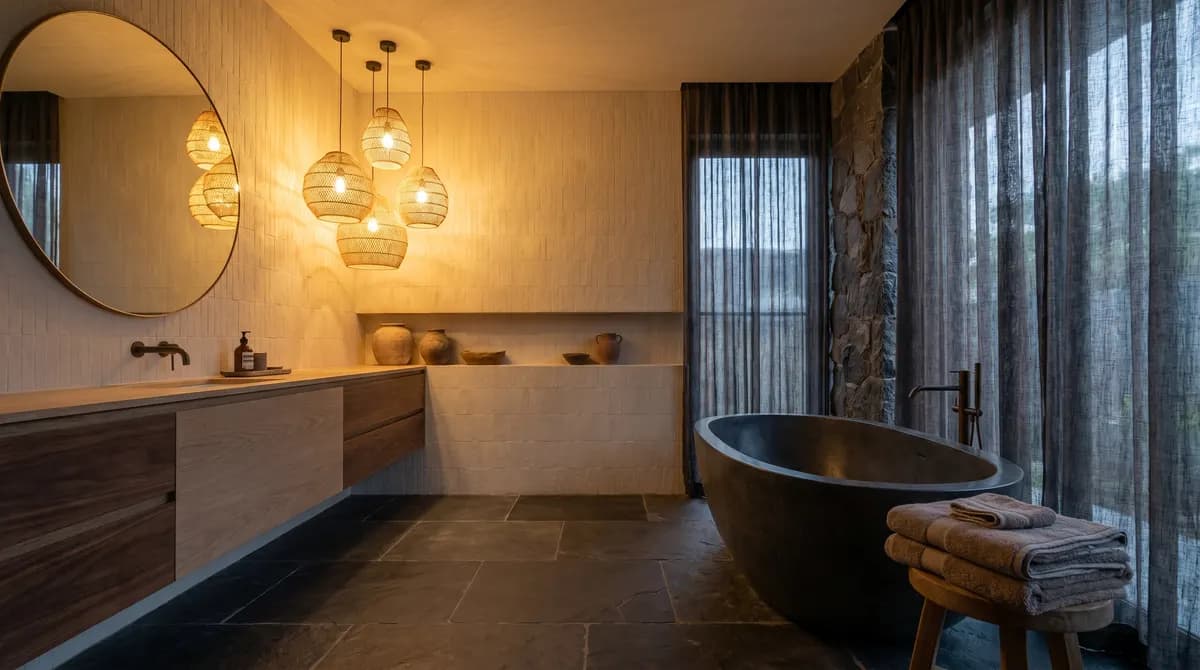
Upload a photo of your real bathroom. Get a photorealistic Japandi redesign in about 30 seconds. 4 free credits, no card.
Generate Your Japandi Bathroom FreeOther Japandi Rooms
Apply the same palette and principles to the rest of the home.


Other Bathroom Styles
Same room, different aesthetic — explore the rest of the bathroom style library.


Japandi Bathroom — Frequently Asked Questions
Is a hinoki tub practical in daily use?
Is microcement really waterproof?
What about ventilation with so much wood?
What lighting works in a Japandi bathroom?
How is Japandi different from Scandinavian for a bathroom?
Can Japandi work in a small bathroom?
How to Design a Japandi Bathroom
Five decisions, in this order. Skip any of them and the look will not land.
- 1
Choose your wet-wall material
Microcement is the canonical specification — seamless, mottled, no grout. Honed limestone or large-format honed travertine are acceptable alternatives. Hand-troweled tadelakt drifts into Mediterranean territory. Whichever you choose, commit to it everywhere: shower walls, splashback and ideally the floor. Mixing two wet-wall materials on the same wall is the fastest way to look amateur.
- 2
Pick the soaking-tub strategy
Option A: a genuine hinoki cedar Japanese soaking tub — most authentic, most expensive, demands ventilation and aftercare. Option B: a freestanding matte-black cast-iron tub — Western plumbing, easier to source, almost as photogenic. Option C: a curbless walk-in wet room with a hinoki duckboard underfoot — best for small flats. Pick one of the three; trying to combine a soaking tub plus a separate walk-in shower in a small space breaks the calm.
- 3
Commit to blackened steel
Every metal in the room — tap, drain cover, shower head, towel ring, mirror frame, light fittings, even the visible switch plates — in the same matte blackened steel. Confirm with each supplier that the finish matches; black-ish chrome and black-painted chrome look wrong next to genuine blackened steel. Consistency at this level is what reads as deliberate rather than accidental.
- 4
Add the charred-cedar accent
Choose one shou-sugi-ban moment — a feature wall behind the tub, the back of the recessed niche, or a low stool by the shower. One only. Two charred-cedar moments overpower the room and tip into Wabi-Sabi or maximalist Japanese. The accent is what stops the bathroom from reading purely Scandinavian.
- 5
Style with one craft vignette
Three rolled waffle linen towels in the oak niche, one stoneware soap dish on the vanity, one ceramic toothbrush cup, one trailing plant in a clay pot, and a single beeswax candle on the tub ledge. Stop there. Japandi is the discipline of empty surfaces; if you would not photograph it, it does not stay on the counter.
Keep Exploring
Tools and guides that pair with this style.