Wabi-Sabi Home Office Design Ideas: 12 Real Examples (2026 Guide)
Lime-plaster walls, a walnut slab desk, a hand-thrown clay vessel by the lamp — the wabi-sabi home office is the quietest workplace you will ever sit at. We unpack the rules, then show 12 photorealistic examples.
- 12
- Real examples
- ~30s
- AI render time
- 4 free
- Credits, no card
What is Wabi-Sabi Home Office Design?
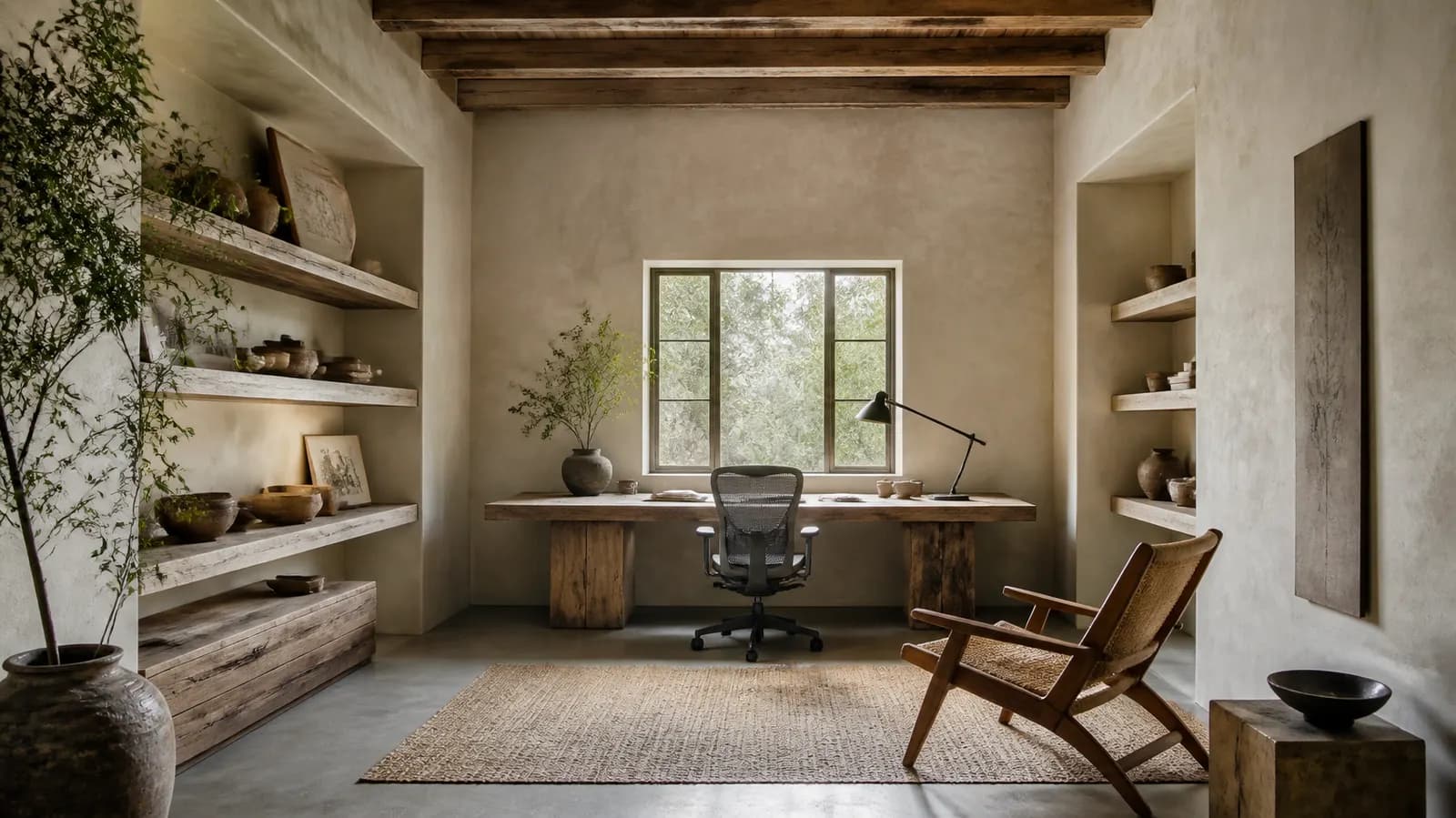
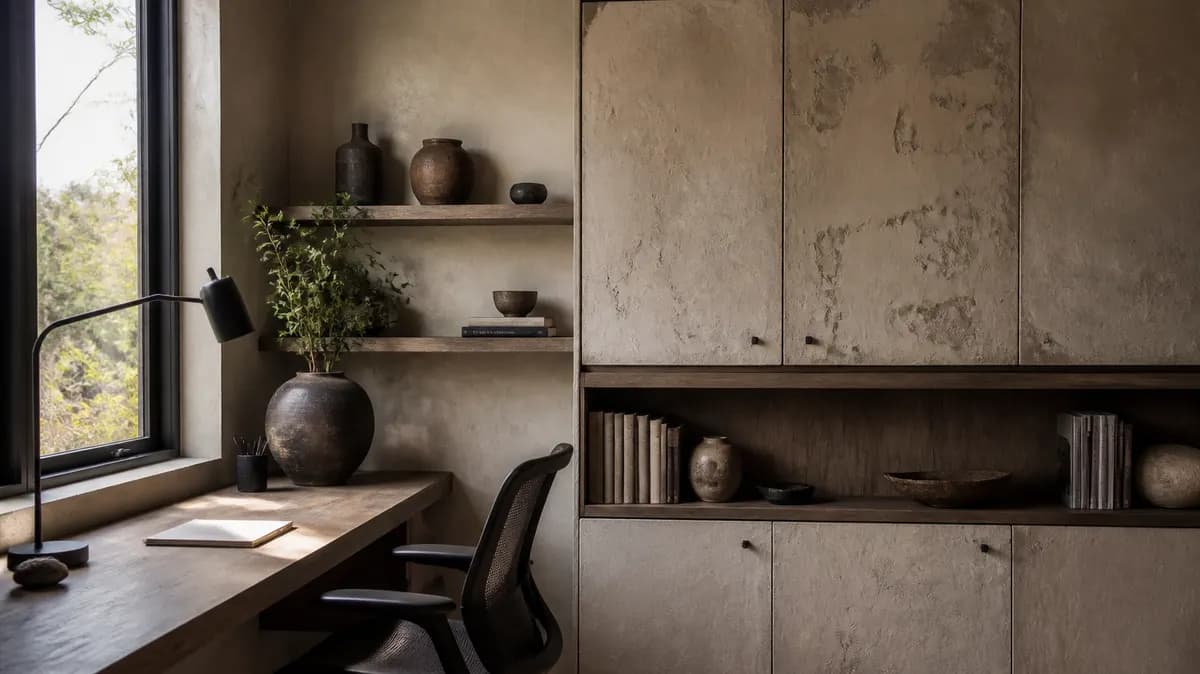
The wabi-sabi home office is the workplace built on the assumption that quiet, slow-paced, hand-made surroundings produce better thinking than a screen-and-glass workstation. Walls are hand-trowelled lime plaster rather than painted drywall; the desk is a single thick slab of walnut, oak or elm with the live edge preserved; the chair is a low solid-wood piece with a hand-loomed linen cushion; the lamp is a hand-thrown ceramic with a linen shade. The room rejects the chrome-and-mesh aesthetic of the modern co-working office in favour of a hand-finished, monastic workspace.
Three principles guide an authentic wabi-sabi home office. First, plaster instead of paint: at least one wall in lime plaster or tadelakt, ideally three. Second, the live-edge slab desk as a hero piece — usually placed asymmetrically rather than perfectly centred against a wall. Third, the discipline of subtraction: one lamp, one ceramic vessel, one notebook, one fountain pen, one book. Everything else is hidden in a closed credenza. The room photographs as a Zen master's reading room rather than as an office.
In 2026 the wabi-sabi home office has become the quiet status workspace of choice for writers, designers and senior remote workers who reject the open-plan co-working aesthetic. It pairs naturally with Japandi (which adds Scandinavian craft), with rustic (which shares the heavy wood) and with modern architecture (against which the soft plaster reads as deliberate counterpoint). The throughline is always plaster instead of paint, a slab desk instead of a parsons table, a ceramic lamp instead of a metal one and lighting warm enough that a 10 PM session feels like a privilege.
12 Real Wabi-Sabi Home Office Examples
Each example below is a complete look — not a mood board. Click any image to see it full-size, then hit the generate button to try the same combination on your own room photo.
 1Example
 2Example
 3Example
 4Example
 5Example
 6Example
 7Example
 8Example
 9Example
 10Example
 11Example
 12Example
Key Design Elements
Colors
- Bone white and warm off-white plaster walls
- Raw clay and warm sand accent walls
- Weathered walnut and aged oak furniture
- Charcoal and ink-black strict accents
- Stone grey and oatmeal linen
Materials
- Hand-trowelled lime plaster or tadelakt walls
- Live-edge walnut, oak or elm slab desk
- Hand-thrown stoneware and raku ceramics
- Stonewashed linen and undyed wool
- Hand-forged iron and aged brass for hardware
Furniture
- Live-edge slab desk on hand-forged iron base
- Low solid-wood chair or hand-caned task chair
- Built-in low credenza in weathered walnut
- Floating wood shelf for books and ceramics
- Reading bench under the window
Lighting
- Hand-thrown ceramic table lamp with linen shade
- Paper-shade pendant on a dimmer overhead
- Recessed niche light grazing the plaster wall
- Layered warm-white sources at 2700 K
- Single beeswax candle for late-night sessions
Textiles
- Stonewashed linen Roman shade on the window
- Woven jute or undyed wool rug under the desk
- Hand-loomed linen cushion on the desk chair
- Sheepskin on the reading bench
- Hand-thrown stoneware as tactile counterpoint
Wabi-Sabi Home Office Color Palette
Six pigments do most of the work — start here, then add one accent of your own.
The base white for plaster walls — warm, slightly grey, never bright. Looks alive in the soft pool of a hand-thrown ceramic lamp.
The signature accent — a tadelakt accent wall or a hand-thrown vessel on the credenza. Adds depth without sweetness or warmth excess.
The hero wood for the live-edge desk and credenza. Medium-dark brown with knots and saw marks visible — hardwax oil, never lacquered.
The strict accent — an ink scroll, the rim of a raku vessel, an iron candle holder. Used sparingly, almost as punctuation.
The ceramics colour — lamp base, the centrepiece vessel on the credenza, a small dish for paper clips. Used in small to medium doses.
Raw linen shade, woven jute rug, a hand-thrown grey ink stone. Grounds the palette and gives the eye a quiet middle tone.
Must-Have Furniture & Fixtures
If you only buy these seven, you will read as authentically wabi-sabi.
Live-edge slab desk
Walnut, oak or elm slab, 160–200 cm wide, with live edge preserved on at least one side. Hand-forged iron base, hardwax oil finish.
Hand-thrown ceramic lamp
Single ceramic table lamp with raw-clay or stoneware base, linen drum shade, 2700 K LED bulb. The single most photographable object in the room.
Hand-trowelled plaster walls
Lime plaster or tadelakt on every wall, hand-applied to leave visible movement. The single biggest surface decision in the room.
Weathered-walnut credenza
Low long sideboard in weathered walnut with slab doors, holding closed storage. Topped with one or two raw-clay vessels and a small ink scroll.
Floating wood shelf
A single thick slab of solid wood, mounted asymmetrically on one wall, holding three or four worn books and one hand-thrown stoneware piece.
Low task chair
Solid-wood chair with a hand-loomed linen cushion, or a real ergonomic chair upholstered in oatmeal linen. No mesh, no plastic, no chrome.
One ceramic vessel and one branch
Single hand-thrown raw-clay vessel on the credenza or floor, holding a fig, persimmon, plum or eucalyptus branch. The room's only styling beyond the desk.
Common Mistakes to Avoid
Mesh task chair as the only seating — the modern ergonomic mesh chair kills the wabi-sabi read instantly. Choose a real solid-wood chair or a high-end ergonomic chair upholstered in linen.
Visible cable spaghetti — monitor cables on top of a slab desk break the look. Run all wiring through a grommet hidden under a leather desk pad, or drill through the back edge.
Painted drywall instead of plaster — flat acrylic walls cannot carry the look. Lime plaster, tadelakt or at minimum a high-quality lime-effect paint on at least one wall.
Cool overhead light — a single 4000 K LED panel kills the mood. Use a ceramic lamp, a paper pendant on a dimmer, and a single candle for late sessions. Every bulb at 2700 K.
Maximalist shelf styling — a row of books interspersed with twelve objects breaks the discipline. Three to five objects per shelf, with deliberate empty space between them.
Try Wabi-Sabi Home Office in Your Own Room
Upload a photo of your real home office. Get a photorealistic wabi-sabi redesign in about 30 seconds. 4 free credits, no card.
Generate Your Wabi-Sabi Home Office FreeOther Wabi-Sabi Rooms
Apply the same palette and principles to the rest of the home.


Other Home Office Styles
Same room, different aesthetic — explore the rest of the office style library.


Wabi-Sabi Home Office — Frequently Asked Questions
What colors define wabi-sabi home office design?
Can a wabi-sabi office be ergonomically modern?
How do I hide cables in a wabi-sabi office?
What flooring works for a wabi-sabi home office?
How is wabi-sabi different from Japandi in a home office?
Is wabi-sabi home office good for a small spare room?
How to Design a Wabi-Sabi Home Office
Five decisions, in this order. Skip any of them and the look will not land.
- 1
Plaster the walls
Hand-trowelled lime plaster or tadelakt on every wall. This is the single most important decision in the room. Flat painted drywall, no matter how good the furniture choice, cannot carry the wabi-sabi read. If budget is tight, do one wall in tadelakt and the rest in high-quality lime-effect paint.
- 2
Buy the live-edge slab desk
Walnut, oak or elm slab, 160–200 cm wide, with live edge preserved on at least one side, on a hand-forged iron base or heavy timber legs. Hardwax oil finish. This is the second most important purchase. Place it asymmetrically — not perfectly centred against a wall — to honour the fukinsei principle.
- 3
Choose the chair — wood or linen-clad ergonomic
Solid-wood chair with a hand-loomed linen cushion for the photographic ideal, or a real ergonomic chair upholstered in oatmeal linen for daily comfort. No mesh, no plastic, no chrome. The chair must look like it could belong in a Japanese tea house, not a Silicon Valley office.
- 4
Layer warm, low lighting
Hand-thrown ceramic table lamp on the desk with a linen shade. Paper-shade pendant on a dimmer overhead. Optional ceramic sconce by the reading bench. One beeswax candle for late-night work. Every bulb at 2700 K. The room should dim from afternoon bright to single-candle low without ever exposing a cool LED.
- 5
Style the credenza and the shelf
On the desk: one fountain pen on a small leather tray, one notebook, one ceramic ink stone or paper-clip dish, one small clay vessel with a single branch. On the credenza: one large raw-clay vessel and one framed ink scroll. On the floating shelf: three or four worn books and one hand-thrown stoneware piece. Resist filling. Empty space is the design.
Keep Exploring
Tools and guides that pair with this style.