Scandinavian Dining Room Design Ideas: 12 Real Examples (2026 Guide)
A light oak table, six Wegner-style chairs, a single paper pendant, white walls, beeswax candles for evening hygge — the Scandinavian dining room is engineered for long, slow meals during long Nordic winters. We unpack what makes it work, then show 12 photorealistic examples you can replicate.
- 12
- Real examples
- ~30s
- AI render time
- 4 free
- Credits, no card
What is Scandinavian Dining Room Design?
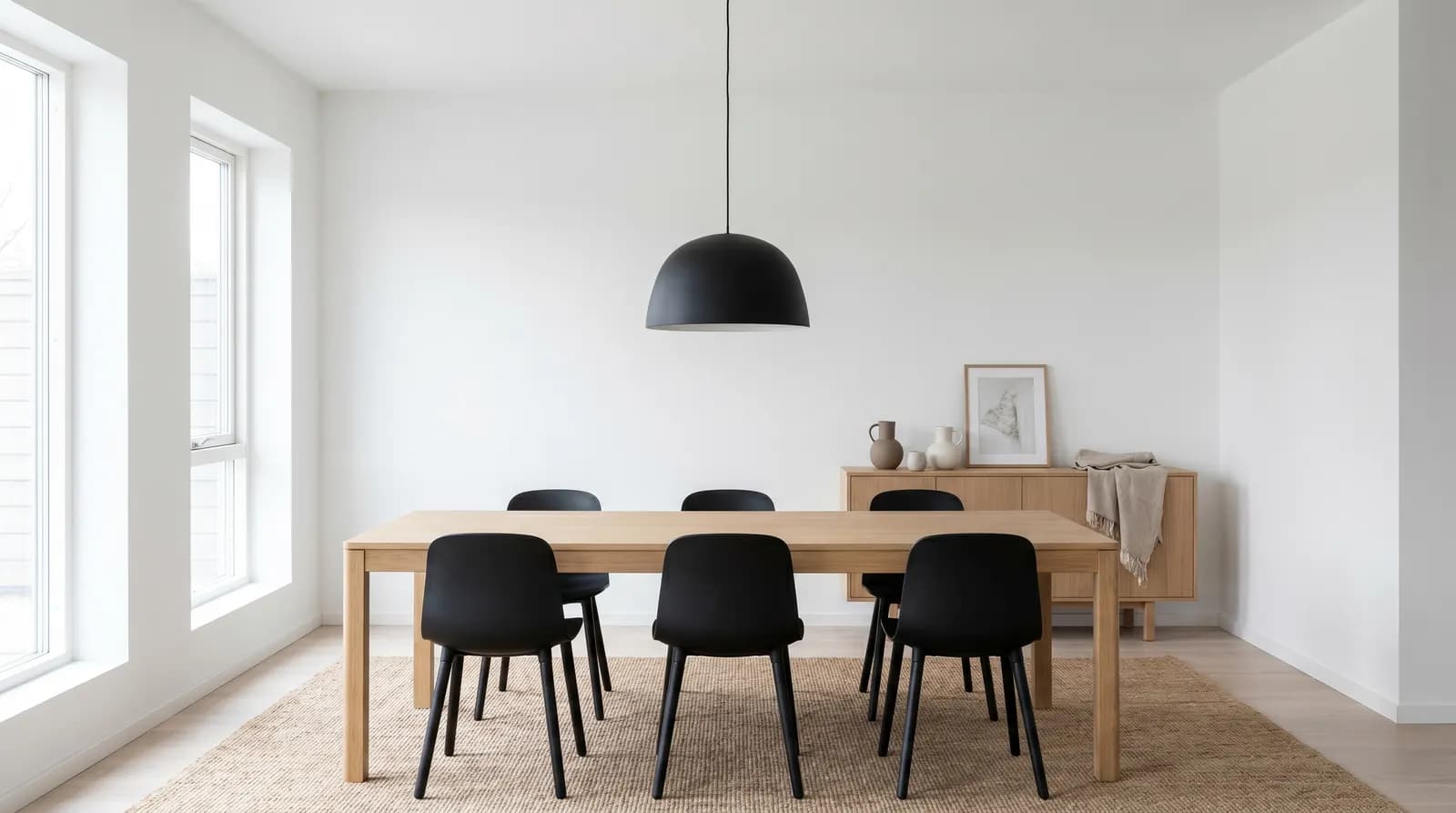
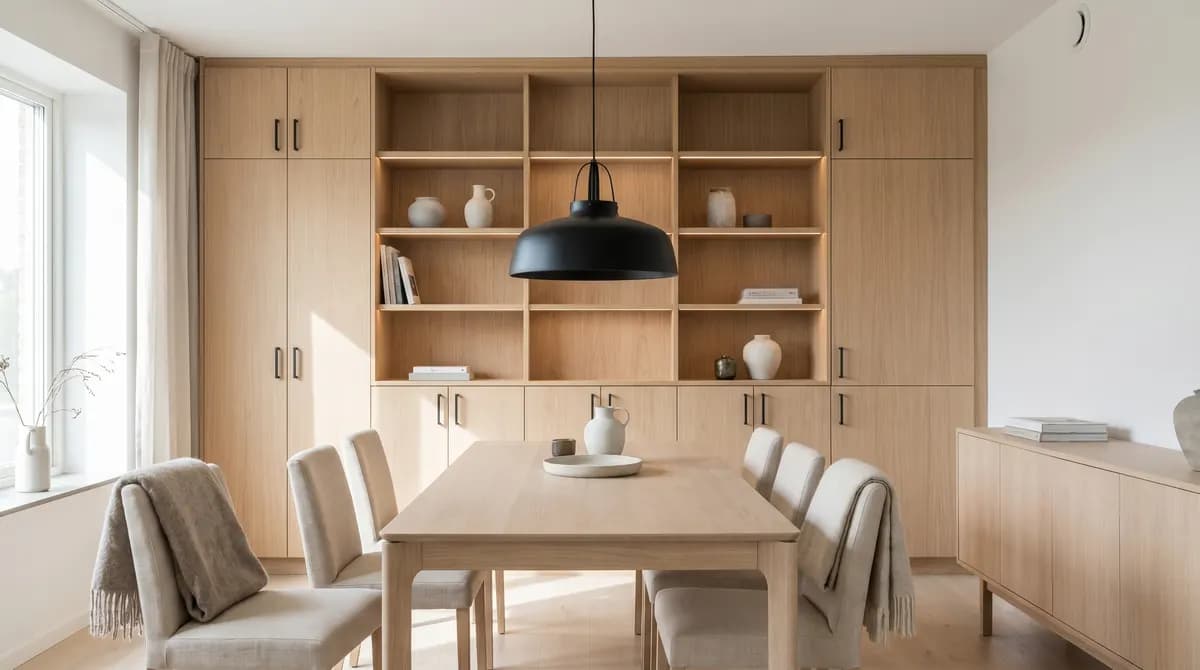
Scandinavian dining room design treats the dining table as the social centre of the home. There are no formal sideboards groaning with china, no chandelier crystals, no elaborate centrepieces. There is one solid light oak table, six matching wood-and-cane chairs from the post-war Danish modern tradition (Wegner CH24, Y-chair or honest equivalents), a single paper-shade pendant overhead, and walls in pure white. The room is built around the act of sharing food, not the act of impressing visitors.
Three principles run through every authentic Scandinavian dining room. First, the chair is the hero: the room is named for the chair. Wegner, Mogensen, Juhl — these designers built dining chairs as architectural objects, and the room defers to them. Second, paper diffusion: the pendant is a paper or rice-paper sphere or globe that glows rather than projects, providing the warm centre for evening meals. Third, hygge in the table set, restraint in the room: linen runners, stoneware ceramics, a single beeswax candle in a brass holder — the warmth lives on the table, not on the walls.
In 2026 the Scandinavian dining room is the dominant aesthetic in well-curated apartments across northern Europe and increasingly in North American open-plan kitchens. It pairs naturally with Japandi (darker chairs), Modern (more material restraint) and Coastal (lighter palette), and is the safest single style to commit to when the dining zone sits inside an open-plan kitchen-living space because it bridges the kitchen's pale oak with the living room's soft textiles. We treat it as the canonical reference point for the dining Style × Room series.
12 Real Scandinavian Dining Room Examples
Each example below is a complete look — not a mood board. Click any image to see it full-size, then hit the generate button to try the same combination on your own room photo.
 1Example
 2Example
 3Example
 4Example
 5Example
 6Example
 7Example
 8Example
 9Example
 10Example
 11Example
 12Example
Key Design Elements
Colors
- Pure white walls
- Light beige linen for runner and napkins
- Soft grey stoneware ceramics
- Matte black or unlacquered brass on the candleholder
- Honey wood tone — oak, ash or birch
Materials
- Light oak — the dominant wood for table and chairs
- Paper-cord or rattan cane on the chair seats
- Heavy washed linen on runners and napkins
- Rice-paper for the pendant shade
- Stoneware ceramic for serving
Furniture
- Solid pale oak rectangular dining table
- Six matching Wegner-style oak chairs with paper-cord seats
- Optional low oak sideboard or built-in console
- Single bench on one wall for compact layouts
- One simple wooden stool as side table
Lighting
- Single paper-shade pendant centred over the table
- Beeswax candles on the table for evening hygge
- Wall sconces flanking the sideboard if present
- Floor-to-ceiling windows wherever possible
- Every fixture dimmable, 2700 K only
Textiles
- Heavy linen runner in oat or stone
- Linen napkins matching the runner
- Single flat-weave wool rug under the table
- Sheepskin draped on the bench if present
- Stoneware ceramics for textural contrast
Scandinavian Dining Room Color Palette
Six pigments do most of the work — start here, then add one accent of your own.
The base white for walls and ceiling. Cleaner than warm whites, it makes oak look honey-coloured rather than yellow.
A creamy off-white for trim and a softer sideboard alternative. Avoids the clinical feel pure white can have in north-facing rooms.
Used on linen runners, napkins and curtains. Adds a quiet undertone that makes the room feel warm rather than minimal.
Stoneware ceramics, the rug and any concrete surface. The grounding mid-tone that keeps the palette from floating.
The strict accent — matte black hardware, a brass candleholder darkened to charcoal, and a single piece of framed art. Used sparingly.
White oak or ash — the hero of the palette. Repeated on the table, six chairs, the sideboard and any open shelving.
Must-Have Furniture & Fixtures
If you only buy these seven, you will read as authentically Scandinavian.
Solid light oak table
Rectangular, 200–240 cm long, solid white oak or ash, with a wood frame or trestle leg. No glass, no stone, no painted finish.
Six Wegner-style chairs
Wegner CH24 (Y-chair), Wegner CH88, Mogensen J39 or any honest reissue or knock-off in matching oak with paper-cord or rattan seats.
Paper-shade pendant
Single rice-paper sphere (Noguchi, IKEA Regolit or honest equivalent), 60–80 cm diameter, hung 75–80 cm above the table top. Dimmable, 2700 K.
Linen table runner
Heavy washed linen runner in oat or stone, 50 cm wide, running the full length of the table. Replaces the need for a tablecloth.
Brass candleholder with beeswax taper
Single unlacquered brass holder or a row of three identical holders down the runner, with natural beeswax tapers in cream or oat.
Optional low sideboard
Solid oak sideboard at chair-rail height with handleless or simple wood-knob doors. Houses serveware and a stack of linen napkins.
Single flat-weave wool rug
Low-pile wool rug in oat or stone, extending at least 60 cm beyond the table on every side so chairs stay on the rug when pulled out.
Common Mistakes to Avoid
Glossy lacquered table — a high-gloss white or black table belongs to modern or contemporary styles, not Scandinavian. The table must be solid oak or ash with a matte oil or wax finish that shows the grain.
Mismatched chairs — six chairs in different styles reads as eclectic, not Scandinavian. Scandinavian dining is the discipline of matching: identical Wegner-style chair, identical finish, identical seat material.
Crystal chandelier — anything with cut crystal, gold leaf or layered tiers breaks the Scandinavian envelope. The pendant must be a single paper or rice-paper sphere that diffuses rather than sparkles.
No textile on the table — a bare oak table reads as minimalist, not Scandinavian. Always a heavy linen runner, even between meals, with at least one stoneware bowl or carafe sitting on it.
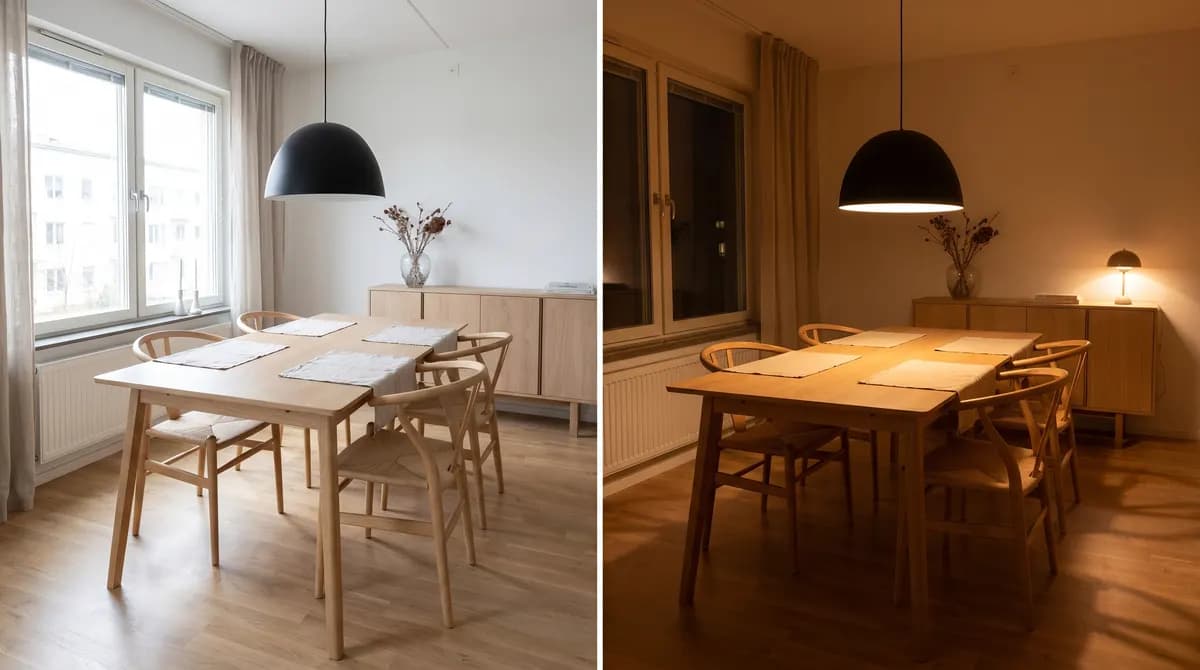
Bright overhead light — a single ceiling pendant in cool white floods the table and kills the hygge. Use a paper-shade pendant on a dimmer at 2700 K, and add beeswax candles for the evening layer.
Try Scandinavian Dining Room in Your Own Room
Upload a photo of your real dining room. Get a photorealistic Scandinavian redesign in about 30 seconds. 4 free credits, no card.
Generate Your Scandinavian Dining Room FreeOther Scandinavian Rooms
Apply the same palette and principles to the rest of the home.


Other Dining Room Styles
Same room, different aesthetic — explore the rest of the dining-room style library.


Scandinavian Dining Room — Frequently Asked Questions
What colors define a Scandinavian dining room?
Do all the chairs need to be the same in a Scandinavian dining room?
What pendant works for a Scandinavian dining room?
What flooring works under a Scandinavian dining table?
How is Scandinavian different from mid-century modern in a dining room?
Is a Scandinavian dining room good for small or open-plan spaces?
How to Design a Scandinavian Dining Room
Five decisions, in this order. Skip any of them and the look will not land.
- 1
Pick the chair first
Counter-intuitively, the chair is the single most consequential decision in a Scandinavian dining room. Wegner CH24, Mogensen J39 or any honest reissue in pale oak with a paper-cord or rattan seat. Buy six of them, matched. The table and the pendant are then sized to defer to the chair.
- 2
Choose the table and the pendant
Solid pale oak rectangular table, 200–240 cm long, matte oil finish, with a wood frame or trestle leg. Single paper-shade pendant overhead, 60–80 cm diameter, hung 75–80 cm above the table top, dimmable, 2700 K. The pendant centred over the table — never over the geometric centre of the room.
- 3
Frame the room with white walls and one piece of art
Pure white walls and ceiling. On the long wall behind the table, install one piece of art — a contemporary print, an abstract canvas, or a black-and-white photograph — framed in matte black, sized to roughly two-thirds the table length. That is the only thing on its wall. Linen curtains on the window, ceiling-track, pooling 2 cm on the floor.
- 4
Layer two kinds of warm light
The paper pendant provides the architectural warm centre. Between meals, two beeswax tapers in matte black or unlacquered brass holders sit on the runner; during evening meals, the tapers are lit and the pendant is dimmed to roughly 30%. If the room has a sideboard, add one wall sconce above it at 2700 K on a dimmer. Never a row of recessed downlights.
- 5
Add hygge to the table set
Heavy linen runner in oat or stone running the full length of the table, with matching linen napkins. Three stoneware bowls, one stoneware carafe, two brass candleholders with beeswax tapers. One single live stem in a stoneware vase. This is the hygge layer that separates a real Scandinavian dining room from a minimalist showroom — the architecture is restrained, the table set is generous.
Keep Exploring
Tools and guides that pair with this style.