Traditional Living Room Design Ideas: 12 Real Examples (2026 Guide)
Rolled-arm sofas, panelled walls, navy and cream — the traditional living room is the room you inherited from a smarter aunt and finally know how to keep. We unpack the rules, then show 12 photorealistic examples.
- 12
- Real examples
- ~30s
- AI render time
- 4 free
- Credits, no card
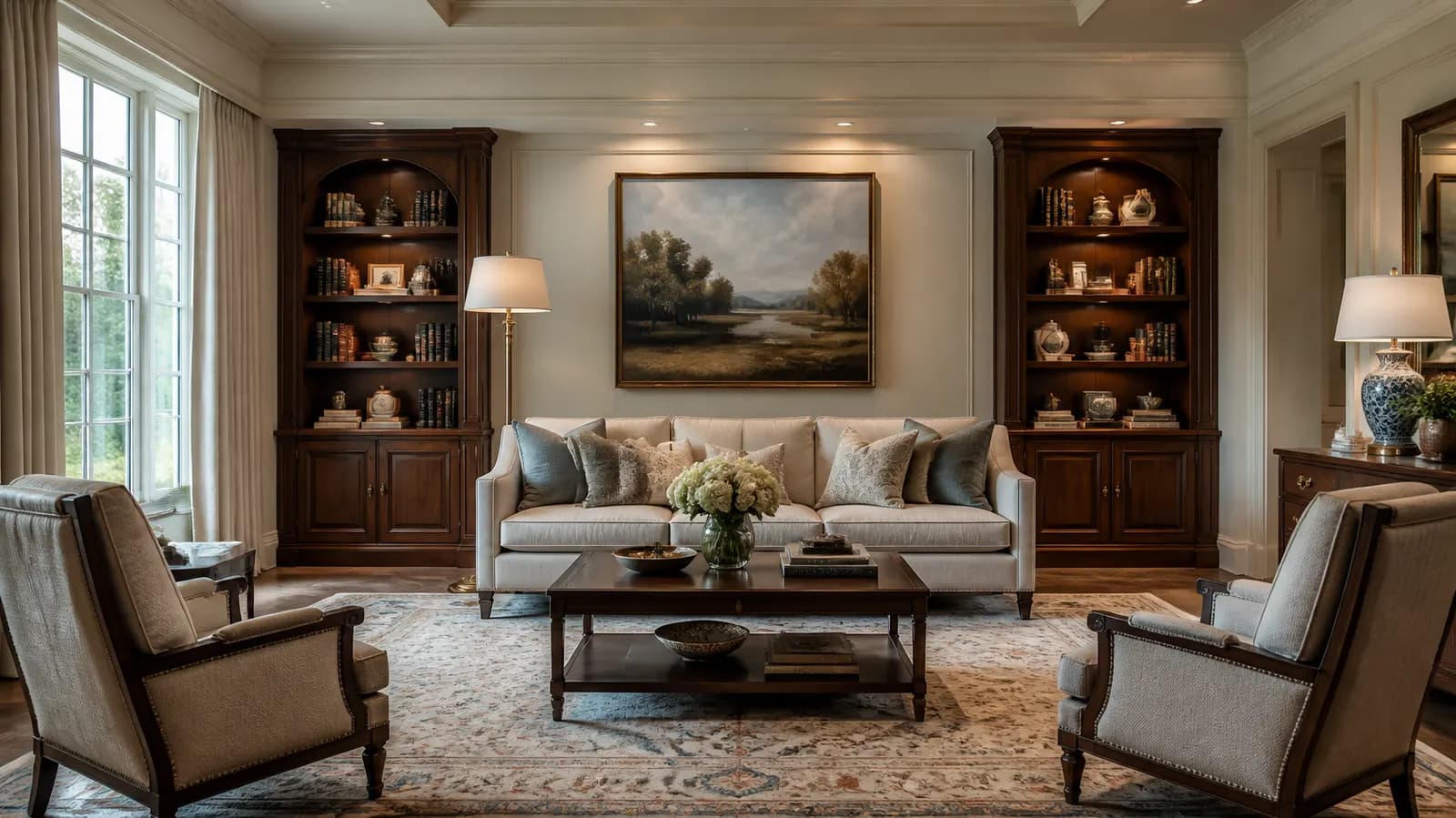
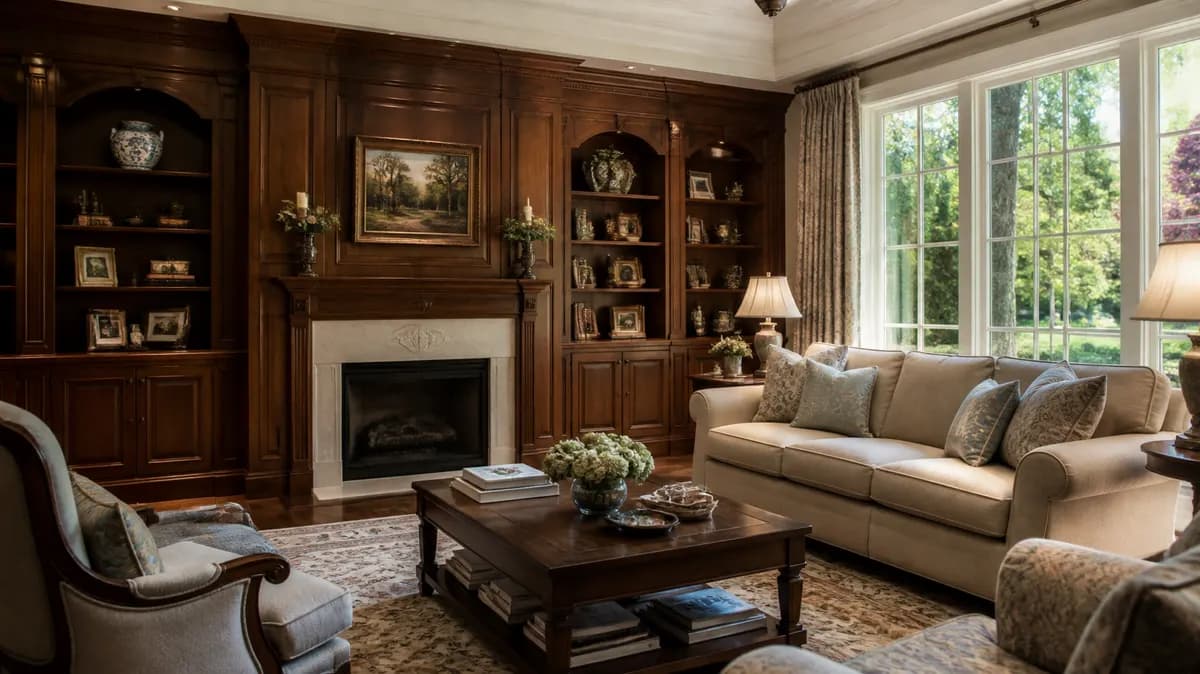
What is Traditional Living Room Design?
Traditional living room design is the long line of English and American interiors that crystallised in the 18th and 19th centuries — Georgian symmetry, classical proportion, decorative mouldings, hand-tied upholstery and a colour palette borrowed from oil portraits. It is the look of the Regency drawing room re-tuned for modern life, where the hand-knotted rug and the silver lamp are still expected but the television no longer has to be hidden behind a fretwork screen.
Three principles guide an authentic traditional living room. First, symmetry: matching pairs of sofas, lamps, side tables and pictures are the default rather than the exception. Second, layered decoration: panelled walls with chair rail and skirting, fringed trim on cushions, tasselled tiebacks on full-length curtains, a deep cornice at the ceiling. Third, a disciplined palette: cream, navy, burgundy, soft sage and dark wood, repeated through fabrics, lampshades and a single Oriental rug.
In 2026 traditional sits between two extremes — pure period-correct rooms in restored houses, and the looser "grandmillennial" version that mixes English country florals with cleaner contemporary pieces. Both are valid, both are inside the Style × Room series. The throughline is always rolled-arm upholstery, classical mouldings, a hand-knotted rug and a sense that this room could comfortably hold a conversation that lasted three hours.
12 Real Traditional Living Room Examples
Each example below is a complete look — not a mood board. Click any image to see it full-size, then hit the generate button to try the same combination on your own room photo.
 1Example
 2Example
 3Example
 4Example
 5Example
 6Example
 7Example
 8Example
 9Example
 10Example
 11Example
 12Example
Key Design Elements
Colors
- Warm cream and antique-white walls
- Deep navy blue on panelling and upholstery
- Burgundy and oxblood as accent pops
- Soft sage and dove grey for fabrics
- Mahogany and walnut wood tones
Materials
- Mahogany, walnut and cherry hardwood furniture
- Cream linen and navy velvet upholstery
- Hand-knotted Oriental or Aubusson rug
- Marble or carved-wood fireplace surround
- Polished brass and antiqued bronze hardware
Furniture
- Pair of rolled-arm sofas facing across the rug
- Wingback armchair with matching ottoman
- Mahogany coffee table or upholstered ottoman tray
- Pair of side tables with matching table lamps
- Antique secretary desk or display cabinet
Lighting
- Pair of porcelain or brass table lamps with silk shades
- Crystal or brass chandelier on a dimmer
- Picture lights over framed oils and prints
- Floor lamp beside the wingback chair
- Mantel candles in silver candlesticks
Textiles
- Full-length silk or linen drapes with tiebacks
- Hand-knotted Oriental rug under the coffee table
- Down-fill cushions with bullion fringe and welting
- Cashmere or wool throw folded on an arm
- Tassel trim on tiebacks and bell pulls
Traditional Living Room Color Palette
Six pigments do most of the work — start here, then add one accent of your own.
The base white for panelled walls and ceilings. Slightly warm and never cold, it makes mahogany furniture and oil paintings come alive.
The hero accent — used on a feature wall, full panelling or upholstery. Anchors the cream palette and reads richer in evening light.
The warm pop — Oriental rug, velvet cushion, leather book bindings. Used in small doses but consistently, to tie the palette to its 19th-century roots.
Quieter green for drapes or a single armchair. Lifts the navy-and-cream scheme without breaking its formality.
The hero wood — coffee table, side tables, picture frames. Deep red-brown that reads instantly traditional and almost never goes out of style.
The strict metal accent — lamps, hardware, picture lights, fireplace tools. Used consistently across the room so it never reads inconsistent.
Must-Have Furniture & Fixtures
If you only buy these seven, you will read as authentically traditional.
Rolled-arm sofa
Eight-way hand-tied frame, rolled arms, T-cushion seat in cream linen or velvet. Pair if the room is large enough; single if a wingback fills the second seat.
Wingback armchair
Tall wing, button-tufted back and a matching ottoman. Navy velvet, burgundy leather or muted floral chintz. Placed at right angles to the sofa, not opposite.
Mahogany coffee table
Solid hardwood with carved apron or a tray-style upholstered ottoman. Layered with a stack of art books, a tray and a single porcelain object.
Pair of side tables and lamps
Matching mahogany or walnut side tables flanking the sofa, each with a porcelain or brass lamp under a silk drum shade at 2700 K.
Hand-knotted Oriental rug
Persian, Aubusson or Caucasian pattern in burgundy, navy and cream. Large enough that all sofa and chair front legs sit on the rug.
Built-in bookshelves
Floor-to-ceiling mahogany shelves flanking the fireplace or covering one wall. Filled with real books, a few porcelain pieces and small framed prints.
Full-length silk drapes
Pleated, lined, with tasselled tiebacks. Length must break the floor by a centimetre. Mounted close to the ceiling so the window reads as tall as possible.
Common Mistakes to Avoid
Buying a beige overstuffed sofa from a chain — the cushy modular shape kills the traditional silhouette. Choose rolled arms and a defined seat instead.
Mixing too many wood tones — pick mahogany or walnut as the dominant tone and stick to it. Three competing browns dilute the period read instantly.
Skipping mouldings — flat builder walls cannot carry the rest of the look. Add chair rail, picture rail and a deep cornice; it is the cheapest upgrade in the room.
Cool overhead light — a single 4000 K LED panel destroys the mood. Use a dimmed chandelier, picture lights, a floor lamp and the fireplace glow at night.
Over-styling the mantel — fifteen objects above the fireplace looks busy. Use the gilt-mirror-plus-two-candlesticks triangle and stop.
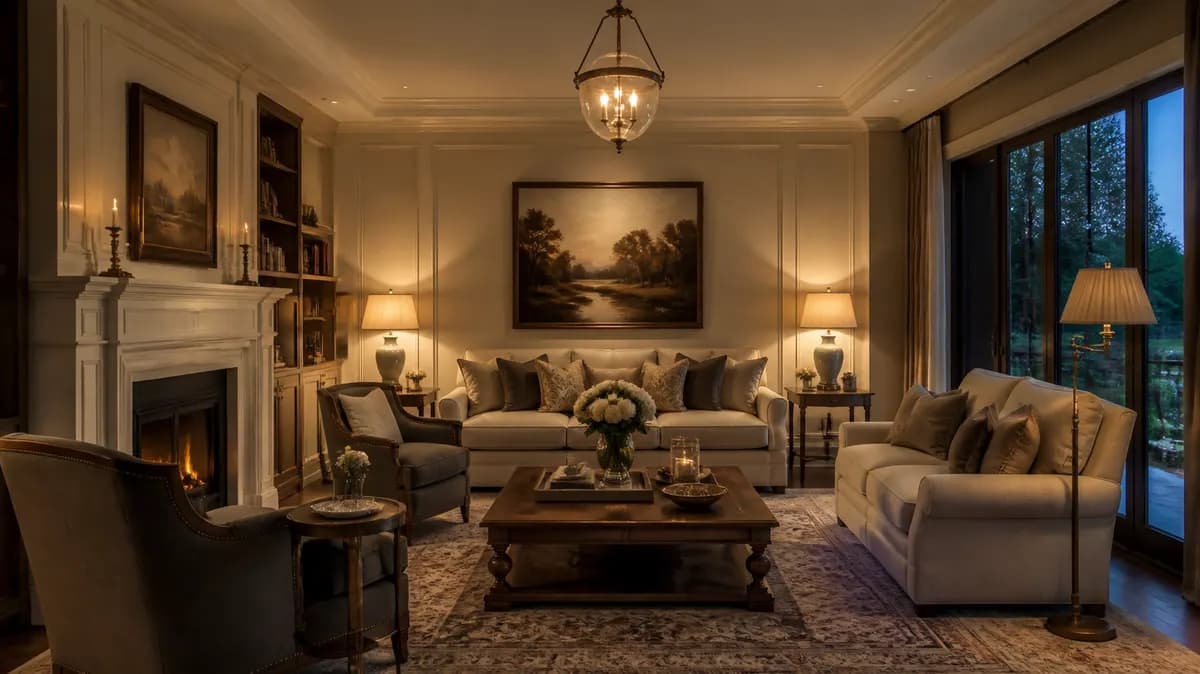
Try Traditional Living Room in Your Own Room
Upload a photo of your real living room. Get a photorealistic traditional redesign in about 30 seconds. 4 free credits, no card.
Generate Your Traditional Living Room FreeOther Traditional Rooms
Apply the same palette and principles to the rest of the home.


Other Living Room Styles
Same room, different aesthetic — explore the rest of the living room style library.


Traditional Living Room — Frequently Asked Questions
What colors define traditional living room design?
Is traditional the same as English country?
How do I make traditional feel current?
What flooring works for a traditional living room?
How is traditional different from transitional?
Is traditional living room good for a small flat?
How to Design a Traditional Living Room
Five decisions, in this order. Skip any of them and the look will not land.
- 1
Treat the architecture first — panelling, chair rail, cornice
If you do nothing else, add the trim. Chair rail at 90 cm, picture rail at 2.4 m, deep cornice at the ceiling, full skirting at the floor. This single set of additions does more for the look than any sofa purchase. Paint the panels in the wall colour or two shades darker, never lighter.
- 2
Place the rug, then the sofas
The hand-knotted Oriental defines the seating zone. Buy it first, large enough that all sofa and armchair front legs sit on the rug. Place a pair of rolled-arm sofas facing each other across the rug, with the coffee table between them, or one sofa plus a pair of wingbacks opposite.
- 3
Add the matched pairs — lamps, tables, pictures
Symmetry is the heart of traditional. A pair of mahogany side tables flank the sofa; a pair of porcelain or brass lamps with silk shades sit on top. A pair of framed prints hang above the sofa; a pair of candlesticks bracket the gilt mirror over the mantel. Even when you break symmetry elsewhere, keep these pairs intact.
- 4
Layer the lighting
Dimmed crystal or brass chandelier overhead, picture lights over the framed art, floor lamp beside the wingback, two table lamps on the side tables, mantel candles. Every bulb at 2700 K. The room should be able to dim from afternoon-tea bright down to fireside dim without ever exposing a cool LED.
- 5
Dress the windows and style the mantel
Full-length silk or heavyweight linen drapes, lined, hung from a brass rod close to the ceiling with tasselled tiebacks. Sheers behind if you need daytime privacy. On the mantel: a single gilt mirror or oil portrait, two candlesticks bracketing it, one porcelain bowl in the centre. Three items, no more. The discipline at the mantel is what reads as confidence at the room scale.
Keep Exploring
Tools and guides that pair with this style.