Scandinavian Kids Room Design Ideas: 12 Real Examples (2026 Guide)
A pale oak bed, a teepee corner with sheepskin and fairy lights, a low oak desk for early homework, white walls with one piece of the child's own art — the Scandinavian kids room is hygge for ages 3 to 10. We unpack what makes it work, then show 12 photorealistic examples you can replicate.
- 12
- Real examples
- ~30s
- AI render time
- 4 free
- Credits, no card
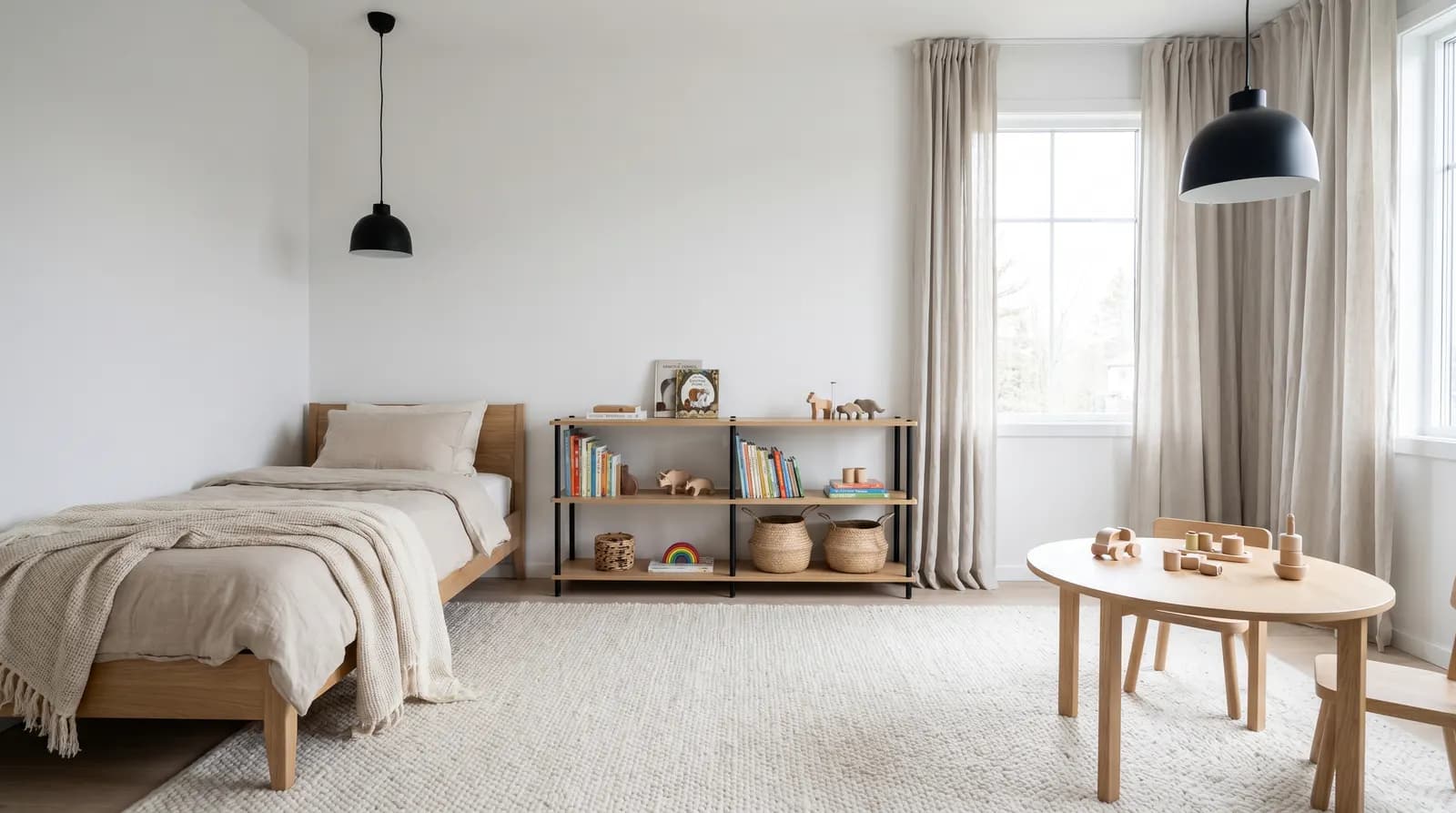
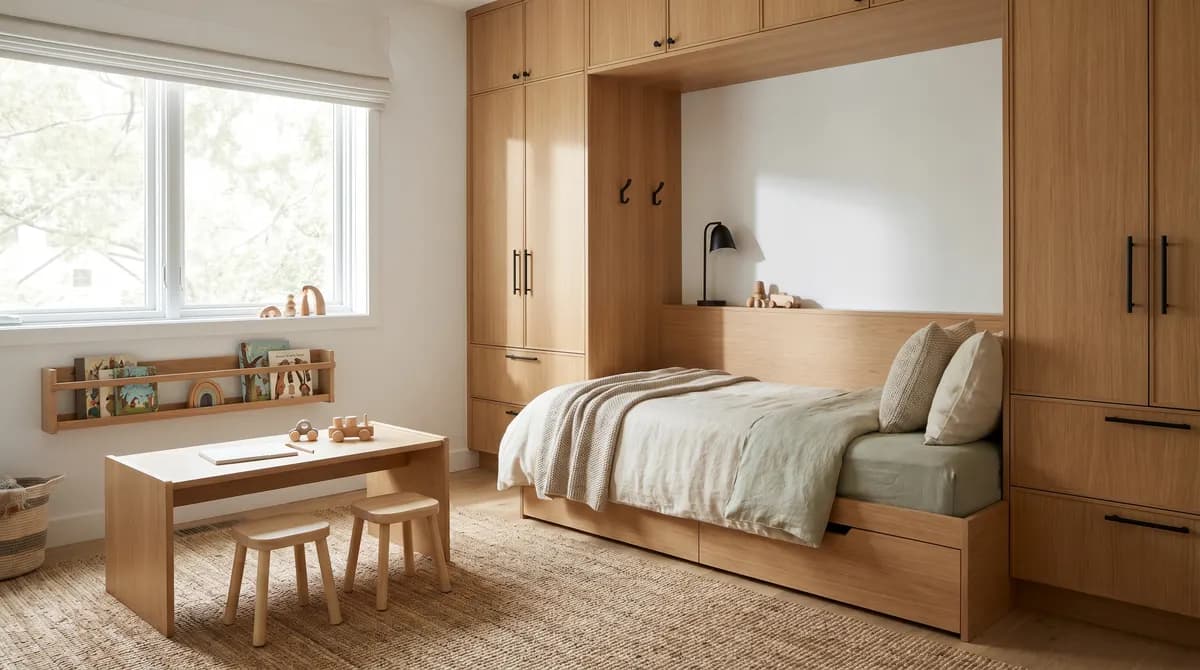
What is Scandinavian Kids Room Design?
Scandinavian kids room design takes the regional modernism of the adult Scandi bedroom and softens it slightly for the child's eye. The bones are the same — pale oak, white walls, linen, matte black accents — but the textile layer multiplies into something a child responds to: a teepee with sheepskin and fairy lights in a corner, a small linen banner above the bed, a felt garland on the open shelf, and a wool rug big enough for floor play. The result is a room that reads as hygge for kids rather than as a miniature adult bedroom.
Three principles run through every authentic Scandinavian kids room. First, scale to the child: every fixture is sized so a five-year-old can reach it independently — low oak shelf, low desk, low bed, low hooks for clothes. Second, layered warm light: a paper-shade pendant, one wall sconce, a string of fairy lights and a low floor-level night light, all at 2700 K on dimmers — never a bright single overhead. Third, restraint of plastic: one or two beloved plastic toys are allowed but the bulk of toys live in wool felt baskets or in closed storage, and the visible toy count stays in the single digits.
In 2026 the Scandinavian kids room is the dominant aesthetic across modern parenting Instagram, well-curated apartments and Pinterest boards. It pairs naturally with Minimalist (less textile, fewer objects), Japandi (darker wood for older kids) and Bohemian (more visible textile pattern), and is the safest single style to commit to because it grows with the child — the toddler bed becomes a single bed, the felt baskets get larger, the teepee gets replaced by a low study desk around age seven. We treat it as the canonical reference point for the kids-room Style × Room series.
12 Real Scandinavian Kids Room Examples
Each example below is a complete look — not a mood board. Click any image to see it full-size, then hit the generate button to try the same combination on your own room photo.
 1Example
 2Example
 3Example
 4Example
 5Example
 6Example
 7Example
 8Example
 9Example
 10Example
 11Example
 12Example
Key Design Elements
Colors
- Pure white plaster walls
- Oat linen on bedding and curtains
- Soft greys for stoneware and felt
- Matte black or muted brass on hardware
- Pale honey oak across the furniture
Materials
- Solid pale oak — the dominant wood
- Washed 100% linen on bedding and curtains
- Wool felt baskets and acoustic panels
- Sheepskin on the floor or teepee
- Rice paper or paper-cord on lighting
Furniture
- Pale oak single bed with slatted headboard
- Low oak desk and matching chair for age 5+
- Floor-to-ceiling handleless wardrobe wall
- Teepee or floor reading nook with sheepskin
- Three wool felt baskets for active toys
Lighting
- Single paper-shade pendant overhead
- Wall sconce above the bed for reading
- String of warm fairy lights in the teepee
- Low warm night light at floor level
- Every fixture dimmable, 2700 K only
Textiles
- Washed linen bedding in oat or stone
- Small wool throw folded at foot of the bed
- Sheepskin in the teepee or reading nook
- Linen curtain on the window, full length
- Wool felt garland on the open shelf
Scandinavian Kids Room Color Palette
Six pigments do most of the work — start here, then add one accent of your own.
The base white for walls and ceiling. Cleaner than warm whites, it makes oak look honey-coloured and the child's art read clearly against it.
A creamy off-white for trim and curtains. Avoids the clinical feel pure white can have when the room is mainly used after sunset.
Used on linen bedding, curtains and the teepee canvas. Adds a quiet undertone that feels safe and warm to a child.
Stoneware, felt baskets and any fabric mid-tone. The grounding mid-tone that keeps the palette from floating.
The strict accent — matte black hardware, the wall sconce arm, one framed piece of the child's own art. Used sparingly, almost as punctuation.
Pale honey oak — the dominant warm tone. Repeated on the bed, desk, wardrobe doors and any visible shelving for visual continuity.
Must-Have Furniture & Fixtures
If you only buy these seven, you will read as authentically Scandinavian.
Pale oak single bed
Solid white oak or ash, low platform with slatted oak headboard. No painted finish, no carved feet, no themed character decals. Sized 90×190 cm for ages 3+.
Low oak desk and chair
Solid oak desk sized to the child (65 cm height for age 5, 70 cm for age 8) with a matching oak chair with paper-cord seat. For homework and drawing.
Built-in wardrobe wall
Floor-to-ceiling handleless oak veneer or warm white lacquer doors. Internal pull-out trays at child height for clothes the child dresses themselves.
Teepee or floor reading nook
Canvas teepee in oat or warm white with a sheepskin on the floor and a string of fairy lights inside. Replaces the need for a child-sized armchair.
Three wool felt baskets
Round wool felt baskets in oat, stone and charcoal, 35 cm diameter, with leather handles. House the active rotation of toys at any given moment.
Paper-shade pendant + wall sconce
Single rice-paper pendant overhead at 2700 K, plus one articulated matte black wall sconce above the bed for the bedtime reading layer.
Linen curtain and fairy lights
Floor-length linen curtain on the window, pooling 2 cm on the floor, plus a string of 20 warm fairy lights either inside the teepee or above the bed.
Common Mistakes to Avoid
Themed wallpaper or murals — printed jungle scenes, dinosaur stickers, alphabet borders, character decals. The Scandinavian kids room uses plaster walls with at most one piece of the child's own art framed in matte black.
Plastic toys on permanent display — open shelves stacked with primary-colour plastic, themed bedding sets, branded character bouncers. Bulk of toys hide in the wardrobe; three felt baskets hold the active rotation.
Painted bed in a saturated colour — fire-engine red, cobalt blue, neon pink. The bed must be solid pale oak with a slatted headboard, repeated in the desk and wardrobe finish. Saturated colour only arrives through the child's own art.
Bright overhead light — a single ceiling pendant in cool white kills the bedtime mood. Use a paper pendant on a dimmer, plus a wall sconce above the bed and a string of fairy lights — all 2700 K.
Mismatched wood tones — pale oak bed, walnut desk, stained pine floor. Pick one wood (white oak, ash or birch) and repeat it on every piece of furniture and any visible shelving.
Try Scandinavian Kids Room in Your Own Room
Upload a photo of your real kids room. Get a photorealistic Scandinavian redesign in about 30 seconds. 4 free credits, no card.
Generate Your Scandinavian Kids Room FreeOther Scandinavian Rooms
Apply the same palette and principles to the rest of the home.


Other Kids Room Styles
Same room, different aesthetic — explore the rest of the kids-room style library.


Scandinavian Kids Room — Frequently Asked Questions
What colors define a Scandinavian kids room?
Is a teepee Scandinavian or just Instagram?
How do I make a Scandinavian kids room feel playful and not too adult?
How do I store toys in a Scandinavian kids room?
Does a Scandinavian kids room grow with the child?
Is a Scandinavian kids room good for shared sibling rooms?
How to Design a Scandinavian Kids Room
Five decisions, in this order. Skip any of them and the look will not land.
- 1
Set the envelope once
Pure white plaster walls and ceiling, wide-plank pale oak floor, floor-to-ceiling handleless oak veneer wardrobe wall on the long side, linen curtain on the window. This envelope is set once and does not change as the child grows from preschool to early primary years — it is the architecture, not the décor.
- 2
Pick one wood and repeat it
Pick one (white oak, ash or birch) and commit. The bed, the desk, the wardrobe doors, the open shelf, the bedside stool — all in the same finish. Two competing wood tones is the fastest way to break the Scandinavian envelope. Pale honey oak is the safe default.
- 3
Add the teepee or floor reading nook
One corner of the room becomes the cosy zone: a canvas teepee in oat with a sheepskin and a string of 20 warm fairy lights, or a floor reading nook with sheepskin, linen cushion and a small floor lamp. This is the child-scaled hygge layer that separates a Scandinavian kids room from a miniature adult bedroom.
- 4
Layer four kinds of warm light
One paper-shade pendant overhead, one articulated wall sconce above the bed for reading, a string of 20 warm fairy lights in the teepee or above the bed, and a low warm night light at floor level. Every fixture on a dimmer, every bulb at 2700 K. Never a bright single overhead spot.
- 5
Edit display down to the child's own art
On the wall: three to five pieces of the child's own drawings, paintings or photographs, framed in matte black, hung at child eye level. On the open shelf: three picture books and one ceramic. In the bed: one curated stuffed companion. In the teepee: one cushion. Everything else lives in the wardrobe or the felt baskets — including the toys not in the current rotation.
Keep Exploring
Tools and guides that pair with this style.