Minimalist Kids Room Design Ideas: 12 Real Examples (2026 Guide)
A pale oak floor bed, hidden toy storage, warm white walls, one shelf with three books, almost zero plastic — the minimalist kids room is the architecture of calm for ages 3 to 10. We unpack what makes it work, then show 12 photorealistic examples you can replicate.
- 12
- Real examples
- ~30s
- AI render time
- 4 free
- Credits, no card
What is Minimalist Kids Room Design?
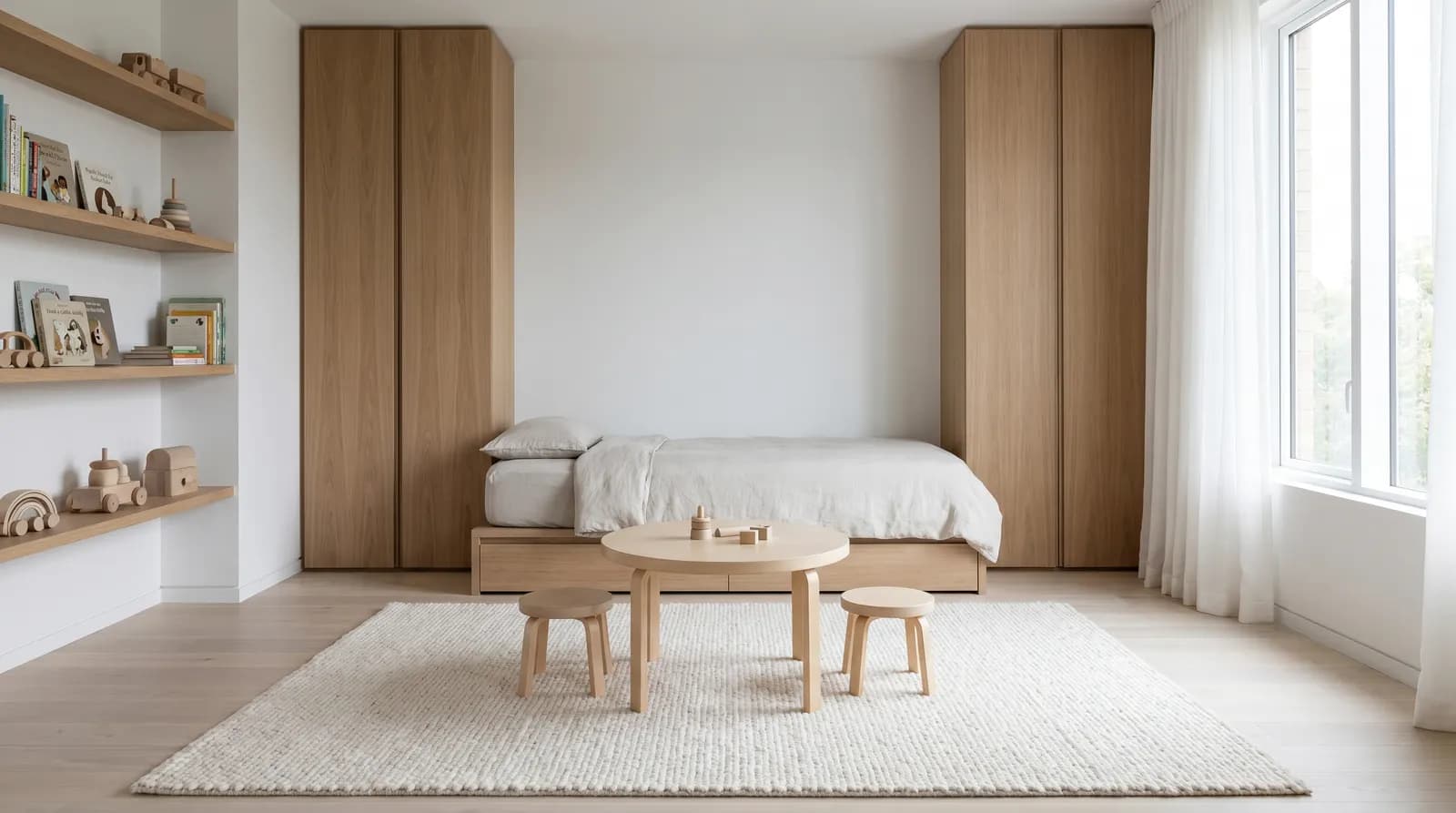
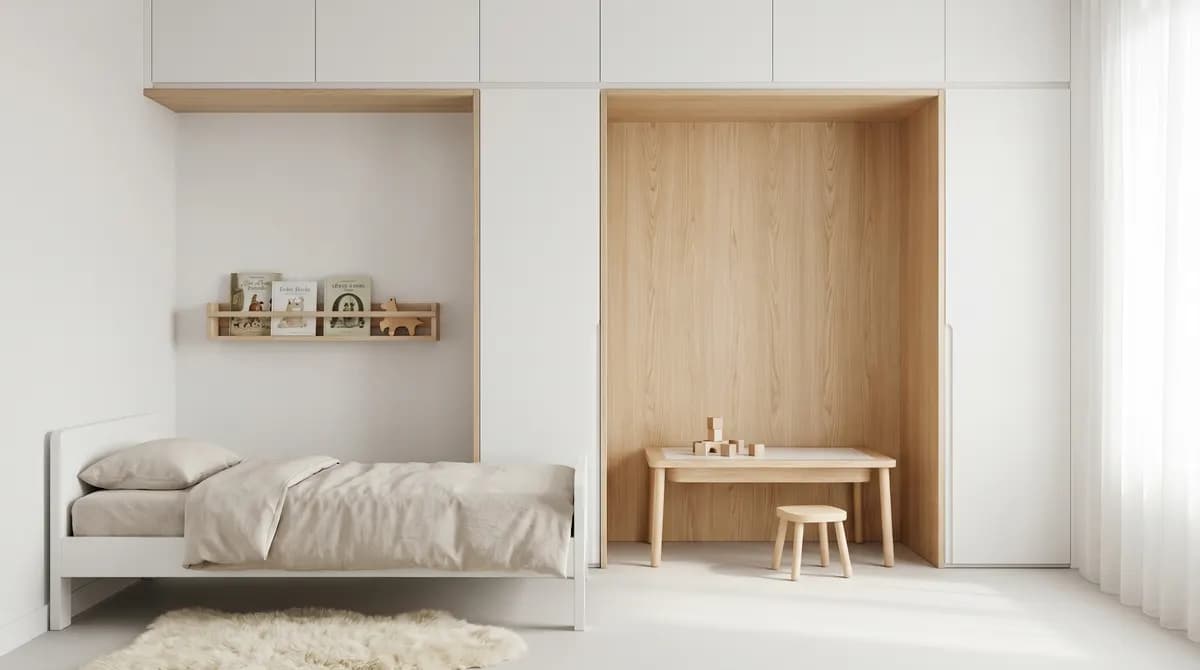
Minimalist kids room design is what happens when you apply the adult discipline of subtraction to a room that historically gets the most clutter. There are no plastic primary-colour toy bins, no cartoon-character bedspreads, no decals stuck to the wardrobe, no licensed merchandise on display. Instead there is a low pale oak floor bed (or a simple platform bed), a single floor-to-ceiling handleless wardrobe wall, one open shelf with three books, a low reading nook on the floor with a sheepskin and a felt basket, and walls in warm white plaster.
Three principles separate a minimalist kids room from a sterile adult bedroom miniaturised. First, ground-level scale: every fixture is sized to the child, low to the floor, accessible without help. Second, the rule of one curated category: toys are stored in closed felt baskets or in the wardrobe, with one rotating set out at a time. Third, calibrated lighting: warm 2700 K wall sconces, a soft pendant, and one floor-level night light — never a single overhead bulb. The room reads as architecture first, child's room second.
In 2026 the minimalist kids room is the dominant aesthetic among parents who have done the Montessori reading, in slow-living renovations, and in Scandinavian-inflected family homes. It pairs naturally with Japandi (more wood and ceramic), Modern (richer materials) and Scandinavian (more visible hygge), and is the safest single style to commit to because it grows with the child — a four-year-old's floor bed, a seven-year-old's reading nook and a ten-year-old's study desk all live comfortably in the same envelope. We treat it as the canonical reference point for the kids-room Style × Room series.
12 Real Minimalist Kids Room Examples
Each example below is a complete look — not a mood board. Click any image to see it full-size, then hit the generate button to try the same combination on your own room photo.
 1Example
 2Example
 3Example
 4Example
 5Example
 6Example
 7Example
 8Example
 9Example
 10Example
 11Example
 12Example
Key Design Elements
Colors
- Warm white lime plaster walls
- Oat for bedding and any visible textile
- Light greige for the rug and curtains
- Matte black or muted brass on hardware
- Pale honey oak across furniture
Materials
- Smooth lime plaster on every wall
- Pale honey oak on the floor bed and shelf
- Wool felt on baskets and acoustic panels
- Linen on bedding, curtains and any cushion
- Sheepskin in the reading nook
Furniture
- Low pale oak floor bed or platform bed
- Floor-to-ceiling handleless wardrobe wall
- One floating oak shelf at child eye-level
- Low oak stool or bench for reading
- Three felt baskets — closed toy storage
Lighting
- One wall sconce above the bed, dimmable
- Single soft pendant or paper-shade ceiling lamp
- Floor-level warm night light, motion-activated
- Cove LED uplighting at the ceiling perimeter
- Every fixture dimmable, 2700 K only
Textiles
- Linen bedding in oat or stone, no pattern
- Sheer linen panel on the window
- Low-pile wool rug under the bed
- Single sheepskin in the floor reading nook
- Felt baskets in oat, stone or charcoal
Minimalist Kids Room Color Palette
Six pigments do most of the work — start here, then add one accent of your own.
The base wall colour, ideally as smooth lime plaster so the eye reads texture as well as colour. Slightly warmer than pure white.
The dominant textile colour — bedding, curtain panel, soft cushion. Carries the room visually and feels safe to touch as a child.
The rug and any soft fabric mid-tone. The neutral that links plaster, oak and felt without competing.
Felt baskets, acoustic panels and the wardrobe doors. The grounding mid-tone that gives the room visual weight.
The strict accent — matte black hardware, the wall sconce arm, one piece of art. Used sparingly, almost as punctuation.
Pale honey oak — the only warm tone in the room. Repeated on the floor bed, the shelf and the low stool to tie the architecture together.
Must-Have Furniture & Fixtures
If you only buy these seven, you will read as authentically minimalist.
Pale oak floor bed
Solid pale oak frame, 10–25 cm off the floor (Montessori-style for ages 3–6, slightly taller for ages 7+). No headboard, no skirt, no decorative panel.
Floor-to-ceiling wardrobe
Handleless plaster-finish or pale oak veneer doors running floor to ceiling on the long wall. Internal pull-out trays at child height for clothes the child dresses themselves.
Single floating oak shelf
One 80 cm pale oak shelf at child eye level (110–130 cm off the floor), hidden bracket, holding three picture books and one ceramic. Rotated weekly.
Three closed felt baskets
Round wool-felt baskets in oat, stone and charcoal, 35 cm diameter, with leather handles. The entire visible toy storage. One basket per category — blocks, vehicles, animals.
Low oak reading stool
Single solid oak stool 25 cm high, placed beside the reading nook. Doubles as a step to reach the shelf and a surface for one mug of warm milk at bedtime.
Wall sconce above the bed
Single articulated matte black or muted brass sconce 60 cm above the mattress, dimmable, 2700 K. Replaces the need for a bedside table and lamp.
Sheepskin reading nook
Single full sheepskin on the floor by the window, with one large linen cushion. Replaces the need for a child-sized armchair or beanbag.
Common Mistakes to Avoid
Plastic primary-colour toys on display — open shelves stacked with plastic, themed bedding, licensed-character posters. Minimalism rotates toys behind closed felt baskets and the wardrobe; the visible toy count is single digits.
Wall decals and wallpaper murals — printed jungle scenes, dinosaur stickers, growth charts, alphabet borders. The wall stays empty plaster with at most one piece of original art the child made, framed in matte black.
Loud rug pattern — a chevron rug, a road-map play rug, a printed star pattern. The textiles in a minimalist kids room are flat colour, low-pile wool, no pattern. The rug is a surface, not a play mat.
Themed bedding — superhero duvets, princess sheets, branded character sets. Replace with plain linen in oat or stone; the child gets to choose one cushion or stuffed companion as the curated personal object.
Bright overhead light — a single ceiling pendant in cool white floods the room and makes nap time impossible. Use cove LED, one wall sconce above the bed, and a soft pendant — every bulb at 2700 K on a dimmer.
Try Minimalist Kids Room in Your Own Room
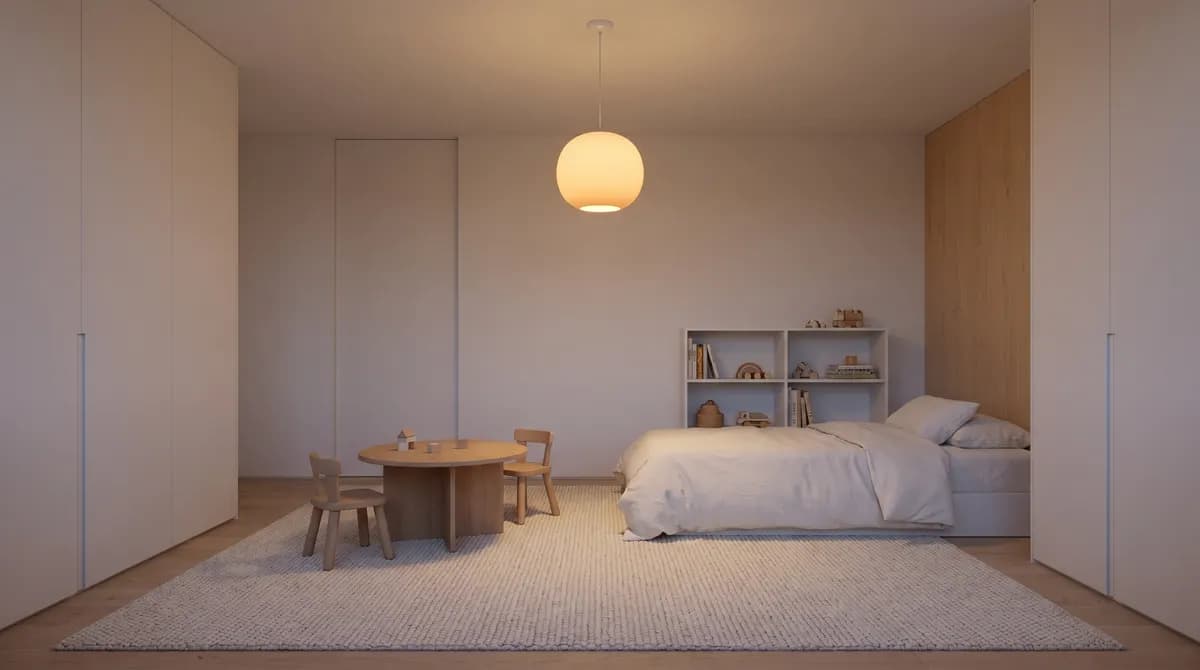
Upload a photo of your real kids room. Get a photorealistic minimalist redesign in about 30 seconds. 4 free credits, no card.
Generate Your Minimalist Kids Room FreeOther Minimalist Rooms
Apply the same palette and principles to the rest of the home.


Other Kids Room Styles
Same room, different aesthetic — explore the rest of the kids-room style library.


Minimalist Kids Room — Frequently Asked Questions
What colors define a minimalist kids room?
Is a floor bed safe for a child?
How do I store toys in a minimalist kids room?
What flooring works for a minimalist kids room?
How is minimalism different from Scandinavian in a kids room?
Does a minimalist kids room grow with the child?
How to Design a Minimalist Kids Room
Five decisions, in this order. Skip any of them and the look will not land.
- 1
Set the envelope once
Smooth lime plaster on every wall and ceiling in a warm white, pale oak floor, floor-to-ceiling handleless wardrobe wall on the long side, sheer linen panel on the window. This envelope is set once and does not change as the child grows — it is the architecture, not the décor.
- 2
Choose a floor bed or a low platform
For ages two to six, a Montessori-style floor bed in pale oak, 10–25 cm off the floor, no headboard. For ages seven and up, a slightly taller pale oak platform bed in the same finish, still low (40 cm max). Linen bedding in oat or stone, no pattern. The bed is the only piece of furniture standing free in the centre of the room.
- 3
Plan toy storage as architecture
Three closed wool-felt baskets in oat, stone and charcoal for the active rotation. The wardrobe wall houses the archive. End-of-day reset returns every toy to its basket or the wardrobe. The wall behind the bed and the floor between bed and wardrobe stay empty. This single decision is what makes the room read minimalist rather than just tidy.
- 4
Light from low, plural, warm sources
Cove LED at the ceiling perimeter, one wall sconce above the bed, a soft paper-shade pendant, and a floor-level warm night light. Every fixture on a dimmer, every bulb at 2700 K. Never a bright single ceiling spot — children sleep better in warm dim light, and the calm palette of the room only reads correctly under warm temperature.
- 5
Rotate the display, never accumulate
On the shelf: three picture books and one ceramic, rotated weekly. On the bed: one curated stuffed companion. In the reading nook: one sheepskin, one linen cushion. The discipline is rotation, not subtraction — the child still has plenty of toys, but only nine to twelve of them are visible at once. The minimalist kids room is the architecture of calm; the rest is parental practice.
Keep Exploring
Tools and guides that pair with this style.