Mediterranean Home Office Design Ideas: 12 Real Examples (2026 Guide)
Hand-troweled plaster, an olive-wood desk, a rattan chair and a single arched window framing cypress trees — the home office of a Mallorcan farmhouse. We unpack what makes it land, then show 12 photorealistic examples you can copy.
- 12
- Real examples
- ~30s
- AI render time
- 4 free
- Credits, no card
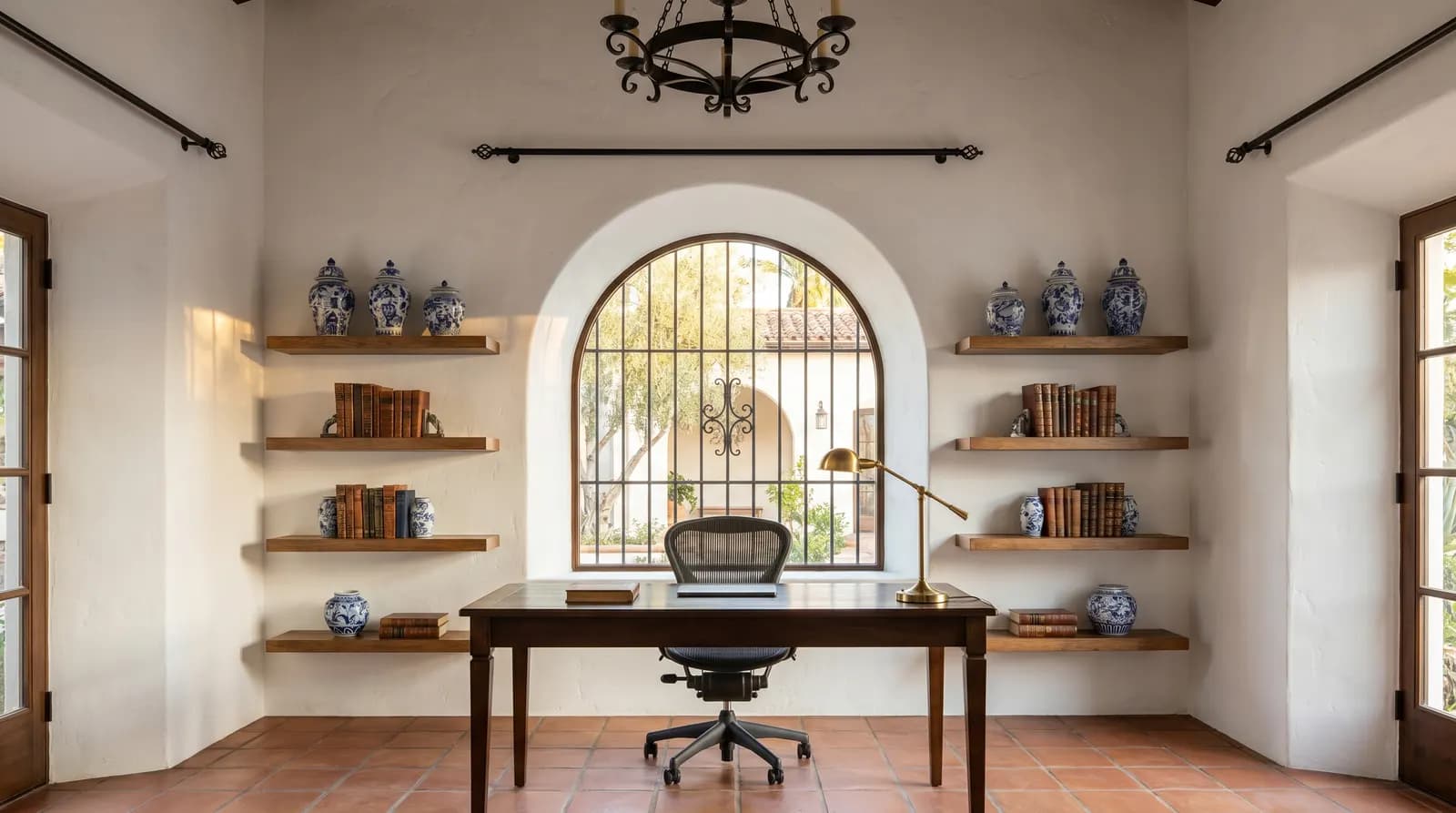
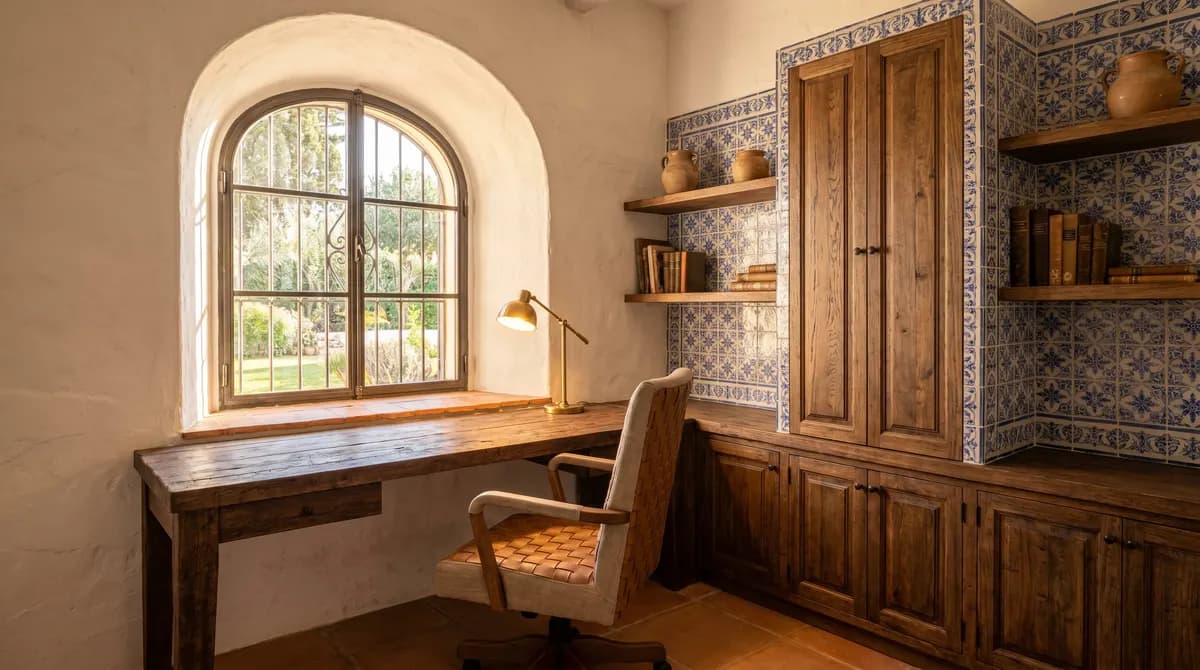
What is Mediterranean Home Office Design?
Mediterranean home office design takes the language of coastal Spain, southern Italy, Greece and Morocco and applies it to the most modern of rooms — the place we now spend our working day. Where most home offices reach for cool greys, black-metal shelving and IKEA white desks, the Mediterranean home office reaches for warm lime plaster, an olive-wood desk on a heavy trestle base, and a rattan or caned chair. The look is rustic but not folksy; quiet but not austere.
Three principles run through every authentic Mediterranean home office. First, the walls are textured: hand-troweled plaster, limewash or rough render rather than flat matte paint. Second, the desk is timber — olive, walnut or reclaimed pine — never laminated MDF on chrome legs. Third, one craft element earns its place in the eye-line: a terracotta pot, a stoneware lamp, a striped Berber rug under the chair, or a single hand-painted ceramic tile inset into the wall.
In 2026 the look has become the answer to Zoom-call fatigue. Where the all-grey office feels corporate even at home, the Mediterranean version photographs as warm and personal on video calls without crossing into Bohemian clutter. It pairs naturally with Bohemian or Spanish Colonial bedrooms, and it remains the dominant aesthetic for creative-class home offices from Lisbon to Brooklyn.
12 Real Mediterranean Home Office Examples
Each example below is a complete look — not a mood board. Click any image to see it full-size, then hit the generate button to try the same combination on your own room photo.
 1Example
 2Example
 3Example
 4Example
 5Example
 6Example
 7Example
 8Example
 9Example
 10Example
 11Example
 12Example
Key Design Elements
Colors
- Sun-bleached chalk white
- Warm oat and limewash beige
- Terracotta and clay rust
- Olive and rosemary green accents
- Honey olive wood and reclaimed chestnut
Materials
- Hand-troweled lime plaster or tadelakt
- Solid olive, walnut or reclaimed pine for the desk
- Caned rattan and woven seagrass
- Terracotta floor tile or honed travertine
- Unlacquered brass and antique bronze fittings
Furniture
- Olive-wood desk on a heavy chestnut trestle base
- Caned or rattan-back chair, leather seat optional
- Open wooden bookshelves with arched openings
- Low caned daybed or stool for a reading corner
- Single chestnut storage chest doubling as bench
Lighting
- Brass swing-arm wall sconce above the desk
- Stoneware table lamp with linen shade
- Floor-to-ceiling arched window where possible
- Warm 2700 K LED in any concealed strips
- Beeswax candle on the desk for evening hours
Textiles
- Striped Berber wool rug under the chair
- Linen curtains in oat or sage
- Sheepskin draped over the desk chair
- Hand-loomed cotton throw on the daybed
- Stoneware desk caddy and ceramic pen cup
Mediterranean Home Office Color Palette
Six pigments do most of the work — start here, then add one accent of your own.
The chalky off-white for plaster ceilings and trim. Warmer than pure white, it reads as old plaster rather than fresh paint.
The dominant wall tone for hand-troweled plaster. A warm, mottled neutral that flatters skin on video calls.
Used on floor tile, an unglazed pot or a single cushion. Adds the warmest temperature in the room and anchors the floor.
A muted herbal green for an upholstered chair, a linen curtain or a single ceramic vase. The botanical note in the palette.
The hero — desk, shelves, stool. Choose one wood tone (olive, walnut or reclaimed chestnut) and repeat it across every wooden surface.
Sconces, drawer pulls, desk-lamp arm and inkwell. Always unlacquered so it spots and patinas over years of use.
Must-Have Furniture & Fixtures
If you only buy these seven, the room will read as authentically Mediterranean.
Solid olive-wood desk
A heavy plank-top desk in olive or reclaimed chestnut, supported on a simple trestle base. Visible grain, no veneer, no laminate. The single most important purchase in the room.
Caned or rattan chair
A rattan-back office chair with a linen or leather seat. If a swivel is essential, choose one with a wooden base and caned back rather than a synthetic mesh model.
Brass swing-arm sconce
An unlacquered brass swing-arm wall lamp mounted above the desk. Replaces a clip-on desk lamp and keeps the desk surface uncluttered.
Open arched shelving
Built-in plaster bookshelves with hand-cut arched openings, or freestanding olive-wood shelves on chunky brackets. Display ceramics and stacked books, not folders.
Striped Berber rug
A handwoven wool rug in oat with rust or charcoal stripes, sized so all four chair legs sit on it. Defines the work zone in an open-plan room.
Stoneware desk lamp
A heavy stoneware table lamp with a linen drum shade. Used in addition to — not instead of — the brass sconce, for layered evening light.
Single terracotta plant pot
One unglazed clay pot holding an olive tree or rosemary plant. The single most photographed object in the room and the cheapest way to land the look.
Common Mistakes to Avoid
Treating the desk as office furniture — IKEA white tops and chrome legs read as call-centre, not Mediterranean. Specify solid wood with visible grain and a trestle base, even if it costs four times more.
Black ergonomic mesh chair — the single fastest way to break the spell. Swap for a caned or rattan-back chair, even if you keep a separate ergonomic chair for long sessions.
Cool LED strip lighting — 4000 K overheads make the plaster look grey and the wood look orange. Specify 2700 K everywhere, dimmable, with at least one brass sconce as the main task light.
Plastic everywhere — printer, monitor stand, cable trays. Hide them in a chestnut chest or under a linen runner. The eye should land on wood, plaster and brass, not on a Logitech logo.
Empty shelves — Mediterranean is warm and lived-in, not minimalist. Style each shelf with two stacked books, one ceramic and one trailing plant. Bare shelves read as showroom, not home.
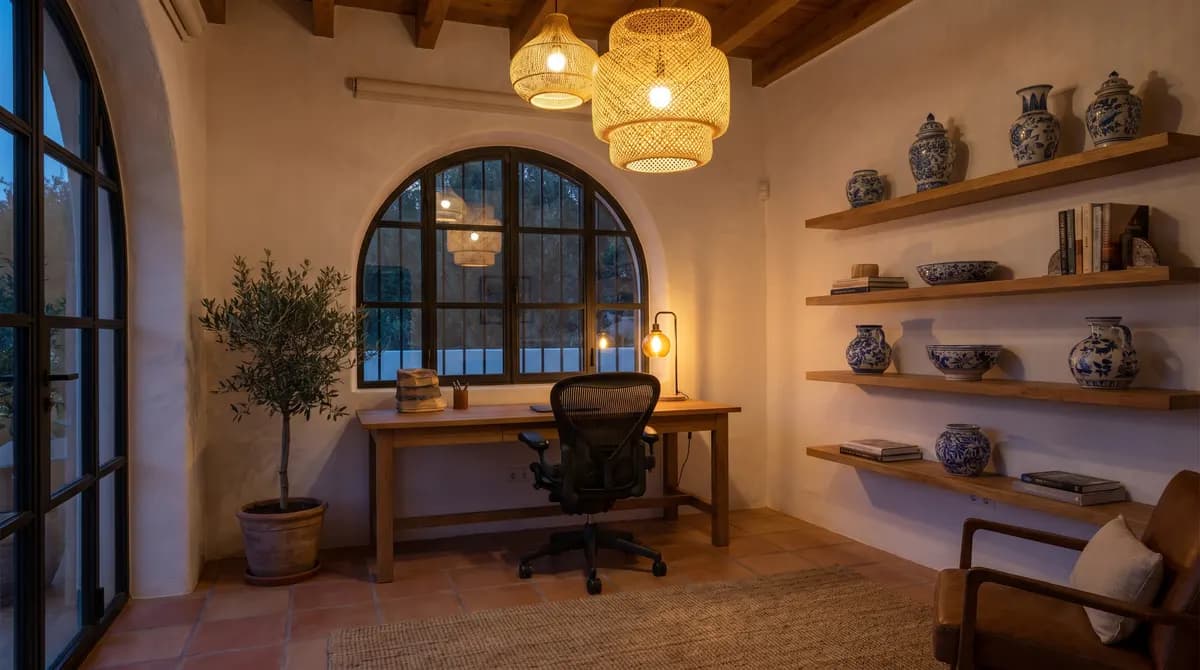
Try Mediterranean Home Office in Your Own Room
Upload a photo of your real workspace. Get a photorealistic Mediterranean redesign in about 30 seconds. 4 free credits, no card.
Generate Your Mediterranean Home Office FreeOther Mediterranean Rooms
Apply the same palette and principles to the rest of the home.


Other Home Office Styles
Same room, different aesthetic — explore the rest of the home office style library.


Mediterranean Home Office — Frequently Asked Questions
Can a Mediterranean home office still feel productive?
What is the right desk for a Mediterranean home office?
How do I hide cables and tech?
What plants work in a Mediterranean home office?
How is Mediterranean different from Bohemian for a home office?
Does Mediterranean style work in a small or windowless office?
How to Design a Mediterranean Home Office
Five decisions, in this order. Skip any of them and the look will not land.
- 1
Choose your wall finish
Pick lime plaster, tadelakt or limewash and commit. This is the single most consequential choice in the room. A flat matte painted wall — even in the right colour — will never read as Mediterranean; the slight mottle, irregular shadow and visible trowel marks are the entire point of the style. If a true plaster is not possible, a high-end limewash paint applied in two cross-hatched coats is the next best thing.
- 2
Pick a single wood tone for the desk and shelves
Olive, walnut or reclaimed chestnut — choose one and repeat it across desk, shelving, chair frame and storage chest. Two competing wood tones is the fastest way to look amateur. Keep the grain visible: matte oil finish only, no high-gloss lacquer, and never veneer over MDF where the joints will eventually show.
- 3
Layer light at three heights
Mediterranean light is warm and layered, never flat overhead. Plan three sources at three heights: a brass sconce or pendant at ceiling height, a stoneware table lamp at eye level, and a single beeswax candle on the desk surface. All at 2700 K. The desk lamp can be brass or stoneware but never plastic, and every source must be on a dimmer.
- 4
Add one craft element
Choose one and only one statement craft element — a hand-painted Spanish tile inset into the wall, a Moroccan zellige feature panel behind the shelf, a Berber wool rug under the chair, or a single hand-carved arched niche. Two craft elements compete; one anchors the room. This is the moment Mediterranean separates from generic-rustic.
- 5
Edit ruthlessly
Mediterranean is warm, not cluttered. Three objects maximum on the desk surface: the screen, the keyboard, and one styled tableau (brass lamp + ceramic pen cup + leather notebook). Two objects per shelf. Hide every cable, every charger and every plastic device. If you would not photograph it, it does not belong on the desk.
Keep Exploring
Tools and guides that pair with this style.