Japandi Living Room Design Ideas: 12 Real Examples (2026 Guide)
Walnut and oak, a low linen sofa, a single washi paper lantern and a great deal of disciplined empty space — Japandi at its calmest. We unpack what makes a living room read as truly Japandi, then show 12 photorealistic examples you can replicate.
- 12
- Real examples
- ~30s
- AI render time
- 4 free
- Credits, no card
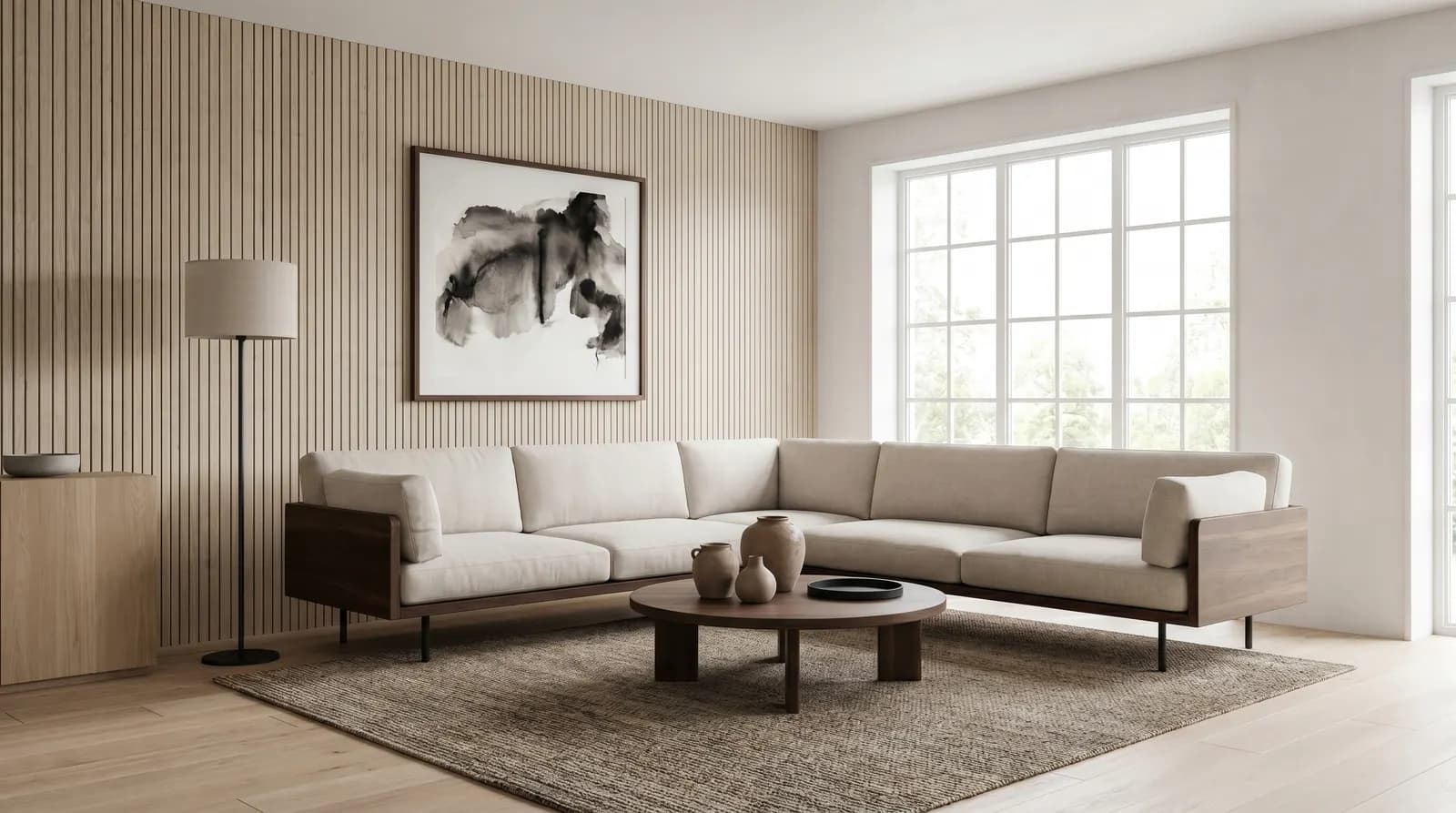
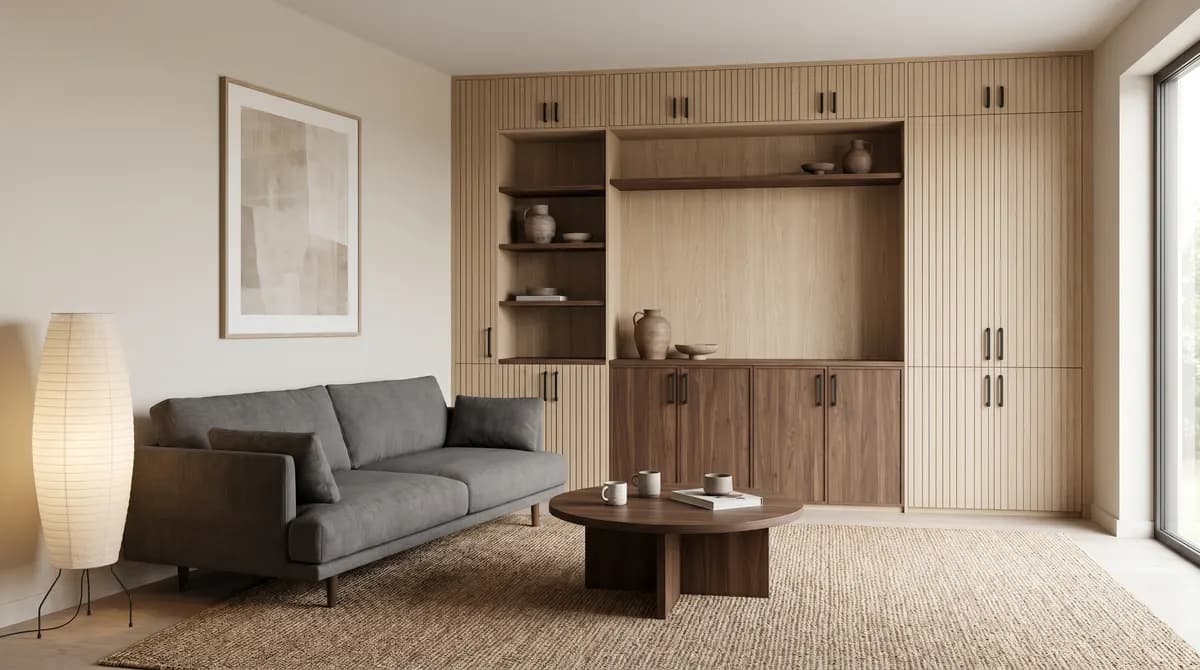
What is Japandi Living Room Design?
Japandi living room design is the deliberate fusion of Scandinavian and Japanese minimalism. From Scandinavia it borrows light woods, pale walls and the discipline of empty surfaces. From Japan it borrows lower furniture, more black, deeper walnut tones, and a respect for hand-made craft and quiet patina. The result is a living room that feels both bright and grounded — a Copenhagen apartment that has spent a year in Kyoto.
Three principles run through every authentic Japandi living room. First, low horizon: the sofa, side tables and shelving sit closer to the floor than in a typical Western room. Second, two wood tones working together: a pale oak or ash for floors and structural shelving, and a darker walnut or black-stained timber for accent pieces. Third, a single craft object — a washi paper lantern, a hand-thrown stoneware vase, a raw-edge live wood bench — that the rest of the room is composed around.
In 2026 Japandi has overtaken pure Scandinavian as the dominant aesthetic for urban living rooms in cities with serious design press. It pairs naturally with Scandinavian kitchens and Wabi-Sabi bedrooms, and unlike the cooler all-white Scandi look, it photographs warmly under both daylight and evening lamp light without needing extra textiles.
12 Real Japandi Living Room Examples
Each example below is a complete look — not a mood board. Click any image to see it full-size, then hit the generate button to try the same combination on your own living room photo.
 1Example
 2Example
 3Example
 4Example
 5Example
 6Example
 7Example
 8Example
 9Example
 10Example
 11Example
 12Example
Key Design Elements
Colors
- Warm off-white plaster walls
- Oat and soft beige for upholstery
- Charcoal and muted black accents
- Deep walnut and dark-stained oak
- Honey oak and ash for floors and shelving
Materials
- Pale oak or ash for structural wood
- Deep walnut or black-stained timber for accents
- Limewash or microcement walls
- Stoneware ceramics and unglazed terracotta
- Washi paper, linen and raw silk
Furniture
- Low modular linen sofa, 70 cm seat height
- Low walnut or oak coffee table
- Raw-edge live-wood bench as a side table
- Tatami-inspired floor cushions or zabuton
- Open shelving in walnut with single objects
Lighting
- Washi paper floor lantern in a corner
- Blackened-steel pendant over the coffee table
- Stoneware table lamp with linen shade
- Recessed warm 2700 K LED, dimmable
- A single beeswax candle on the coffee table
Textiles
- Stonewashed linen sofa covers in oat
- Wool throw in charcoal or muted clay
- Hand-loomed cotton floor cushions
- Sisal or wool flatweave rug
- Single raw-silk cushion for tactile contrast
Japandi Living Room Color Palette
Six pigments do most of the work — start here, then add one accent of your own.
The base for walls and ceiling. Always slightly warm — never pure white — so the wood tones do not turn yellow against it.
The dominant upholstery and curtain colour. Quiet, warm and forgiving on both pale and dark wood neighbours.
The strict dark accent — a blackened-steel pendant, a single charcoal cushion, the base of a ceramic vase. Used like punctuation.
The deeper of the two wood tones, used for the coffee table, side tables and shelving accents. The Japanese half of the equation.
Floors, structural cabinetry and any pale shelving. The Scandinavian half of the equation, repeated as the room's brightest wood tone.
A muted earthy brown for ceramics, vases and small plant pots. The handmade craft note that separates Japandi from Scandinavian.
Must-Have Furniture & Fixtures
If you only buy these seven, the room will read as authentically Japandi.
Low linen sofa
Modular, 70–75 cm seat height (lower than a typical Western sofa), upholstered in stonewashed linen in oat or muted clay. Three seats minimum, no rolled arms, visible wood feet.
Low walnut coffee table
Solid walnut, 30–35 cm high, simple rectangular form with visible end grain. Holds a single ceramic vessel and a stack of two books. Skip glass tops entirely.
Washi paper floor lantern
An Akari-style washi paper floor lamp or column lantern. The single most photographed object in the room and the one piece that immediately reads as Japandi rather than Scandinavian.
Raw-edge live-wood bench
A live-edge walnut or oak slab on simple blackened-steel legs, used as a side table or under a window. Shows knots, sap lines and natural curvature — never a sanded-rectangular plank.
Open walnut shelving
One or two runs of walnut shelving on a single wall, styled with three ceramics, two stacked books and one trailing plant per shelf. Negative space is the design.
Sisal flatweave rug
A large natural-sisal or wool flatweave rug in oat, sized so the front legs of the sofa and chairs sit on it. Skip pile rugs and skip patterns; the floor is part of the calm.
Stoneware tea set
A hand-thrown stoneware teapot and two cups on a linen runner. The single craft vignette that gives the room its handmade soul. Used, not displayed.
Common Mistakes to Avoid
All Scandinavian, no Japan — a room with only pale oak, white walls and IKEA boxes is Scandinavian, not Japandi. The walnut, the black accent and the washi paper are the entire Japanese half of the equation.
All Japan, no Scandi — a room with only dark walnut, black accents and tatami reads as Japanese minimalist, not Japandi. You need the pale oak floor and the warm off-white wall to lift it.
High-backed Western sofa — a chesterfield or any 90 cm-tall sofa breaks the low horizon instantly. Specify a 70–75 cm seat height with no rolled arms.
Too many craft objects — Japandi is restrained. One washi lantern and one stoneware tea set is the entire ceramic and lighting story. A shelf full of pottery is Bohemian, not Japandi.
Mixed metals — one warm metal (blackened steel) running through pendant, table legs and lamp bases. Mixing chrome, brass and black instantly breaks the discipline.
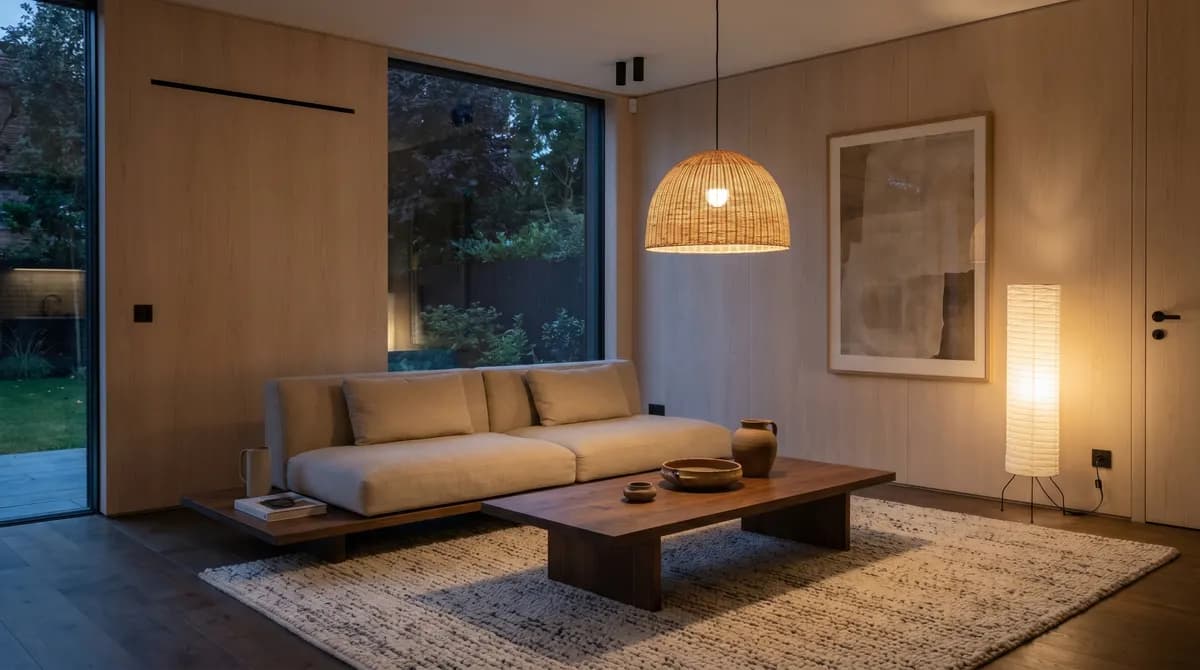
Try Japandi Living Room in Your Own Room
Upload a photo of your real living room. Get a photorealistic Japandi redesign in about 30 seconds. 4 free credits, no card.
Generate Your Japandi Living Room FreeOther Japandi Rooms
Apply the same palette and principles to the rest of the home.


Other Living Room Styles
Same room, different aesthetic — explore the rest of the living room style library.


Japandi Living Room — Frequently Asked Questions
How is Japandi different from Scandinavian?
Do I really need two wood tones?
Can Japandi work in a small living room?
What flooring works for a Japandi living room?
How do I add warmth without breaking the minimalism?
Is Japandi a passing trend?
How to Design a Japandi Living Room
Five decisions, in this order. Skip any of them and the look will not land.
- 1
Choose your two wood tones
Pick one pale wood (oak or ash) and one dark wood (walnut or black-stained oak) and commit. The pale wood lives on the floor and the structural shelves. The dark wood lives on the coffee table, side tables and a single shelving accent. Two competing pale woods or two competing dark woods kills the discipline — one of each is the entire formula.
- 2
Buy the low linen sofa
70–75 cm seat height, three seats minimum, stonewashed linen upholstery in oat, no rolled arms, visible wood feet. This is the single most consequential purchase in the room and the one that pushes the horizon down to Japandi proportions. A 90 cm Western sofa will undo every other choice.
- 3
Add the washi paper lantern
An Akari-style floor lantern or column lantern in a corner, or a washi pendant over the coffee table. This is the single piece of lighting that separates Japandi from Scandinavian. It diffuses light in a way no fabric shade can match and reads as handmade rather than mass-produced. Buy genuine Isamu Noguchi or a respected reproduction; skip plastic imitations.
- 4
Compose the empty space
Negative space is the design in a Japandi living room. Each open shelf gets three objects maximum — one tall, one short, one round. The coffee table holds one stoneware piece and a stack of two books, nothing else. The walls hold zero gallery walls and at most one large piece of art or one calligraphy scroll. The eye must have somewhere to rest.
- 5
Layer warm 2700 K light at three heights
Plan three sources at three heights, all 2700 K and all dimmable: a blackened-steel pendant over the coffee table, a stoneware table lamp on a side table, and the washi floor lantern in a corner. Skip recessed ceiling downlights entirely if you can; if they are non-negotiable, dim them to 20 percent and let the three layered sources do the work.
Keep Exploring
Tools and guides that pair with this style.