Japandi Home Office Design Ideas: 12 Real Examples (2026 Guide)
A solid walnut desk, a low oak chair, a single washi paper pendant overhead and a great deal of empty wall. We unpack what makes a home office read as truly Japandi, then show 12 photorealistic examples.
- 12
- Real examples
- ~30s
- AI render time
- 4 free
- Credits, no card
What is Japandi Home Office Design?
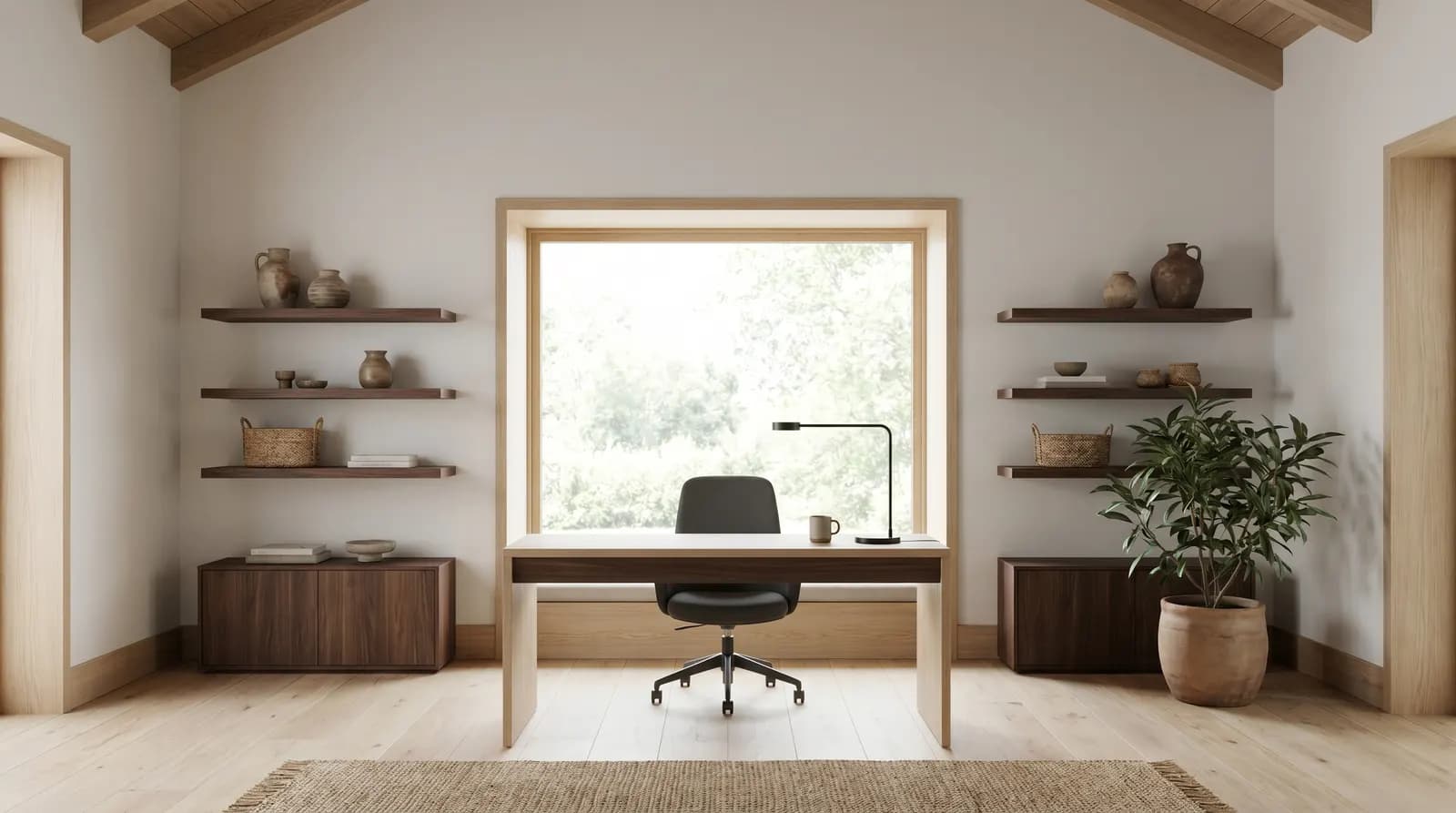
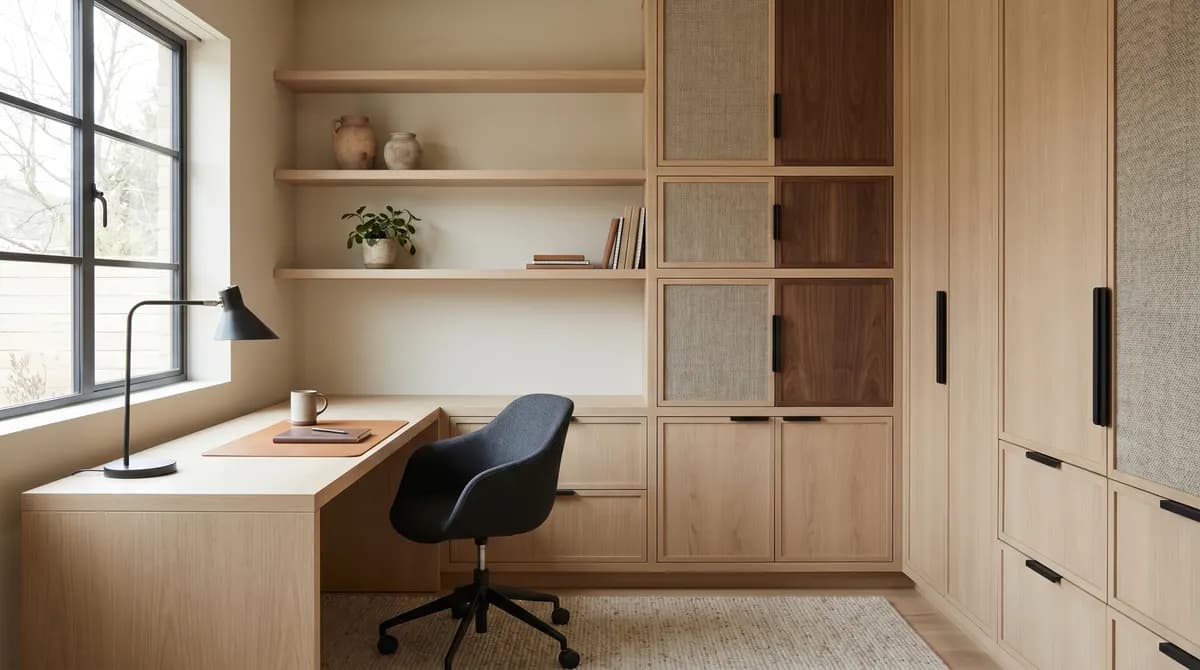
Japandi home office design is the deliberate fusion of Scandinavian craft furniture and Japanese ritual minimalism, applied to the place we now spend our working day. The desk is a solid walnut slab — or pale oak, with a walnut accent shelf above — on simple blackened-steel legs. The chair is a low oak frame with a paper-cord or thin linen seat. The walls are warm off-white plaster. The room is calm enough for a four-hour focus block and warm enough for a video call.
Three principles run through every authentic Japandi home office. First, the desk is the room: a single high-quality piece, sized for two screens and a notebook, and deep enough to push every plastic device behind it out of view. Second, two wood tones working together: walnut and pale oak, repeating between desk, chair, shelving and floor. Third, ruthless cable discipline — every cable, charger and dock hidden inside the desk or behind the credenza so the eye lands on wood, plaster and washi paper, never on a Logitech logo.
In 2026 Japandi has overtaken Scandinavian as the dominant home-office aesthetic in design press. It photographs as warm and personal on video calls, calms the eye during long focus sessions, and ages slowly. It pairs naturally with Japandi living rooms and Wabi-Sabi bedrooms. Done well, it is the rare home office that does not need to be tidied before a meeting starts.
12 Real Japandi Home Office Examples
Each example below is a complete look — not a mood board. Click any image to see it full-size, then hit the generate button to try the same combination on your own home office photo.
 1Example
 2Example
 3Example
 4Example
 5Example
 6Example
 7Example
 8Example
 9Example
 10Example
 11Example
 12Example
Key Design Elements
Colors
- Warm off-white plaster walls
- Oat and soft beige for textiles and curtains
- Charcoal and matte black accents
- Deep walnut for the desk and accent shelving
- Honey oak for floor and chair
Materials
- Solid walnut for the desk top
- Pale oak or ash for chair and shelving
- Blackened steel for desk legs and lamp
- Limewash or microcement walls
- Washi paper, linen and stoneware ceramics
Furniture
- Solid walnut plank desk on trestle base
- Low oak chair with paper-cord seat
- Slim oak credenza for storage along one wall
- Single open walnut shelf above the desk
- Tatami floor cushion for the reading corner
Lighting
- Washi paper pendant above the desk
- Blackened-steel swing-arm task lamp on the desk
- Single washi sconce by the credenza
- Warm 2700 K LED, dimmable, no cool downlights
- Beeswax candle on the desk for evening hours
Textiles
- Stonewashed linen seat pad on the oak chair
- Wool flatweave rug in oat under the desk
- Linen curtain in soft oat
- Single charcoal cushion on the reading cushion
- Stoneware desk caddy and ceramic pen cup
Japandi Home Office Color Palette
Six pigments do most of the work — start here, then add one accent of your own.
The base for plaster walls and ceiling. Slightly warm so the walnut desk reads rich brown rather than yellow against the wall.
The dominant textile colour — chair pad, rug, curtain. Flatters skin on video calls and calms the eye during long focus blocks.
The strict dark accent — blackened-steel desk legs, swing-arm task lamp, one charcoal cushion. Used like punctuation, never in volume.
The desk and the accent shelf above it — the deeper of the two wood tones. Visible grain, oil-finished, never lacquered.
Floor, chair frame and the credenza — the pale Scandinavian half of the equation. One pale wood tone, repeated.
A muted earthy brown for the pen cup, desk caddy and a small vase on the credenza. The handmade craft note that separates Japandi from Scandinavian.
Must-Have Furniture & Fixtures
If you only buy these seven, the room will read as authentically Japandi.
Solid walnut plank desk
A single walnut slab, 160–180 cm long, 70 cm deep, on simple blackened-steel trestle legs. Visible grain, oil-finished, no veneer. The single most consequential purchase in the room.
Low oak chair with paper-cord seat
A Hans Wegner-style oak desk chair with a paper-cord seat, or a Carl Hansen CH37. About 75 cm overall height — keeps the Japandi horizon down. Comfortable for two-hour blocks; pair with a hidden ergonomic chair for longer sessions if needed.
Washi paper pendant
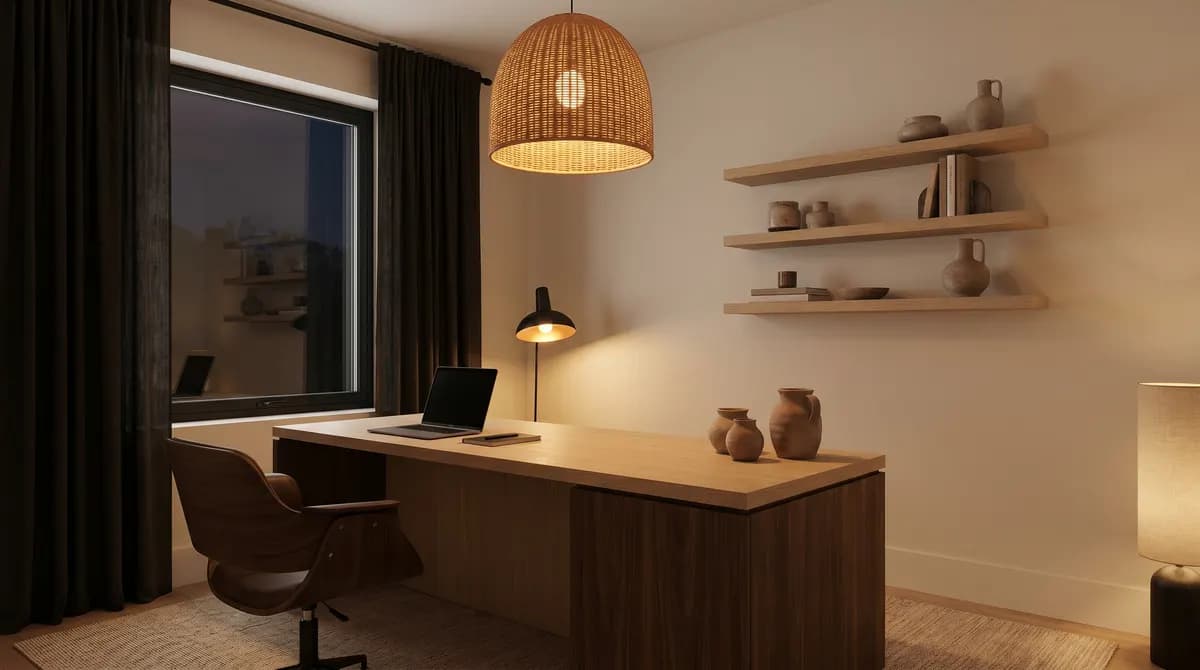
A single Akari-style washi paper pendant centred over the desk, hung 80 cm above the surface. Diffuses light beautifully on a video call and reads as deliberately Japandi rather than generic Scandinavian.
Blackened-steel swing-arm task lamp
A clamped or wall-mounted swing-arm lamp in matte blackened steel with a small linen shade. Replaces a clip-on lamp and frees the desk surface for the work.
Slim oak credenza
A long slim oak credenza along one wall, 40 cm deep with sliding doors. Holds the printer, files, cables and dock — everything plastic the eye should not land on.
Open walnut accent shelf
One single walnut shelf above the desk, styled with three objects: a stack of two books, one stoneware vessel, one small ceramic. Negative space is the design.
Tatami floor cushion
A single zabuton or tatami floor cushion in a corner for the reading break. The visual cue that this is a Japandi room and not just a Scandinavian one.
Common Mistakes to Avoid
Black mesh ergonomic chair visible in the room — kills the discipline instantly. Use a low oak chair as the visible chair and keep a hidden ergonomic chair tucked behind the credenza for long sessions if needed.
Cable clutter — three power strips, a tangle of USB-C cables and a charger maze under the desk. Drill one cable hole, route everything to a single channel into the credenza, and finish the underside of the desk with a linen sleeve. Cables are the test.
Cool LED ceiling lights at 4000 K — make walnut look grey and oat linen look green. Specify 2700 K everywhere, dimmable, with the washi pendant as the main source.
Gallery wall behind the desk — instantly tips the room into Mid-Century or Bohemian. One framed calligraphy scroll or one monochrome photograph maximum. Empty wall is the design.
Plastic desk accessories — neon highlighters, plastic pen holder, branded mouse pad. Replace with stoneware pen cup, leather notebook, linen mouse pad. The eye should land on wood, plaster and craft objects.
Try Japandi Home Office in Your Own Room
Upload a photo of your real workspace. Get a photorealistic Japandi redesign in about 30 seconds. 4 free credits, no card.
Generate Your Japandi Home Office FreeOther Japandi Rooms
Apply the same palette and principles to the rest of the home.


Other Home Office Styles
Same room, different aesthetic — explore the rest of the home office style library.


Japandi Home Office — Frequently Asked Questions
Can I still be productive with a low oak chair instead of an ergonomic mesh one?
What is the right desk for a Japandi home office?
How do I hide cables and tech in a Japandi office?
What plants work in a Japandi home office?
How is Japandi different from Scandinavian for a home office?
Does Japandi work in a small or windowless home office?
How to Design a Japandi Home Office
Five decisions, in this order. Skip any of them and the look will not land.
- 1
Buy the walnut desk first
The desk is the room — choose it before anything else. A solid walnut plank, 160–180 cm long, 70 cm deep, on simple blackened-steel trestle legs. Visible grain, oil-finished. Skip veneer, skip MDF, skip chrome. This is the single most consequential purchase in the room and the one that justifies the rest of the budget.
- 2
Pick a single pale wood for chair, floor and storage
Pale European oak is the safest specification. Use it for the chair frame, the credenza, the open accent shelf and ideally the floor. The walnut desk sits as the single dark wood against this pale family. Two competing pale woods (oak plus ash, for example) is the fastest way to look amateur.
- 3
Hang the washi pendant and add the task lamp
One large Akari-style washi paper pendant centred over the desk, hung 80 cm above the surface. Add one blackened-steel swing-arm task lamp clamped to the desk. Both at 2700 K, both dimmable. This pair of light sources is what separates a Japandi office from a Scandinavian one; the pendant for ambient warmth, the swing-arm for task focus.
- 4
Hide everything plastic in a closed credenza
A slim oak credenza along one wall, 40 cm deep with sliding doors, holds the printer, dock, files, cables and chargers. The single rule is that any object made of plastic must live inside it. The eye in a Japandi office should land on wood, plaster, washi paper and ceramic — never on a logo or a coloured plastic shell.
- 5
Style with one craft vignette
A stoneware pen cup, a leather notebook, a single Japanese maple branch in a tall ceramic vase, and a beeswax candle for evening. Three objects on the open shelf above the desk: a stack of two books, one stoneware vessel, one small ceramic. Stop there. Japandi is the discipline of empty surfaces; the empty space is what makes the office calm.
Keep Exploring
Tools and guides that pair with this style.