Japandi Dining Room Design Ideas: 12 Real Examples (2026 Guide)
A live-edge walnut table on blackened-steel legs, low oak chairs, a washi paper pendant overhead and a great deal of empty wall. We unpack what makes a dining room read as Japandi, then show 12 photorealistic examples.
- 12
- Real examples
- ~30s
- AI render time
- 4 free
- Credits, no card
What is Japandi Dining Room Design?
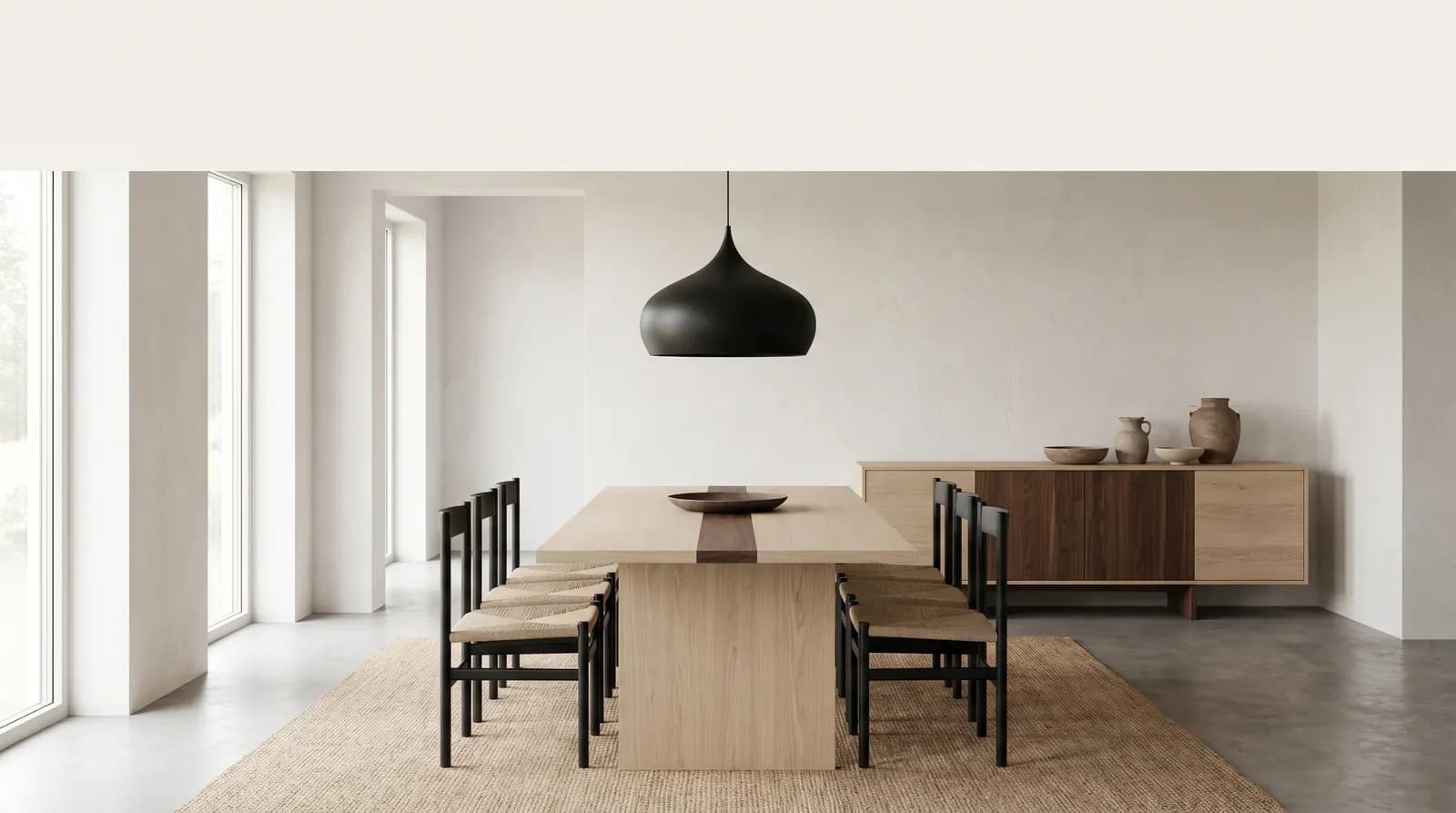
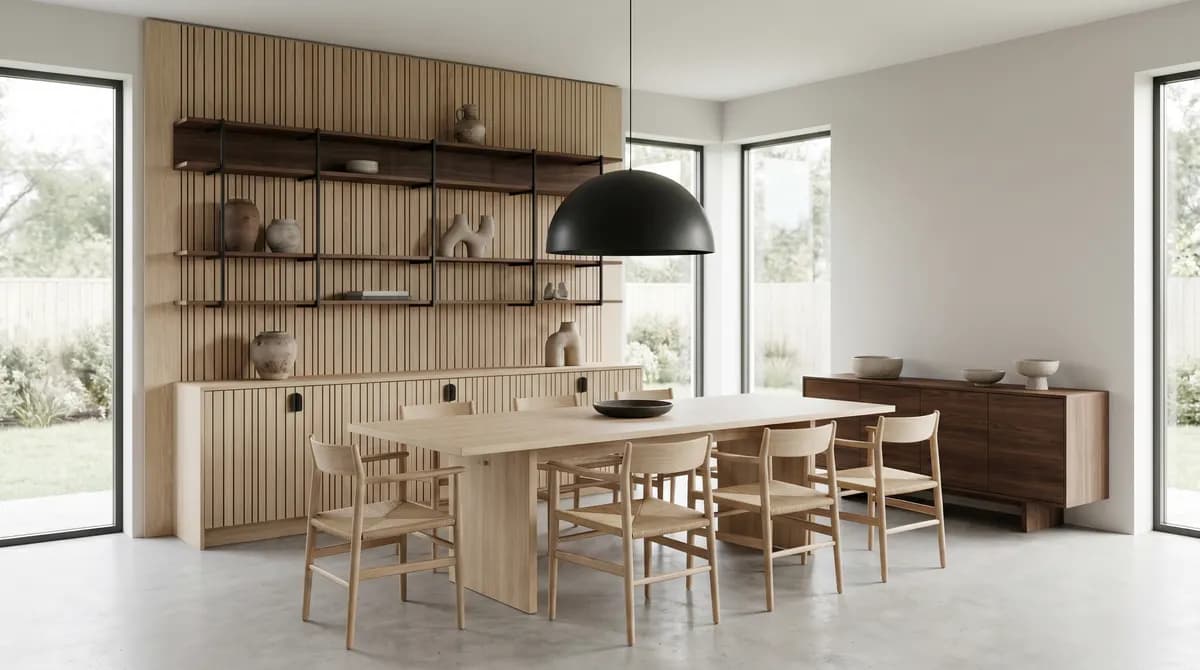
Japandi dining room design is the deliberate fusion of Scandinavian craft furniture (Hans Wegner, Børge Mogensen) and Japanese ritual minimalism. The room is built around a single dining table — usually a long live-edge walnut or oak slab — and a set of low-backed chairs in a complementary wood. Walls are warm off-white plaster, the ceiling holds one washi paper pendant, and the floor is wide-plank pale oak. The room reads as both informal and ceremonial at once.
Three principles run through every authentic Japandi dining room. First, the table is the room: it is selected first, usually for ten to thirty years of use, and every other choice follows from it. Second, two wood tones working together — a pale floor and a darker table top, or a pale table top and walnut chairs. Third, ruthless edge editing: zero gallery walls, zero ornate light fittings, zero decorative bowls beyond the single one in the centre of the table.
In 2026 Japandi has displaced both Mid-Century Modern and Modern Farmhouse as the dominant dining-room idiom in serious design press. It pairs naturally with Japandi living rooms and Scandinavian kitchens, photographs beautifully under both daylight and evening pendant glow, and unlike trend-driven looks it is genuinely built around a piece of furniture (the table) rather than a styling moment.
12 Real Japandi Dining Room Examples
Each example below is a complete look — not a mood board. Click any image to see it full-size, then hit the generate button to try the same combination on your own dining room photo.
 1Example
 2Example
 3Example
 4Example
 5Example
 6Example
 7Example
 8Example
 9Example
 10Example
 11Example
 12Example
Key Design Elements
Colors
- Warm off-white plaster walls
- Oat and soft beige for upholstery and curtains
- Charcoal and matte black accents
- Deep walnut for the table
- Honey oak for chairs, floor and shelving
Materials
- Live-edge walnut for the table top
- Pale oak or ash for chairs and floor
- Blackened steel for table legs and pendant
- Limewash or microcement walls
- Washi paper and stoneware ceramics
Furniture
- Long live-edge walnut dining table
- Low-backed oak or ash dining chairs
- Optional tatami bench seat on one side
- Slim oak credenza along one wall
- Single open shelf with three styled objects
Lighting
- Washi paper pendant centred over the table
- Floor-to-ceiling window where possible
- Warm 2700 K LED, dimmable, no overheads
- Single washi sconce on the credenza wall
- Beeswax candle on the table for evening meals
Textiles
- Stonewashed linen runner down the table
- Linen napkins in oat and charcoal
- Sisal or wool flatweave rug under the table
- Wool throw on the bench seat for evening
- Stoneware bowls and cups in muted clay tones
Japandi Dining Room Color Palette
Six pigments do most of the work — start here, then add one accent of your own.
The base for plaster walls and ceiling. Always slightly warm so the walnut table does not turn yellow against a cool wall.
The dominant linen and curtain tone — table runner, napkins, an upholstered chair seat. Calm and forgiving.
Strict accent — the blackened-steel pendant and table legs, a single charcoal cushion, one matte-black ceramic. Used like punctuation.
The table — the deeper of the two wood tones, the room's anchor. Visible grain, end-grain showing on the slab edges, oil-finished never lacquered.
The floor and the chairs — the pale Scandinavian half of the equation. Two competing oak tones is the fastest way to look amateur.
A muted earthy brown for ceramics — table bowls, vases, the soap dish on the credenza. The handmade craft note that separates Japandi from Scandinavian.
Must-Have Furniture & Fixtures
If you only buy these seven, the room will read as authentically Japandi.
Live-edge walnut dining table
A solid walnut slab, 220 cm minimum for a six-seater, on blackened-steel trestle or square legs. Visible knots, sap lines and natural curvature on the long edges. Skip veneer, skip oval rounded edges, skip glass tops.
Wegner CH24 Wishbone chairs
The canonical Japandi dining chair — Hans Wegner's CH24 in soaped or oiled oak with a hand-woven paper-cord seat. Six minimum. The most photographed Japandi chair on Earth for good reason.
Washi paper pendant
A single large Akari-style washi paper pendant centred over the table, hung 70–80 cm above the surface. Diffuses light beautifully and reads as deliberately Japanese rather than generic Scandinavian.
Oak credenza
A long slim oak credenza along the back wall, 40–50 cm deep with sliding doors. Holds glassware, linens and dinner plates. Doubles as a serving surface during dinners.
Sisal flatweave rug
A large natural-sisal or wool flatweave rug under the table, sized so all four chair legs sit on it when pulled out. Skip pile rugs and skip patterns — the rug is part of the calm.
Stoneware tableware set
Hand-thrown stoneware in muted clay, oat or charcoal — six dinner plates, six bowls, six cups. Mismatched glazes are fine; matching brand-new gloss-ceramic sets are too clinical.
Single statement vessel
One large hand-thrown stoneware vase or wide ceramic bowl in the centre of the table at all times. Holds a single branch (cherry, maple, eucalyptus) — never a busy mixed bouquet.
Common Mistakes to Avoid
Rectangular factory-cut walnut top — kills the look. The slight irregularity of a live edge is the entire point. Specify a true live-edge slab from a furniture maker, not a veneered rectangular table in walnut finish.
High-backed upholstered chairs — they break the low Japandi horizon and read as Modern Farmhouse instead. Specify low-backed wood-frame chairs with paper-cord or thin upholstery.
Brass or chrome pendant — Japandi is blackened steel. A brass cluster pendant tips the room into Mid-Century Modern; chrome tips it into Modern Hotel. Stay disciplined.
Gallery wall behind the table — empty wall is the design. One framed calligraphy scroll or one large monochrome photograph maximum. Never a cluster of frames.
Matching glossy tableware set — the brand-new shiny six-piece dinner set kills the handmade calm instantly. Build the table setting from hand-thrown stoneware in muted clay; slight variation is the point.
Try Japandi Dining Room in Your Own Room
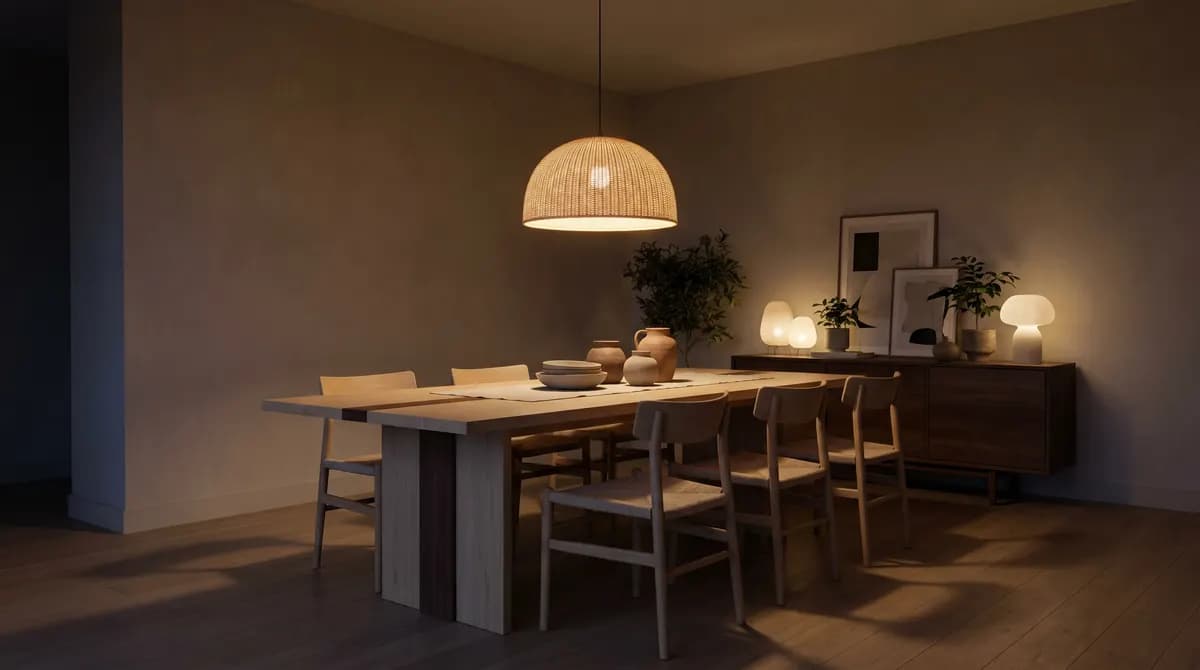
Upload a photo of your real dining room. Get a photorealistic Japandi redesign in about 30 seconds. 4 free credits, no card.
Generate Your Japandi Dining Room FreeOther Japandi Rooms
Apply the same palette and principles to the rest of the home.


Other Dining Room Styles
Same room, different aesthetic — explore the rest of the dining room style library.


Japandi Dining Room — Frequently Asked Questions
What is the right dining table for a Japandi room?
How many chairs and which model?
What kind of pendant works over a Japandi table?
How do I light a Japandi dining room beyond the pendant?
How is Japandi different from Mid-Century Modern for a dining room?
Does a Japandi dining room work in an open-plan kitchen?
How to Design a Japandi Dining Room
Five decisions, in this order. Skip any of them and the look will not land.
- 1
Buy the table first
The table is the room — choose it before anything else. A live-edge walnut slab on blackened-steel legs is the canonical specification. Length matched to your space (220 cm for six, 260 cm for eight, 300+ cm for ten). Every other choice in the room follows from this single decision, so do not compromise on it.
- 2
Pick the chair model
Hans Wegner CH24 Wishbone or Børge Mogensen J39 Shaker are the two canonical options, both in soaped or oiled oak. Six chairs minimum, all identical. Mixing two chair models is a Mid-Century styling trick that does not work in Japandi — the discipline is one chair model repeated.
- 3
Hang the washi pendant
One Akari-style washi paper pendant, centred over the table, 70 to 80 cm above the surface. This is the single piece of lighting that pushes the room from Scandinavian into Japandi. Buy genuine Noguchi or a respected reproduction; the diffusion of light through real washi paper is the design.
- 4
Empty the walls
Empty wall is the design in a Japandi dining room. One framed calligraphy scroll, one large monochrome photograph, or one woven textile — maximum, on one wall. The other three walls remain bare plaster. A gallery wall instantly tips the room into Bohemian or Mid-Century, not Japandi.
- 5
Style the table with one vessel
A single large hand-thrown stoneware vase or wide ceramic bowl centred on the table at all times. Holds a single branch — cherry blossom in spring, eucalyptus in summer, dried hydrangea in autumn, bare beech twigs in winter. One stem, one season, one vessel. Stop there.
Keep Exploring
Tools and guides that pair with this style.