Scandinavian Facade Design
Guide to facade design in Scandinavian Facade style: materials, colors, architectural solutions, and examples
The Scandinavian house facade has evolved from the traditional red Falu-painted timber cabin (popularized in 1700s Sweden) through 1950s functionalist modernism to today's "Nordic black" aesthetic — vertical charred wood cladding (shou sugi ban inspired), steeply pitched gables, and minimal ornamentation. The look reflects a climate of long winters, abundant timber, and a cultural preference for honest materials over decoration.
What makes the Scandinavian facade distinctive
Four elements signal a contemporary Scandinavian exterior: vertical wood cladding in black, charred timber, or pale pine; simple steeply pitched gable roofs (often 35–45 degrees); large window openings with minimal frames; and a disciplined two-tone palette — usually black-and-white, charcoal-and-pale-wood, or red-and-white in traditional iterations.
Material palette
- Cladding: vertical pine/spruce (black-stained, charred, or pale), board-and-batten, fiber cement planks
- Roof: standing-seam metal (black or grey), corrugated steel, or dark slate — always simple gables
- Windows: large rectangular openings, black or charcoal aluminum frames, minimal trim
- Trim: black contrast trim around windows; white-painted timber on traditional homes
- Foundation: board-formed concrete, basalt, or natural stone base
Color palettes
Modern Nordic Black: charcoal/black vertical cladding + pale oak entry door + black-framed windows + standing-seam dark grey roof. Traditional Falu Red: deep red-oxide cladding + white trim + black metal roof + white window frames. Modern Pale: light grey or whitewashed pine cladding + black trim + black roof. Contemporary Mixed: charred timber lower half + white render upper half + black roof.
Common mistakes
- Horizontal lap siding. Scandinavian facades are vertical — the verticality is essential to the silhouette.
- Complicated roof shapes. Hip roofs, dormers, and roof breaks fight the style. Simple gables only.
- Ornate trim. Scandinavian exteriors are flat-detailed — no Victorian gingerbread, no shaker shingles in patterns.
- Wrong window proportions. Use tall vertical or large rectangular openings — never small multi-pane Colonial windows.
Budget approach
For renovations: paint existing horizontal siding charcoal or black, replace existing windows with black-frame aluminum or vinyl alternatives, simplify entry-door trim, and update the front door to pale oak or black. The single most transformative move is painting the entire exterior matte black with white window trim.
Upload a photo of your house and our AI redraws it in Scandinavian facade style in seconds — free to try.

Nyckelelement i stilen Scandinavian Facade
Vertical Wood Cladding
Pine or spruce boards run vertically — stained black, charred, or left pale — defining the unmistakable Nordic silhouette.
Steep Gable Roofs
Simple symmetrical gables pitched at 35-45 degrees shed Nordic snow and create the iconic house-shaped profile.
Black Window Frames
Large rectangular windows with slim black or charcoal aluminum frames create high-contrast graphic openings.
Two-Tone Palette
Disciplined black-and-white, charcoal-and-pale-wood, or traditional Falu red-and-white color schemes — never more than two main tones.
Minimal Ornamentation
Flat trim details, no decorative brackets, no shutters, no Victorian flourishes — the wood itself is the design.
Stone Foundation
Board-formed concrete or natural basalt foundations anchor the wood cladding visually and protect against ground moisture.
Prova att skapa din egen design
Ladda upp ett foto av ditt hus och få en professionell fasaddesign på 30 sekunder. De första 3 designerna är gratis.
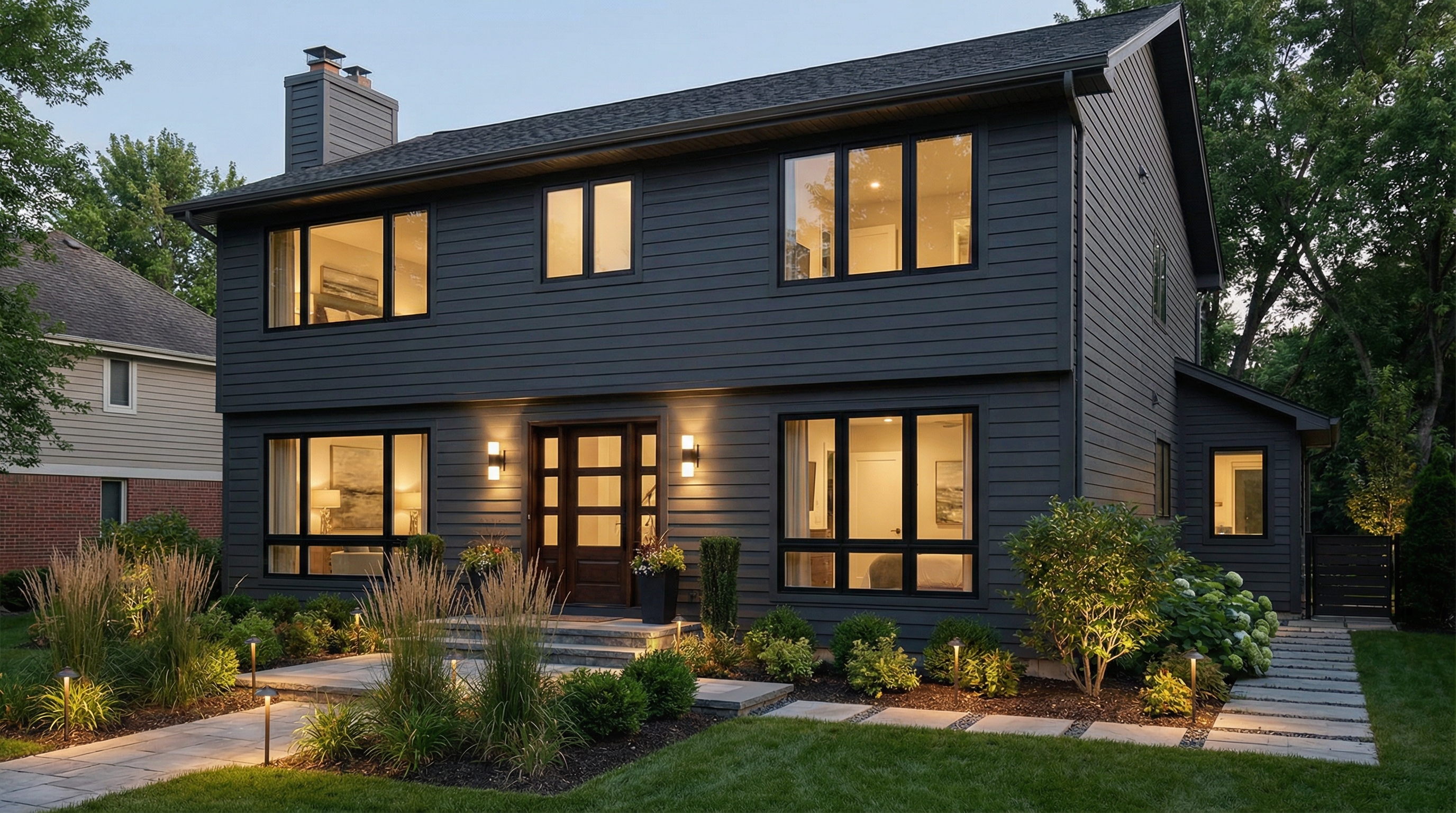
Scandinavian Facade: fasaddesign
Se fler exempel i galleriet för stilen Scandinavian Facade eller det fullständiga designgalleriet.
Vanliga frågor: fasaddesign i stilen Scandinavian Facade
- Vertical wood cladding (often black-stained or charred), a simple steeply pitched gable roof, large rectangular black-framed windows, and a disciplined two-tone palette. Minimal trim and no decorative ornamentation.
- Black-stained or pine-tar-treated wood has practical roots in Nordic preservation traditions — the dark coating extends timber lifespan in harsh climates. Aesthetically, black facades absorb winter sun, contrast beautifully with snow, and emphasize the wood texture.
- A simple symmetrical gable pitched between 35 and 45 degrees. Material: standing-seam metal in dark grey or black, corrugated steel, or dark slate. Avoid hipped roofs, mansards, dormers, and roof breaks — they fight the style.
- Yes — paint the exterior charcoal or matte black, replace window frames with black aluminum or vinyl, remove decorative trim, simplify the entry door, and add board-and-batten vertical cladding on at least one facade plane.
- Falu red (Faluröd) — a deep red-oxide pigment originally produced as a byproduct of copper mining at Falun, Sweden since the 1700s. Paired with white window trim and a black roof, it remains the iconic traditional Scandinavian palette.
- The aesthetic adapts to fiber cement planks, dark stucco, and metal cladding. The essential elements are vertical pattern, simple gable form, large dark-framed windows, and a disciplined two-tone palette — material is secondary.
- The architecture supports efficiency well — simple compact volumes minimize wall area, steep roofs shed snow, dark cladding absorbs winter solar gain, and small vestibule entries reduce heat loss. Pair with modern insulation and triple-glazed windows for high performance.