English Cottage Garden Design
Guide to landscape design in English Cottage Garden style: features, plants, materials, and examples
The English cottage garden traces to medieval working gardens of rural England, where peasants packed small plots with herbs, fruits, vegetables, and flowers in dense informal abundance. The aesthetic was romanticized and codified by William Robinson in his 1883 book The English Flower Garden and refined by Gertrude Jekyll (1843-1932) into the disciplined-yet-romantic style still copied today. Her partnership with architect Edwin Lutyens created the foundation of 20th-century English garden design.
What makes an English cottage garden distinctive
Six hallmarks: dense profuse planting with no visible soil, mixed perennials, roses, herbs, and self-seeding annuals, winding informal paths, climbing roses and clematis on every vertical surface, traditional materials (brick paths, stone walls, weathered timber fences, picket gates), and a romantic color palette dominated by pinks, blues, whites, and silvers.
Plant palette
- Roses: David Austin English roses, climbing roses (Albertine, New Dawn), rambling roses (Rambling Rector)
- Perennials: delphiniums, lupines, foxgloves, peonies, phlox, salvia, hardy geraniums, lady's mantle
- Annuals/biennials: hollyhocks, sweet peas, cosmos, cornflowers, sweet William, nicotiana
- Herbs: lavender, rosemary, sage, thyme, chives, mint, fennel — integrated into ornamental beds
- Climbers: clematis (montana, viticella, large-flowered), wisteria, honeysuckle, jasmine
Hardscape elements
Paths: winding brick, weathered York stone flags, gravel with stone edging — never straight or rectilinear. Walls: dry-stacked Cotswold stone, mellow red brick, lime-washed white. Fences and gates: traditional white picket fence, weathered oak post-and-rail, painted wooden garden gate. Structures: wood pergolas swathed in wisteria/roses, painted wooden benches, traditional greenhouses, small wooden potting sheds. Edging: low boxwood hedges, lavender edging, or simply allowed to spill over path edges.
Common mistakes
- Too much order. English cottage gardens are intentionally informal and abundant — straight lines and rigid spacing break the style.
- Bare soil. Cottage gardens are planted so densely no soil shows — the layered planting suppresses weeds and creates the abundant look.
- Wrong color palette. Stick to romantic palette (pinks, blues, whites, soft yellows, silvers). Avoid bedding-plant orange and harsh reds.
- Forgetting climbers. Every vertical surface in a true cottage garden hosts a rose, clematis, or wisteria. Bare walls and fences fail the style.
Budget approach
Cottage gardens reward enthusiastic growing and patience. Self-seeding annuals (foxgloves, cosmos, hollyhocks) cost $5 per seed packet and naturalize permanently. Mail-order David Austin roses ($30-60 each) deliver authentic English bloom. Replace lawn with mixed perennial beds at the rate of 30% per year over 3-4 years to spread cost. A full cottage garden transformation runs $1,500-5,000 over 2-3 years.
Upload a photo of your yard and our AI redraws it as an English cottage garden in seconds — free to try.
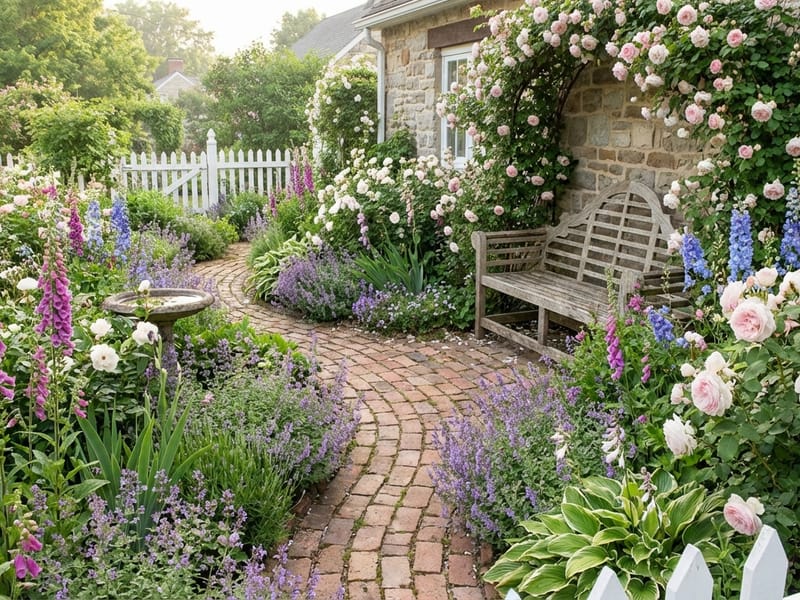
Elementele cheie ale stilului English Cottage Garden
Profuse Mixed Planting
Roses, perennials, herbs, and self-seeding annuals packed together with no visible soil create the abundant cottage garden look.
David Austin Roses
English roses bred by David Austin combine old-rose fragrance and form with modern repeat flowering, anchoring cottage garden borders.
Climbing Plants Everywhere
Clematis, climbing roses, wisteria, and honeysuckle cover walls, fences, pergolas, and arches — every vertical surface is planted.
Winding Stone Paths
Curving brick, weathered York stone, or gravel paths with stone edging snake through dense planting, revealing the garden gradually.
Hollyhocks and Foxgloves
Tall biennials and self-seeders (hollyhocks, foxgloves, delphiniums, lupines) provide the vertical bloom spikes that punctuate cottage borders.
Romantic Color Palette
Pinks, soft blues, whites, lavender purples, and silvery foliage create the unmistakable English cottage atmosphere across all seasons.
Încearcă să-ți creezi propriul design
Încarcă o poză a curții tale și primești un design peisagistic profesional în 30 de secunde. Primele 2 designuri sunt gratuite.
English Cottage Garden: design peisagistic
Vezi mai multe exemple în galeria stilului English Cottage Garden sau în galeria completă de design.
FAQ: design peisagistic în stil English Cottage Garden
- An English cottage garden is a dense, informal planting style packing roses, mixed perennials, herbs, and self-seeding annuals into abundant beds with no visible soil. It originated in medieval rural England and was codified by William Robinson (1883) and Gertrude Jekyll in the late 19th century.
- Roses (especially David Austin English roses), delphiniums, lupines, foxgloves, hollyhocks, peonies, lavender, geraniums, lady's mantle, salvia, and climbers (clematis, wisteria, honeysuckle). Mix perennials with self-seeding annuals for year-round abundance.
- Wildflower meadows are naturalistic plantings of native species in grass, mowed annually. Cottage gardens are cultivated ornamental plantings of garden cultivars — roses, peonies, lupines, delphiniums — densely packed in beds with paths between. Both are informal but very different traditions.
- Beautifully — historically cottage gardens were tiny working plots (typically under 50 square meters). The dense planting maximizes a small area. Use winding paths, vertical climbers on every surface, and packed mixed borders to make a small garden feel abundant.
- No — they require ongoing attention. Deadheading roses (weekly in summer), dividing perennials every 3-4 years, training climbers, weeding and replanting self-seeders, and seasonal mulching. Expect 4-8 hours per week on a medium garden during the growing season.
- Romantic palette: soft pinks, lavender purples, deep blues, whites, soft yellows, and silvery-grey foliage. Pastels and deeper jewel tones (deep pink, navy, oxblood roses) both fit. Avoid harsh oranges, primary yellows, and bright reds — they break the romantic feel.
- Strongly recommended — climbing and rambling roses are central to the English cottage look. Train them up walls, over fences, and onto pergolas. Recommended varieties: Albertine, New Dawn, Rambling Rector, Cécile Brünner, and climbing David Austin varieties.