Spanish Courtyard Design
Guide to landscape design in Spanish Courtyard style: features, plants, materials, and examples
Spanish courtyard design — the patio interior — has shaped Iberian houses since the Romans, refined through 800 years of Moorish rule (711-1492) and continued under Christian Spain. The form is unique in southern Europe: a central open-air courtyard at the heart of the house, with rooms opening inward to it rather than outward to the street. The most famous examples are in Cordoba (whose 50,000-courtyard tradition has been recognized by UNESCO since 2012), Seville, Granada and Toledo, with later colonial expressions in Mexico, Peru and the American Southwest.
Materials and plants
Hardscape is dominant: hand-painted azulejo tile (blue-and-white Sevillian or polychrome Triana), terracotta floor tile, wrought iron furniture and grilles, whitewashed lime-plaster walls, marble or stone fountain in the center. Plants are containerized — citrus trees (orange, lemon, kumquat) in large terracotta pots, geraniums (Spain's national flower for patios) cascading from wall pots, jasmine climbing trellises, bougainvillea on walls, and herbs (mint, basil, oregano) in clusters. A central palm or olive tree provides shade.
Design elements
The patio is typically square or rectangular, with 2-3 meter walls. A central fountain provides cooling and white noise; tile-mosaic seating benches line the walls; an arched colonnade or simple deep eave shades one or two sides. Wall pots in clusters of 5-15 hold geraniums and herbs (the famous "white walls and red geraniums" of Andalusia). Wrought-iron lanterns light the space at night. The floor is tiled or laid in stone.
Climate notes
Spanish patios are designed for hot dry Mediterranean climates (USDA zones 9-10 ideal). The high walls and shade trees moderate summer heat; the open floor plan allows winter sun. In colder climates, hardy citrus and frost-tolerant alternatives work; the architectural form translates everywhere.
Common mistakes
Don't skip the central fountain — it is climate-functional and acoustically essential. Don't use modern furniture; wrought iron, painted wood and tile-mosaic benches are the language. Don't over-plant: Spanish patios use containerized plants in clusters, not ground beds.
Budget tips
Authentic Sevillian azulejo runs $10-25 per tile (Triana sellers ship internationally). A wrought-iron table and chairs set is $400-1,200. A small central fountain in cast stone is $1,500-4,000. Mature potted citrus is $200-500 per tree. A complete Spanish patio refresh on a 30-50 sq m courtyard is typically $15,000-40,000. Upload a photo of your yard and our AI redraws it in Spanish courtyard style in seconds — free to try.
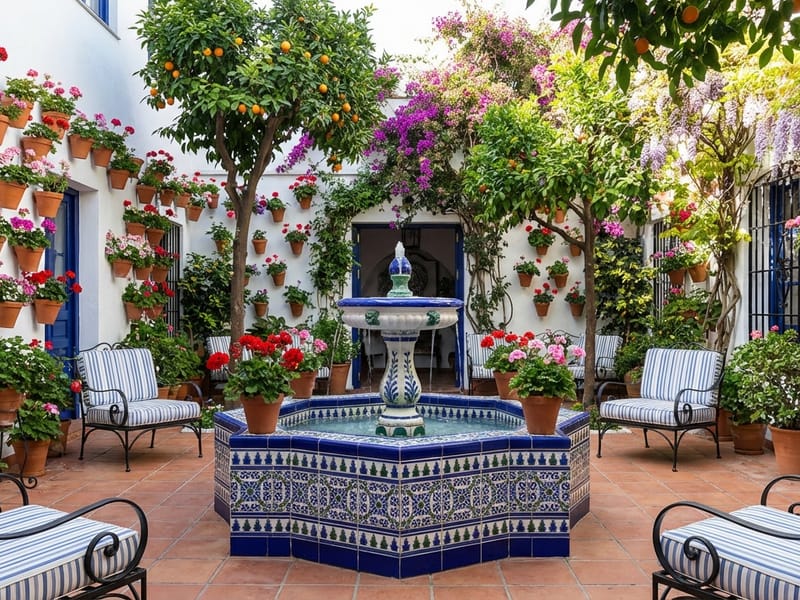
Kluczowe elementy stylu Spanish Courtyard
Central Fountain
A geometric tile or stone fountain at the heart of the patio, providing cooling, white noise and visual focus.
Azulejo Tile Surfaces
Hand-painted blue-and-white or polychrome Spanish tile on benches, fountain basins, dadoes and risers throughout the patio.
Whitewashed Walls
High lime-plaster walls in chalky white, typically 2-3 meters tall for privacy and to provide shade through the day.
Geranium Wall Pots
Clusters of terracotta wall pots holding red geraniums — the iconic Andalusian patio image, often 50+ pots on a single wall.
Containerized Citrus
Orange, lemon and kumquat trees in large terracotta pots, providing fragrance, color and structural plant interest.
Wrought Iron Furniture
Painted wrought-iron tables, chairs and lanterns with classical scroll detailing — the Spanish patio furniture tradition.
Spróbuj stworzyć własny projekt
Prześlij zdjęcie swojego ogrodu i otrzymaj profesjonalny projekt krajobrazu w 30 sekund. Pierwsze 2 projekty są darmowe.
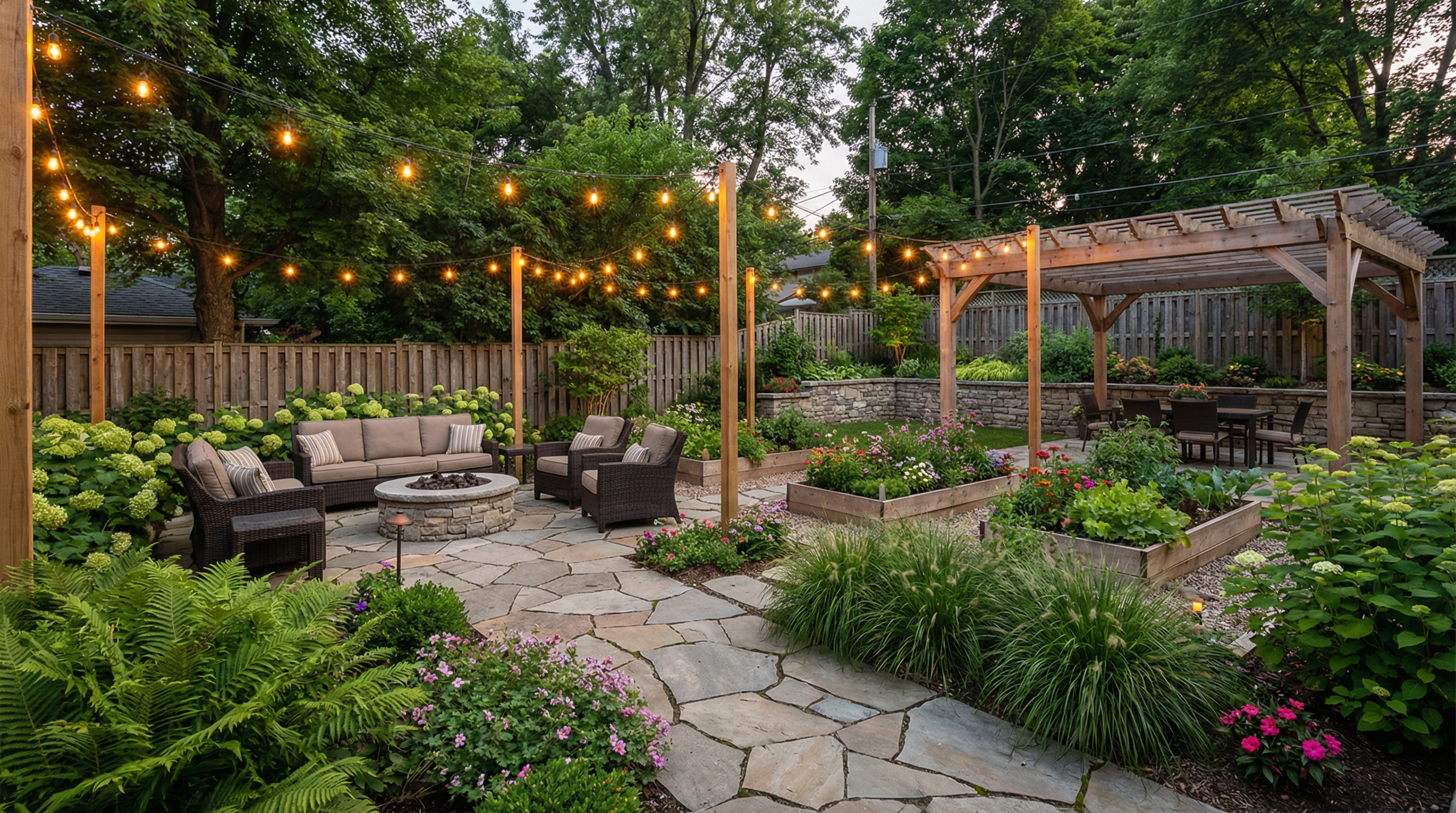
Spanish Courtyard: projekt krajobrazu
Zobacz więcej przykładów w galerii stylu Spanish Courtyard lub pełnej galerii projektów.
FAQ: projekt krajobrazu w stylu Spanish Courtyard
- A central open-air courtyard at the heart of a Spanish house, with rooms opening inward to it. The form developed over 2,000 years from Roman atria through Moorish riads to modern Andalusian patios.
- Hand-painted glazed ceramic tiles, typically blue and white, used in Spanish architecture since Moorish times. Major producers in the Triana neighborhood of Seville ship internationally.
- Spanish patios share Moorish roots but use more white space and less elaborate ornament. Plant style is also different: Spanish patios use containerized geraniums and citrus; Moroccan riads use more ground beds and citrus trees in the ground.
- Geraniums in red, pink and white planted in clusters of 30-100 wall pots is the iconic image of Andalusian patios. They provide color, fragrance and a strong vertical decorative element on white walls.
- Hot dry Mediterranean (USDA zones 9-10) is ideal. The form translates to other climates with hardy plant substitutions.
- Cordoba holds an annual Patio Festival every May (UNESCO-recognized since 2012). Seville and Granada also have many open-to-the-public courtyards in restored mansions.
- Strongly recommended — historically and aesthetically. A small wall-mounted fountain works if floor space is limited.