Neoclassic Interior Design
Guide to creating an interior in Neoclassic style: history, features, materials, color solutions, and examples
Neoclassic interior design is the late 18th and early 19th-century revival of ancient Greek and Roman architectural ideals. It emerged in Europe after the 1748 excavations of Pompeii revealed Roman interiors and triggered a continent-wide return to columns, pediments, symmetrical proportion and classical motifs. Designers like Robert Adam in Britain and Charles Percier in France codified the look, which dominated grand homes from the 1760s through the 1820s and influences high-end interiors to this day.
Materials and palette
The palette is restrained and architectural: cream, ivory, oyster, soft Wedgwood blue, pale green and gray. White marble (Carrara, Calacatta) is fundamental — used in fireplaces, columns and busts. Floors are wide oak with herringbone parquet, often with marble inlay borders. Walls are typically off-white with delicate plaster ornament: pilasters, swags, urns and Greek key friezes. Furniture is symmetrical and lean — Adam-style chairs, demi-lune consoles, klismos seating.
Room ideas
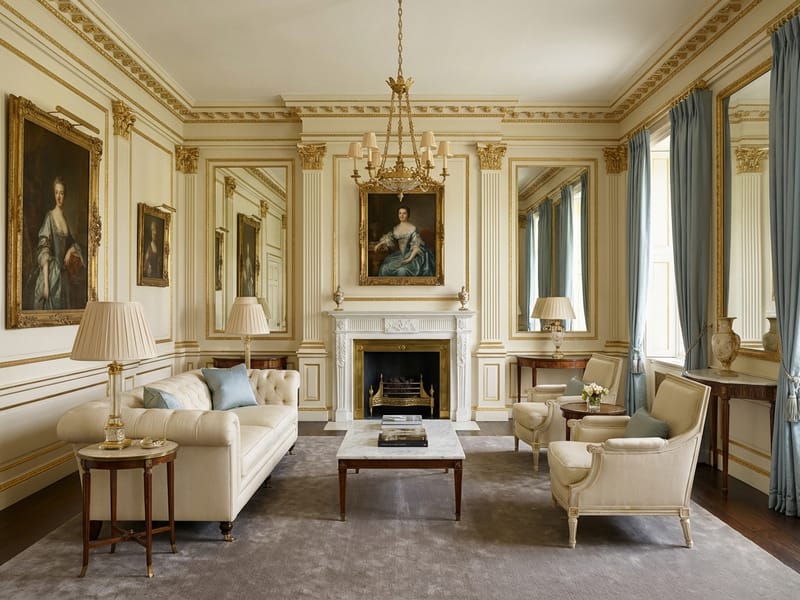
A neoclassic drawing room is built around symmetry: a marble fireplace centered on one wall, matched pairs of consoles, paired sconces, paired armchairs flanking the hearth. A large gilded mirror above the mantle, an antique chandelier and one or two classical busts on plinths complete the picture. Dining rooms feature a symmetrical pedestal table, klismos chairs and a Greek-key plaster cornice. Bedrooms use a fluted four-poster, white linen and a single classical landscape painting.
Common mistakes
Don't confuse neoclassic with classic or traditional — neoclassic is leaner, more architectural and more restrained. Avoid heavy Victorian ornament. Don't mix gold leaf with brass; pick one finish per room.
Budget tips
Plaster ornament (pilasters, friezes, ceiling medallions) can be applied to drywall for $200-600 per room total. Vintage gilded mirrors are widely available at auction. One marble bust or column can be sourced from architectural salvage for under $400. Upload a photo of your room and our AI redraws it in neoclassic style in seconds — free to try.
Zdjęcia wnętrz w stylu Neoclassic
Kluczowe elementy stylu Neoclassic
Classical Symmetry
Matched pairs of furniture, sconces and accessories balanced around a central focal point — usually a fireplace.
Marble & Plaster Ornament
White Carrara marble fireplaces and busts, with applied plaster pilasters, swags, urns and Greek-key friezes on walls.
Restrained Palette
Cream, ivory, oyster, pale Wedgwood blue and soft gray — architectural and quiet rather than colorful.
Klismos & Adam Furniture
Lean classical seating including klismos chairs, demi-lune consoles and Robert Adam-style upholstered furniture.
Herringbone Parquet
Wide-plank oak floors in herringbone pattern, often with marble inlay borders at doorways and edges.
Gilded Accents
Antique or reproduction gilded mirrors, picture frames and one or two pieces of furniture detail — used sparingly.
Spróbuj stworzyć własny projekt
Prześlij zdjęcie swojego pokoju i otrzymaj profesjonalny projekt w 30 sekund. Pierwsze 2 projekty są darmowe.
Neoclassic dla różnych pomieszczeń
Zobacz więcej przykładów w galerii stylu Neoclassic lub pełnej galerii projektów.
FAQ: wnętrze w stylu Neoclassic
- A late 18th and early 19th-century revival of ancient Greek and Roman design ideals — columns, symmetry, marble, restrained palette and classical ornament.
- Classic is a broader European tradition; neoclassic is specifically the Greek/Roman revival of c.1760-1830, which is leaner and more architectural than later Victorian classic.
- Robert Adam in Britain (1760s-90s), Charles Percier and Pierre Fontaine in France (1790s-1820s), and Charles Cameron in Russia for Catherine the Great.
- Pale "Adam" colors — soft pinks, Wedgwood blues, eau de Nil green, cream and gray. These were the actual color schemes documented in Adam interiors.
- Yes — the proportions and palette are classical, but pairing with one modern art piece or contemporary lighting keeps it from feeling like a museum.
- A repeating interlocking geometric pattern from ancient Greek decoration, used in plaster friezes, rug borders and textile trim in neoclassic interiors.
- Yes. One symmetrical wall arrangement, applied plaster moldings and a single marble accent (a fireplace, a bust on a plinth) can carry the look in any room size.