Minimalist Home Office Design Ideas: 12 Real Examples (2026 Guide)
A floating oak desk, one chair, one lamp, empty walls, hidden cables, and not a single inspirational quote print in sight — the minimalist home office is the architecture of focus. We unpack what makes it work, then show 12 photorealistic examples you can replicate.
- 12
- Real examples
- ~30s
- AI render time
- 4 free
- Credits, no card
What is Minimalist Home Office Design?
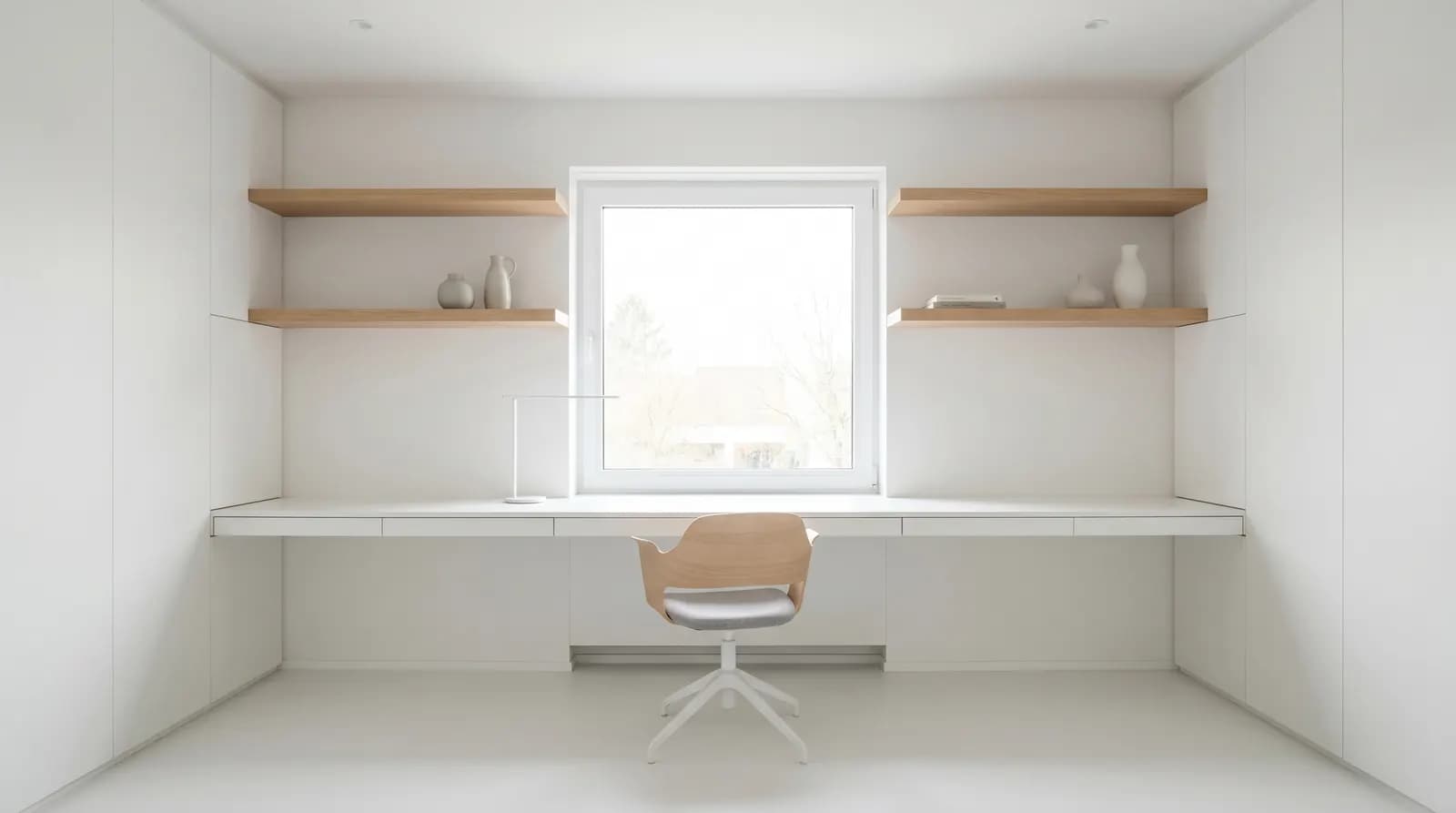
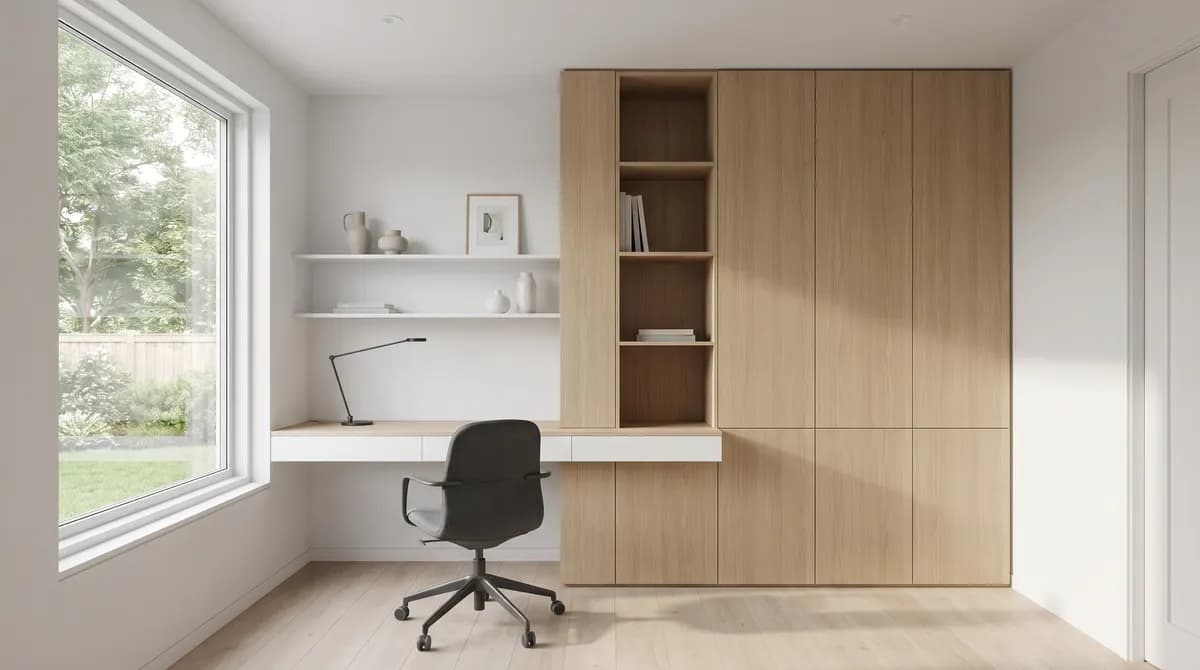
Minimalist home office design is the rejection of the office as a productivity-cosplay theatre. There are no inspirational quote prints, no whiteboards covered in sticky notes, no shelves of branded notebooks, no second monitor stacked at the wrong angle, no RGB peripherals. There is one floating oak desk against a single plaster wall, one ergonomic chair, one slim task lamp, one floating shelf with three objects, and a hidden cable system that means the eye sees no wires at all.
Three principles run through every authentic minimalist home office. First, restraint of objects: a visible object count under ten, including the chair, the desk, the monitor and the lamp. Second, integration of technology: every cable sleeved, every device powered through a single back-grommet, CPU on a wall bracket, router hidden in closed storage. Third, calibrated lighting: warm 2700 K LEDs at multiple low fixtures, plus a bias light strip behind the monitor for video calls — never a single overhead bulb.
In 2026 the minimalist home office is the dominant aesthetic among knowledge workers, writers, designers and anyone whose work needs sustained focus. It pairs naturally with Japandi (more wood and ceramic), Modern (richer materials) and Scandinavian (more visible textile), and is the safest style to commit to when the room appears in video-call backgrounds because empty walls always read more confident on a wide-angle lens. We treat it as the canonical reference point for the home-office Style × Room series.
12 Real Minimalist Home Office Examples
Each example below is a complete look — not a mood board. Click any image to see it full-size, then hit the generate button to try the same combination on your own room photo.
 1Example
 2Example
 3Example
 4Example
 5Example
 6Example
 7Example
 8Example
 9Example
 10Example
 11Example
 12Example
Key Design Elements
Colors
- Warm white lime plaster walls
- Oat for any visible textile
- Light greige for the rug
- Matte black on the monitor arm and lamp
- One pale honey oak tone across the desk and shelf
Materials
- Smooth lime plaster on every wall
- Pale honey oak on the floating desk top
- Full-grain leather on the desk pad
- Dark mesh or full-grain leather on the chair
- Stoneware ceramic as the only display object
Furniture
- Single wall-hung floating oak desk
- One ergonomic chair in dark mesh or leather
- One floating oak shelf above the desk
- Floor-to-ceiling handleless storage wall
- No console, no side chair, no second desk
Lighting
- One slim task lamp in matte black
- Bias light strip behind the monitor
- Cove LED uplighting at the ceiling perimeter
- Single wall sconce above the storage wall
- Every fixture dimmable, 2700 K only
Textiles
- Sheer linen panel on the window
- Single low-pile wool rug under the desk
- Full-grain leather desk pad covering the work area
- No throw, no cushions, no fabric on the chair
- Plain stoneware mug — the only soft-adjacent object
Minimalist Home Office Color Palette
Six pigments do most of the work — start here, then add one accent of your own.
The base wall colour, ideally applied as smooth lime plaster so the eye reads texture as well as colour. Slightly warmer than pure white.
The dominant textile colour on the linen panel. Carries the room visually and softens the hard plaster envelope on camera.
Used on the rug and any subtle storage tone. The neutral that links plaster, oak and metal without competing on a wide-angle lens.
Storage wall doors and any concrete surfaces. The grounding mid-tone that gives the room visual weight on a video call.
The strict accent — matte black monitor arm, lamp, chair frame and any wall hardware. Used sparingly, almost as punctuation.
Pale honey oak — the only warm tone in the room. Repeated on the desk top, the floating shelf and any wood detail.
Must-Have Furniture & Fixtures
If you only buy these seven, you will read as authentically minimalist.
Floating oak desk
Solid pale oak top, 140–160 cm wide, 55–60 cm deep, fixed to the wall with a hidden steel French cleat. No legs. Single grommet on the back edge.
Ergonomic chair
Herman Miller Aeron, Steelcase Leap or any honest equivalent in dark mesh or full-grain leather. Matte black frame, no logos, no coloured plastic.
Single monitor on arm
One monitor only, on a matte black gas-spring arm clamped to the back of the desk. CPU on a wall bracket under the desk. Cables sleeved through the back grommet.
Floating oak shelf
One 80 cm pale oak shelf above the desk, hidden bracket, holding three objects only — one plant, one art book, one ceramic.
Slim task lamp
Single articulated matte black or pale oak desk lamp, 2700 K dimmable bulb, low enough to clear the monitor when off. The only lamp in the room.
Full-grain leather desk pad
90×40 cm leather mat in oat, cognac or charcoal, covering the keyboard and mouse area. Replaces the need for a separate mouse pad and protects the desk.
Floor-to-ceiling storage wall
Handleless plaster-finish or pale oak veneer doors running floor to ceiling on one wall. Houses every drive, scanner, paper file, notebook and the router.
Common Mistakes to Avoid
Inspirational quote prints — printed posters, motivational sticker walls, framed company values. The minimalist home office has zero printed text on the walls; one large abstract canvas only, or nothing.
Visible cables — power bricks, USB cables, an extension cord, a power strip on the floor. Sleeve every cable, route through a single back grommet, wall-mount the CPU, hide the router in closed storage.
Two monitors — minimalism works at one monitor maximum. A second monitor doubles the visible hardware and creates a contradiction with the discipline of empty surfaces. Use one ultra-wide instead of two screens.
Gaming chair with RGB — coloured plastic, mesh-back gaming chairs and LED-lit peripherals are the fastest way to break the look. The chair must be matte black, leather or dark mesh.
Crowded desk — three coffee mugs, a stack of paper, a notebook, a stress ball, a phone charger cable, a pair of headphones, a printer. Minimalism allows desk pad, monitor, keyboard, mouse, lamp, one mug, one notebook. End-of-day reset clears mug and notebook.
Try Minimalist Home Office in Your Own Room
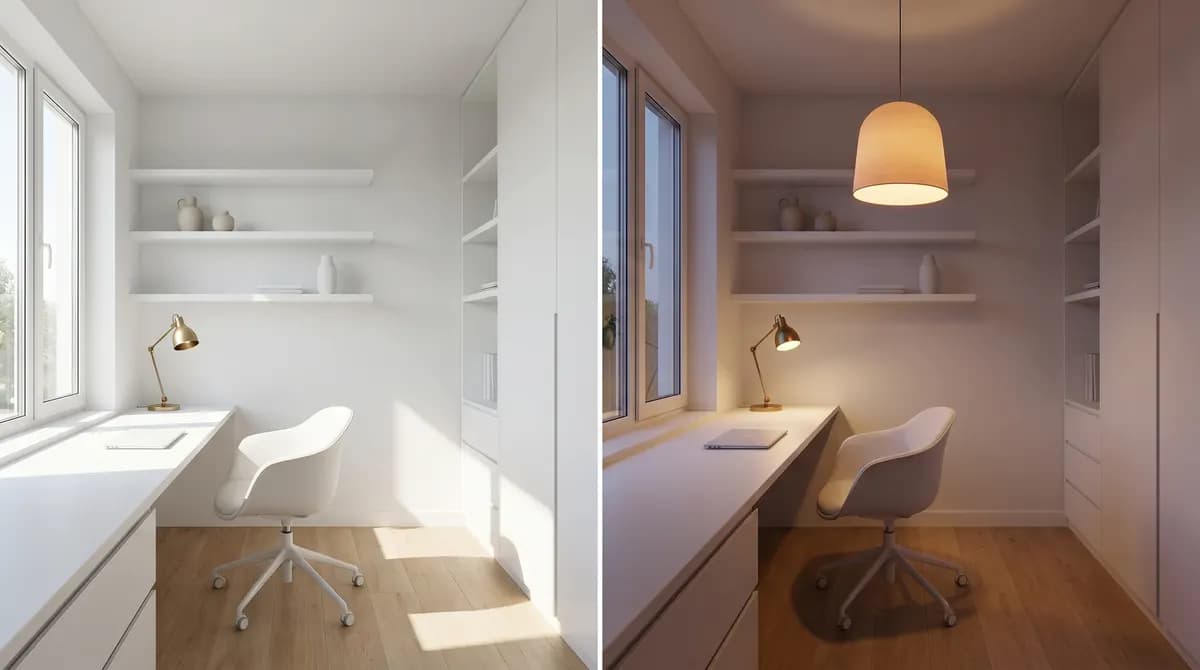
Upload a photo of your real home office. Get a photorealistic minimalist redesign in about 30 seconds. 4 free credits, no card.
Generate Your Minimalist Home Office FreeOther Minimalist Rooms
Apply the same palette and principles to the rest of the home.


Other Home Office Styles
Same room, different aesthetic — explore the rest of the home-office style library.


Minimalist Home Office — Frequently Asked Questions
What colors define a minimalist home office?
Can I really work productively with only one monitor?
How do I hide cables in a minimalist home office?
What chair belongs in a minimalist home office?
How do I make a minimalist home office look good on video calls?
Is a minimalist home office good for small or shared spaces?
How to Design a Minimalist Home Office
Five decisions, in this order. Skip any of them and the look will not land.
- 1
Pick the wall — single floating desk against the best vertical surface
Choose the desk wall before the desk. The wall must support a wall-hung floating top (so a stud wall or solid masonry), sit perpendicular to a window for side-light rather than backlight, and be free of plumbing or vents. Whatever wall meets those three constraints is where the floating desk lives; everything else is built around it. There is no second desk.
- 2
Commit to one wood, one metal, one fabric
Minimalist home offices work on three materials: pale honey oak for the desk and shelf, matte black for the monitor arm, lamp and chair frame, and one neutral fabric (oat linen, dark mesh or full-grain leather) for the chair and the desk pad. Do not introduce a fourth material. This single rule is what makes the room read calm on a video call.
- 3
Engineer cable management from day one
Plan the cables before the desk is fixed. Single back grommet, sleeved braid, wall-mounted CPU bracket, covered cable tray, single floor outlet, router hidden in the storage wall. This step is more consequential than any furniture choice — visible cables instantly break the look no matter how perfect the rest of the room is.
- 4
Light from low, plural, warm sources
One slim task lamp on the desk, a bias light strip behind the monitor in warm white, cove LED at the ceiling perimeter, and one wall sconce above the storage wall. Every fixture on a dimmer, every bulb at 2700 K. Never a single overhead spot — overhead lighting flattens the room on camera and exposes every minor imperfection in the plaster.
- 5
Apply the end-of-day reset
During work: monitor, keyboard, mouse, leather pad, lamp, one mug, one notebook. End-of-day: clear the mug and notebook into the storage wall, leaving an empty leather pad. On the floating shelf: three objects only — plant, art book, ceramic. The minimalist home office is the discipline of an empty desk at the end of every working day.
Keep Exploring
Tools and guides that pair with this style.