Mediterranean Bathroom Design Ideas: 12 Real Examples (2026 Guide)
Hand-troweled tadelakt, terracotta tile, an arched shower niche and warm brass — the bathroom language of the Mediterranean coast. We unpack what makes it feel authentic, then show 12 photorealistic examples you can copy.
- 12
- Real examples
- ~30s
- AI render time
- 4 free
- Credits, no card
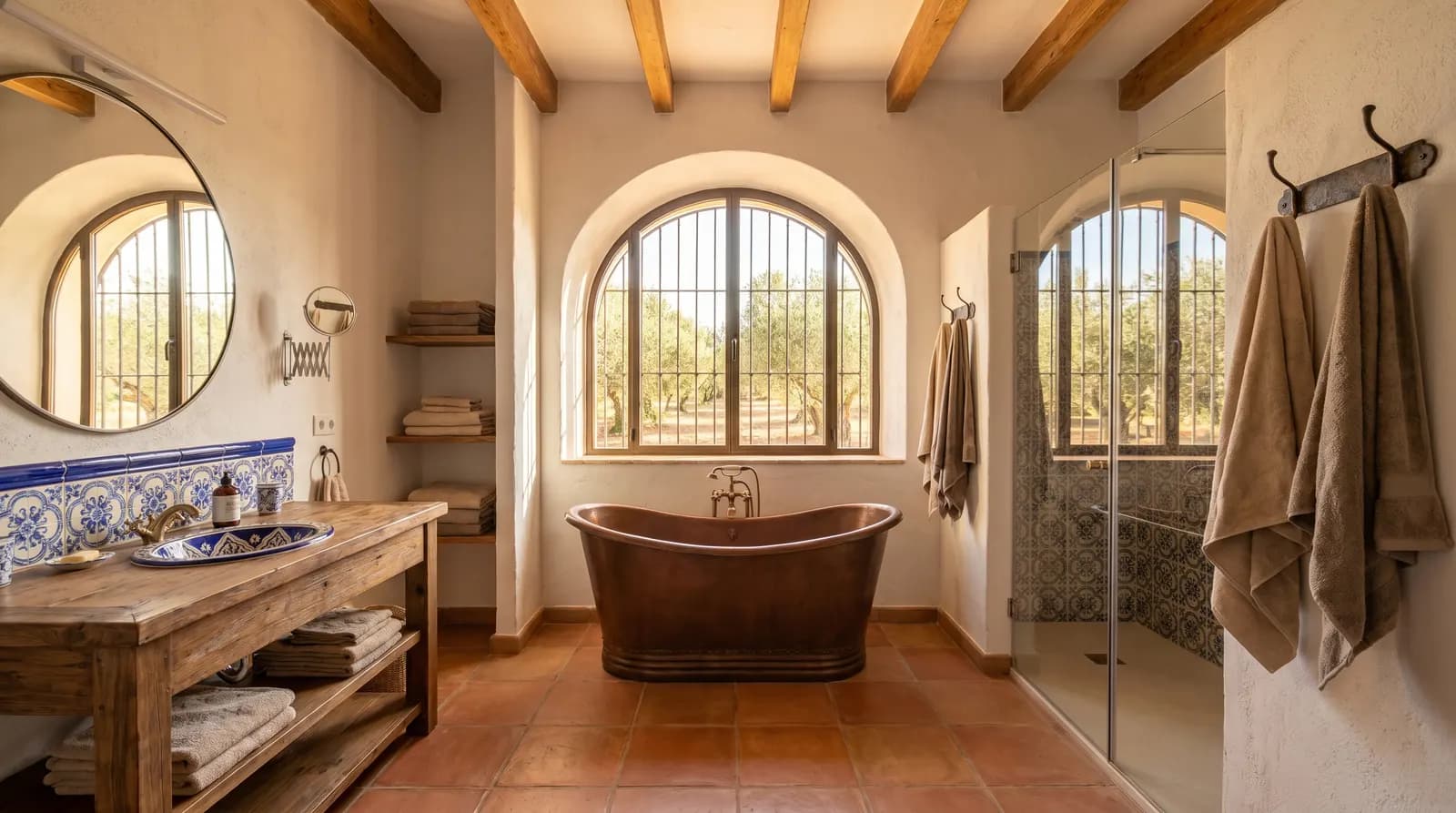
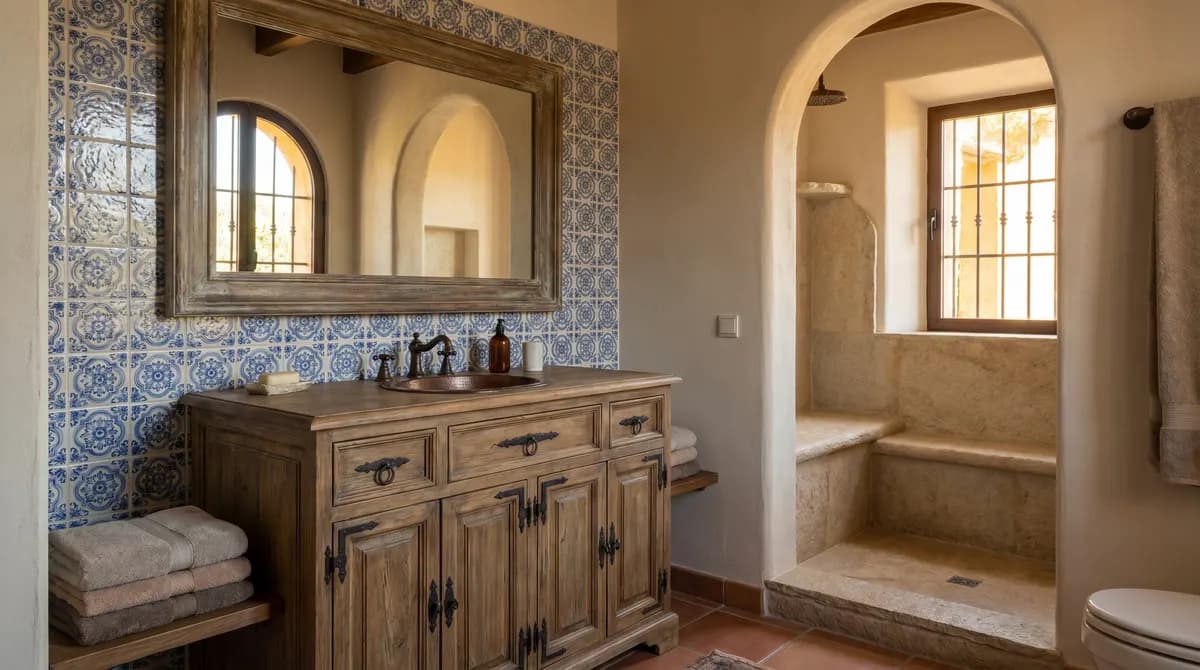
What is Mediterranean Bathroom Design?
Mediterranean bathroom design is a regional vernacular that grew out of Morocco, southern Spain, Greece, southern Italy and coastal Turkey. It is defined by a love of imperfect, sun-warmed surfaces — hand-troweled lime plaster, terracotta clay, honed travertine and unlacquered brass that is allowed to patina. The room is built around water rather than hiding it: an open walk-in shower, an arched niche, a stone basin, a single window framing a square of bright sky.
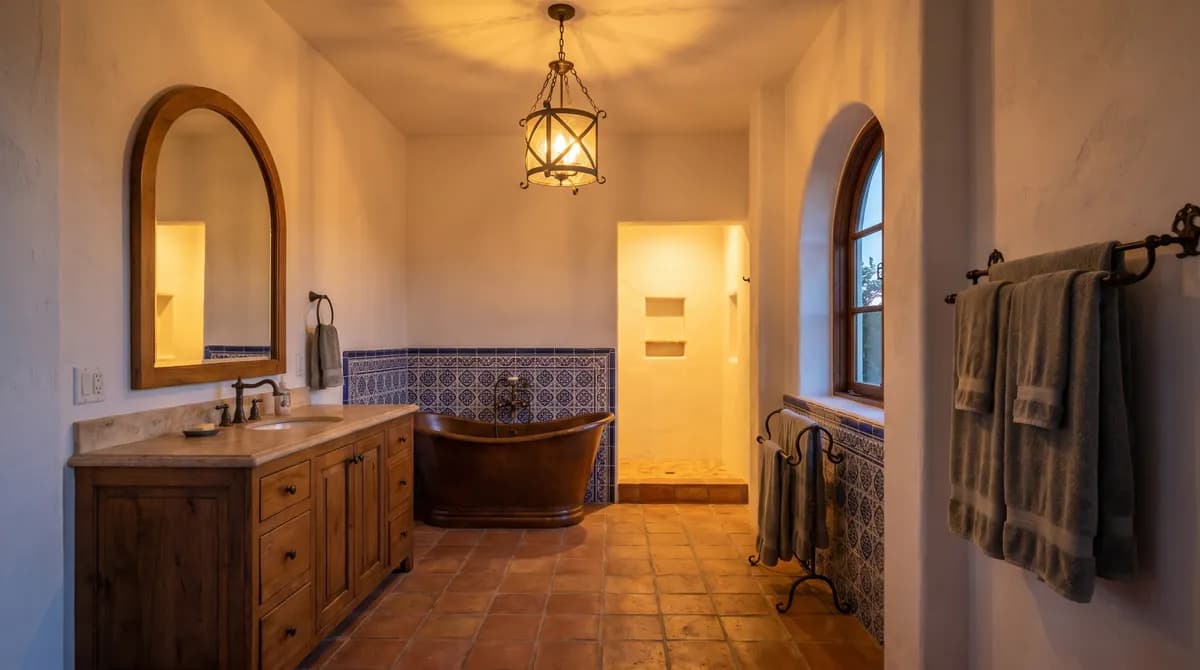
Three principles run through every authentic Mediterranean bathroom. First, the wet wall is a craft surface: tadelakt, zellige, terracotta or honed limestone — never a slab of porcelain. Second, geometry softens — the door is arched, the niche is arched, the mirror is arched. Third, every metal is warm: unlacquered brass, antique bronze, or aged copper that turns greenish over the years.
In 2026 the style has become the dominant alternative to the white-and-grey hotel bathroom. Designers in London, New York, Mexico City and Sydney specify Moroccan tadelakt and zellige tile by name. It pairs naturally with Bohemian and Spanish Colonial bedrooms, and it is one of the few looks that survives daily use better the more lived-in it becomes — the patina is the point.
12 Real Mediterranean Bathroom Examples
Each example below is a complete look — not a mood board. Click any image to see it full-size, then hit the generate button to try the same combination on your own bathroom photo.
 1Example
 2Example
 3Example
 4Example
 5Example
 6Example
 7Example
 8Example
 9Example
 10Example
 11Example
 12Example
Key Design Elements
Colors
- Sun-bleached chalk white
- Warm terracotta and clay pink
- Olive and sage green
- Aegean and cobalt blue accents
- Honed travertine and oat beige
Materials
- Tadelakt — waterproof Moroccan lime plaster
- Zellige terracotta-backed wall tile
- Honed travertine or limestone for floor and basin
- Terracotta or saltillo tile underfoot
- Unlacquered brass and antique bronze fittings
Furniture
- Floating wooden vanity in olive or chestnut
- Carved stone basin on a travertine pedestal
- Low caned stool for towels or feet
- Arched recessed niche replacing a medicine cabinet
- Wall-hung mirror in arched brass frame
Lighting
- Brass wall sconces flanking the mirror
- Single arched window for daylight
- Warm 2700 K LED in the shower niche
- Pierced ceramic pendant for diffused shadow play
- A single beeswax candle on the vanity ledge
Textiles
- Stonewashed linen waffle bath towels
- Striped Moroccan flatweave bath mat
- Linen shower curtain in oat or sage
- Hand-loomed cotton hand towel on a brass ring
- Stoneware soap dish and ceramic tumbler
Mediterranean Bathroom Color Palette
Six pigments do most of the work — start here, then add one accent of your own.
The chalky off-white for tadelakt walls and ceilings. Warmer than pure white, it reads as plaster rather than paint.
A dusty terracotta-pink for accent walls, niches or a single tadelakt panel. The warmest, friendliest pigment in the palette.
Used on floor tile, saltillo pavers and unglazed pottery. Anchors the floor and gives the room a sun-warmed temperature.
Vanity wood, linen towels and a single olive plant in a clay pot. The herbal note that keeps the room from reading desert-dry.
A single strict accent — a hand-painted ceramic bowl, a strip of zellige, a glass bottle on the niche. Used sparingly, like punctuation.
Unlacquered brass for taps, drain covers, mirror frames and lighting. Allowed to patina — the spotting is the look, not a defect.
Must-Have Furniture & Fixtures
If you only specify these seven, the room will read as authentically Mediterranean.
Tadelakt shower walls
Hand-troweled lime plaster sealed with olive-oil soap. Slightly mottled, completely seamless, no grout lines. The single most important specification in the room.
Zellige feature tile
Hand-pressed Moroccan terracotta tile with a glassy glaze. Used on a single wall, a niche back or the splashback — never on every surface.
Carved stone basin
Travertine, limestone or marble carved from a single block. Sat on a wooden vanity or a stone pedestal. No drop-in ceramic sinks.
Arched niche
Recessed shelving cut into the shower or vanity wall with a true arched top. Stores rolled linen towels, a sea sponge and a stoneware bottle of soap.
Brass tap set
Unlacquered brass wall-mount or deck-mount mixer with simple cross-handles. Will spot, darken and patina — never polish it back.
Arched brass mirror
Single arched mirror, brass frame, hung centred above the basin. Skip frameless and skip rectangular — the arch repeats the door and niche.
Terracotta floor
Saltillo or reclaimed terracotta hexagons, sealed but not glossy. Adds the warmest visual temperature in the room and ages beautifully underfoot.
Common Mistakes to Avoid
Defaulting to porcelain slab — large-format porcelain reads as hotel bathroom, not Mediterranean. Specify tadelakt, zellige or honed stone instead.
Chrome or matte black fittings — both kill the warmth instantly. Mediterranean is unlacquered brass, antique bronze or aged copper, full stop.
Lacquering the brass — a clear-coated brass tap stays shiny and looks fake. Real Mediterranean brass spots, darkens and patinas. The patina is the design.
Skipping the arch — a rectangular niche, rectangular mirror and rectangular shower opening turns the room contemporary. At least one true arched form must repeat.
Cool-white LED — 4000 K downlights destroy every other choice. Specify 2700 K warm white everywhere, ideally with a single dimmable sconce above the mirror.
Try Mediterranean Bathroom in Your Own Room
Upload a photo of your real bathroom. Get a photorealistic Mediterranean redesign in about 30 seconds. 4 free credits, no card.
Generate Your Mediterranean Bathroom FreeOther Mediterranean Rooms
Apply the same palette and principles to the rest of the home.


Other Bathroom Styles
Same room, different aesthetic — explore the rest of the bathroom style library.


Mediterranean Bathroom — Frequently Asked Questions
What is tadelakt and do I really need it?
What tile should I use for a Mediterranean bathroom?
Will brass fittings get water spots and patina?
Can a Mediterranean bathroom work without windows?
How is Mediterranean different from Bohemian?
Does Mediterranean style work in a small bathroom?
How to Design a Mediterranean Bathroom
Five decisions, in this order. Skip any of them and the look will not land.
- 1
Choose your wet-wall material
Pick one of three: tadelakt for the most authentic Moroccan look, zellige for the most graphic, or honed travertine for the simplest specification. Whichever you choose, commit to it for every wet surface in the room — shower walls, splashback and the back of the niche. Do not mix two of them on the same wall; the room is built around one craft material.
- 2
Pick your warm metal
Unlacquered brass is the default. Antique bronze and aged copper are valid alternatives. Choose one and apply it to every metal surface in the room — taps, shower head, drain cover, mirror frame, towel ring, light switch plate. Mixing brass and chrome instantly kills the look. Confirm with the supplier that the finish is unlacquered, otherwise it will never develop a real patina.
- 3
Add at least one arch
Mediterranean geometry is built on the arched form. Choose one of the four candidates and commit: an arched mirror, an arched shower opening, an arched recessed niche, or an arched door. Two arches are even better if the room can carry them. A bathroom with zero arched forms will read as Bohemian or Spanish-adjacent but never as truly Mediterranean.
- 4
Layer the warm palette
Start with a sun-bleached white ceiling, add a clay-pink or oat tadelakt for the walls, terracotta on the floor, and one accent colour — sage green linens or a hand-painted Aegean-blue bowl. The temperature of every surface should sit on the warm side of neutral. Avoid grey, navy, charcoal and anything that reads as cool — those tones break the Mediterranean spell instantly.
- 5
Style with restraint
Two stoneware bottles on the niche, one rolled linen towel, one sea sponge, one terracotta pot with a single olive sprig — and stop. Mediterranean is not Bohemian, and a maximalist styled bathroom drifts into Marrakech-flea-market. Keep the vanity surface almost empty so the patina of the tap, the texture of the tadelakt and the irregularity of the zellige can do the talking.
Keep Exploring
Tools and guides that pair with this style.