Turkish Garden Design
Guide to landscape design in Turkish Garden style: features, plants, materials, and examples
Turkish garden design has a 600-year continuous tradition shaped by Ottoman imperial gardens, Anatolian village courtyards and Persian influence. The most famous era is the Tulip Period (Lale Devri, 1718-1730) under Sultan Ahmed III, when tulip cultivation reached a fever pitch and palace gardens at Topkapi, Yildiz and the Bosphorus yali houses became models of refined Ottoman landscape. The form combines Persian chahar bagh geometry with Anatolian plant traditions and Mediterranean climate adaptation.
Materials and plants
The plant signature is tulips — historically Turkish tulips were narrow and pointed (Lale-i Rumi) rather than the Dutch cup form. Plant alongside roses (especially Damask rose, Rosa damascena), jasmine, hyacinth, narcissus, and plane trees (Platanus orientalis) for shade. Cypress (Mediterranean cypress) marks vertical axes. Herbs and aromatic plants — mint, basil, lemon balm — fill borders. Hardscape uses Iznik-style tile in fountains and borders, brick or terracotta paving, marble for fountain basins.
Design elements
The chahar bagh ("four gardens") layout divides the garden into four quadrants around a central fountain — inherited from Persian tradition. Water features are essential: a central fountain, narrow water channels (rills) along axes, sometimes a small reflecting pool. Plane trees provide structural shade overhead, with low borders of flowers below. A wooden gazebo (köşk) provides outdoor seating with views of the garden. Walls are often plastered and capped with terracotta tile.
Climate notes
Turkish gardens originated in Mediterranean and continental Anatolian climates (zones 7-9 work best). Tulips need cold winters to flower well, while plane trees and cypress prefer warm summers with dry conditions. In humid climates, substitute hardier roses and consider mildew-resistant cultivars.
Common mistakes
Don't use only Dutch tulips — Turkish heritage tulips (now back in cultivation through groups like the Turkish Tulip Society) have the pointed petals that define the historical look. Don't omit water features; they are climate-functional (cooling, humidity) and aesthetically essential. Don't overplant — Ottoman gardens are formal and contained, not abundant.
Budget tips
Heritage Turkish tulip bulbs run $3-8 each (compared to $0.50-2 for standard Dutch tulips). Plant 100+ for impact. A small tiled fountain costs $1,500-5,000. Iznik-style tile borders run $25-60 per sq ft installed. A complete Turkish-style garden on a quarter-acre lot is typically $15,000-40,000. Upload a photo of your yard and our AI redraws it in Turkish garden style in seconds — free to try.
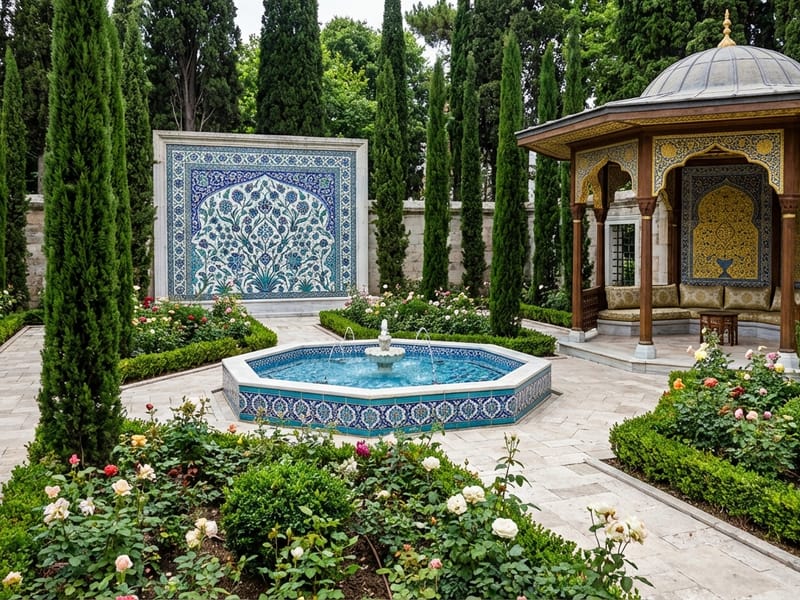
Turkish Garden стилінің негізгі элементтері
Chahar Bagh Layout
A 4-part geometric division around a central fountain, inherited from Persian garden tradition and central to Ottoman royal gardens.
Heritage Turkish Tulips
Narrow pointed Lale-i Rumi tulips planted in masses — the historic form celebrated during the Tulip Period (1718-1730) of Sultan Ahmed III.
Damask Roses
Rosa damascena and other heritage roses planted in beds and along walls, prized in Ottoman gardens for fragrance and rose water production.
Tile Fountains
Central or wall-mounted fountains in glazed Iznik-style tile, with marble basins and geometric or floral patterns.
Plane Tree Shade
Mature plane trees (Platanus orientalis) providing structural shade, especially over seating areas and along main axes.
Wooden Köşk Pavilion
A wooden garden pavilion (köşk) with carved screens and a low platform for sitting, providing shaded views across the garden.
Өз дизайныңызды жасап көріңіз
Аула фотосын жүктеңіз де, 30 секундта кәсіби ландшафт дизайнын алыңыз. Алғашқы 2 дизайн — тегін.
Turkish Garden: ландшафт дизайны
Көбірек мысалды мына жерден көріңіз: Turkish Garden стилі галереясы немесе толық дизайн галереясы.
FAQ: Turkish Garden стиліндегі ландшафт дизайны
- A formal Ottoman-tradition garden with a 4-part geometric layout, central fountain, heritage tulips and roses, plane trees and a wooden pavilion (köşk).
- Lale Devri (1718-1730), under Sultan Ahmed III, when Ottoman cultural attention focused intensely on tulip cultivation. Hundreds of cultivars were bred; tulips appeared in tile, textile, painting and palace gardens.
- Turkish heritage tulips (Lale-i Rumi) have narrow, pointed petals — the form depicted in Iznik tile and Ottoman miniature painting. Standard Dutch tulips have rounded cups.
- Both share the chahar bagh 4-part layout. Turkish gardens add Mediterranean plants (plane trees, cypress), Iznik tile and a more relaxed planting style. Persian gardens are more enclosed and use Persian fruits and roses.
- Mediterranean and continental climates (USDA zones 7-9) suit best — cold winters for tulips, warm dry summers for cypress and roses. Humid summers can stress some signature plants.
- The Topkapi Palace gardens in Istanbul, the Yıldız Palace gardens, Bosphorus yali estates and the gardens at Edirne all preserve elements of Ottoman tradition.
- Strongly recommended — water features are central to Ottoman garden tradition, providing cooling, sound and visual focus. Even a small wall-mounted fountain suffices.