German Garden Design
Guide to landscape design in German Garden style: features, plants, materials, and examples
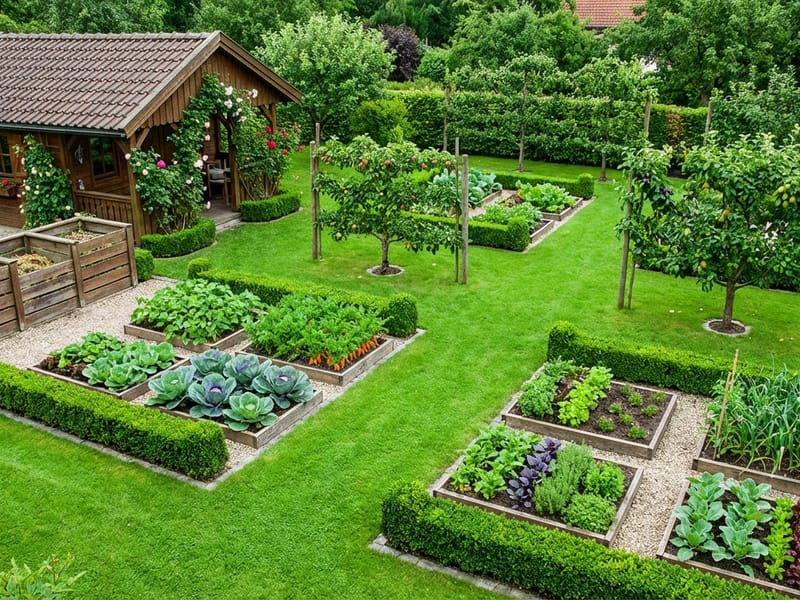
German garden design has a distinctive character: ordered, productive and balanced between ornamental and useful. The dominant tradition is the Schrebergarten (after Dr. Moritz Schreber, 1860s), Germany's allotment garden movement that created over 1 million ordered plots across cities — each containing a small structure, fruit trees, vegetable beds and flower borders. The form has shaped the broader German residential garden aesthetic: clean lines, productive plantings integrated with ornamental ones, gravel paths, stone edging, and a strong sense of seasonality.
Materials and plants
Hardscape is restrained: gravel paths in gray-white tones, granite or limestone edging, weathered cedar or oak fencing, stone retaining walls. Plants combine productive and ornamental — vegetable beds (Hochbeete or raised beds), espaliered fruit trees (apple, pear, plum trained against walls), herb gardens organized in geometric beds, flower borders with hardy German favorites (Heidekraut/heather, asters, dahlias, peonies, hortensia/hydrangea), and shrubs like Forsythia, Hibiscus syriacus and Cornus mas providing structure.
Design elements
Expect a grid layout, with vegetable, herb and flower areas separated into clearly defined beds. Espaliered fruit trees along walls are signature German practice (they save space and provide structure). A garden shed (Gartenhäuschen) provides storage and sometimes a small living space. Composting (Kompostieren) is integrated into the design — every German garden has a visible compost bin. A small water feature, often a Wassergarten with hardy water plants, anchors one corner.
Climate notes
German gardens are designed for temperate continental climates (USDA zones 5-8). Cold winters allow excellent fruit production and force plants into productive seasonal cycles. The style adapts well to similar climates in the northern US, northern Europe and parts of Canada.
Common mistakes
Don't over-ornament — German gardens prize visible productivity. Don't skip the composting infrastructure; integrating a visible compost bin is culturally important. Don't overplant; German gardens use spacing and order, not abundance. Avoid lawn-dominated layouts; productive beds and paths should structure the yard.
Budget tips
Raised cedar vegetable beds (Hochbeete) run $200-500 each in standard sizes. Espaliered fruit trees cost $80-200 each (a 3-tier espalier takes 4-5 years to fully form). Local stone edging runs $15-25 per linear foot. A complete German-style garden refresh on a quarter-acre lot is typically $5,000-15,000. Upload a photo of your yard and our AI redraws it in German garden style in seconds — free to try.
German Garden стилінің негізгі элементтері
Ordered Layout
A clear grid layout with vegetable, herb and flower areas in geometric beds separated by gravel paths — the Schrebergarten tradition translated to private yards.
Raised Vegetable Beds
Cedar or oak Hochbeete (raised beds) for vegetables, herbs and salad crops, providing ergonomic height and improved drainage.
Espaliered Fruit Trees
Apple, pear and plum trees trained against walls in 2 or 3-tier horizontal espaliers — space-saving and architecturally striking.
Herb Garden
A dedicated Kräutergarten of culinary and medicinal herbs (parsley, chives, lovage, lemon balm, dill) organized in geometric beds.
Mixed Flower Borders
Hardy ornamental borders with peonies, hortensia (hydrangea), dahlias, asters and Heidekraut (heather) providing seasonal color.
Garden Shed (Gartenhäuschen)
A traditional wooden Gartenhäuschen with painted shutters, providing storage and sometimes a small seating or sleeping space for warm-weather garden time.
Өз дизайныңызды жасап көріңіз
Аула фотосын жүктеңіз де, 30 секундта кәсіби ландшафт дизайнын алыңыз. Алғашқы 2 дизайн — тегін.
German Garden: ландшафт дизайны
Көбірек мысалды мына жерден көріңіз: German Garden стилі галереясы немесе толық дизайн галереясы.
FAQ: German Garden стиліндегі ландшафт дизайны
- An ordered productive garden combining vegetable beds, espaliered fruit trees, herbs, flower borders, gravel paths and a traditional wooden Gartenhäuschen.
- A Germany allotment garden, established under Dr. Moritz Schreber's 1860s reforms. Over 1 million Schrebergärten exist in Germany, each with a small structure, fruit trees and productive beds.
- A raised vegetable bed, typically 60-80 cm tall, built of cedar or oak. Layered with branches, leaves, compost and topsoil, it provides excellent drainage and ergonomic gardening.
- English gardens (especially Capability Brown style and cottage gardens) are more naturalistic and ornamental. German gardens are more ordered and productive, integrating vegetable, fruit and ornamental in clear geometric divisions.
- Temperate continental (USDA zones 5-8) — cold winters that allow excellent fruit and vegetable cycles, moderate summers and reliable rainfall.
- It requires patience — a full 3-tier espalier takes 4-5 years to form. But the technique is well-documented, and many German garden centers sell pre-trained 2-year-old trees.
- A small wooden garden shed adds significant character, but a simple cedar tool shed or pergola can substitute. The key is honest wooden construction with vernacular detailing.