German Modernist Facade Design
Guide to facade design in German Modernist Facade style: materials, colors, architectural solutions, and examples
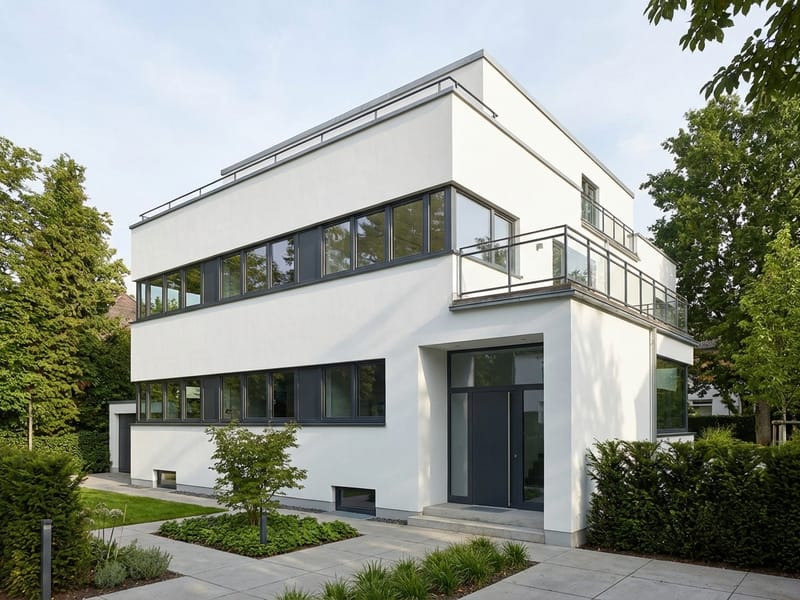
German modernist facade design grew from the Bauhaus and Werkbund movements of the 1920s and continues through contemporary German residential architecture today. The defining principles, set by Walter Gropius, Mies van der Rohe and Erich Mendelsohn between 1919 and 1933, remain remarkably consistent: flat roofs, smooth uninterrupted white facades, large rectangular windows aligned in horizontal bands, structural honesty and no ornament. Postwar architects like Egon Eiermann and Sep Ruf extended the language, and modern practices like Sauerbruch Hutton and David Chipperfield continue it.
Materials and palette
The dominant material is smooth white-painted stucco over insulated masonry, sometimes complemented with exposed concrete, glass curtain walls or warm-toned wood cladding (typically larch or oak). Window frames are aluminum, dark anodized or painted black. The palette is restrained: white, gray, anthracite, with occasional wood accents in light larch or warm oak. Roofs are flat with parapet edges, sometimes accommodating green roofs (a German specialty).
Facade features
Look for horizontal window bands (a Bauhaus signature) rather than punched single openings, flush detailing with no protruding sills, recessed front entries, and a strong indoor-outdoor relationship via floor-to-ceiling glass at the rear. Garages and front doors are often flush with the facade plane, hidden behind matching cladding. Solar panels, geothermal vents and other technical equipment are integrated rather than added.
Common mistakes
Don't add ornament — no shutters, no decorative trim, no faux columns. Don't break the flat roof with traditional gables. Don't paint the trim a contrasting color; window frames and walls should read as a unified plane.
Budget tips
Smooth EIFS stucco systems run $9-15 per sq ft installed. Larch or oak rainscreen cladding adds $20-35 per sq ft for an accent panel. Black anodized aluminum windows are essential; budget $1,000-2,500 per opening. A small German-modernist facade refresh on an existing house often costs less than a traditional remodel because there is less material. Upload a photo of your house and our AI redraws it in German modernist style in seconds — free to try.
Key elements of German Modernist Facade style
Flat Roof Geometry
Flat or near-flat roofs with parapet edges, sometimes accommodating green roofs or hidden solar arrays — no traditional gables.
Smooth White Stucco
Uninterrupted white-painted stucco facades with flush detailing, no decorative trim and no protruding sills.
Horizontal Window Bands
Large rectangular windows aligned in horizontal bands across the facade — a Bauhaus signature dating to the 1920s.
Larch Wood Accents
Warm-toned larch or oak rainscreen cladding used as a single accent panel against the dominant white stucco.
Black Aluminum Frames
Dark anodized or painted-black aluminum window frames, slim-profile and flush-mounted to emphasize the facade plane.
Integrated Technology
Solar panels, heat pumps, EV chargers and rainwater systems integrated into the facade rather than visibly added.
Try creating your own design
Upload a photo of your house and get a professional facade design in 30 seconds. First 2 designs are free.
German Modernist Facade: facade design
See more examples in the German Modernist Facade style gallery or the full design gallery.
FAQ: facade design in German Modernist Facade style
- Flat roofs, smooth white facades, horizontal window bands, structural honesty and no ornament — a language rooted in 1920s Bauhaus and continued today.
- It descends from Bauhaus principles (Gropius, Mies, 1919-1933) and remains the dominant language of contemporary German residential modernism.
- Flat or very low-pitch roof with a clean parapet edge. Pitched roofs break the language unless detailed in a deliberately abstracted way.
- Long horizontal rectangles aligned in bands across the facade, not punched single openings. Slim black aluminum frames are essential.
- Yes — one section of larch or oak rainscreen against the dominant white stucco is a contemporary German signature.
- Yes — Germany is a cold climate. The style relies on high-performance insulation and triple-glazed windows for energy efficiency.
- German modernism is more rigorous and white-dominant; Scandinavian leans warmer with more wood and smaller windows. Both share a Bauhaus inheritance.