Traditional Home Office Design Ideas: 12 Real Examples (2026 Guide)
Mahogany partners desk, leather Chesterfield, panelled walls and a wall of books — the traditional home office is the room you stay in long after the meeting ends. We unpack the rules, then show 12 photorealistic examples.
- 12
- Real examples
- ~30s
- AI render time
- 4 free
- Credits, no card
What is Traditional Home Office Design?
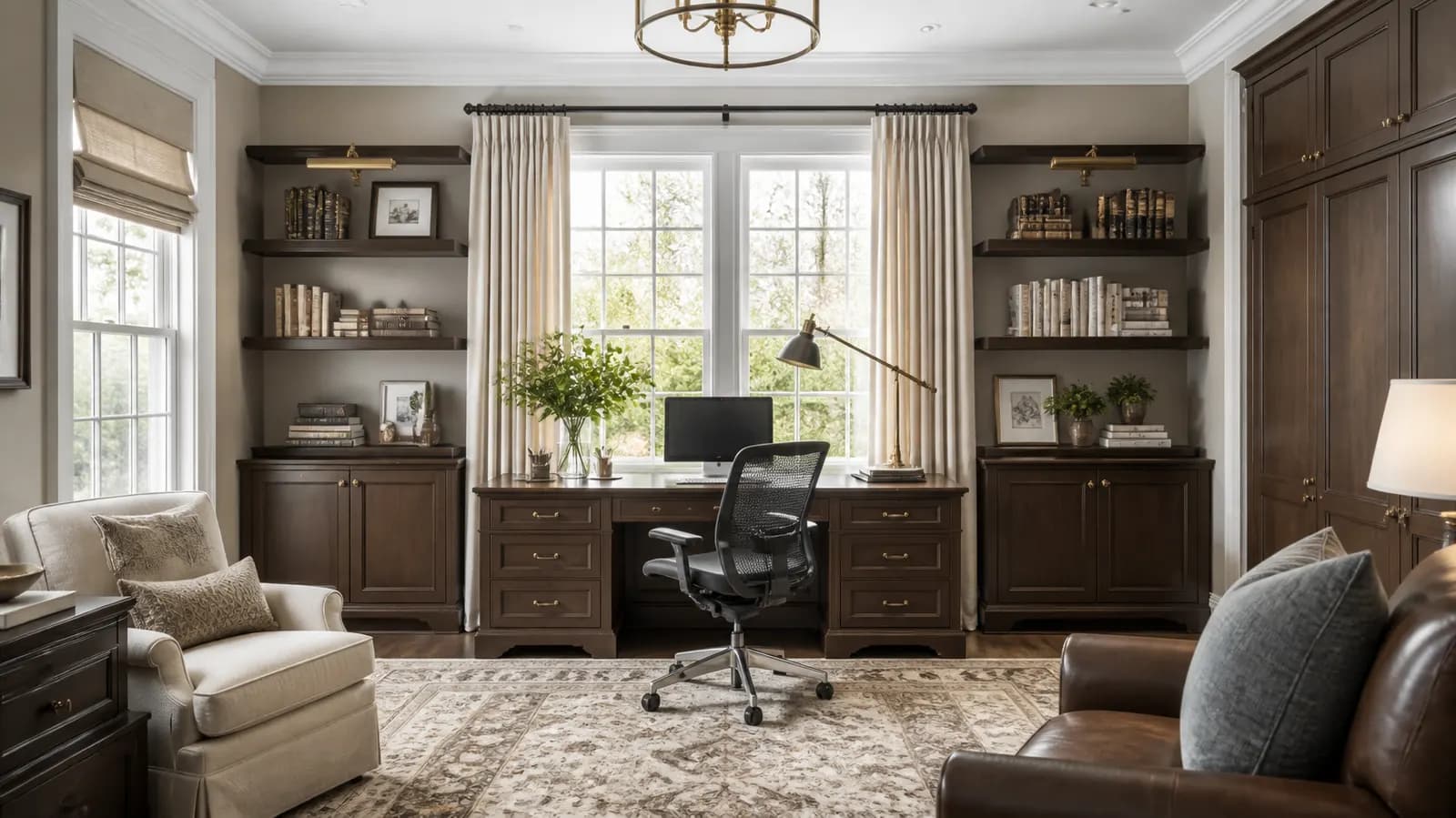
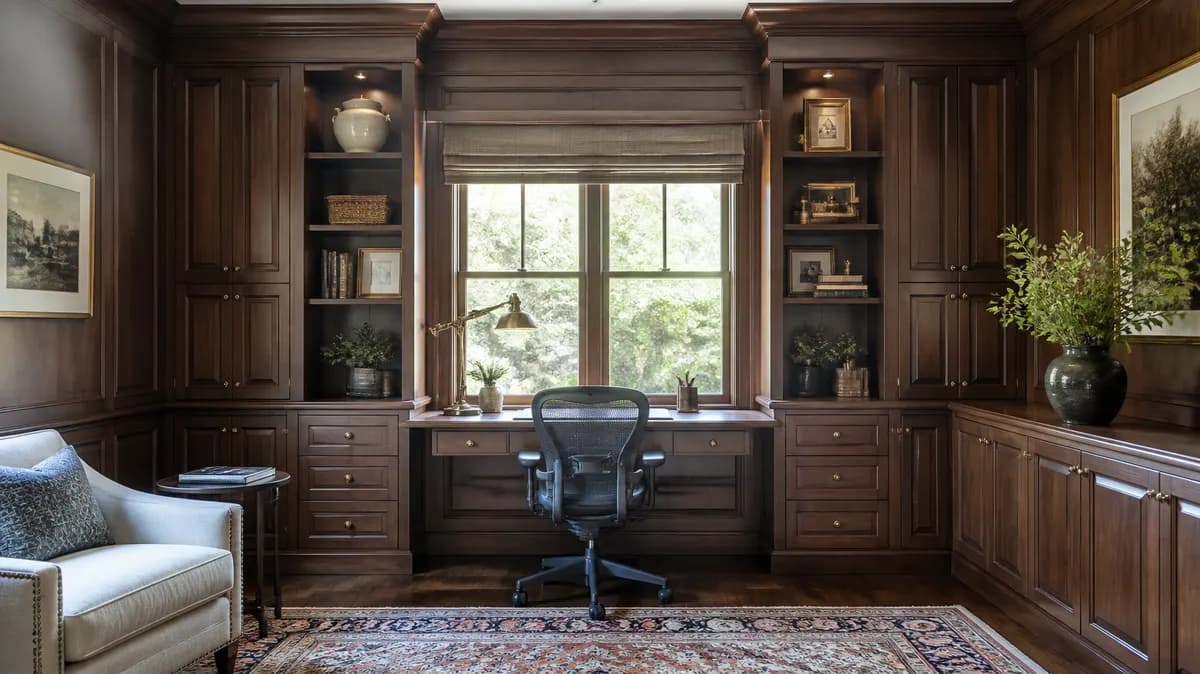
Traditional home office design descends directly from the gentleman's study — a Georgian or Victorian room set aside for correspondence, accounts and reading. Its architecture was the same as the formal rooms of the house: panelled walls, deep cornices, sash windows dressed with full-length curtains, and a stone fireplace as the visual anchor. Its furniture was different — a heavy partners desk in the centre of the room rather than against a wall, a brass bankers lamp, leather club chairs and a wall of books behind glass.
Three principles guide an authentic traditional home office. First, classical proportion: the desk centred and free-standing rather than pushed to a wall, the seating opposite the desk, the wall of books treated as architecture. Second, period materials: mahogany or walnut hardwood, deep cognac leather, hand-knotted Oriental rug, polished brass on every fixture. Third, a disciplined palette of cream, oxblood, deep navy and dark wood, used in the same proportions across desk, chair, drapes and books.
In 2026 the traditional home office has become a quiet status symbol for senior remote workers, professionals and writers. The look is the antithesis of the open-plan co-working aesthetic — closed door, dimmable warm light, real books, no whiteboards. It pairs naturally with English country (looser styling) and Mid-Century Modern (the leather and wood overlap). The throughline is always a hero desk, a hero chair, a wall of books and lighting warm enough that a 10 PM session feels like a privilege.
12 Real Traditional Home Office Examples
Each example below is a complete look — not a mood board. Click any image to see it full-size, then hit the generate button to try the same combination on your own room photo.
 1Example
 2Example
 3Example
 4Example
 5Example
 6Example
 7Example
 8Example
 9Example
 10Example
 11Example
 12Example
Key Design Elements
Colors
- Antique cream and warm-white walls
- Deep navy on full panelling and accent walls
- Oxblood and cognac leather
- Burgundy on the Oriental rug and small textiles
- Mahogany and walnut wood tones
Materials
- Solid mahogany, walnut or cherry hardwood furniture
- Aniline-dyed leather for chair and Chesterfield
- Hand-knotted Oriental or Aubusson rug
- Painted raised-panel wainscoting
- Polished brass and antiqued bronze hardware
Furniture
- Mahogany partners desk, centred and free-standing
- Captain's leather chair with brass nailheads
- Tufted leather Chesterfield or pair of club chairs
- Floor-to-ceiling mahogany bookcases
- Globe and credenza for reference books
Lighting
- Brass bankers lamp with green glass shade
- Brass picture lights over bookshelves and art
- Crystal or brass chandelier on a dimmer
- Floor lamp beside the Chesterfield
- Pair of brass candlesticks on the credenza
Textiles
- Full-length silk drapes with tasselled tiebacks
- Hand-knotted Oriental rug under the desk and chair
- Leather blotter and desk pad
- Cashmere throw on the Chesterfield
- Velvet cushions in oxblood and navy
Traditional Home Office Color Palette
Six pigments do most of the work — start here, then add one accent of your own.
The base white for ceilings and upper walls. Slightly warm and never cold, it lets mahogany furniture and leather upholstery read at their richest.
The hero wall colour for full panelling — anchors the room and reads as confident rather than corporate. Stands up beautifully to brass lamps.
The leather hero — captain's chair or Chesterfield. Used in the largest single colour block in the room after the wall paint.
The textile pop — Oriental rug, velvet cushion, leather book bindings. Echoes the oxblood and ties the palette to its 19th-century roots.
The hero wood — desk, bookcases, side tables, picture frames. Deep red-brown that reads instantly traditional and almost never goes out of style.
The strict metal accent — bankers lamp, picture lights, desk hardware, picture-frame brackets. Used consistently so the room reads coherent.
Must-Have Furniture & Fixtures
If you only buy these seven, you will read as authentically traditional.
Mahogany partners desk
Heavy solid mahogany with a green or oxblood leather inset top, gilt-tooled border, brass hardware. Centred and free-standing in the room.
Captain's leather chair
Tufted aniline-leather chair in oxblood or cognac with brass nailhead trim and brass castors. Hardwood frame visible. Adjustable for ergonomics.
Leather Chesterfield or pair of club chairs
Tufted leather Chesterfield in oxblood facing the desk, or a pair of wingback club chairs opposite. Throws and velvet cushions for evening warmth.
Floor-to-ceiling mahogany bookcases
Built-in or freestanding mahogany shelves filling one wall or flanking the fireplace. Filled with real books, framed photos and small objects.
Hand-knotted Oriental rug
Persian or Aubusson in burgundy, navy and cream. Large enough that both desk and Chesterfield front legs sit on the rug.
Brass bankers lamp
Single brass desk lamp with a green or oxblood glass shade. 2700 K LED bulb. The single most photographable object in the room.
Full-length silk drapes
Pleated and lined, hung from a brass rod close to the ceiling, with tasselled tiebacks. Sheers behind if you need daytime privacy.
Common Mistakes to Avoid
Pushing the desk to a wall — the partners desk wants to be centred and free-standing. Against a wall it reads bedroom-corner-workstation, not study.
Using mesh task chairs as the only seating — they shout cubicle. Keep one if you must for posture, but put the leather chair in shot.
Mixing brass and chrome — pick one metal and commit. Polished brass for full traditional, polished nickel for transitional crossover.
Visible cable spaghetti — a partners desk with monitor cables on top breaks the spell. Run all wiring through a grommet hidden under the desk pad.
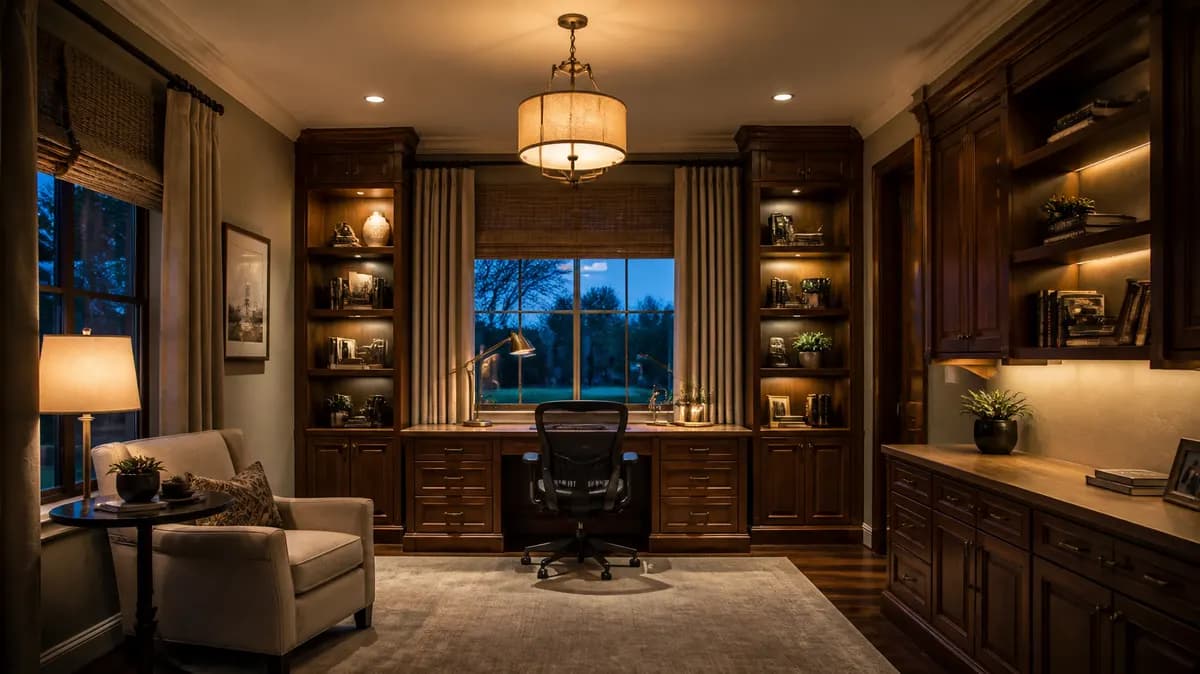
Cool overhead light — a single 4000 K LED panel kills the room. Bankers lamp + picture lights + dimmed chandelier + floor lamp, every bulb at 2700 K.
Try Traditional Home Office in Your Own Room
Upload a photo of your real home office. Get a photorealistic traditional redesign in about 30 seconds. 4 free credits, no card.
Generate Your Traditional Home Office FreeOther Traditional Rooms
Apply the same palette and principles to the rest of the home.


Other Home Office Styles
Same room, different aesthetic — explore the rest of the office style library.


Traditional Home Office — Frequently Asked Questions
What colors define traditional home office design?
Should I centre the desk in the room?
Can a traditional office be ergonomically modern?
How do I hide modern technology in a traditional office?
How is traditional different from English country in a study?
Is traditional home office good for a small spare room?
How to Design a Traditional Home Office
Five decisions, in this order. Skip any of them and the look will not land.
- 1
Place the desk first
Mahogany partners desk with leather inset top, centred and free-standing whenever the room is over 3.5 m wide. Facing the door. This single placement decision does more for the look than any other single choice. The desk is the architecture of the room.
- 2
Build the wall of books
Floor-to-ceiling mahogany bookcases on one wall or flanking the fireplace, with one or two brass picture lights mounted on top of the case. Real books, organised by spine height and colour band, with the occasional horizontal stack to break the verticality. Skip the Pinterest colour-sort.
- 3
Choose the leather hero — Chesterfield or wingbacks
Tufted leather Chesterfield in oxblood facing the desk on the opposite side of the rug, or a pair of leather wingback club chairs in cognac. The leather hero is the second most photographable object in the room after the desk; spend on quality aniline hide that will patina over decades.
- 4
Lay the rug and layer the lighting
Hand-knotted Oriental rug under the desk and the seating, large enough that all front legs sit on it. Brass bankers lamp on the desk. Two brass picture lights over the bookcase. Crystal or brass chandelier on a dimmer overhead. Floor lamp beside the Chesterfield. Every bulb at 2700 K.
- 5
Style the desk and the credenza
On the desk: leather blotter, brass desk clock, fountain-pen tray, single fresh notepad, brass paperweight. On the credenza: globe, pair of brass candlesticks, small oil portrait or framed photograph, stack of three reference books. The discipline at these two surfaces is what reads as confidence at the whole-room scale — three to five objects per vignette, never more.
Keep Exploring
Tools and guides that pair with this style.