Industrial Dining Room Design Ideas: 12 Real Examples (2026 Guide)
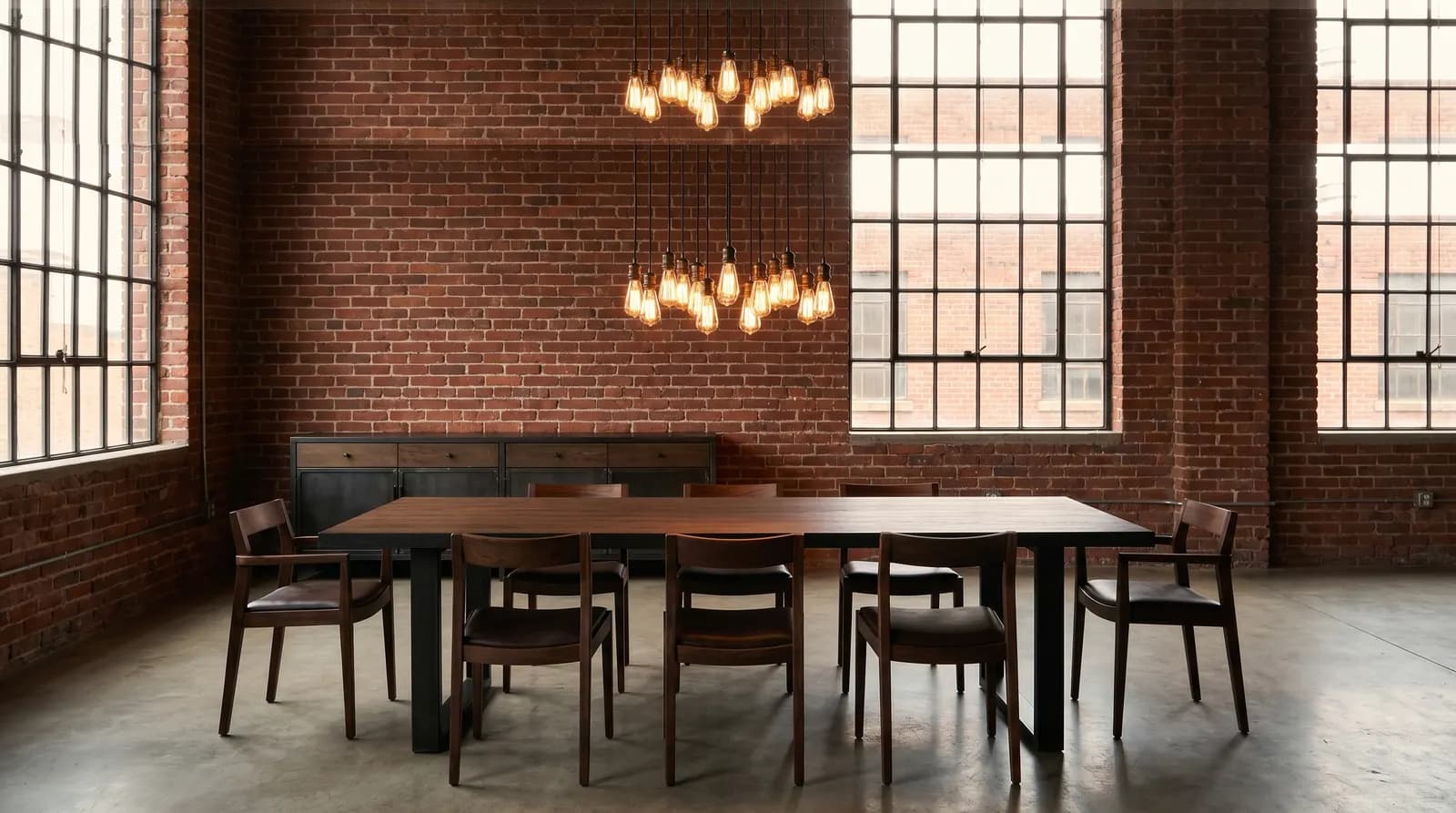
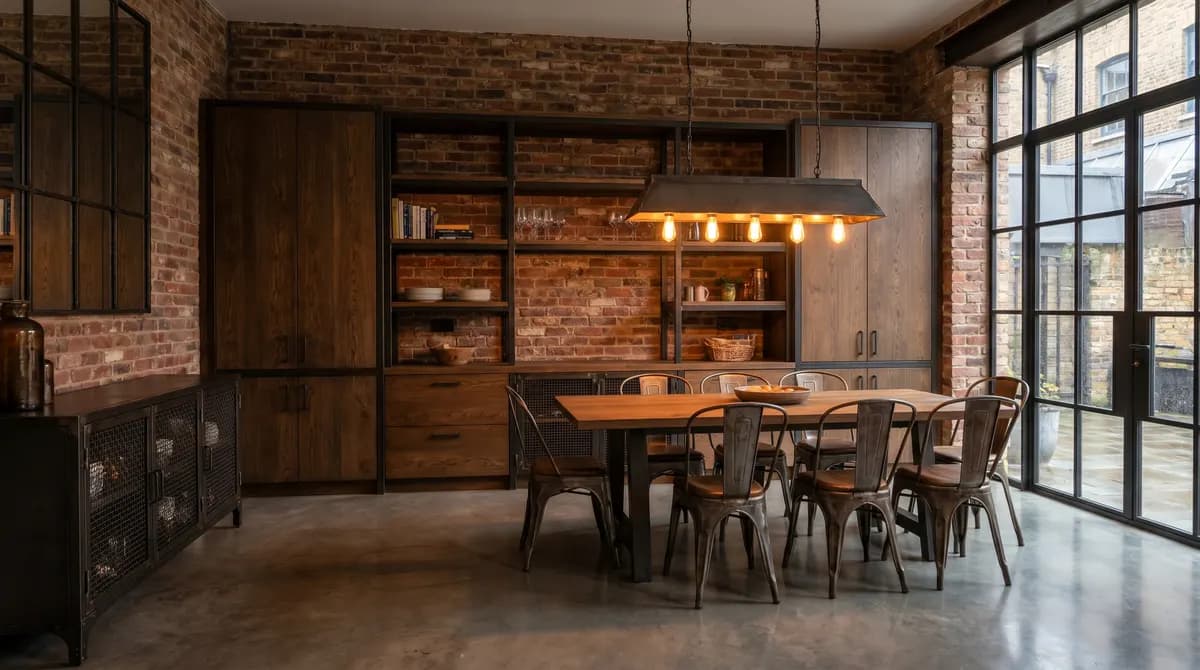
A reclaimed oak table on a blackened steel base, six Tolix-style steel chairs, a row of three enamel factory pendants overhead, exposed brick wall behind, vintage leather and copper accents — the industrial dining room is the converted-warehouse table at scale. We unpack what makes it work, then show 12 photorealistic examples you can replicate.
- 12
- Real examples
- ~30s
- AI render time
- 4 free
- Credits, no card
What is Industrial Dining Room Design?
Industrial dining room design treats the dining table as a piece of converted factory furniture. There is no sculpted pedestal, no upholstered wing-back chair, no polished glass. There is one heavy reclaimed oak table on a blackened-steel trestle base with visible welds and bolts, six matched steel-frame chairs (Tolix Marais A, Bertoia or honest knock-offs), a row of three enamel factory pendants overhead, an exposed brick or polished concrete wall behind, and the structure of the building visible above (joists, beams, ductwork, conduit).
Three principles run through every authentic industrial dining room. First, material honesty: the table is solid reclaimed oak, the chairs are real steel (not painted plastic), the pendants are real enamel (not printed metal). Second, visible structure: the ceiling shows joists, the walls show brick, the plumbing and conduit run exposed. Third, factory lighting: enamel pendants, articulated steel sconces, caged Edison bulbs in warm 2700 K — never a chandelier, never a polished-chrome fixture. The room reads as repurposed industrial space rather than as themed décor.
In 2026 the industrial dining room is the dominant aesthetic in genuine warehouse and loft conversions, in open-plan kitchen-dining areas of industrial homes, and increasingly in suburban renovations that want a single industrial-accent room. It pairs naturally with Modern (cleaner geometry), Rustic (more reclaimed wood) and Mid-Century Modern (warmer wood tones), and is the safest style to commit to when the existing building has high ceilings, exposed brick, or visible structural steel. We treat it as the canonical reference point for the dining Style × Room series in industrial buildings.
12 Real Industrial Dining Room Examples
Each example below is a complete look — not a mood board. Click any image to see it full-size, then hit the generate button to try the same combination on your own room photo.
 1Example
 2Example
 3Example
 4Example
 5Example
 6Example
 7Example
 8Example
 9Example
 10Example
 11Example
 12Example
Key Design Elements
Colors
- Exposed red brick — the dominant warm tone
- Polished concrete grey on floor or one wall
- Charcoal black on steel chairs and pendants
- Aged copper accents on tabletop objects
- Reclaimed oak on the table top
Materials
- Reclaimed oak — the dominant wood
- Blackened steel on the table base and chairs
- Reclaimed brick on the feature wall
- Polished concrete or original timber floor
- Unlacquered copper or aged brass on accessories
Furniture
- Solid reclaimed oak rectangular dining table
- Six Tolix-style steel-frame matching chairs
- Optional reclaimed oak bench on one side
- Industrial sideboard or salvaged steel cabinet
- One leather club chair as a corner accent
Lighting
- Three enamel factory pendants in a row over the table
- Articulated steel-arm wall lamp by the sideboard
- Caged Edison-bulb sconces above the brick wall
- Large steel-frame Crittall windows for daylight
- Every fixture 2700 K Edison-style, dimmable
Textiles
- Worn full-grain leather on the bench seat and club chair
- Heavy linen runner in oat, charcoal or rust
- Jute or wool low-pile rug under the dining table
- Linen napkins matching the runner
- Stoneware ceramics for tactile contrast
Industrial Dining Room Color Palette
Six pigments do most of the work — start here, then add one accent of your own.
The dominant wall colour, delivered by actual reclaimed red brick. Carries the warmth of the room and is the largest visible surface.
The floor or a secondary wall in concrete. Mid-grey, matte, the grounding tone that contrasts with the brick.
Used on the optional sideboard, the larder cupboard and any painted timber. The British-warehouse green that softens the steel.
Blackened steel chair frames, factory pendants, table base, hardware. The structural mid-dark that gives the room its industrial language.
The accent — unlacquered copper carafes, exposed copper pipe runs, copper pendant interiors. Used sparingly on tabletop objects.
Warm honey-brown reclaimed oak on the table top, the optional bench, and the floor. The single warm wood tone that balances the steel and brick.
Must-Have Furniture & Fixtures
If you only buy these seven, you will read as authentically industrial.
Reclaimed oak table
Rectangular, 200–240 cm long, solid reclaimed oak top 50–60 mm thick with visible saw marks and old nail holes, on a heavy blackened-steel trestle base.
Six matched steel chairs
Tolix Marais A, Bertoia Side Chair, or honest knock-offs in blackened steel. Optionally worn leather seat cushion in cognac or charcoal. Identical, six of them.
Row of three enamel pendants
Three identical enamel-shade factory pendants in dark green, black or copper hung in a row 75–80 cm above the table top. Dimmable, 2700 K Edison-style bulb.
Optional reclaimed oak bench
Solid reclaimed oak bench on a blackened-steel base, running one full side of the table, replacing three chairs in compact layouts. Worn leather cushion optional.
Industrial sideboard or steel cabinet
Salvaged industrial cabinet, riveted steel locker, or custom blackened-steel sideboard with mesh or seeded-glass doors. Houses serveware and napkins.
Exposed reclaimed brick wall
Real reclaimed brick (or original brick exposed by stripping plaster) on the long wall behind the table, sealed with a clear matte penetrating sealer.
Jute or wool low-pile rug
Heavy jute or low-pile wool rug under the table in oat or charcoal, extending at least 60 cm beyond the table on every side so chairs stay on the rug.
Common Mistakes to Avoid
Glossy lacquered table — a high-gloss white or black table belongs to modern or contemporary styles. The industrial dining table is solid reclaimed oak with a matte oil or wax finish that shows the grain, saw marks and old nail holes.
Crystal chandelier — anything with cut crystal, gold leaf or layered tiers breaks the industrial envelope. The pendant row is three identical enamel factory shades, no decorative bulbs visible.
Upholstered wing-back chairs — wing-back, tufted or Hollywood-Regency chairs belong to traditional or art deco. Industrial uses Tolix-style steel chairs, Bertoia, or honest equivalents — identical, matched, six of them.
Polished chrome instead of blackened steel — polished chrome and stainless steel belong to modern. Industrial uses matte blackened steel with visible welds and bolts, or unlacquered copper that develops patina.
Too many decorative signs — vintage Coca-Cola posters, framed restaurant menus from imaginary breweries, neon bar signs. Industrial uses one functional object on a wall (a wall clock, a chalkboard) and nothing else.
Try Industrial Dining Room in Your Own Room
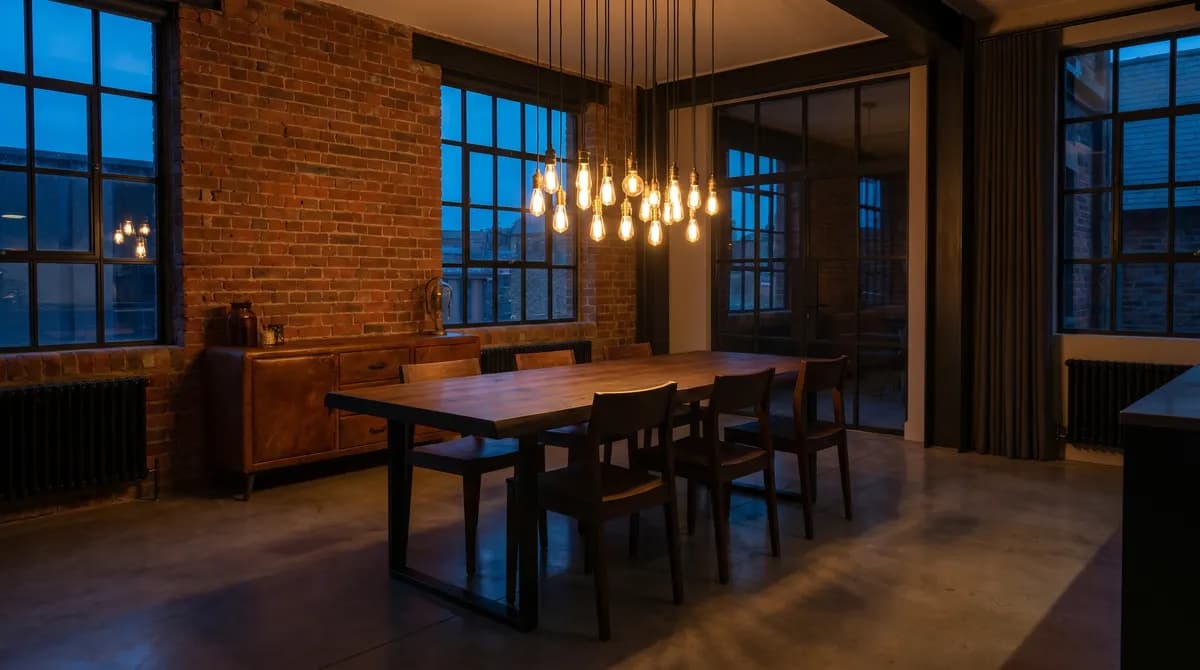
Upload a photo of your real dining room. Get a photorealistic industrial redesign in about 30 seconds. 4 free credits, no card.
Generate Your Industrial Dining Room FreeOther Industrial Rooms
Apply the same palette and principles to the rest of the home.


Other Dining Room Styles
Same room, different aesthetic — explore the rest of the dining-room style library.


Industrial Dining Room — Frequently Asked Questions
What colors define an industrial dining room?
Do all six chairs have to be the same in an industrial dining room?
What lighting works over an industrial dining table?
What flooring works for an industrial dining room?
How is industrial different from mid-century modern in a dining room?
Is an industrial dining room good for open-plan layouts?
How to Design an Industrial Dining Room
Five decisions, in this order. Skip any of them and the look will not land.
- 1
Pick the table first
The reclaimed oak table on a blackened-steel base is the single most consequential decision and the strongest visual anchor in the room. Solid reclaimed oak top 50–60 mm thick, visible saw marks and old nail holes, trestle or H-frame steel base with visible welds and bolts. Sized 200–240 cm for six seats. The chairs and the pendant row are then sized to defer to the table.
- 2
Choose six matched steel chairs
Six identical Tolix-style steel-frame chairs in blackened or aged finish (galvanised, gunmetal, or matte black). Optionally a worn leather seat cushion in cognac or charcoal on each. Resist the urge to mix two armchairs at the head with four side chairs — industrial dining is the discipline of repetition, six matched chairs.
- 3
Hang three enamel pendants in a row
Three identical enamel factory pendants in dark green, black or copper, hung in a row 75–80 cm above the table top, evenly spaced along the length of the table. Edison-style 2700 K bulb inside the shade, dimmable. The pendant row, not the table, is what most visitors will notice first when they enter the room.
- 4
Frame the room with brick and concrete
Real reclaimed brick on one feature wall behind the table, sealed with clear matte penetrating sealer. Polished concrete or original timber on the floor. The opposite wall stays as the existing finish (lime-plastered putty, or painted dark green if the room needs more contrast). Avoid feature wallpaper, gloss paint and decorative panelling — they all break the industrial envelope.
- 5
Add hygge through copper, leather and beeswax
On the table: a heavy linen runner in oat or charcoal, three unlacquered copper carafes, two blackened-steel candleholders with beeswax tapers, one stoneware bowl. On the corner: one worn leather club chair as an off-table reading seat. On the bench: a worn leather cushion the full length. These small touches are what turn an architectural warehouse into a dining room that people actually want to linger in.
Keep Exploring
Tools and guides that pair with this style.