Classic Yard Design
Guide to landscape design in Classic Garden style: features, plants, materials, and examples
Classic yard design follows the long tradition of formal European garden architecture, with roots in 16th-century Italian Renaissance villas, 17th-century French parterre design (codified by André Le Nôtre at Versailles, 1661 onward), and 18th-century English formal gardens. The style rests on geometry, symmetry and hierarchy: clipped evergreen hedges defining geometric beds, gravel paths intersecting at right angles, focal points (urns, statuary, fountains) at the end of axes, and a clear central axis from house to garden.
Materials and plants
Hardscape is structural: gravel paths in classic French gray-gold, cut stone or brick edging, formal cast-stone urns, classical statuary, a central fountain or reflecting pool. Walls are stone, stuccoed brick or pleached lime hedges. The plant palette is restrained: boxwood, yew or holly for clipped hedges, formal lawn panels, classic perennials in muted colors (roses, lavender, peonies, perennial salvia), specimen evergreens (Italian cypress in warmer climates, junipers in cooler), and clipped topiary forms.
Design elements
The defining feature is the parterre — a geometric pattern of clipped hedges enclosing planted beds or gravel. A central axis aligns the main door of the house with a distant focal point (statue, fountain, urn). Side axes intersect at right angles, creating a grid. Lawn panels are perfectly rectangular and edged with brick or stone. Steps and changes of level reinforce the hierarchy.
Climate notes
Classic gardens originated in temperate climates and work best in USDA zones 5-9. In hotter or drier regions, substitute drought-tolerant evergreens (rosemary hedges instead of boxwood) and gravel for lawn panels. Cold climates need hardy boxwood varieties and may require winter wrapping for topiary.
Common mistakes
Don't asymmetrize — the soul of classic design is strict bilateral symmetry along the central axis. Don't mix in cottage-garden plants; classic uses repetition and restraint, not floral abundance. Don't omit edging; crisp lines between gravel, lawn and beds are essential.
Budget tips
Boxwood hedges are the major expense — about $40-80 per linear foot for established 60cm plants. Gravel paths run $4-8 per sq ft. A central cast-stone urn or fountain is $400-2,500. A full classic parterre on a quarter-acre lot is typically $20,000-50,000 fully designed and planted. Upload a photo of your yard and our AI redraws it in classic garden style in seconds — free to try.
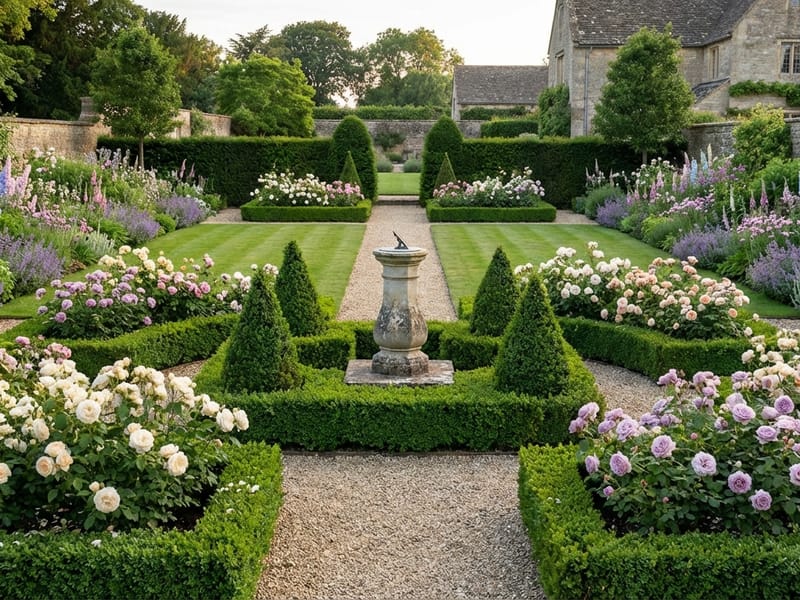
Key elements dari Classic Garden gaya
Strict Symmetry
A central axis from house to garden focal point, with side axes at right angles and bilateral symmetry across the entire composition.
Boxwood Parterre
Geometric beds defined by clipped boxwood or yew hedges, with formal patterns of planted beds, gravel and lawn panels.
Gravel Paths
Classic French gray-gold gravel paths with cut stone or brick edging, intersecting at right angles to form a structured grid.
Classical Focal Points
Cast-stone urns, classical statuary, sundials or fountains at the terminations of axes, providing visual punctuation.
Specimen Evergreens
Italian cypress (warmer climates) or columnar juniper (cooler climates) used as vertical accents flanking entrances and along axes.
Restrained Plant Palette
A limited palette of formal perennials (roses, lavender, peonies, salvia) in muted colors, used repetitively rather than mixed for abundance.
Coba creating own desain
Unggah foto halaman Anda dan dapatkan desain lanskap profesional dalam 30 detik. 2 desain pertama gratis.
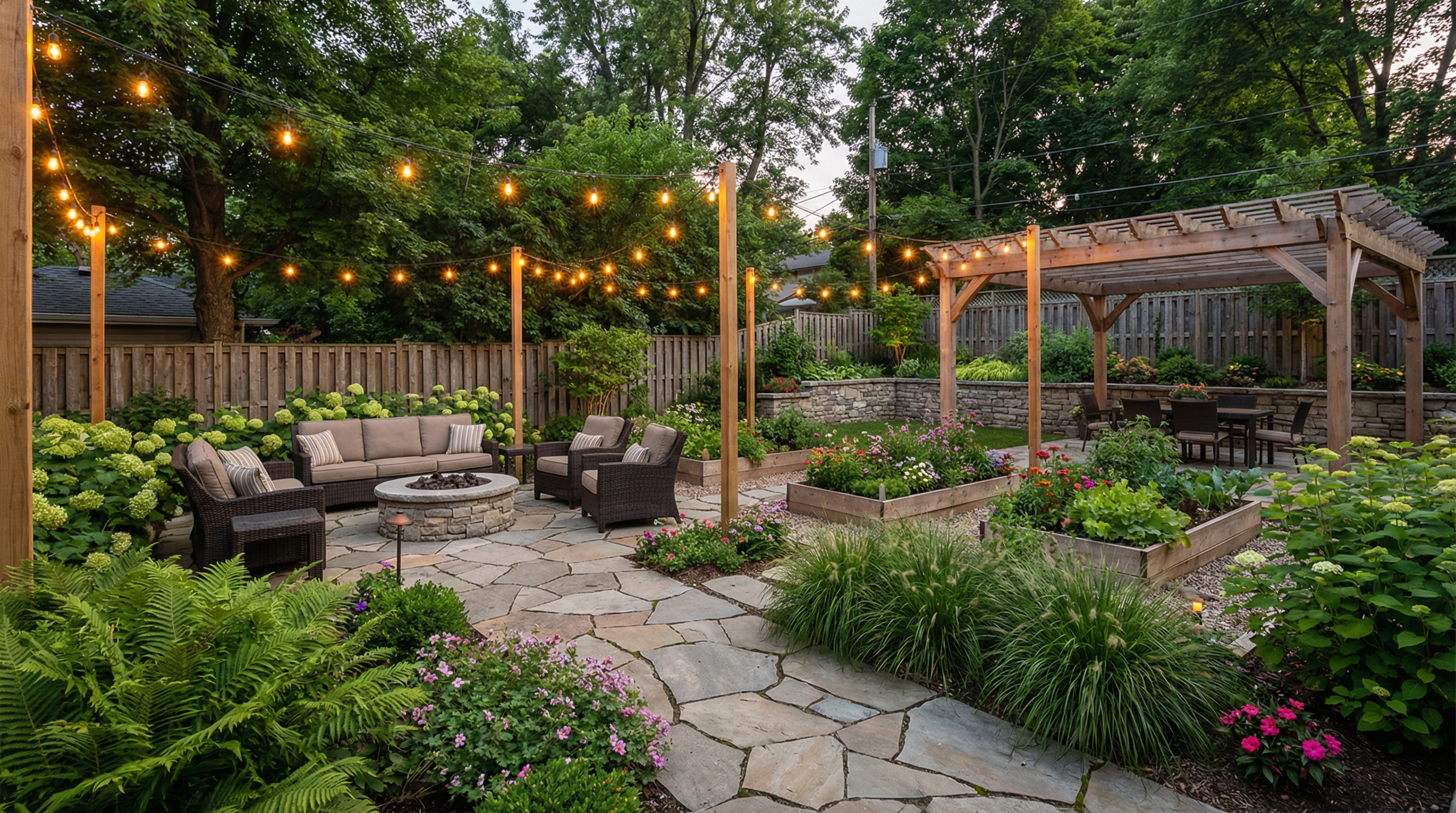
Classic Garden: landscape desain
Lihat lebih examples di the Classic Garden gaya galeri atau the full desain galeri.
FAQ: landscape desain di Classic Garden gaya
- Strict symmetry, clipped evergreen hedges defining geometric beds, gravel paths intersecting at right angles, and classical focal points along clear axes.
- A formal geometric pattern of clipped low hedges enclosing planted beds, gravel or lawn — codified by 17th-century French designer André Le Nôtre at Versailles and Vaux-le-Vicomte.
- Classic (continental European) gardens are formal, geometric and symmetrical. English gardens (especially after Capability Brown, mid-18th century) are intentionally naturalistic, with curves, rolling lawns and informal massing.
- Boxwood (Buxus sempervirens) is the classic choice; yew (Taxus) works in cooler climates; holly (Ilex crenata) is a boxwood-blight-resistant alternative.
- It can — boxwood blight has spread widely since 2011. Use disease-resistant varieties (NewGen Independence, Better Boxwoods series) or substitute Ilex crenata for similar effect.
- No — small classic gardens of 30-50 sq m can use the same principles. A miniature parterre with four boxwood-edged beds around a central urn works at any scale.
- Boxwood hedges need clipping 1-2 times per year; gravel paths require occasional weeding and topping; lawn panels need standard mowing and edging. Total maintenance is moderate but consistent.