Living Room in Maximalist style
Complete guide to living room interior in Maximalist style: features, materials, color solutions, and examples
Maximalist style is an excellent choice for your living room. This style creates a harmonious and functional space, combining aesthetics and comfort.
Features of a living room in Maximalist style
Maximalist style living room design features thoughtful details and characteristic elements that create a unique atmosphere. The right combination of materials, colors, and textures unlocks the full potential of the room.
Color palette
A living room in Maximalist style is characterized by harmonious color combinations that emphasize stylistic features and create the right mood.
With GenRoom you can visualize your living room in Maximalist style in seconds. Simply upload a photo of your room, choose the "Maximalist" style, and our AI will create a professional design!
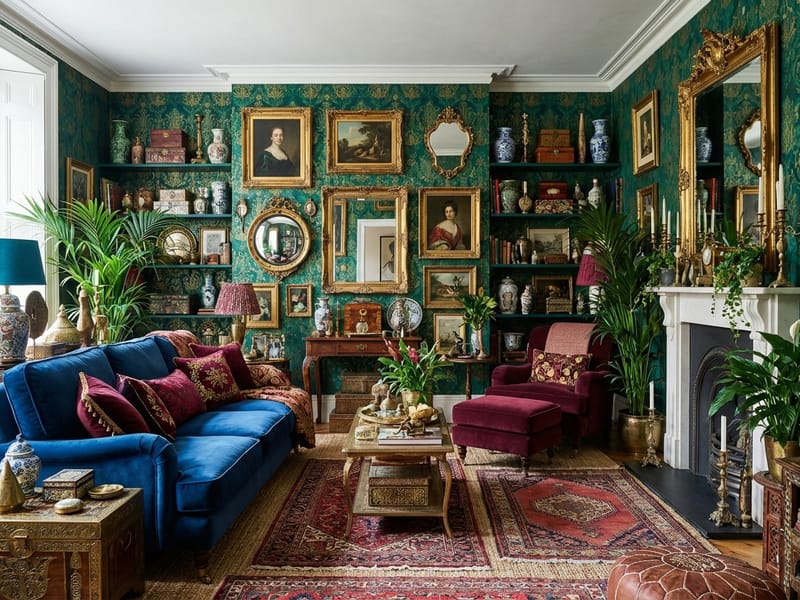
Living Room examples in Maximalist style
Try creating your own design
Upload a photo of your room and get a professional design in 30 seconds. First 2 designs are free.
Key elements of Maximalist style
Saturated Color
Deep emerald, oxblood, navy, plum, and mustard cover entire walls — and often the ceiling too — replacing neutral palettes.
Pattern Layering
Florals, stripes, geometrics, and animal prints combine in three or more scales per room, unified by repeated color.
Gallery Walls
Floor-to-ceiling collections of 20-plus framed pieces in mixed frames cover entire walls with personality and visual density.
Velvet and Silk
Tufted velvet sofas, silk drapes, and embroidered cushions add tactile luxury that matches the visual abundance.
Collected Objects
Ceramics, mirrors, taxidermy, vintage glassware, and antique brass collected over years populate shelves and surfaces.
Statement Lighting
Crystal chandeliers, brass sconces, antique lamps, and abundant candles — multiple light sources layered for atmosphere.
Frequently asked questions
- Maximalism is the design philosophy of "more is more" — saturated colors, layered patterns, abundant decorative objects, gallery walls, and floor-to-ceiling visual richness. It rejects minimalist restraint while remaining intentionally curated.
- Clutter is accidental and personal-only. Maximalism is intentional, color-disciplined, and visually composed. Each object is chosen and placed; the abundance is the design strategy, not the absence of editing.
- Saturated jewel tones: emerald, oxblood, navy, plum, mustard, terracotta, and forest green. Use 4–6 colors repeated across walls, textiles, and accents. Avoid neutral-only palettes — they neutralize the maximalist effect.
- Yes — small spaces actually benefit. The visual saturation makes the room feel intentional rather than empty, and dark walls (counterintuitively) make small rooms feel like cocoons rather than cramped boxes.
- Pick a 4–6 color palette and stick to it. Paint or wallpaper one bold wall, layer a saturated rug, install a gallery wall with mixed frames in your palette, and add collected objects in groups of 3 or 5 — never alone.
- Flea markets and estate sales (for collected objects, frames, vintage textiles), Etsy (for prints and embroidery), Farrow & Ball or Sherwin-Williams (for saturated paint), and Anthropologie or House of Hackney (for bold wallpaper).
- The visual saturation aesthetic peaks and falls in 30-year cycles (Victorian 1880s, postmodernism 1980s, current revival 2020s). The current wave has 5–10 years of momentum left, and historically these eras produce highly collectible objects.
Try creating your own design
Upload a photo of your room and get a professional design in 30 seconds. First 2 designs are free.