Japanese Garden Design
Guide to landscape design in Japanese Garden style: features, plants, materials, and examples
Japanese garden design dates to the 7th century CE, when imperial Heian-era gardens (794-1185) first codified the integration of natural landscape elements as spiritual practice. Three formal traditions developed: kare-sansui (dry/Zen rock gardens) at Buddhist temples like Ryoan-ji (c. 1500), tsukiyama (hill-and-pond strolling gardens) for aristocratic estates, and chaniwa (tea gardens) for the tea ceremony. Each principle — borrowed scenery (shakkei), asymmetric balance, layered miegakure (hide-and-reveal) — emerged from over 1,000 years of refinement.
What makes a Japanese garden distinctive
Five principles run through every authentic Japanese garden: asymmetric balance (never bilateral symmetry), controlled naturalism (every element looks effortless but is precisely placed), borrowed scenery (incorporating views beyond the property), symbolic miniaturization (a single rock represents a mountain), and seasonal awareness (plants chosen for specific times of year).
Plant palette
- Trees: Japanese maple (Acer palmatum), Japanese black pine (Pinus thunbergii), cherry blossom (Prunus serrulata)
- Shrubs: azaleas (cloud-pruned), camellia, Japanese andromeda (Pieris japonica), boxwood
- Groundcover: mosses (Hypnum, Polytrichum), Mondo grass (Ophiopogon), Japanese forest grass (Hakonechloa)
- Bamboo: contained or running varieties as screening, kuro-chiku black bamboo for accents
- Forbidden: bright flowering perennials, manicured turf grass, geometric hedges
Hardscape elements
Stones: always in odd numbers (3, 5, 7), placed asymmetrically with 1/3 of each stone buried for stability. Paths: stepping stones (tobi-ishi) of irregular natural rock or cut granite, with planted moss or fine gravel between. Water: raked white gravel representing dry ocean (kare-sansui), or genuine ponds with stone borders, or stone basins (tsukubai) refilled by bamboo spouts. Structures: stone lanterns (yukimi-doro), bamboo fences (yotsume-gaki), wooden bridges (taiko-bashi), traditional torii at significant transitions.
Common mistakes
- Symmetry. Western garden symmetry kills Japanese aesthetics instantly. All compositions must be asymmetric.
- Too many elements. Japanese gardens reward editing — one perfectly placed stone beats five mediocre ones.
- Wrong plants. Tropical or English-cottage plants in a "Japanese garden" fail. Stick to the regional palette.
- Forgetting maintenance. Authentic Japanese gardens require constant pruning (niwaki technique) — neglected, they revert to ordinary backyards.
Budget approach
Start with kare-sansui (dry garden) — the most accessible style for small budgets and small yards. Required: a flat area of white pebbles (5-10 cm depth), 3-5 carefully chosen stones placed asymmetrically, a single Japanese maple, a stone lantern, and a bamboo screen. Total cost for a 20-square-meter Zen garden can stay under $1,000.
Upload a photo of your yard and our AI redraws it as a Japanese garden in seconds — free to try.

Key elements of Japanese Garden style
Asymmetric Stone Placement
Stones grouped in odd numbers (3, 5, 7) with 1/3 buried for stability — never symmetrical, always carefully composed.
Moss and Groundcover
Living moss carpets (Hypnum, Polytrichum) or Mondo grass replace lawn turf, creating soft green textures that thrive in shade.
Japanese Maples
Acer palmatum varieties — laceleaf, upright, weeping — provide spring greens, summer shade, and brilliant autumn red.
Stone Basins and Lanterns
Stone tsukubai water basins refilled by bamboo spouts, paired with yukimi-doro snow-viewing lanterns, mark contemplative pauses.
Raked Gravel
White gravel raked into wave patterns (samon) represents flowing water in dry kare-sansui gardens at Buddhist temples.
Bamboo Screening
Yotsume-gaki bamboo fences, black-bamboo accents, and contained running bamboo provide vertical structure and acoustic softness.
Try creating your own design
Upload a photo of your yard and get a professional landscape design in 30 seconds. First 2 designs are free.
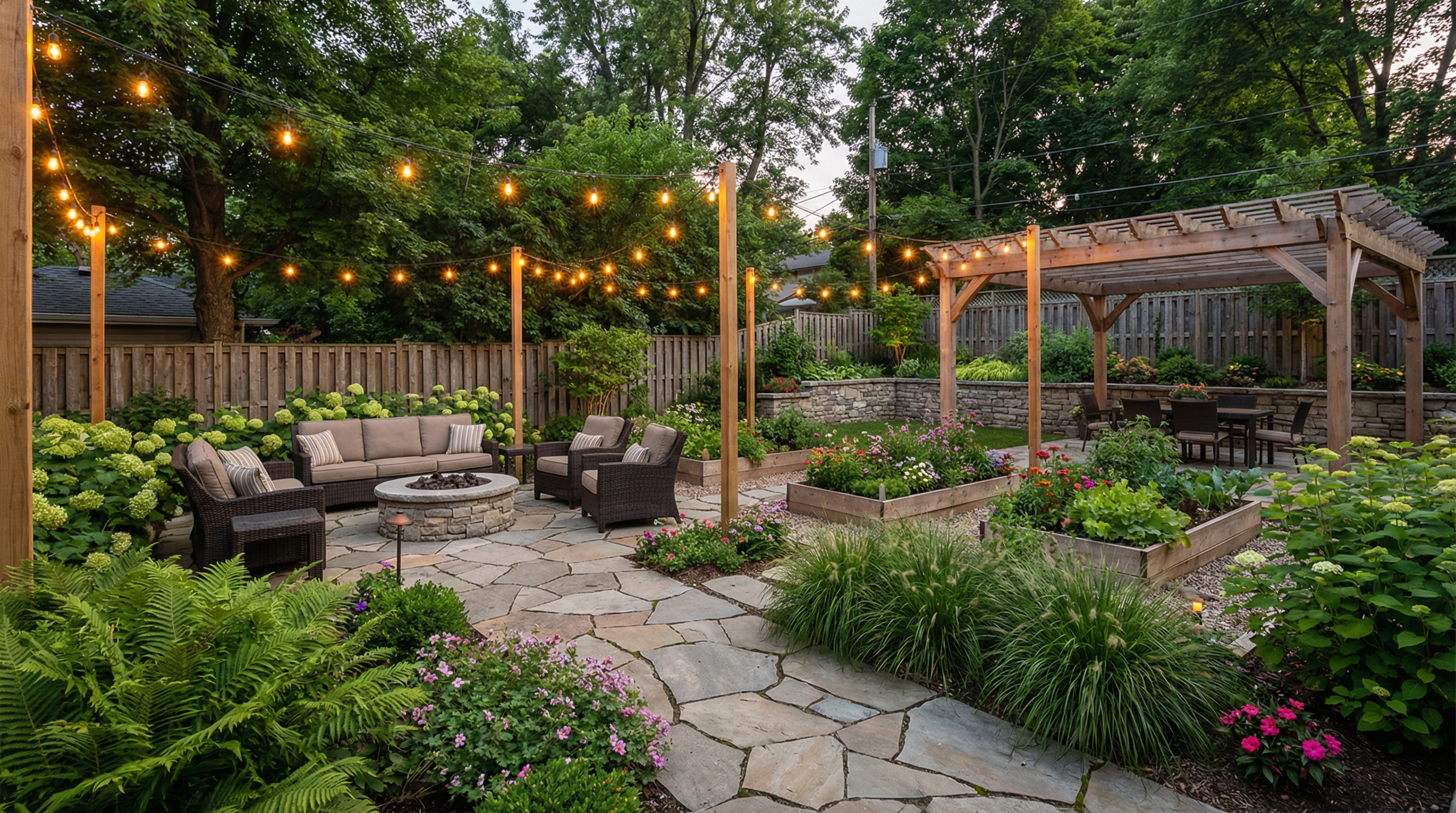
Japanese Garden: landscape design
See more examples in the Japanese Garden style gallery or the full design gallery.
FAQ: landscape design in Japanese Garden style
- A Japanese garden is a centuries-old landscape tradition originating in 7th-century imperial Heian-era Japan. It uses carefully placed stones, moss, water, and selected plants to create asymmetric, symbolic compositions that embody natural landscape in miniature.
- Three formal traditions: kare-sansui (dry/Zen rock gardens using raked gravel and stones), tsukiyama (hill-and-pond strolling gardens for estates), and chaniwa (tea gardens leading to tea ceremony houses). Each follows different design rules.
- Japanese maples (Acer palmatum), Japanese black pine, cherry blossom, azaleas (often cloud-pruned), camellia, moss, Mondo grass, and bamboo. The palette is restrained — typically under 15 species in even large gardens.
- Yes — kare-sansui (dry garden) style is ideal for small spaces. A 20-square-meter area can contain a complete authentic Zen garden: white gravel base, 3-5 stones, one maple, one stone lantern, and a bamboo screen background.
- "Zen garden" specifically refers to kare-sansui (dry rock and gravel) gardens originally created at Buddhist temples for meditation. All Zen gardens are Japanese gardens; not all Japanese gardens are Zen — strolling and tea gardens are equally traditional.
- Significant — pruning (niwaki) is constant, moss requires consistent moisture and partial shade, and raked gravel must be re-raked weekly. Plan for 2-4 hours per week on a small garden. Neglected, the garden reverts to ordinary landscape within months.
- Shakkei is the Japanese principle of incorporating distant views — a neighboring mountain, a distant tree, a borrowed building — into your garden's composition. The garden frames and includes scenes beyond its boundaries, expanding its perceived scale and depth.